
High Courts in India
Introduction
India follows a single and integrated judicial system — which means, unlike the U.S., we don’t have separate courts for the Centre and the States.
So, there is one unified hierarchy of courts for both the Union and the States.
👉 In this hierarchy:
- Supreme Court sits at the top,
- High Courts come next (for the states), and
- Subordinate Courts (like District and Sessions Courts) come below them.
So, in simple terms — if the Supreme Court is the headquarters of justice, the High Court is the state capital of justice, and the District Courts are like district branches.
Thus, within every state, the High Court is the highest judicial authority.
Historical Background: How High Courts Began in India
The institution of High Court is not a post-independence creation — it began way back during the British period.
- The first three High Courts were established in 1862 — at Calcutta, Bombay, and Madras.
- A fourth High Court came up at Allahabad in 1866.
Gradually, every British province got its own High Court.
Then, after the Constitution of India came into force in 1950, the High Courts that existed in the provinces automatically became the High Courts for the corresponding Indian States.
Constitutional Provision for High Courts
The Constitution originally provided that each state should have its own High Court.
However, the 7th Constitutional Amendment Act (1956) gave Parliament the power to:
- Create a common High Court for two or more states, or
- For two or more states and a Union Territory together.
👉 The area over which a High Court has authority is called its territorial jurisdiction.
So, the territorial jurisdiction of a High Court = territory of the state it serves.
In the case of a common High Court, its jurisdiction covers the combined territories of those states or UTs.
⚖️ Present Scenario of High Courts in India
Currently, India has 25 High Courts.
- Out of these, 3 High Courts have jurisdiction over more than one state.
- Among the 8 Union Territories, only Delhi has its own separate High Court (since 1966).
- The UTs of Jammu & Kashmir and Ladakh share a common High Court.
- Other UTs fall under the jurisdiction of various State High Courts.
Also, Parliament can at any time extend or reduce the jurisdiction of any High Court over Union Territories.
📜 Relevant Constitutional Articles
Articles 214 to 231, in Part VI of the Constitution, deal with:
- Organisation of High Courts,
- Independence of judges,
- Jurisdiction and powers,
- Appointment procedures, etc.
So, all High Court-related provisions lie between Articles 214–231.
Composition and Appointment
👥 Composition of a High Court
Every High Court (whether individual or common) consists of:
- A Chief Justice, and
- Other Judges as may be deemed necessary by the President of India.
👉 The Constitution does not fix any specific strength for High Courts.
It leaves it to the President’s discretion, who decides the number of judges based on workload and necessity.
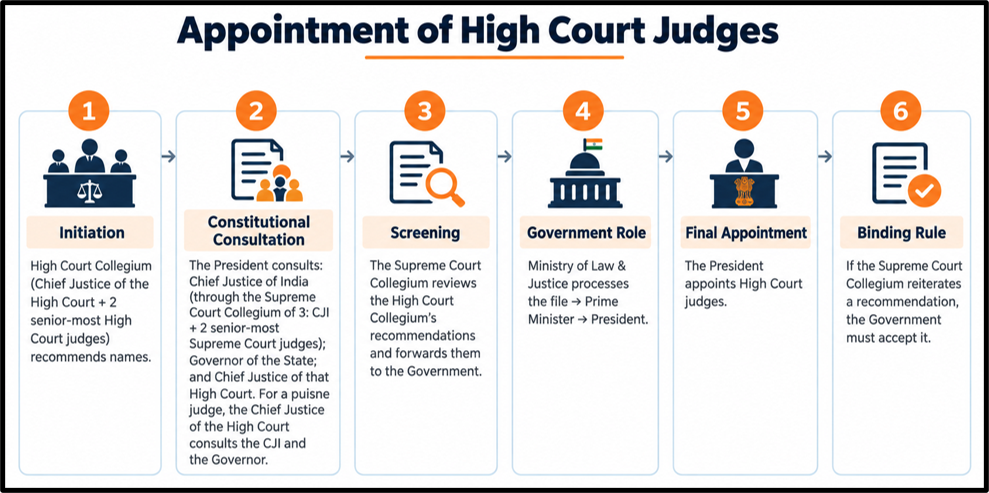
🏅 Appointment of High Court Judges
All judges of a High Court are appointed by the President of India.
Now, the consultation process differs slightly between the Chief Justice and other judges:
(a) For Chief Justice of a High Court:
The President consults —
- Chief Justice of India (CJI), and
- Governor of the concerned State.
(b) For other Judges of the High Court:
The President consults —
- CJI,
- Governor of the concerned State, and
- Chief Justice of that particular High Court.
If it’s a common High Court for more than one State — the Governors of all those States are consulted.
⚖️ Evolution of the Appointment Process — From Consultation to Collegium
Let’s understand how the “consultation” system evolved into the “Collegium System” through a series of Supreme Court cases, often called the Judges Cases.
🧩 First Judges Case (1982)
- The Supreme Court held that the President is not bound by the advice of the CJI — so the executive had the upper hand.
🧩 Second Judges Case (1993)
- The Court reversed its earlier view and ruled that CJI’s opinion has primacy in judicial appointments.
- No appointment can be made without the concurrence of the CJI.
🧩 Third Judges Case (1998)
- Clarified that the CJI’s opinion means the opinion formed by a Collegium —
i.e., the CJI + 2 senior-most judges of the Supreme Court in case of High Court appointments. - So, CJI alone cannot decide; it must be a collective decision.
🧩 Fourth Judges Case (2015)
- Parliament had tried to replace the Collegium System through the 99th Constitutional Amendment and NJAC Act, 2014 (National Judicial Appointments Commission).
- But the Supreme Court struck down both as unconstitutional, saying they violated the independence of the judiciary.
- Hence, the Collegium System continues even today.
Qualifications, Oath and Salaries
🎓 Qualifications to Become a High Court Judge
To be eligible for appointment as a High Court Judge, a person must:
- Be a citizen of India; and
- Either:
- Have held a judicial office in India for 10 years, OR
- Have been an advocate of a High Court (or two or more High Courts in succession) for 10 years.
🟢 Note:
- There is no minimum age requirement.
- Unlike the Supreme Court, no provision exists for appointing a distinguished jurist as a High Court judge.
✋ Oath or Affirmation
Before taking office, a High Court judge must take an oath of office before the Governor of the State (or someone appointed by the Governor).
In the oath, the judge swears:
- To bear true faith and allegiance to the Constitution of India,
- To uphold the sovereignty and integrity of India,
- To perform duties faithfully, without fear or favour, affection or ill-will, and
- To uphold the Constitution and the laws.
This oath symbolises judicial independence and impartiality.
💰 Salaries and Allowances
The salaries, allowances, leave, pension, etc. of High Court judges are decided by Parliament.
Importantly, their service conditions cannot be changed to their disadvantage after appointment —
except during a Financial Emergency (under Article 360).
After the 2018 revision:
- Chief Justice of a High Court → ₹2.50 lakh/month
- Other Judges → ₹2.25 lakh/month
They also receive:
- Free accommodation,
- Sumptuary allowance,
- Medical and travel facilities,
- Official car, telephone, etc.
After retirement, they get 50% of their last drawn salary as a monthly pension.
Tenure, Removal and Transfer of High Court Judges
🕰️ Tenure of High Court Judges
The Constitution does not fix a specific term like 5 years or 10 years for a High Court Judge.
Instead, it sets conditions under which the judge holds office.
Let’s understand 👇
Retirement Age –
A High Court judge holds office till the age of 62 years.
(Compare: a Supreme Court judge retires at 65 years.)
👉 So, a High Court judge’s tenure depends on when they were appointed.
If any question arises about a judge’s age, the President decides it after consulting the Chief Justice of India, and that decision is final.
Resignation –
A High Court judge can resign voluntarily by writing to the President of India.
Removal –
A judge can be removed only by the President, and that too on the recommendation of Parliament, in the manner prescribed by the Constitution (explained next).
Vacating Office Automatically –
A judge vacates office:
- When appointed as a judge of the Supreme Court, or
- When transferred to another High Court.
So, the moment they move up or move out, their seat falls vacant.
⚖️ Removal of Judges (Impeachment Process)
This is one of the most sensitive and dignified provisions of our Constitution.
A High Court judge cannot be removed casually.
Removal can happen only by the President, and only when both Houses of Parliament — Lok Sabha and Rajya Sabha — pass an address for removal in the same session, supported by a special majority.
💠 The Grounds:
Only two:
- Proved misbehaviour, or
- Incapacity (for example, due to illness or mental incapacity).
So, the removal procedure and grounds are exactly the same as that of a Supreme Court judge.
🧩 The Judges Enquiry Act, 1968 — The Detailed Procedure
Let’s understand:
- A removal motion must be signed by
- at least 100 members of Lok Sabha, or
- 50 members of Rajya Sabha, and submitted to the Speaker or Chairman, respectively.
- The Speaker/Chairman can either admit or refuse the motion.
- If admitted, they set up a three-member inquiry committee, which includes:
- The Chief Justice or a Judge of the Supreme Court,
- A Chief Justice of a High Court, and
- A distinguished jurist.
- The committee investigates the charges.
- If the committee finds the judge guilty of misbehaviour or incapacity,
then the concerned House can consider the motion. - If each House passes the motion by special majority
(majority of total membership + 2/3rd of members present and voting),
then an address is presented to the President. - Finally, the President issues an order removing the judge.
👉 Thus, it’s a multi-layered, rigorous process — designed to protect judicial independence.
🟢 Interesting fact:
Till today, no High Court judge has ever been impeached in India’s history.
🔁 Transfer of High Court Judges
The President has the power to transfer a High Court judge from one High Court to another, after consultation with the Chief Justice of India (CJI).
Upon transfer, the judge receives a compensatory allowance, as decided by Parliament.
Now, there have been controversies regarding transfers — especially during the 1970s — because it was sometimes used as a political tool to punish judges.
Hence, the Supreme Court clarified the constitutional position in a few landmark judgments:
🧩 1977 Judgement:
Transfer of judges can be done only in public interest, not as punishment.
🧩 1994 Judgement:
Transfers are subject to judicial review — meaning, the court can check whether the transfer was arbitrary.
But only the transferred judge can challenge it.
🧩 Third Judges Case (1998):
For transfer, the CJI must consult:
- a collegium of four senior-most judges of the Supreme Court, and
- the Chief Justices of both High Courts (the one transferring from and the one transferring to).
Thus, the CJI alone cannot decide — it must be a collective consultation process.
Acting, Additional, and Retired Judges
🏛️ Acting Chief Justice
The President can appoint an Acting Chief Justice when:
- The office of Chief Justice is vacant, or
- The Chief Justice is temporarily absent, or
- The Chief Justice is unable to perform duties for some reason.
This ensures no vacuum in judicial leadership.
⚖️ Additional and Acting Judges
Sometimes, High Courts face a temporary surge in workload — many pending cases, or new influx due to public interest litigations, etc.
In such situations, the President can appoint:
🔹 Additional Judges
For a temporary period not exceeding two years, when —
- There is a temporary increase in business, or
- There are arrears (backlog) of work.
🔹 Acting Judges
When a regular judge is:
- Unable to perform duties (due to absence, illness, etc.), or
- Appointed temporarily as Acting Chief Justice.
Such acting judges hold office till the permanent judge resumes duty.
🔸 But both Additional and Acting Judges cannot continue after 62 years of age.
👴 Retired Judges
Even after retirement, judicial wisdom is not wasted.
The Chief Justice of a High Court can request a retired judge (of that High Court or any other)
to act temporarily as a judge of the same High Court.
Conditions:
- Needs the President’s consent, and
- Also the consent of the retired judge.
Such a judge:
- Gets allowances decided by the President,
- Enjoys all powers and privileges of a judge,
- But is not deemed to be a permanent judge of the High Court.
This provision helps when the High Court faces a shortage of judges.
Independence of High Court
Now comes one of the most crucial conceptual areas — the independence of the judiciary.
Why is it so important?
Because justice must not only be done, but must also appear to be done — without fear or favour.
The High Court must function free from political pressures — whether from the executive or the legislature.
Let’s see how the Constitution protects this independence through nine safeguards 👇
1. Mode of Appointment
Judges are appointed by the President but only after consultation with senior members of the judiciary —
like the CJI and the Chief Justice of the High Court concerned.
This limits the executive’s power and prevents political appointments.
2. Security of Tenure
Judges can be removed only in the manner prescribed —
by Parliament, and only on proved misbehaviour or incapacity.
They do not hold office at the pleasure of the President.
This ensures stability and fearlessness.
3. Fixed Service Conditions
Salaries, allowances, privileges, and pensions are decided by Parliament,
but cannot be changed to their disadvantage after appointment
(except during a Financial Emergency).
Hence, the executive cannot “threaten” judges through salary changes.
4. Expenses Charged on Consolidated Fund
All High Court expenses — including salaries and pensions — are charged on the Consolidated Fund of the State,
meaning, they cannot be voted upon in the legislature (though they can be discussed).
⚠️ Note: The pension of a High Court judge is charged on the Consolidated Fund of India, not of the State.
5. Conduct of Judges Not to Be Discussed
The Parliament or a State Legislature cannot discuss the conduct of High Court judges
in the discharge of their duties,
except when an impeachment motion is being considered.
This avoids unnecessary political criticism.
6. Ban on Practice After Retirement
A retired permanent judge cannot practice law in any court or before any authority in India
except in the Supreme Court or other High Courts.
This avoids any temptation to please future clients while in office.
7. Power to Punish for Contempt
A High Court has the power to punish anyone for its contempt —
to maintain its dignity and authority.
No person — not even the executive — can interfere with or insult the court’s orders.
8. Freedom to Appoint Its Staff
The Chief Justice of a High Court can appoint the officers and employees of the court
and determine their service conditions —
without interference from the government.
This ensures administrative independence.
9. Jurisdiction Cannot Be Curtailed
Neither the Parliament nor the State Legislature can reduce the jurisdiction or powers
that the Constitution gives to the High Court.
Thus, the High Court remains constitutionally supreme within its own sphere.
Articles Related to High Courts at a Glance
| Article No. | Subject Matter |
|---|---|
| 214. | High Courts for states |
| 215. | High Courts to be courts of record |
| 216. | Constitution of High Courts |
| 217. | Appointment and conditions of the office of a Judge of a High Court |
| 218. | Application of certain provisions relating to Supreme Court to High Courts |
| 219. | Oath or affirmation by judges of High Courts |
| 220. | Restriction on practice after being a permanent judge |
| 221. | Salaries etc., of judges |
| 222. | Transfer of a judge from one High Court to another |
| 223. | Appointment of acting Chief Justice |
| 224. | Appointment of additional and acting judges |
| 224A. | Appointment of retired judges at sittings of High Courts |
| 225. | Jurisdiction of existing High Courts |
| 226. | Power of High Courts to issue certain writs |
| 226A. | Constitutional validity of Central laws not to be considered in proceedings under Article 226 (Repealed) |
| 227. | Power of superintendence over all courts by the High Court |
| 228. | Transfer of certain cases to High Court |
| 228A. | Special provisions as to disposal of questions relating to constitutional validity of state laws (Repealed) |
| 229. | Officers and servants and the expenses of High Courts |
| 230. | Extension of jurisdiction of High Courts to union territories |
| 231. | Establishment of a common High Court for two or more states |
| 232. | Interpretation (Repealed) |
To explore all Polity and Governance topics in a structured manner, visit the complete Polity and Governance UPSC page.