
Lokpal and Lokayuktas
To understand Lokpal and Lokayuktas properly, we must begin with the global background—because these institutions are not uniquely Indian; they evolved from a long tradition of democratic accountability.
Global Scenario: Why Did the World Need an Ombudsman?
Modern democracies increasingly adopted a welfare role:
- Large governments
- Expanded bureaucracy
- Increased discretionary power
- More approvals, inspections, sanctions, permits
As bureaucracy expanded, so did the possibility of abuse of power, leading to → Harassment, Maladministration, Corruption, Nepotism, Delay and Discourtesy
Naturally, citizens’ grievances began rising.
The success of democracy depends on how quickly and effectively these grievances are redressed.
Hence, countries across the world invented institutional mechanisms to check administrative injustice.
Global Models of Grievance Redressal
Three major systems evolved:
1. Ombudsman System
- Origin: Sweden, 1809
- The most influential and widely copied model.
2. Administrative Courts System
- Origin: France
- Specialized courts to correct administrative wrongs.
3. Procurator System
- Used in USSR (now Russia) and China
- A prosecuting authority checking legality of administrative actions.
The Ombudsman: The World’s First Grievance Redressal Institution
Donald C. Rowat, an expert on Ombudsman, calls it:
“A uniquely appropriate institution for dealing with average citizens’ complaints against unfair administrative actions.”
Meaning of Ombudsman
The word ‘Ombud’ is Swedish—meaning representative or agent.
Who is an Ombudsman?
According to Rowat:
“An officer appointed by the legislature to handle complaints against administrative and judicial actions.”
What Does the Swedish Ombudsman Do?
Handles complaints related to:
- Abuse of administrative discretion
- Maladministration
- Administrative corruption
- Nepotism
- Discourtesy
Powers
- Constitutional authority
- Supervises public officials—civil, judicial, military
- Ensures impartial, legal, objective functioning
- Can act on citizen complaints or suo motu
- Can prosecute erring officials, including judges
- Cannot punish directly; reports to higher authorities
Spread of Ombudsman System
From Sweden → Finland (1919) → Denmark (1955) → Norway (1962)
Then spread to:
- New Zealand (1962) – first Commonwealth nation
- UK (1967) – Parliamentary Commissioner for Administration
Today, most democracies have Ombudsman-like institutions.
Indian Version of Ombudsman
➡ Lokpal (Centre)
➡ Lokayukta (States)
Scholars describe the Ombudsman as:
- “Bulwark against tyranny of officialdom” (Rowat)
- “Institutionalised public conscience” (Caiden)
Position in India: Existing Anti-Corruption Mechanisms
Before the Lokpal Act, India already had a wide network of laws and institutions:
Anti-corruption & disciplinary laws
- Public Servants (Enquiries) Act, 1850
- IPC, 1860
- Delhi Special Police Establishment Act, 1946
- Prevention of Corruption Act, 1988
- Benami Transactions Act, 1988
Conduct & discipline rules
- All-India Services (Conduct) Rules, 1968
- Central Civil Services (Conduct) Rules, 1964
- All-India Services (Discipline and Appeal) Rules, 1969
- CCS (CCA) Rules, 1965
- Railway Services (Conduct) Rules, 1966
Investigative/Vigilance agencies
- CBI (1963)
- CVC (1964)
- State Vigilance Commissions
- Anti-corruption Bureaus in States
Ombudsman & grievance redress mechanisms
- Lokpal (Centre)
- Lokayuktas (States)
- Directorate of Public Grievances (1988)
- Consumer Disputes Redressal Commissions
Constitutional Commissions
- National Commission for SCs
- National Commission for STs
- National Commission for BCs
- National Commission for Minorities
Judicial/quasi-judicial organs
- Supreme Court
- High Courts
- Administrative Tribunals
Modern grievance portals
- CPGRAMS (2007)
- Whistle Blowers Protection Act, 2014
This shows that India had multiple layers of grievance redress—yet corruption persisted, proving the need for an independent, empowered Lokpal.
Origin of Lokpal in India
First Administrative Reforms Commission (ARC), 1966–70
ARC recommended creation of:
- Lokpal – For complaints against Ministers and Secretaries at Centre & States
- Lokayukta – For complaints against senior officials
ARC suggested keeping judiciary outside its purview (like New Zealand), unlike Sweden where judiciary is included.
Appointment of Lokpal (as per ARC)
ARC suggested Lokpal be appointed by the President after consulting:
- Chief Justice of India
- Speaker, Lok Sabha
- Chairman, Rajya Sabha
ARC’s Key Features for Lokpal/Lokayukta
- Must be independent & impartial
- Investigations should be private and informal
- Appointment should be non-political
- Status comparable to highest judicial functionaries
- Should deal with injustice, corruption, favouritism
- Their proceedings should not face judicial interference
- Should have maximum freedom for collecting information
- Should not seek any benefit from Government
The Government accepted ARC’s recommendations—but implementing them took decades.
The Long Legislative Journey (10 Attempts!)
Between 1968–2013, ten attempts were made to enact a Lokpal Bill:
Bills Introduced:
- 1968 – Indira Gandhi
- 1971 – Indira Gandhi
- 1977 – Morarji Desai
- 1985 – Rajiv Gandhi
- 1989 – V.P. Singh
- 1996 – Deve Gowda
- 1998 – A.B. Vajpayee
- 2001 – A.B. Vajpayee
- August 2011 – Manmohan Singh
- December 2011 – Manmohan Singh
Why did so many bills fail?
- Dissolution of Lok Sabha (1968, 1971, 1977, 1985, 1996, 1998, 2001)
- Withdrawal of Bills (1989, Aug 2011)
- Lack of political consensus
- Complexity of jurisdiction
- Debates over inclusion of PM, judiciary, MPs
Finally, the Lokpal and Lokayuktas Bill, 2011 became law as the:
Lokpal and Lokayuktas Act, 2013
This was catalysed by the 2011 anti-corruption movement led by Anna Hazare.
The 50-Year Legislative Journey at a Glance
From the First ARC recommendation to the final Act, the Lokpal idea went through a remarkable — and frustrating — legislative odyssey. Ten Bills were introduced, most of them dying in silence as Parliament dissolved.
| Year / Stage | What Happened | Outcome |
| First ARC (1966) | Recommended Lokpal at Centre + Lokayuktas in States | ✅ Recommendation made |
| 1968–2011 | Ten separate Lokpal Bills introduced in Lok Sabha | ❌ Seven lapsed on dissolution |
| 1985 and Aug 2011 Bill | Bills that did not lapse on dissolution | ❌ Later withdrawn |
| 2011 – Anna Movement | Anna Hazare’s Jan Lokpal agitation forces government’s hand | ⚡ Political pressure |
| Joint Drafting Comm. | Govt + Anna’s team jointly drafted the Bill | 📋 Draft prepared |
| Dec 2011 | Lokpal & Lokayuktas Bill passed in Lok Sabha; Constitution 116th Amendment Bill failed | ⚠️ Half-victory |
| 2013 | Parliament finally passed The Lokpal & Lokayuktas Act, 2013 | ✅ Presidential assent 1.1.2014 |
In Summary
The idea of Lokpal is rooted deeply in global democratic traditions and was recommended in India nearly five decades before its actual enactment. Its evolution reflects:
- The growth of bureaucracy
- Rising public demand for accountability
- Need for an independent watchdog
- Persistent efforts across 10 legislative attempts
Lokpal And Lokayuktas Act, 2013
(India’s Landmark Anti-Corruption Legislation)
After nearly five decades of deliberation, ten unsuccessful Bills, and a nationwide anti-corruption movement in 2011, India finally enacted the Lokpal and Lokayuktas Act, 2013.
Let’s understand its features, drawbacks, and the nature of Lokayuktas across the States.
Salient Features of the Lokpal and Lokayuktas Act (2013)
The 2013 Act aims to create a uniform anti-corruption mechanism at both Centre and State levels.
Let’s understand the major features:
1. Institution of Lokpal (Centre) and Lokayukta (State)
A uniform vigilance framework for the whole country.
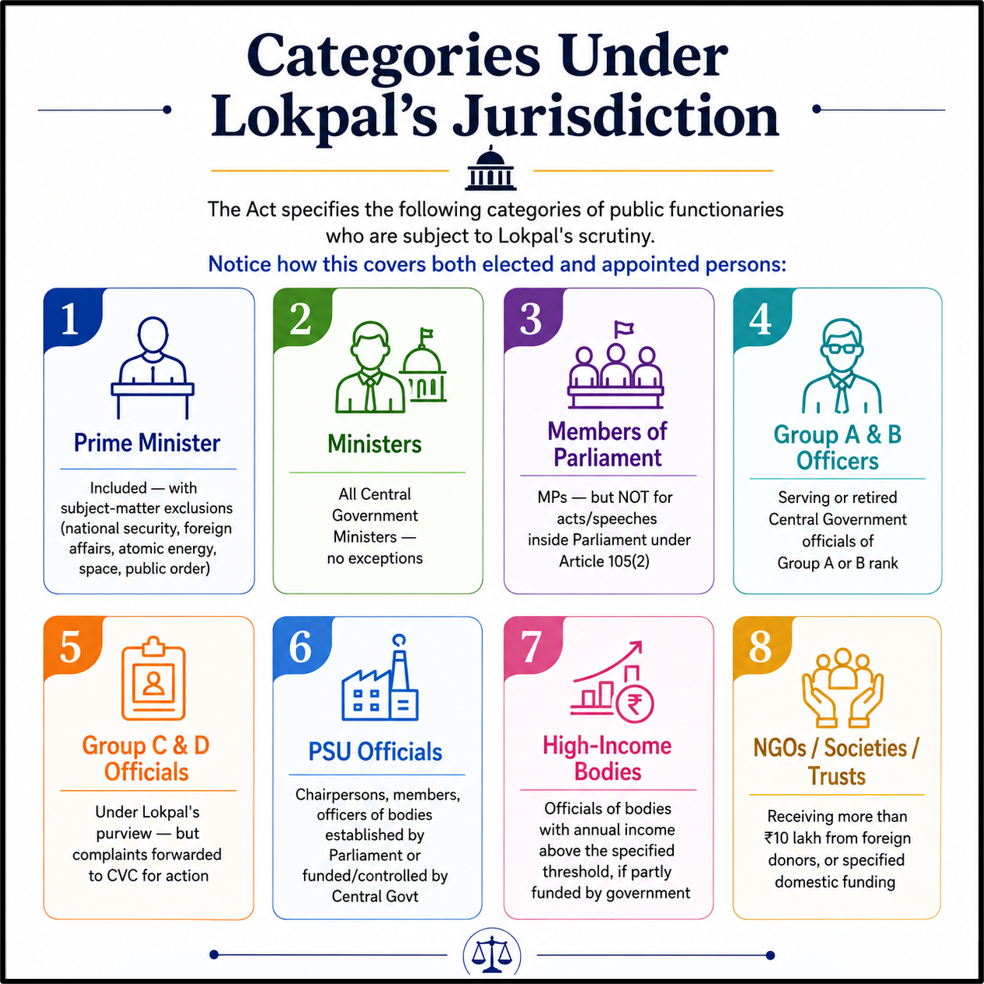
Lokpal’s jurisdiction includes:
- Prime Minister
- Union Ministers
- Members of Parliament
- Group A, B, C, and D Central Government officials
- PSU Officials
- High Income Bodies officials (partly funded by Govt.)
- NGOs/Societies/Trusts.(receiving >10lakh)
2. Composition of Lokpal
- 1 Chairperson
- Maximum 8 Members
- 50% must be judicial members
3. Social Representation
At least 50% of Lokpal members must belong to → SCs, STs, OBCs, Minorities and Women
This ensures fairness and inclusivity.
4. Selection Committee for Lokpal
A powerful, bipartisan Selection Committee:
- Prime Minister – Chairperson
- Speaker, Lok Sabha
- Leader of Opposition in Lok Sabha
- Chief Justice of India (or his nominee)
- Eminent jurist (nominated by President on recommendation of the above four)
5. Search Committee
Assists the Selection Committee.
- 50% of Search Committee members must also be from SCs, STs, OBCs, minorities, and women.
6. PM Under Lokpal’s Purview (With Safeguards)
The Prime Minister is included, but with subject-matter exclusions, especially:
- International relations
- External and internal security
- Public order
- Atomic energy
Complaints involving PM follow a special procedure to protect national security.
7. Coverage of All Public Servants
Lokpal can investigate:
- Group A, B, C, and D government employees
- Central Government bodies
Flow of enquiry:
- For Group A & B → CVC sends report back to Lokpal
- For Group C & D → CVC proceeds independently, but reports to Lokpal
8. Superintendence Over Investigating Agencies (Including CBI)
For cases referred by Lokpal, it can:
- Direct investigations
- Monitor progress
- Guide CBI’s functioning
9. High-Powered Committee for CBI Director
The same committee that selects the Lokpal also recommends the CBI Director.
10. Attachment/Confiscation of Corrupt Assets
Even before trial completes, illegal assets of corrupt officials can be confiscated.
11. Strict Timelines
To avoid endless investigations:
- Preliminary enquiry: 3 months (+3 months extension)
- Investigation: 6 months (+6 months extension)
- Trial: 1 year (+1 year extension)
- Special courts to handle such cases
12. Stronger Punishments (PC Act Amendments)
Under Prevention of Corruption Act:
- Maximum punishment → 10 years
- Minimum punishment under Sections 7, 8, 9, 12 → 3 years
- Minimum under Section 15 (attempt) → 2 years
13. Jurisdiction Over Government-Financed Institutions
Lokpal covers institutions fully or partly financed by Government. But institutions only aided by the Government are excluded.
14. Protection for Honest Public Servants
Structural safeguards ensure whistle-blowing is not misused against upright officers.
15. Lokpal Can Grant Sanction for Prosecution
This power shifts from Government to Lokpal—ensuring independence.
16. Strengthening the CBI
The Act reforms CBI through:
- Directorate of Prosecution under CBI
- Appointment of Director of Prosecution via CVC
- Panel of advocates (approved by Lokpal)
- No transfer of CBI officers investigating Lokpal cases without Lokpal’s approval
- Adequate funds for CBI investigations, protected from political interference
17. Foreign-Funded NGOs Under Lokpal
Any entity receiving more than ₹10 lakh per year under FCRA comes under Lokpal’s jurisdiction.
18. Mandate for Establishing Lokayuktas
Every State must establish a Lokayukta within 365 days of the Act. But States are free to design the structure—ensuring flexibility in federalism.
| 🚫 Post-Tenure Restrictions |
| • After tenure, Lokpal members CANNOT hold any Central or State government office • CANNOT contest elections for Parliament, State Assemblies, or local bodies for 5 years after tenure • This prevents the “revolving door” problem where watchdogs return as those watched |
Inquiry Wing and Prosecution Wing
Traditional practice placed investigative and prosecution agencies under executive control. CBI, for instance, reports to the government. This created an obvious conflict of interest in corruption cases against government functionaries. Lokpal corrects this by having its own in-house wings:
| 🔍 Inquiry Wing | ⚖️ Prosecution Wing |
| Headed by the Director of Inquiry | Headed by the Director of Prosecution |
| Conducts preliminary inquiry into corruption allegations | Prosecutes public servants in the Special Court after investigation |
| Can use CBI for investigation after prima facie case is established | Files charge sheets or closure reports before Special Court |
| Reports to a bench of ≥3 Lokpal members | Acts on Lokpal bench’s direction to initiate prosecution |
The Complaint-to-Conviction Pipeline
One of Lokpal’s most important contributions is a clearly defined complaint-handling procedure — a pipeline from receiving a complaint to final prosecution. Think of it as an assembly line, where each station has a specific job.
| 📋 Step-by-Step Complaint Procedure |
| ① Complaint received by Lokpal ② Lokpal bench decides: Proceed or Close (frivolous complaints closed) ③ Preliminary Inquiry ordered — Inquiry Wing or CBI ascertains prima facie case → Group C/D complaints sent to CVC for preliminary inquiry; CVC submits report to Lokpal ④ Public servant given opportunity to be heard ⑤ Bench of ≥3 Members reviews preliminary inquiry report ⑥ If prima facie case: Investigation by CBI/agency ordered (to be completed within 6 months) ⑦ Bench of 3 Members reviews investigation report ⑧ Lokpal directs: Chargesheet filed OR Departmental proceedings OR Case Closed ⑨ Prosecution Wing files chargesheet in Special Court ⑩ Special Court trial and verdict |
No Prior Sanction — Removing the Bureaucratic Shield
Before Lokpal, three laws created a wall of protection around senior officials. Any investigation or prosecution required the government’s prior approval — which, unsurprisingly, was often withheld or delayed:
| Law | Section | What It Required |
| Code of Criminal Procedure | Section 197 | Prior approval of government to prosecute public servants |
| Delhi Special Police Establishment Act | Section 6A | Prior approval to investigate senior officers |
| Prevention of Corruption Act | Section 19 | Sanction from competent authority before prosecution |
| ✅ Lokpal’s Game-Changer: No Prior Sanction Required |
| • When Lokpal orders preliminary inquiry, investigation, or prosecution — NO sanction/approval from any authority is required • This removes the biggest procedural shield corrupt officials used to delay action • Exception: Constitutional office-holders who are removable only by special procedures laid down in the Constitution • Result: Faster, cleaner investigations without political interference |
Asset Attachment Powers
Lokpal does not just investigate — it can freeze the proceeds of corruption. In practical terms, this means a corrupt official cannot quietly transfer or liquidate ill-gotten assets while the case is ongoing:
- Lokpal can ATTACH the cash and assets of a public servant during investigation
- Attachment can last up to 90 days; extended further with Special Court approval
- If convicted: Attached assets CONFISCATED by the Central Government
- If acquitted: Assets returned to the public servant
- Special Court can also order recovery of losses caused to the public exchequer from convicted officials
Drawbacks of the Act
Despite its strengths, the law has shortcomings:
1. No Suo Motu Powers
Lokpal cannot start investigations on its own. It must wait for a formal complaint.
2. Emphasis on Form Over Substance
Technical errors in complaints can lead to rejection—even when substance is strong.
3. Heavy Punishment for False Complaints
Fear of punishment may discourage genuine whistle-blowers.
4. Anonymous Complaints Not Allowed
No provision for anonymous submissions—even with evidence.
5. Legal Assistance for Accused Public Servant
This may make proceedings skewed in favour of the accused.
6. Seven-Year Limitation Period
Complaints cannot be filed about events older than 7 years.
7. Opaque Procedure for PM-Related Complaints
The process for handling complaints against the Prime Minister is not transparent.
Lokayuktas (State-Level Ombudsman)
Interestingly, several states had Lokayuktas even before 2013.
- First Lokayukta: Maharashtra (1971)
- First Act passed: Odisha (1970)
Features of Lokayuktas Across States
The structure varies widely across States.
1. Structure Varies
Some States have → Lokayukta + Upa-Lokayukta. Others have only Lokayukta.
2. Appointment
Appointed by the Governor.
3. Qualifications
Judicial qualifications exist in some States, absent in others.
4. Tenure
Generally: 5 years or up to 65 years of age, whichever is earlier.
5. Jurisdiction Varies
Key variations:
- Chief Minister → Included in some States, Excluded in others
- Ministers & Senior Civil Servants → Included in almost all States.
- MLAs → Included in some; excluded in others.
- Local Bodies & Corporations → Most States allow jurisdiction over: Municipal corporations, Companies and Public societies
6. Initiation of Inquiry
Lokayukta can:
- Act on citizen complaints
- Act suo motu in most states
7. Types of Cases
- In some States → Both grievances (maladministration) and allegations (corruption)
- In others → Only corruption allegations
8. Reporting
Lokayukta submits an annual report to the Governor, who tables it in State Legislature.
9. Recommendations Are Advisory
Not binding on the State Government—reducing Lokayukta’s effectiveness.
Lokpal and Lokayuktas (Amendment) Act, 2016
The 2016 amendment addressed practical difficulties, especially:
- Modified provisions related to declaration of assets and liabilities
- Allowed the leader of the largest opposition party in Lok Sabha to be part of the Selection Committee when a formal Leader of Opposition is absent
This amendment was crucial to resolve institutional deadlock.
Lokpal vs Lokayukta: Quick Comparison
Students often confuse Lokpal and Lokayukta. Here’s a clear distinction — think of Lokpal as the “National Level” watchdog and Lokayukta as the “State Level” watchdog.
| Dimension | Lokpal | Lokayukta |
| Level | Central Government | State Government |
| Established by | Lokpal & Lokayuktas Act, 2013 | State Legislature laws (varying by state) |
| Appointment | By President on Selection Committee recommendations | By Governor, generally on recommendation of CM/CJ |
| Jurisdiction | PM, Ministers, MPs, Central Govt servants, PSU officials, NGOs | State CM, Ministers, MLAs, State Govt servants |
| Uniformity | Uniform national framework | Varies widely — Karnataka (1984) vs others |
| CVC Link | Can send Group C/D cases to CVC | Typically no CVC link |
| Judicial Review | Special Courts for Lokpal cases | Varies by State law |
Summary
The Lokpal and Lokayuktas Act, 2013 represents India’s most comprehensive attempt to institutionalise an independent anti-corruption framework at both Central and State levels.
It is inspired by global Ombudsman traditions, enriched by ARC recommendations, shaped by decades of political debate, and finally enabled by public pressure during the 2011 anti-corruption movement.
However, its effectiveness depends heavily on → Independence, Transparency, Strong State-level Lokayuktas and supportive political will
The Great Debates: Five Controversial Issues
The Lokpal bill did not sail through smoothly. It was hammered on the anvil of intense debate between the government, Anna’s team, parliamentary committees, legal experts, and political parties. Five issues divided opinion most sharply. Think of this as a debate club where every side had a legitimate point.
| CONTROVERSIAL ISSUE 1: Should the Prime Minister be Under Lokpal? |
This was the most politically explosive question. Three distinct camps emerged, each with its own logic:
| Position | Argument | Final Act Provision |
| Exclude PM Entirely | PM is head of government; investigating the PM would paralyse governance and endanger national security | ❌ Not adopted |
| Include PM Without Restrictions | No one is above the law; PM is the most powerful and most prone to corruption | ❌ Not adopted fully |
| Include PM With Subject-Matter Exclusions (Middle Path) | PM can be investigated for general corruption, but sensitive areas like security/foreign policy need protection | ✅ Adopted — this is the law |
| 🔐 What the Act Actually Says About the PM |
| • Lokpal CANNOT inquire into PM complaints relating to: International Relations, External & Internal Security, Public Order, Atomic Energy, Space • Lokpal CAN inquire into other corruption allegations against PM (financial, administrative) • SAFEGUARD: Full bench of Lokpal (Chairperson + ALL Members) must consider it; ≥2/3 must approve • Any such inquiry is held IN CAMERA (in private) • If complaint dismissed, records are NOT published or shared |
| CONTROVERSIAL ISSUE 2: Should Conduct of MPs Inside Parliament Be Covered? |
A concrete example makes this vivid: Can Lokpal investigate an MP who took a bribe to vote in a particular way? Here the Constitution itself is the starting point — Article 105(2) protects an MP’s speech, vote, and conduct inside the House from external scrutiny.
| 🏛️ Anna’s Team: Include MPs | ⚖️ Government/Committee: Exclude |
| Article 105(2) does not protect corrupt vote or corrupt speech — it only protects honest deliberation | Article 105(2) is ancient and time-tested; its purpose is to allow free thought without external fetters |
| If Article 105 does protect corruption, then it must be amended | Any external investigation into vote/speech would “whittle down parliamentary autonomy to vanishing point” |
| Bribery to vote is a crime, not a legislative act | Parliament itself has strong disciplinary powers — the Cash-for-Questions scam led to expulsion of 11 MPs |
| 📜 What the Act Says: Article 105(2) Shield Maintained |
| • Lokpal shall NOT inquire into any matter arising from an MP’s vote, speech, or conduct in Parliament covered under Article 105(2) • Parliament retains disciplinary control over its members for in-House conduct • The Cash-for-Questions Scam precedent: 11 MPs expelled; Supreme Court upheld expulsion — showing Parliament CAN act |
| CONTROVERSIAL ISSUE 3: Should Group C & D Employees Be Included? |
Anna’s team wanted Lokpal to cover everyone, including the patwari and police constable who are the most direct exploiters of ordinary citizens. The government countered with a numbers argument that is actually quite compelling.
| 📊 The Numbers That Ended the Debate |
| • Total Central Govt employees (2011): ~65 lakh • Group C & D alone: ~57–58 lakh (88% of total!) • At 1 policing officer per 200 employees: Lokpal would need ~35,000 officers just to monitor C & D • Select Committee: This would create a “huge parallel bureaucracy” — a super Lokpal would then need a Dharampal! • Group A & B alone: ~7.75 lakh — a manageable number for Lokpal |
The Act’s practical solution: Group C & D ARE under Lokpal’s purview, but Lokpal can transmit their complaints to the Central Vigilance Commission (CVC), which takes final decisions. This preserves coverage without overwhelming Lokpal’s capacity.
| CONTROVERSIAL ISSUE 4: Should the Judiciary Be Under Lokpal? |
This question goes to the heart of the separation of powers. The judiciary is India’s third pillar — not under the executive, not under Parliament. Can Lokpal (an executive-type body) investigate judges?
| ⚖️ Arguments for Including Judiciary | 🏛️ Arguments for Excluding Judiciary |
| Public clamour for judicial accountability is strong; judges are not immune from corruption | Separation of judicial power from executive is fundamental — Article 50 of the Constitution |
| High Court and Supreme Court judges can ONLY be removed by impeachment (near impossible) | Lower judiciary is under High Court disciplinary control (Article 235) |
| Collegium system for appointments is opaque; self-disciplinary mechanisms are no longer effective | Conduct of higher judiciary cannot even be discussed in Parliament except during removal proceedings |
| Anna’s proposal: Separate Judicial Conduct Commission, independent of both government and judiciary | Judicial Standards and Accountability Bill was already proposed for internal disciplinary mechanisms |
| 🏛️ Final Position: Judiciary Kept OUT of Lokpal |
| • Consensus: Judiciary should be excluded from Lokpal’s ambit • Reason: Need to protect judicial independence; separate mechanisms are more appropriate • BUT: Urgent need for a comprehensive Judicial Standards and Accountability law (proposed but not yet enacted) • Select Committee called for a National Judicial Commission (NJC) for transparent judicial appointments • Collegium system criticised as “self-appointed common law mechanism operating since early 1990s” |
| CONTROVERSIAL ISSUE 5: Can the Centre Make a Law on Lokayuktas? |
This is a federalism question. India’s Constitution divides legislative powers into a Central List, State List, and Concurrent List. States govern public servants at the state level. Can Parliament force States to create Lokayuktas?
| 🗺️ The Federal Tightrope |
| • Anna’s Demand: The Bill must mandate Lokayuktas in all states with uniform standards • State Rights Argument: Creating Lokayuktas for state servants falls in the State List — Centre cannot legislate on it • Centre’s Justification: UN Convention Against Corruption (a treaty India signed) gives Centre legislative competence • Ministry of Law’s Warning: Using treaty obligations to override state rights could set a dangerous precedent • Practical Problem: Existing Lokayuktas differ wildly in structure, powers, and procedures across states • Final Solution: Act says every State SHALL establish a Lokayukta within 1 year — it mandates the outcome, not the design |
Conclusion: The Significance of Lokpal
The Lokpal and Lokayuktas Act is, “a welcome addition to the mechanisms for fighting corruption.” It represents more than just a new institution — it represents a democratic consensus: government, civil society, political parties, experts, and the public agreeing that the old system was broken and needed fixing.
But institutions are only as good as the political will behind them. Lokpal was enacted in 2013 and its first Chairperson was appointed only in 2019 — six years of institutional dormancy after a 50-year legislative battle. The lesson for UPSC aspirants — and for citizens — is clear: passing a law is the beginning, not the end.
| “The Lokpal is not a magic wand. It is a legal framework. Whether it fights corruption or becomes another bureaucratic layer depends entirely on the integrity of those who man it, and the vigilance of the citizens who demand accountability.” |
| 🏆 The Big Picture: Where Lokpal Fits in India’s Anti-Corruption Architecture |
| • CVC → Vigilance in Central Govt departments (Group A & B; advisory role) • CBI → Investigation of major corruption cases (under CVC superintendence for PC Act cases) • ED → Financial crimes, money laundering, foreign exchange violations • CAG → Audit of government expenditure and accounts • Lokpal → Independent investigation AND prosecution of corruption at ALL levels of Central Govt • Lokayuktas → Same function at State level → Lokpal is the APEX of this pyramid — the institution that can investigate all others |
This topic is covered under the Polity and Governance UPSC notes series designed for UPSC Prelims, Mains, and Interview preparation.