
Major Language Families of India
Introduction
When we say India is multilingual, we are not just describing a demographic fact — we are describing a cultural reality shaped by geography, history, migration, trade, conquest, devotion, and literature.
Language in India is not merely a tool of communication. It is a carrier of memory, philosophy, poetry, identity, and power.
India: A Multilingual Civilisational Space
India has hundreds of languages and thousands of dialects. Most Indians are bilingual or even trilingual. It is common to speak:
- One mother tongue
- One regional/state language
- Hindi or English as a link language
In this context:
- Hindi functions as a major link language across northern and central India.
- English acts as a lingua franca in administration, higher education, judiciary, and inter-state communication.
This multilingualism is not accidental — it reflects centuries of layered cultural evolution.
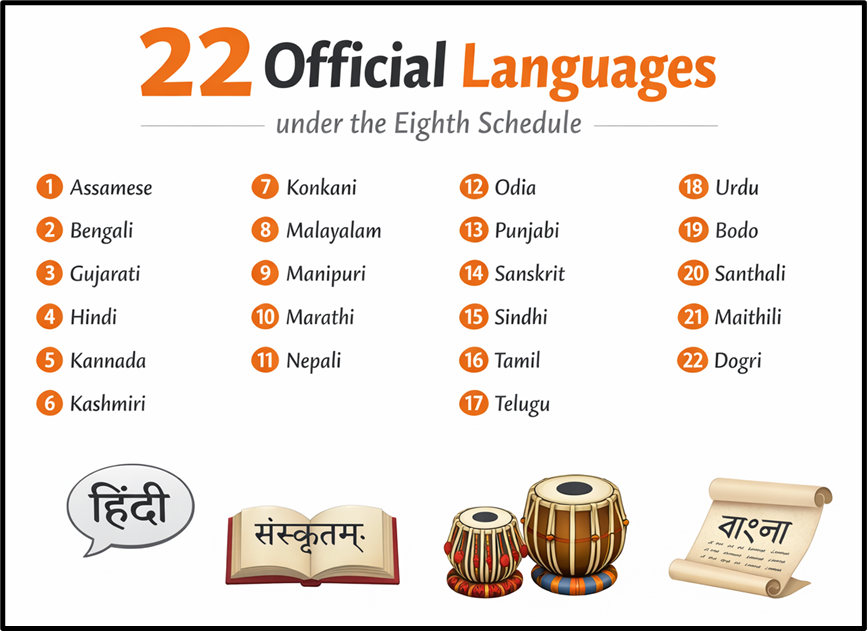
Constitutional Recognition: The Eighth Schedule
The Constitution of India recognises 22 official languages under the Eighth Schedule (as of 2026).
Historical Expansion of the List
Originally, 14 languages were included in 1950.
Later additions happened through Constitutional Amendments:
- Sindhi → 21st Amendment (1967)
- Konkani, Manipuri, Nepali → 71st Amendment (1992)
- Bodo, Dogri, Maithili, Santhali → 92nd Amendment (2004)
👉 This gradual inclusion reflects India’s democratic commitment to linguistic diversity.
Major Language Families of India
India’s linguistic diversity can be classified into five major language families:
- Indo–Aryan
- Dravidian
- Austro–Asiatic
- Tibeto–Burman (Sino-Tibetan)
- Semito–Hamitic
In terms of number of speakers:
Indo–Aryan > Dravidian > Austro–Asiatic > Tibeto–Burman
Now let us focus on the most dominant family.
Indo–Aryan Languages
Indo–Aryan languages belong to the Indo–Iranian branch of the Indo–European family.
Major Indo–Aryan Languages (by first-language speakers)
- Hindi–Urdu (~330 million)
- Bengali (~242 million)
- Punjabi (~150 million)
- Marathi (~112 million)
- Gujarati (~60 million)
Region: Northern, Western and Central India.
Features:
- Derived historically from Sanskrit
- Many use Devanagari script
Now we study the major languages one by one.
Sanskrit
Panini gave Sanskrit its scientific structure.
Why is Sanskrit important?
- One of the earliest documented languages of India.
- Called Samskrita (refined) in contrast to Prakrits (natural/popular dialects).
- Mother of many Indian languages.
- Highly structured grammar — codified in Panini’s Ashtadhyayi.
Important Milestones:
- Girnar Inscription (2nd century CE) of Rudradaman I — earliest long chaste Sanskrit inscription.
- Amarakosha by Amarasimha — earliest Sanskrit thesaurus.
- Recognised in Eighth Schedule.
- Script: Brahmi (early), later Devanagari.
- Pan-Indian character — transcended geography.
👉 Sanskrit was not just a language; it was a civilisational glue.
Hindi
- Evolved from Sanskrit → Prakrit → Apabhramsha.
- Early literary work: Prithviraj Raso by Chand Bardai (12th century).
- Most widely spoken language in India.
- Official language of Union Government (with English).
- Script: Devanagari.
- Region: Uttar Pradesh, Bihar, Rajasthan, Madhya Pradesh etc.
👉 Hindi became a major vehicle of nationalism during the freedom struggle.
Bengali
Origin: Magadhi Prakrit.
- Rich poetic and literary tradition.
- Rabindranath Tagore — first Asian Nobel Laureate (Literature, 1913).
- Official language of West Bengal and Bangladesh.
- Script: Bengali script.
👉 Bengal was the epicentre of 19th-century cultural renaissance.
Marathi
- Origin: Maharashtri Prakrit.
- 13th century saint-poet Dnyaneshwar — Bhakti literature.
- Promoted under Shivaji.
- Region: Maharashtra.
- Script: Devanagari.
👉 Marathi literature deeply influenced the Bhakti movement and regional identity.
Gujarati
- Developed during 12th–14th centuries.
- Major contributors:
- Narsinh Mehta
- Mahatma Gandhi
- Official language of Gujarat.
- Script: Gujarati script.
👉 Gujarati played a major role in trade communities and reform movements.
Punjabi
- Derived from Shauraseni Prakrit.
- Unique because it uses:
- Gurmukhi (India)
- Shahmukhi (Pakistan)
- Sacred text: Guru Granth Sahib
- Famous folk epic: Heer Ranjha
👉 Strong oral and devotional tradition.
Urdu
- Developed in medieval period.
- Fusion of Persian, Arabic, Turkish, and local Indian dialects.
- Script: Perso-Arabic (Nastaʿlīq).
- Great poets:
- Mirza Ghalib
- Allama Iqbal
👉 Urdu symbolises Indo-Islamic cultural synthesis.
Dravidian Languages
The Dravidian language family is one of the oldest linguistic families of the world.
Before the spread of Indo–Aryan languages, Dravidian languages covered a much larger region of the Indian subcontinent.
Important Points:
- Indigenous to South India.
- One of the most ancient linguistic families.
- Possess their own scripts.
- Rich literary traditions.
- The only Dravidian language spoken entirely outside India is Brahui (Baluchistan region, Pakistan–Afghanistan border).
Region: Primarily Southern India.
Now let us understand the major Dravidian languages.
Tamil
Tamil is not just a language — it is a civilisational identity.
Key Features:
- One of the world’s oldest living classical languages.
- Continuous literary tradition for over 2,000 years.
- Rich corpus of Sangam literature.
- Granted Classical Language status by the Government of India.
- Official language of Tamil Nadu and Sri Lanka.
- Script: Tamil script.
Tamil demonstrates cultural continuity in its purest form — ancient yet modern.
Telugu
Telugu is often called the “Italian of the East” because almost all its words end in vowel sounds, giving it a melodious flow.
Key Features:
- Inscriptions from 6th century CE.
- Literary flowering from 11th century onward.
- Famous literary work: Andhra Mahabharatam.
- Written by the Kavitrayam (Trinity of Poets):
- Nannayya
- Thikkana
- Yerrapragada
- Written by the Kavitrayam (Trinity of Poets):
- Region: Andhra Pradesh and Telangana.
- Script: Telugu script.
Telugu literature beautifully blends court poetry, devotion, and classical refinement.
Kannada
Kannada is another ancient Dravidian language with remarkable antiquity.
Archaeological Evidence:
- Halmidi Inscription (450–500 CE) — earliest known Kannada inscription.
- Written in Kadamba script.
- Discovered in Hassan district, Karnataka.
- Talagunda inscription (Simhakatanjana) dated to 370 CE also indicates antiquity.
Literary Tradition:
Prominent writers include → Adikavi Pampa, Ranna, Basavanna
Region: Karnataka.
Script: Kannada script.
Kannada literature reflects both Jain and Bhakti influences, showing the pluralistic nature of South Indian culture.
Malayalam
Malayalam evolved from Old Tamil around the 9th century CE and became distinct by the 13th century.
Key Features:
- Rich literary tradition.
- Earliest known work: Ramacharitam.
- Region: Kerala.
- Script: Malayalam script.
Malayalam literature reflects temple culture, maritime trade influences, and later social reform movements.
Austro–Asiatic Languages
This family extends beyond India into Southeast Asia.
Region in India: Eastern and North-Eastern India.
Characteristics:
- Many are tribal languages.
- Belong to the Munda branch.
- Significant oral traditions.
Santali
Santali belongs to the Munda branch of the Austro–Asiatic family.
Unique Feature:
Unlike many tribal languages, Santali has its own script — Ol Chiki.
- Developed in 1925 by Raghunath Murmu.
- Preserved linguistic identity.
- Region: Jharkhand, West Bengal, Odisha, Bihar.
This shows that tribal languages are not “primitive” — they possess structured systems and literary aspirations.
Tibeto–Burman Languages
These belong to the Sino–Tibetan family.
Region: North–Eastern India and Himalayan belt.
Features:
- Tonal variations.
- Distinct phonetic structures.
- Rich oral traditions.
Meitei (Manipuri)
- Official language of Manipur.
- Script: Meitei Mayek (revived after centuries of replacement by Bengali script).
- Strong literary and performing tradition.
This revival of script reflects cultural assertion and identity politics.
Bodo
- Spoken mainly in Assam.
- Rich oral heritage.
- Currently written in Devanagari script.
- Earlier written in Roman and Assamese scripts.
Language here becomes an instrument of ethnic assertion and political recognition.
Semito–Hamitic (Afro–Asiatic)
Also called Afro–Asiatic language family.
Region (in Indian context): Small communities in Bihar and Uttar Pradesh.
Major Language: Arabic.
Arabic entered India mainly through:
- Trade (Arab merchants)
- Religious influence (Islam)
- Scholarly exchanges
It significantly influenced Urdu vocabulary and Indo-Islamic intellectual traditions.
Classical Languages of India
When we speak of Classical Languages of India, we are not merely discussing old languages. We are discussing languages that carry civilisational memory, intellectual traditions, and cultural continuity stretching back thousands of years.
The Idea of “Classical Language” — Why Was It Needed?
In 2004, the Government of India introduced a new official category: “Classical Language”.
Why?
Because some Indian languages were not just regional communication tools — they were repositories of ancient knowledge systems, philosophy, poetry, grammar, epigraphy, and intellectual traditions.
Classical Languages are discussed in detail in the CDH notes on Ancient and Medieval India, under the chapter “Buddhism and Jainism.” You can access the notes here.