
Market Based Monetary Instruments
Bank Rate
The Bank Rate is the rate at which the RBI → Lends money to commercial banks → Without collateral
It is also called the discount rate.
Historical Role of Bank Rate
Earlier:
- Bank Rate was the primary policy rate
- Changes in Bank Rate influenced → Lending rates, Deposit rates, Overall credit conditions
However, with the introduction of → LAF, Repo rate, MSF → The Bank Rate lost its day-to-day operational role.
Current Role of Bank Rate
Today, the Bank Rate functions mainly as a → Penalty and Signalling Rate
It is used to calculate penal interest when banks fail to maintain → CRR/ SLR
Penal Structure
Penalties are imposed as → Bank Rate + 3%, or Bank Rate + 5%
Example
- Bank Rate = 4%
- Penalty = Bank Rate + 3%
- Penal interest = 7%
If a bank falls short of SLR:
- It must pay 7% interest on the shortfall
- This enforces regulatory discipline
Alignment with MSF
- The Bank Rate is aligned with the MSF rate
- Therefore → Whenever MSF changes, Bank Rate changes automatically
📌 UPSC Insight:
Bank Rate is now a reference rate, not a liquidity management tool.
One-Glance Comparison of Policy Rates
| Feature | Repo Rate | Reverse Repo | MSF Rate | SDF Rate | Bank Rate |
|---|---|---|---|---|---|
| Basic Function | RBI lends to banks | RBI borrows from banks | Emergency lending | Absorbs excess funds | Penal/reference rate |
| Collateral | Yes | Yes | Yes (SLR allowed) | No | No |
| Role in LAF | Centre | Discretionary | Ceiling | Floor | Outside LAF |
| Relation to Repo | Base rate | Below repo | Repo + 25 bps | Repo − 25 bps | = MSF |
| Main Use Today | Core policy signal | Secondary | Safety valve | Liquidity floor | Penalty computation |
Open Market Operations
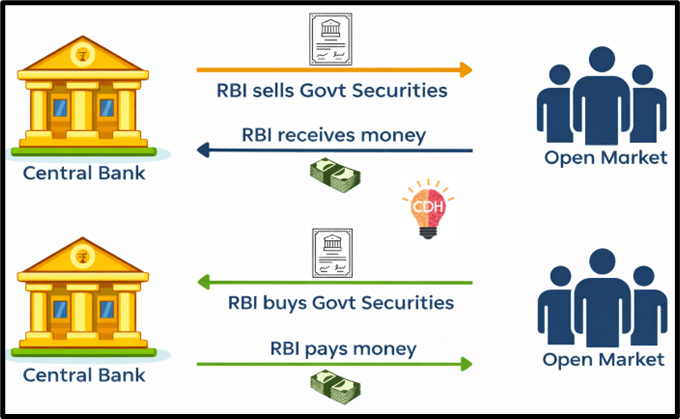
Open Market Operations (OMOs) refer to the buying and selling of government securities by RBI in the open market to regulate liquidity.
Unlike LAF:
- OMOs are outright transactions
- They have a longer-lasting impact on liquidity
OMO for Liquidity Injection
When RBI wants to increase money supply:
- It buys government securities from banks and PDs (Primary Dealers)
- Pays by crediting banks’ accounts
- Bank reserves increase
- Lending capacity expands
📌 Impact
More credit → higher investment & consumption → economic growth
OMO for Liquidity Absorption
When RBI wants to control inflation:
- It sells government securities
- Money flows from banks to RBI
- Bank reserves fall
- Lending capacity reduces
📌 Impact
Lower borrowing & spending → inflation cools down
OMOs vs LAF (Conceptual Distinction)
- LAF → Short-term, reversible liquidity management
- OMOs → Longer-term, durable liquidity impact
👉 UPSC often tests this difference.
Forex Swaps (Foreign Exchange Swaps)
What is a Forex Swap?
A forex swap is a two-leg transaction:
- One transaction happens today
- The reverse transaction happens on a pre-decided future date
- Exchange rate for both legs is pre-agreed
Forex swaps are conducted through RBI-announced auctions, in which commercial banks participate.
👉 Key idea: Temporary exchange of currencies to manage liquidity without permanently changing forex reserves.
Types of Forex Swaps
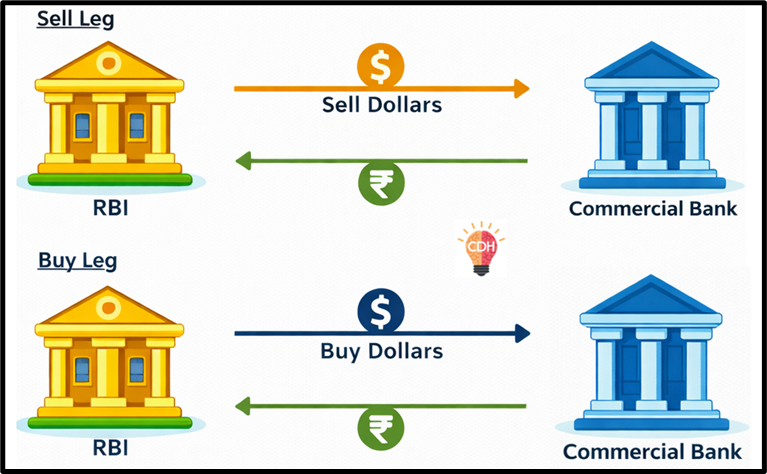
1. Sell/Buy Forex Swap
(Liquidity Absorption Tool)
Structure
- Sell leg (now): RBI sells foreign currency (e.g., USD) to banks
- Buy leg (future): RBI agrees to buy back the same foreign currency later
Purpose
- Absorb rupee liquidity
- Prevent rupee depreciation
- Manage inflationary pressure caused by excess liquidity
Example
- RBI sells USD 100 million at ₹80/USD
- Absorbs ₹8 billion from the banking system
- After one year, RBI buys back USD at ₹81/USD
- Re-injects ₹8.1 billion
📌 Insight: Liquidity absorption is temporary, unlike permanent sterilization.
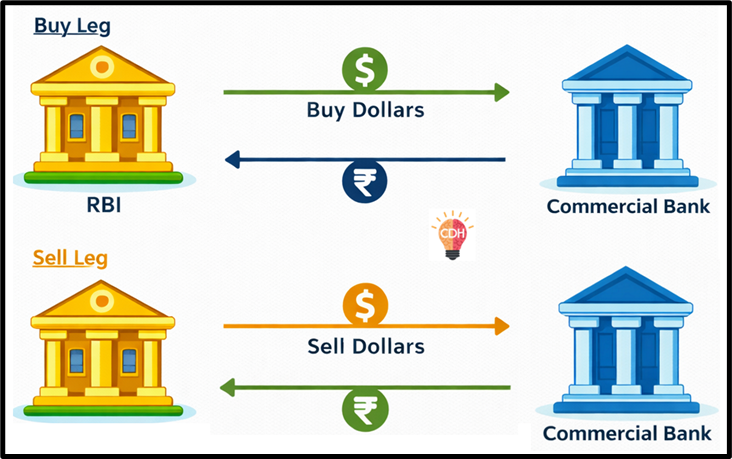
2. Buy/Sell Forex Swap
(Liquidity Injection Tool)
Structure
- Buy leg (now): RBI buys foreign currency from banks
- Sell leg (future): RBI sells the same amount back later
Purpose
- Inject rupee liquidity
- Tackle liquidity crunch
- Smooth volatility in forex markets
Example
- RBI anticipates liquidity stress due to tax outflows
- Buys USD 100 million at ₹80/USD
- Injects ₹8 billion into the system
- After one year, RBI sells back USD at ₹79/USD
- Absorbs ₹7.9 billion
Why Forex Swaps Are Powerful
- Liquidity impact is time-bound
- Do not permanently alter RBI’s forex reserves
- Useful during:
- Capital flow volatility
- External shocks
- Global monetary tightening/loosening cycles
📌 Note:
Forex swaps allow RBI to manage liquidity and exchange rate simultaneously without changing the policy rate.
Market Stabilization Scheme (MSS)
What is MSS?
The Market Stabilization Scheme (MSS) is a liquidity absorption tool used by RBI to sterilize excess liquidity, especially arising from large foreign exchange inflows.
- Introduced in 2004
- Used when forex inflows create → Excess rupee liquidity, Inflationary pressure, Undue appreciation of the rupee
Why MSS Was Needed
When RBI buys foreign currency to prevent rupee appreciation → It injects rupees into the banking system → This can fuel inflation
👉 MSS was designed to neutralize (sterilize) this excess liquidity.
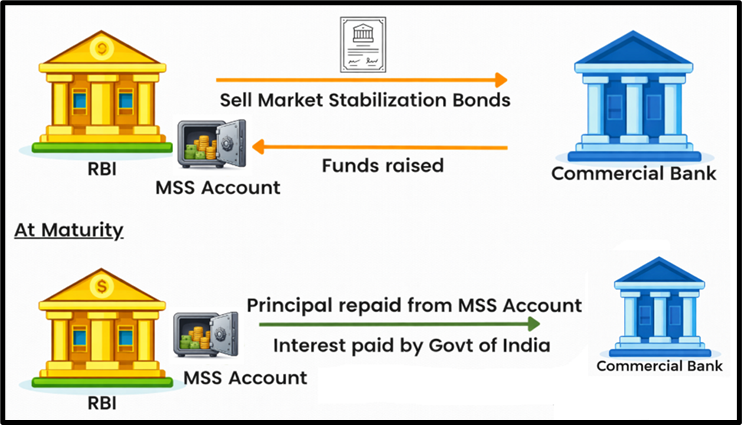
How MSS Works
- RBI issues Market Stabilization Bonds (MSBs)
- These are government-backed securities
- Sold via auction to banks and financial institutions
- Money raised:
- Not used for government spending
- Parked in a separate MSS account
Important Features
- Interest cost borne by Government of India
- Principal repaid from the MSS account
- Usually short-term securities
- Purely a liquidity management tool
Indian Context Examples
Early 2000s
- Large capital inflows → Rupee appreciation pressure → MSS used extensively to absorb liquidity
Demonetisation (2016)
- Sudden surge in bank deposits → Massive excess liquidity → MSS deployed to mop up surplus funds
📌 UPSC Value Addition:
MSS is an exceptional tool, activated only during extraordinary liquidity situations.
MSS vs Open Market Operations (OMOs)
| Aspect | OMOs | MSS |
|---|---|---|
| Nature | Buying/selling G-secs | Issuance of special bonds |
| Usage | Regular monetary tool | Exceptional, situation-specific |
| Liquidity Impact | Injection or absorption | Mainly absorption |
| Securities | Normal G-Secs, T-Bills | Market Stabilization Bonds |
| Fiscal Impact | Normal budget process | Interest borne by government, funds parked |