
Classification of Cells
To understand the diversity of life at the cellular level, cells are classified on two complementary bases—structural organization and functional specialization.
At the most fundamental level, cells are divided into prokaryotic and eukaryotic cells, based on the presence or absence of a true nucleus and membrane-bound organelles. This distinction reflects the evolutionary progression from simple to complex cellular forms.
Building upon this, eukaryotic cells are further differentiated into plant and animal cells, depending on their mode of nutrition and structural adaptations—such as the presence of a cell wall, chloroplasts, and vacuoles in plants.
Together, these two layers of classification provide a clear and systematic framework to understand both the basic architecture and the functional diversity of cells.
Prokaryotic and Eukaryotic Cells
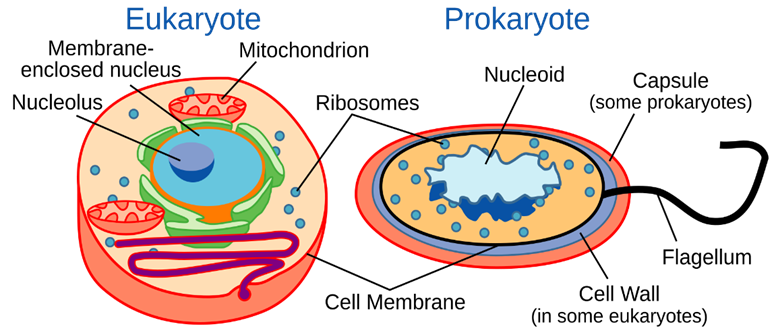
This classification forms the backbone of cell biology, explaining differences in complexity, evolution, and functional specialization. Prokaryotic cells represent the most primitive forms of life, while eukaryotic cells exhibit advanced structural organization, enabling higher levels of biological complexity.
| Feature | Eukaryotic Cells | Prokaryotic Cells |
| Meaning | Eu = after; Karyon = nucleus | Pro = before; Karyon = nucleus |
| Evolution | 1.5 billion years ago | 3.5 billion years ago |
| Nucleus | Present (Genetic material enclosed within a membrane-bound nucleus) | Absent (Genetic material free-floats in the cytoplasm in a region called the nucleoid) |
| Organelles | Contain membrane-bound organelles (mitochondria, endoplasmic reticulum, Golgi apparatus, etc.) | No membrane-bound organelles |
| Cell size | Larger | Smaller |
| DNA | Linear, wrapped around histones to form chromatin | Circular, without histones (proteins that help organise DNA) |
| Plasmids | Typically absent | Present (small circular DNA; often confer traits like antibiotic resistance) |
| Cell type | Unicellular or multicellular | Unicellular |
| Cell wall | Present only in plants, fungi, algae, and some protists; absent in animals | Present in most |
| Ribosomes | Larger; free in cytoplasm or attached to endoplasmic reticulum | Smaller, scattered in cytoplasm |
| Reproduction | Sexual (meiosis, fertilisation) or asexual (mitosis) | Asexual (binary fission, budding) |
| Metabolism | Less diverse; compartmentalised metabolism; mainly aerobic respiration; slower metabolic rates | Diverse pathways; both aerobic and anaerobic respiration; faster metabolic rates → rapid adaptation |
| Cytoskeleton | Well developed | Less complex, not well-defined |
| Examples | Animals, plants, fungi, protists | Bacteria and Archaea |
Animal Cell and Plant Cells
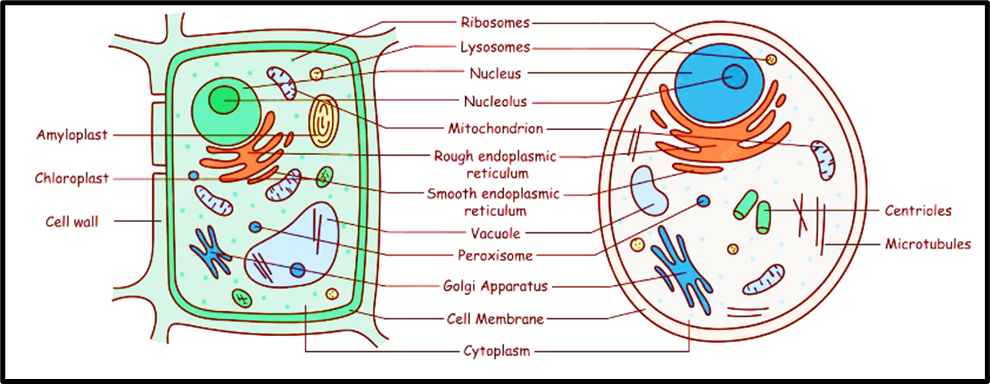
Before comparing animal and plant cells, it is important to recognize that both are eukaryotic cells, sharing a common structural framework. However, their differences arise from their distinct modes of life—plants being autotrophic (self-sustaining through photosynthesis) and animals being heterotrophic. These functional needs drive structural specializations in each cell type.
| Feature | Animal Cell | Plant Cell |
| Cell Wall | Absent | Present (made of cellulose) |
| Shape | Irregular | Fixed, rectangular |
| Size | Smaller | Larger |
| Vacuole | Many small vacuoles | One large central vacuole (occupies ~90% of cell volume) |
| Chloroplasts | Absent | Present (site of photosynthesis) |
| Centrioles | Present | Absent |
| Lysosomes | Present | Rare |
| Cilia | Present | Rare |
Similarities
Both animal and plant cells possess → Nucleus, Endoplasmic reticulum, Cytoplasm, Ribosomes, Mitochondria and Golgi apparatus