
Cell Cycle and Cell Division
Imagine you are a city. A healthy city doesn’t just exist — it grows, repairs its roads, and eventually builds new neighbourhoods. Cells do exactly the same thing. The cell cycle is the city’s master plan — a precisely choreographed sequence of events in which a cell duplicates its genome, manufactures essential components, and then divides into two daughter cells. This process is the biological engine behind growth, development, repair, and reproduction.
Now, how does a cell divide? There are two fundamental methods: Mitosis and Meiosis. Think of mitosis as a photocopier, and meiosis as a remix artist. One makes perfect copies; the other creates something new.
Let’s start with mitosis — the simpler, more common of the two.
Mitosis — The Photocopier
Mitosis is nuclear division (karyokinesis) followed by cytoplasmic division (cytokinesis), resulting in two daughter cells that are genetically identical to the parent. Think of it as a corporation making a perfect copy of its blueprint before handing it to a new branch office.
Karyokinesis has four stages — easily remembered as PMAT:
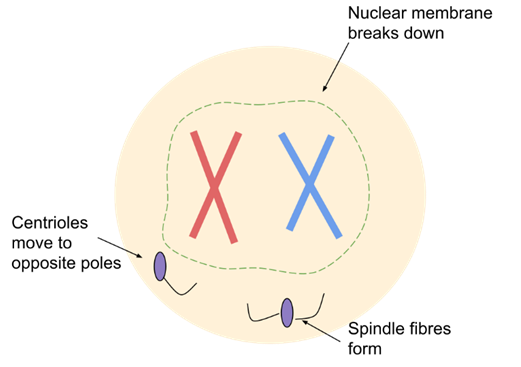
Prophase is the preparation stage. The chromosomes, which normally exist as loosely wound chromatin threads, condense and become visible under a microscope. The nuclear envelope dissolves (the “wall comes down”), and the mitotic spindle begins to form, with centrosomes migrating to opposite poles.
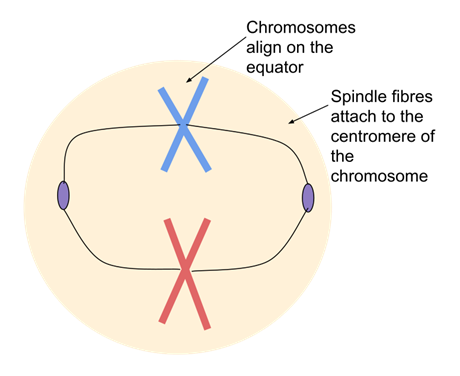
Metaphase is the alignment stage. All chromosomes line up neatly along the cell’s equatorial plane — like soldiers on a parade ground. Spindle fibres attach to their centromeres and hold them in position.
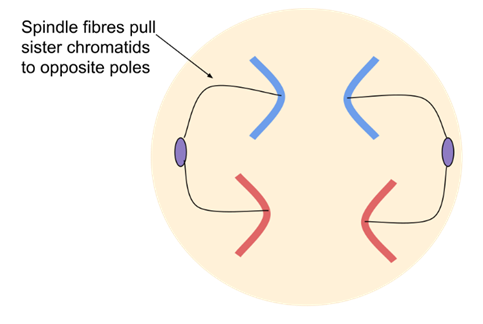
Anaphase is the separation stage. Sister chromatids are physically pulled apart to opposite poles by the spindle fibres. Each chromatid now becomes an independent chromosome. This is the most dramatic moment — the cell is literally tearing its genetic material in two.
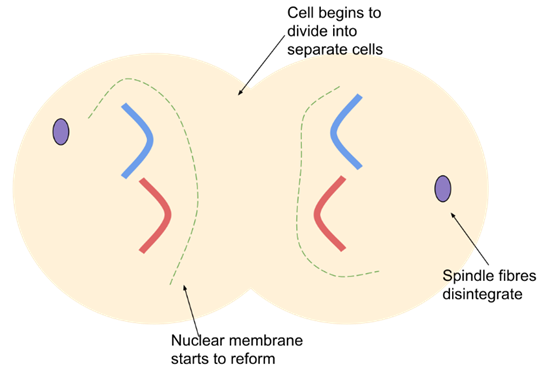
Telophase is the resolution stage. Chromosomes reach the poles, unwind back into chromatin, and new nuclear envelopes form around each set. Two nuclei now exist within one cell. Then cytokinesis follows — the cytoplasm divides — and two complete, identical daughter cells are born.
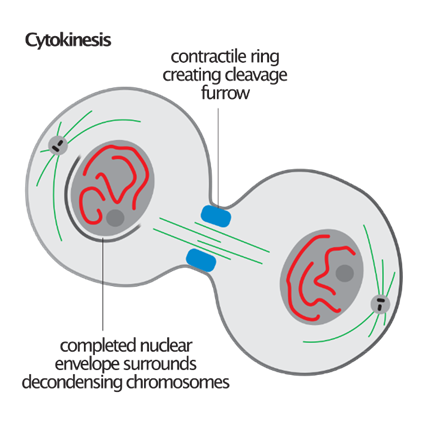
Why does mitosis matter? Because without it, you would not exist. Every time a wound heals, every time your gut replaces its lining, every time an embryo grows from a single fertilised egg to a trillion-cell human — mitosis is at work. It also ensures genetic consistency: every cell in your liver, your brain, your skin carries the same chromosomal information, which is essential for organs to function properly.
Now let’s meet the more complex cousin — Meiosis.
Meiosis — The Remix Artist
Meiosis is the process by which one diploid cell divides twice to produce four haploid daughter cells — each genetically unique. A haploid cell contains only half the normal chromosome number. This is the process that produces gametes: sperm, eggs, pollen, ovules.
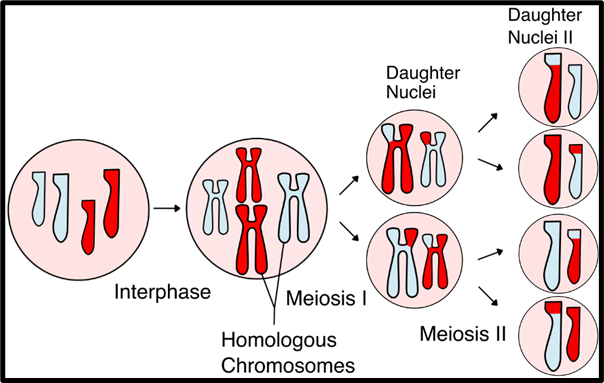
Why do we need haploid cells? Simple logic — when two gametes fuse during fertilisation, the chromosome number must be restored to the normal diploid count. If gametes were diploid, every generation would double the chromosome number, and life would quickly become chromosomally chaotic!
Meiosis happens in two rounds:
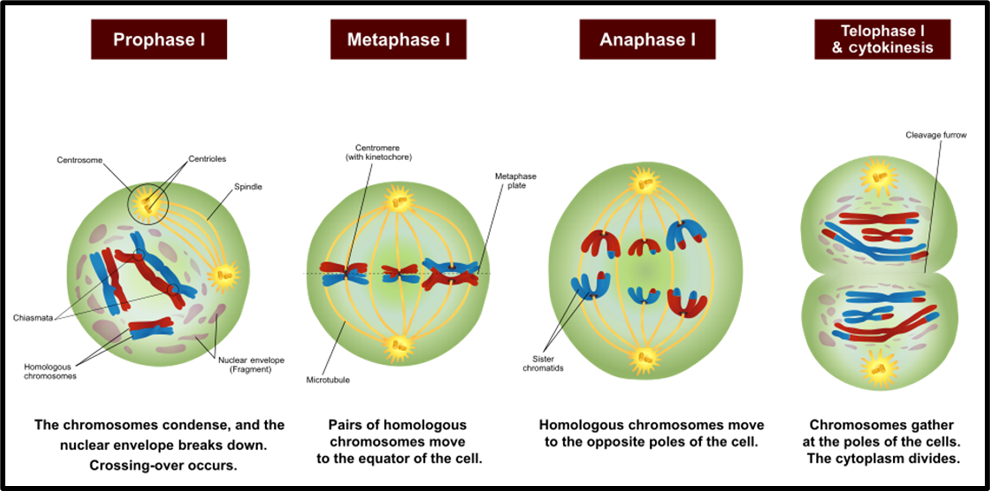
Meiosis I is the reductive division — it cuts the chromosome number in half.
- Prophase I is the star of the show. This is where crossing over (also called recombination) happens. Homologous chromosomes pair up, forming structures called tetrads, and physically exchange segments of genetic material. This is the single biggest source of genetic diversity in sexually reproducing organisms. Imagine two encyclopaedias swapping chapters with each other — the result is two books, neither of which is identical to the original.
- Metaphase I: The tetrads line up at the metaphase plate. Crucially, which homologue faces which pole is random — this independent assortment is another engine of genetic variation.
- Anaphase I: Unlike mitosis (where sister chromatids separate), here it is the homologous chromosomes that are pulled apart. Sister chromatids still stay together.
- Telophase I + cytokinesis: Two haploid daughter cells are produced. Each still has two sister chromatids per chromosome — the work isn’t finished yet.
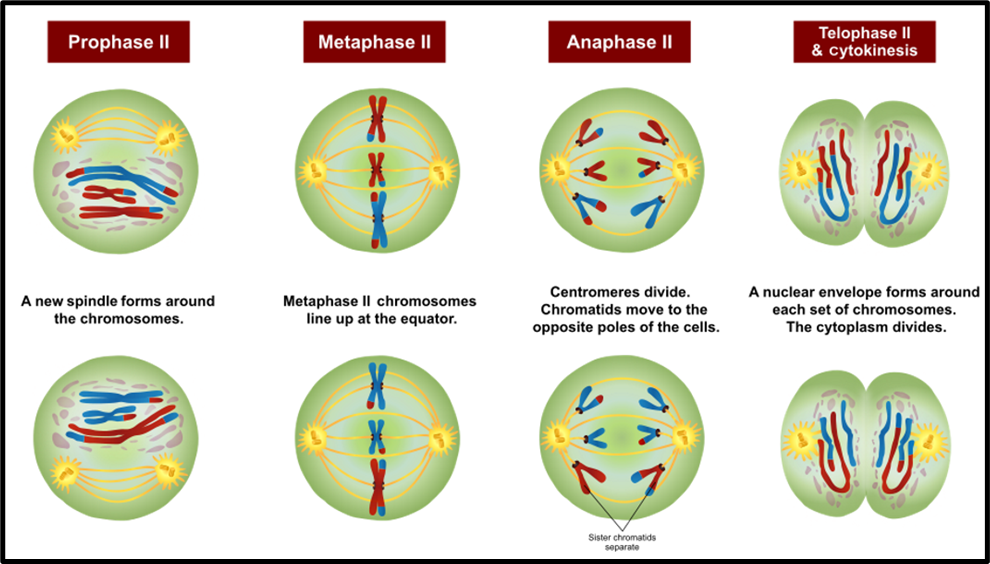
Meiosis II is essentially mitosis for the haploid cells — sister chromatids finally separate.
- Prophase II → Metaphase II → Anaphase II → Telophase II: The process mirrors mitosis. Sister chromatids are pulled apart, and after cytokinesis, four genetically unique haploid cells emerge.
Now let’s look at the critical comparison.
The Big Picture — Why Does Any of This Matter?
Let’s zoom out and you may think “so what?”
Mitosis is the foundation of continuity within an individual. It keeps you alive — healing your skin, replacing your blood cells, growing every tissue from a single embryo. It preserves genetic identity across all your somatic cells. Organisms like amoebae even use it for asexual reproduction.
Meiosis is the foundation of variation across generations. Through crossing over and independent assortment, it ensures no two offspring are identical (except identical twins, who arise from the same fertilised egg). This genetic diversity is not a bug — it is evolution’s greatest feature. When environments change, populations with more variation survive better. Meiosis is, in a very real sense, the engine of evolution and adaptation.
One more thing worth noting: maintaining chromosomal stability across generations is a feat meiosis performs with mathematical precision.
Humans have 46 chromosomes (diploid = 2n). Meiosis halves this to 23 (haploid = n) in each gamete. When sperm and egg fuse, 23 + 23 = 46. Generation after generation, the count stays constant. Without meiosis, this balance would collapse.
| Feature | Mitosis | Meiosis |
| Purpose | Growth, repair, and asexual reproduction | Production of gametes for sexual reproduction |
| No. of Divisions | One division (mitotic division) | Two divisions (meiosis I and meiosis II) |
| No. of Daughter Cells | Two | Four |
| No. of Chromosomes | Diploid (same as parent cell) | Haploid (half the parent cell’s chromosomes) |
| Genetic Variation | No (daughter cells are genetically identical to each other and the parent cell) | Yes (daughter cells are genetically unique) |
| Occurrence | In somatic cells (non-reproductive) | In germ cells (reproductive cells that produce gametes) |