
Plant Tissues
Think of a plant as a living organisation. Every organisation has workers at different levels — some are still in training and can become anything, while others have settled into permanent, specialised roles. Plant tissues work exactly the same way.
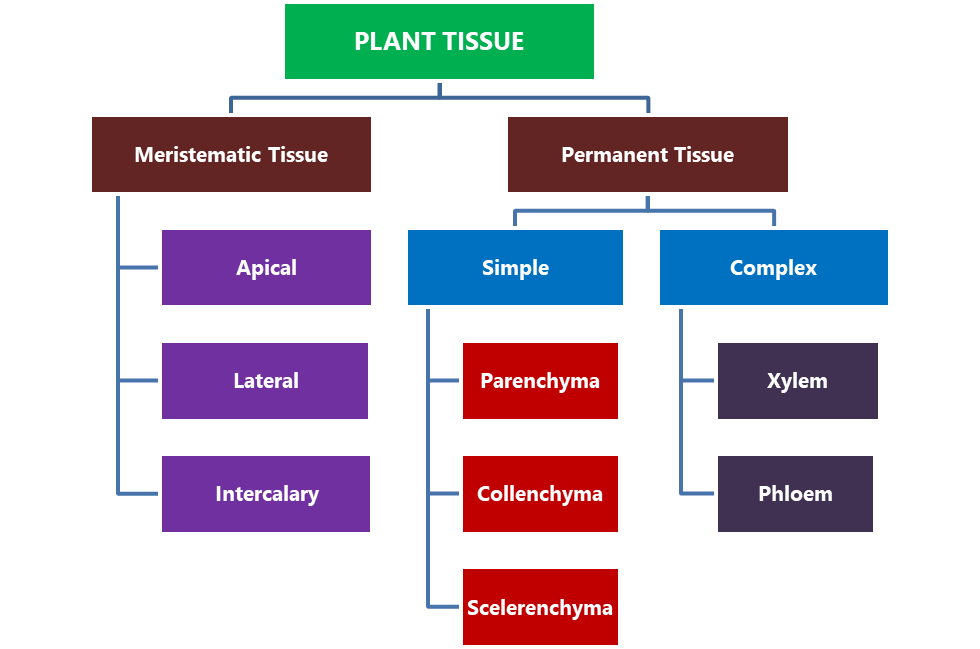
Every plant tissue belongs to one of two families.
- The first is Meristematic Tissue — the “trainee pool” of the plant, cells that haven’t decided what they want to be yet.
- The second is Permanent Tissue — cells that have graduated and taken up their final, specialised roles.
Let’s start with the trainees.
Meristematic Tissue
Imagine a boot camp where recruits are constantly being trained and sent out. Meristematic tissue is exactly that. These cells have a remarkable “superpower” — they can keep dividing indefinitely through mitosis, and each new cell can become any type of specialised plant cell.
The key characteristics are easy to remember if you think of a cell that is young and hungry: it has a prominent nucleus (the boss is clearly visible), dense cytoplasm (packed and ready), no vacuoles (no storage — just pure machinery), no intercellular spaces (tightly packed like soldiers), and thin cell walls (still flexible, not yet hardened).
Now, where exactly are these training camps located? Three places:
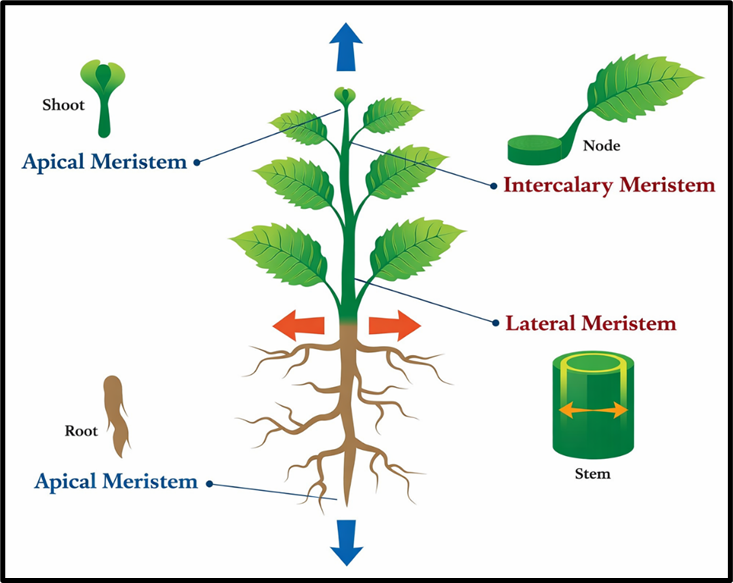
- Apical Meristems sit at the tips of roots and shoots. Every time you see a plant growing taller or a root pushing deeper into soil, apical meristems are responsible. This is called primary growth — increasing length. As the shoot grows, some cells from the shoot apical meristem become axillary buds — those little bumps that eventually become branches or flowers.
- Intercalary Meristems are found between mature tissue, especially near the nodes (joints) of stems and in grasses. Here is an elegant insight: when a cow grazes on grass and cuts it near the middle, the plant doesn’t panic. It has intercalary meristems near the nodes that regenerate the damaged sections. This is why cutting grass makes it grow back — it evolved to survive grazing! Both apical and intercalary meristems are called primary meristems because they appear early in the plant’s life.
- Lateral Meristems (Cambium) appear later in life, in mature regions of roots and shoots, especially in woody plants. They are responsible for secondary growth — increasing girth and thickness. Vascular cambium and cork cambium are the two key examples. The rings you see on a tree trunk’s cross-section? Those are the signature of lateral meristems doing their work, year after year.
Permanent Tissue
Once meristematic cells differentiate, they take on permanent shapes, sizes, and functions. They lose the ability to divide (mostly), develop thick or varied cell walls, and gain vacuoles for storage. Think of these as employees who have completed training and joined specific departments.
Permanent tissue has two broad departments: Simple (one type of employee) and Complex (multiple types working together).
Simple Permanent Tissue
Parenchyma
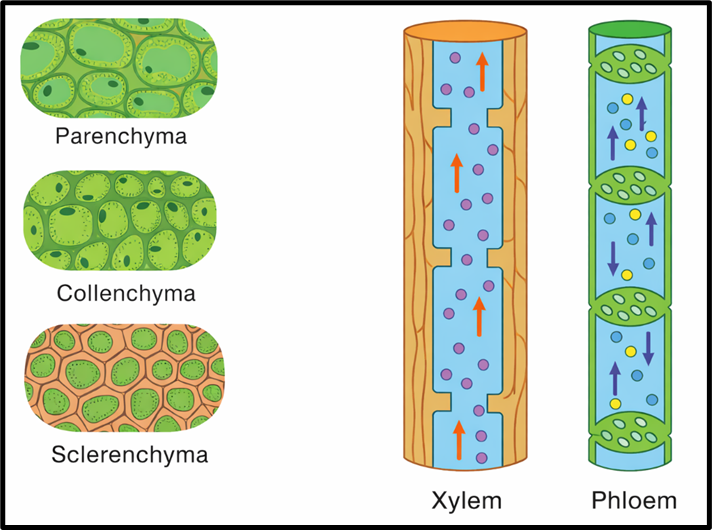
Parenchyma is the jack-of-all-trades of plant tissue. These are living cells with thin cellulose walls, and they carry out photosynthesis, storage, and secretion. They can be tightly packed or have small air spaces.
Two important specialisations:
- Chlorenchyma contains chlorophyll and does photosynthesis;
- Aerenchyma has large air cavities that help aquatic plants like water hyacinth float.
Nature is beautifully economical — the same basic cell type, modified for entirely different environments.
Collenchyma
Found just beneath the outer skin (epidermis) of dicot plants, collenchyma cells are living and have thickened corners — extra deposits of cellulose, hemicellulose, and pectin at the junctions.
Picture a room where the corners are reinforced with extra material. This gives mechanical support to young, growing parts like tender stems and leaf stalks, while still allowing flexibility. They may even contain chloroplasts, so they can contribute to food production as a side task.
Sclerenchyma
If collenchyma is flexible support, sclerenchyma is the hard armour. These cells have thick, lignified (hardened with lignin) walls and are usually dead — they don’t need to be alive to do their job, which is purely mechanical support.
Two cell types exist here:
- Fibres (long, bundled cells — this is what gives hemp, jute, and cotton their strength) and
- Sclereids (short, gritty cells found in nutshells, the hard bits of guava and pear fruit, seed coats, and tea leaves — that slight grittiness when you eat a pear? That’s sclereids.
Complex Permanent Tissue
Here the real engineering genius of plants shows up. Complex tissues have multiple types of cells working in coordination — like a team, not a solo performer. The two great examples are Xylem and Phloem, collectively called vascular tissue (conducting tissue).
Xylem
Think of xylem as a pipeline from the basement (roots) to the top floor (leaves). It transports water and dissolved minerals upward. The driving force is elegant: water evaporates through tiny pores called stomata on the leaf surface (transpiration), and this creates a negative pressure — a pull — that sucks water upward through the xylem the way you suck through a straw. This is called the transpiration pull.
Xylem is composed of four cell types:
- Tracheids: Elongated, dead, tube-like cells with lignified walls. Think of them as hollow, hardened pipes.
- Vessels: Even longer tubes of dead cells, more efficient at transport. Crucially, vessels are found only in angiosperms (flowering plants).
- Xylem parenchyma: The only living cell in xylem — it stores food and helps with lateral movement of water.
- Xylem fibres: Dead cells providing additional mechanical support to the xylem bundle.
Phloem
If xylem is a water pipeline going up, phloem is a food distribution network going in both directions. It transports sugars (mainly sucrose) made during photosynthesis in leaves to every other part of the plant — growing tips, roots, fruits, seeds. This process is called translocation, and it requires active energy (unlike xylem, which is passive).
Phloem has four cell types too:
- Sieve tubes: Long, living, tube-like cells with sieve-like perforated plates at their ends to allow food to flow through. Remarkably, they have no nucleus — they depend entirely on their companion cells to function.
- Companion cells: Living cells that “babysit” the sieve tubes — controlling and maintaining them since sieve tubes have sacrificed their nucleus.
- Phloem fibres: Dead cells providing mechanical support.
- Phloem parenchyma: Living cells involved in lateral transport and storage of nutrients.
Protective Tissue
No organisation survives without security. Plants have two layers of protection.
Epidermis
- It is the outermost single-cell layer of young plant parts — the skin.
- Most epidermal cells are flat and tightly packed with no gaps.
- They secrete a waxy coating called the cuticle, which is the plant’s waterproofing layer — it prevents water loss, keeps out mechanical damage, and blocks fungal invasion. Notice how desert plants have a thicker cuticle (they can’t afford water loss) while roots have no cuticle at all (they need to absorb water).
- The leaf epidermis contains stomata — pores bordered by kidney-shaped guard cells that open and close to regulate gas exchange and transpiration. Root epidermis has tiny hair-like extensions to increase the surface area for water absorption.
Cork
- It takes over in older, woody plants. As the plant matures, the secondary meristem (cork cambium) produces cork tissue that replaces the epidermis.
- Cork cells are dead, stacked in multiple compact layers without any gaps. Their walls are impregnated with a waxy substance called suberin, which makes them completely impervious to water and gases.
- The bark of a tree is essentially cork — tough, waterproof armour that protects against physical damage, pathogens, and desiccation.
Here is your content presented in a clean, structured, and UPSC-ready format—balanced between readability and compactness (avoiding unnecessary vertical stretching):
Vascular and Avascular Tissue in Plants
Basic Definition
- Vascular Tissues: Tissues that contain tubular structures for the transport of fluids, nutrients, and other substances.
- Avascular Tissues: Tissues that lack tubular transport structures; movement occurs without specialised vessels.
Comparison
| Feature | Vascular Tissue in Plants | Avascular Tissue in Plants |
| Definition | Contains specialised transport structures (xylem and phloem) for water, nutrients, and food transport | Lacks specialised transport structures |
| Transport Function | Efficient long-distance transport of water, minerals, and organic compounds | Transport occurs through diffusion and osmosis, suitable only for short distances |
| Complexity | Structurally complex with differentiated tissues | Simple and undifferentiated |
| Support Role | Provides strong structural support due to lignified xylem | Provides minimal structural support |
| Plant Size | Found in larger plants due to efficient transport system | Restricted to small-sized plants |
| Water Dependency | Less dependent on external water availability | Highly dependent on water for nutrient movement and reproduction |
| Habitat | Can survive in diverse environments, including dry regions | Mostly found in moist environments |
| Examples | Ferns, Gymnosperms, Angiosperms | Mosses, Liverworts, Hornworts |