
Properties of Solids and Fluids
Introduction
Pick up a stone. Now pour some water. Now breathe in some air. You have just interacted with three of the fundamental forms of matter — a solid, a liquid, and a gas. 😊
Physics classifies all matter into solids and fluids (fluids encompass both liquids and gases). Understanding how they behave — why steel bridges hold, why ships float, why planes fly — is what this chapter is all about.
A solid is a state of matter that has both a definite shape and a definite volume. The atoms or molecules inside are tightly packed in a fixed, orderly arrangement, making solids rigid and resistant to deformation. Examples: metals, wood, ice, glass, rocks.
A fluid is any substance that can flow and does not have a fixed shape. The particles are loosely packed and can flow and deform when subjected to shear forces. Fluids include:
- Liquids: Have a definite volume but not a definite shape — they take the shape of their container. Examples: water, oil, mercury.
- Gases: Have neither a definite shape nor a definite volume — they expand to fill whatever container they occupy. Examples: air, helium, steam.
Comparison between Solids and Fluids
| Feature | Solids | Fluids (Liquids & Gases) |
| Shape | Definite and fixed | Indefinite — takes the shape of the container |
| Volume | Definite | Definite (liquids) / Indefinite (gases) |
| Density | Generally high | High but less than solids (liquids); very low (gases) |
| Intermolecular Forces | Strong | Weak |
| Particle Arrangement | Closely packed, ordered or disordered | Loosely packed, randomly arranged |
| Particle Movement | Vibrate around fixed positions | Free to move and collide |
| Compressibility | Generally incompressible | Easily compressible (gases); slightly compressible (liquids) |
| Flow | Do not flow | Flow under applied forces |
| Elasticity | Elastic — return to original shape after force removed | Not elastic; deforms easily |
| Examples | Metals, wood, ice, glass, rocks | Water, air, oil, helium, milk |
Physical Properties of Solids and Fluids
Mass and Weight
As discussed in last chapter, mass is the measure of the amount of matter in an object (scalar, unit: kg), while weight is the force exerted on it due to gravity (vector, unit: Newton). These properties apply equally to solids and fluids.
Volume
Volume is the amount of three-dimensional space occupied by a substance, whether solid, liquid, or gas. It is a scalar quantity.
Common units: cubic metres (m³), cubic centimetres (cm³), litres (L), millilitres (mL).
| Shape | Volume Formula |
| Cube | V = a³ (a = side length) |
| Rectangular Cuboid | V = l × b × h (length × breadth × height) |
| Cylinder | V = πr²h (r = radius, h = height) |
| Sphere | V = (4/3) πr³ (r = radius) |
| Cone | V = (1/3) πr²h (r = radius, h = height) |
| Irregular shapes | Displacement method: submerge in water and measure displaced volume |
Density
Density tells us how much mass is packed into a given volume. It is the ‘crowdedness’ of matter in a substance.
Density = Mass / Volume | SI unit: kg/m³
- High density substances are compact and heavy for their size — example: lead, gold, steel.
- Low density substances are light for their size — example: wood, cork, gases.
- For solids and liquids, density is relatively stable with changes in temperature and pressure. For gases, density changes significantly with temperature and pressure.
Relative Density (Specific Gravity)
Relative Density is the ratio of the density of a substance to the density of a reference substance.
- For solids and liquids, the reference is water at 4°C (where water achieves its maximum density of 1000 kg/m³).
- For gases, the reference is air at Standard Temperature and Pressure (STP).
Relative Density = Density of the substance / Density of the reference material
Relative Density is a dimensionless quantity — since it’s a ratio of two densities, the units cancel out.
| Relative Density Value | Interpretation |
| = 1 | Same density as water — the substance barely floats or is neutrally buoyant |
| > 1 | Denser than water — the substance sinks |
| < 1 | Less dense than water — the substance floats |
Mechanical Properties of Solids
Different materials behave differently when forces are applied to them. Some spring back; others squash permanently; others snap. These behaviours are captured by the mechanical properties of solids — a topic of immense practical importance in engineering, construction, and material science.
1. Elasticity: The ability of a material to return to its original shape and size after the deforming force is removed, provided the force is within the material’s elastic limit. Example: rubber bands, spring steel.
2. Plasticity: The ability of a material to undergo permanent deformation without breaking when a force exceeds its elastic limit. Example: clay, putty — once you press them, they keep the new shape.
3. Brittleness: The tendency of a material to fracture or break suddenly without significant deformation. Example: glass, ceramic materials snap without bending much.
4. Ductility: The ability of a material to be drawn or pulled into thin wires without breaking. Example: gold and copper are highly ductile — that is why they are used in electrical wiring.
5. Malleability: The ability of a material to be hammered, pressed, or rolled into thin sheets without breaking. Example: aluminium foil, gold leaf.
6. Toughness: The ability to absorb energy and deform without breaking — a combination of strength and ductility. Example: steel is tougher than glass.
7. Hardness: The resistance of a material to deformation, indentation, or scratching. Example: diamond is the hardest known natural material.
8. Strength: The ability of a solid to resist deformation or fracture under stress. Types: Tensile strength (resists stretching), Compressive strength (resists compression), Shear strength (resists shearing).
9. Stiffness: The ability of a material to resist deformation under an applied force. Example: steel is much stiffer than rubber.
10. Fatigue: Weakening of a material caused by repeated cycles of loading and unloading. Example: aircraft wings can develop cracks due to metal fatigue after many take-offs and landings — a critical safety concern in aviation.
11. Creep: The gradual, time-dependent deformation of a material under a constant load, typically at high temperatures. Example: metal components in jet engines deform slowly over time due to creep under sustained heat and stress.
Elasticity — A Deeper Look
Elasticity is the property that allows a material to recover its original shape after deformation. Every elastic material has an Elastic Limit — the maximum extent to which it can be stretched or compressed and still bounce back. Beyond this limit, the material either deforms permanently (plasticity) or breaks (fracture).
Elastomers are special polymeric materials — like natural rubber and silicone — that exhibit exceptionally large elastic deformations. They can stretch many times their original length and still return to their original shape.
Stress
When an external force is applied to a material, the material internally resists it. This internal resistance per unit area is called Stress.
Stress = Force / Area | SI unit: Pascal (Pa) = 1 N/m²
Characteristics of Stress:
- Directly proportional to the applied force — larger force, greater stress.
- Inversely proportional to the area — same force over a smaller area creates more stress (think of a needle vs. a flat palm).
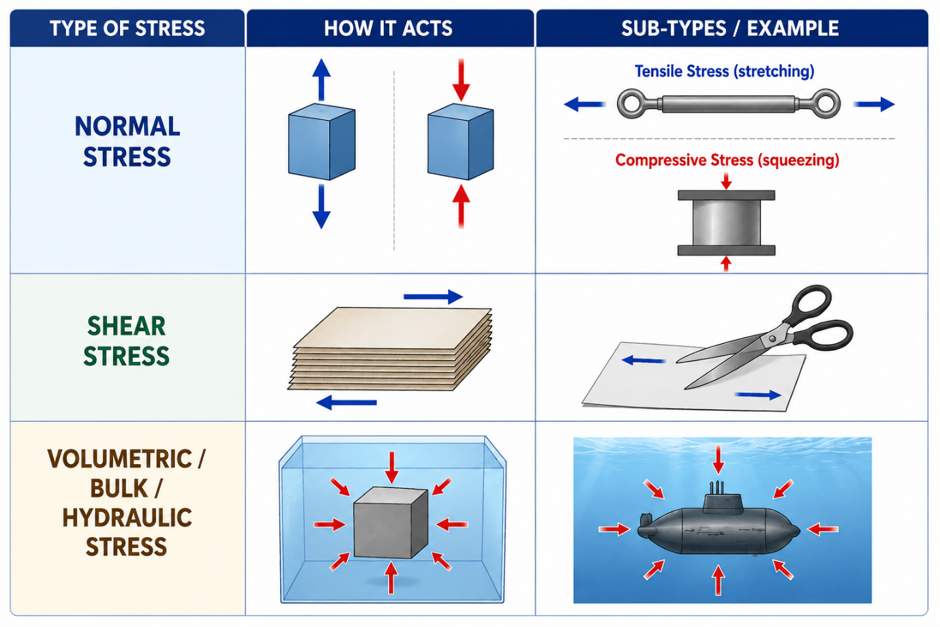
| Type of Stress | How it acts | Sub-types / Example |
| Normal Stress | Force applied perpendicular to the surface | Tensile Stress (stretching) | Compressive Stress (squeezing) |
| Shear Stress | Force applied parallel to the surface | Cutting, sliding layers — e.g., scissors cutting paper |
| Volumetric/ Bulk/ Hydraulic Stress | Force uniformly in all directions | Object submerged deep in water — compressed from all sides |
Strain
Strain is the measure of deformation caused by stress. It quantifies how much a material changes its shape or size relative to its original dimensions.
Strain = Change in Dimension / Original Dimension
Strain is dimensionless — it is a pure ratio with no units.
| Type of Strain | Definition | Formula | Example |
| Normal/ Longitudinal Strain | Force perpendicular to surface | Change in Length / Original Length | Pulling a rubber band (tensile) | Squeezing a sponge (compressive) |
| Shear Strain | Force parallel to cross-section | Relative Displacement / Original Length | Cutting paper with scissors |
| Volumetric Strain | Uniform force on all sides | Change in Volume / Original Volume | Submerging a ball in deep water |
Hooke’s Law
Hooke’s Law is the foundational principle of elasticity. It states that within the elastic limit of a material, stress is directly proportional to strain.
Stress ∝ Strain → Stress = E × Strain
Here, E is the constant of proportionality called the Modulus of Elasticity (or Young’s Modulus for stretching/compression). A higher E means a stiffer material — steel has a very high modulus while rubber has a very low one.
- Hooke’s Law is valid only within the elastic limit.
- It applies only to small deformations where the material behaves linearly.
Poisson’s Ratio
When you stretch a rubber band lengthwise, notice that it becomes thinner in the middle. This cross-sectional shrinkage while lengthening — or bulging while compressing — is captured by Poisson’s Ratio.
Poisson’s Ratio (ν) = Lateral Strain / Longitudinal Strain
For most common materials, Poisson’s ratio lies between 0 and 0.5. Rubber has a ratio close to 0.5 (nearly incompressible), while cork has a ratio near 0 (that is why corks can be pushed into wine bottles without expanding sideways).
Mechanical Properties of Fluids
If solids resist forces, fluids submit to them — and in fascinating ways. The mechanical properties of fluids explain everything from how blood flows in our veins to how aeroplanes stay aloft and how submarines dive and surface. Let us explore each property.
Fluid Pressure
Fluid pressure is the force exerted by a fluid per unit area on any surface it is in contact with. Unlike stress in solids (which can be directional), fluid pressure at any point acts equally in all directions. This is because fluid molecules are free to move and exert force on all surrounding surfaces.
Pressure in a static fluid: P = ρgh + P₀
Where: P = total pressure | ρ = density of fluid | g = acceleration due to gravity | h = depth | P₀ = external (atmospheric) pressure
SI unit of pressure: Pascal (Pa) = 1 N/m²
| Factor | Effect on Fluid Pressure |
| Depth (h) | Pressure increases with depth — more fluid above means more weight pressing down |
| Fluid Density (ρ) | Denser fluids exert more pressure at the same depth |
| Gravity (g) | Greater gravitational acceleration → greater pressure |
| External Pressure | Atmospheric and other surface pressures add to the total fluid pressure |
Types of Fluid Pressure:
- Hydrostatic (Static) Pressure: Pressure exerted by a fluid at rest. Example: water pressure at the bottom of a swimming pool.
- Dynamic Pressure: Pressure due to the fluid’s motion. Example: water pressure in a flowing pipe.
Pascal’s Law
Pascal’s Law states:
“In a confined, incompressible fluid at rest, any change in pressure applied at any point is transmitted undiminished throughout the fluid in all directions.”
The practical power of this law is extraordinary.
If you apply a small force over a small area, the pressure is transmitted to every part of the fluid. If you now apply this pressure over a larger area (a larger piston), you get a much larger force out. This is the hydraulic lever effect — the principle behind hydraulic brakes in cars, hydraulic jacks in garages, and hydraulic lifts.
Key characteristics:
(1) Applies to confined fluids.
(2) Pressure is transmitted equally in all directions.
(3) Independent of the shape of the container.
(4) Forms the basis of all hydraulic and pneumatic machinery.
Atmospheric Pressure
The Earth’s atmosphere — that blanket of air surrounding our planet — has weight. The force that this weight exerts on a unit area of surface below it is called Atmospheric Pressure.
Standard Atmospheric Pressure at sea level:
- 1 atm = 101,325 Pa ≈ 760 mmHg ≈ 14.7 psi = 1013.25 millibars
- Atmospheric pressure is measured using a Barometer (invented by Evangelista Torricelli).
- As altitude increases, there is less air above, so atmospheric pressure decreases. This is why aircraft cabins need to be pressurised and why mountain climbers carry oxygen cylinders.
Buoyancy and Archimedes’ Principle
Why does a massive steel ship float while a small steel nail sinks? The answer lies in buoyancy — one of the most counterintuitive yet beautiful concepts in physics.
Buoyancy is the upward force exerted by a fluid on any object immersed in it. This force acts vertically upward, opposing the downward pull of gravity. When you submerge an object in a fluid, it displaces some fluid. The weight of that displaced fluid is the buoyant force.
Archimedes’ Principle formally states:
“When a body is partially or fully submerged in a fluid, it experiences an upward buoyant force equal to the weight of the fluid displaced by the body.”
| Condition | What Happens | Example |
| Buoyant Force = Object’s Weight | Object floats (neutral buoyancy possible at surface) | Ship floating on water |
| Buoyant Force > Object’s Weight | Object rises to the surface and floats | Helium balloon, iceberg |
| Buoyant Force < Object’s Weight | Object sinks | Iron nail in water |
| Neutral Buoyancy (suspended in fluid) | Object remains at that depth without rising or sinking | Submarine hovering underwater |
Factors affecting Buoyant Force:
- Density of the fluid: Seawater (denser due to dissolved salt) exerts more buoyancy than freshwater — that is why objects float higher in the sea.
- Gravitational acceleration: Greater g → greater weight of displaced fluid → greater buoyant force.
Applications: Ships (hull designed to displace enough water to float despite being made of steel), submarines (adjust buoyancy by filling/emptying ballast tanks with water), hot air balloons (buoyancy in air), life jackets (increase displaced volume).
Surface Tension
Have you noticed that a needle can be made to float on still water if placed carefully? Or that water droplets are spherical? Or that mosquitoes can walk on water? These phenomena are due to Surface Tension — one of the most elegant properties of liquids.
Surface tension is a property of the liquid surface that makes it behave like a stretched elastic membrane. It arises because molecules inside a liquid are pulled equally in all directions by cohesive forces (attraction between like molecules).
But surface molecules have no molecules above them — so they experience a net inward pull. This creates a ‘skin’ on the surface that resists being stretched.
Characteristics of Surface Tension:
1. Cohesive forces hold the liquid together and create inward pull on surface molecules.
2. The liquid minimises its surface area — this is why water droplets form spheres (minimum surface area for a given volume).
3. Surface tension decreases with increasing temperature (molecules move faster, weakening intermolecular bonds).
4. Impurities and surfactants reduce surface tension. Soap and detergents are surfactants — they reduce the surface tension of water, helping it penetrate fabric to clean dirt.
Capillarity (Capillary Action)
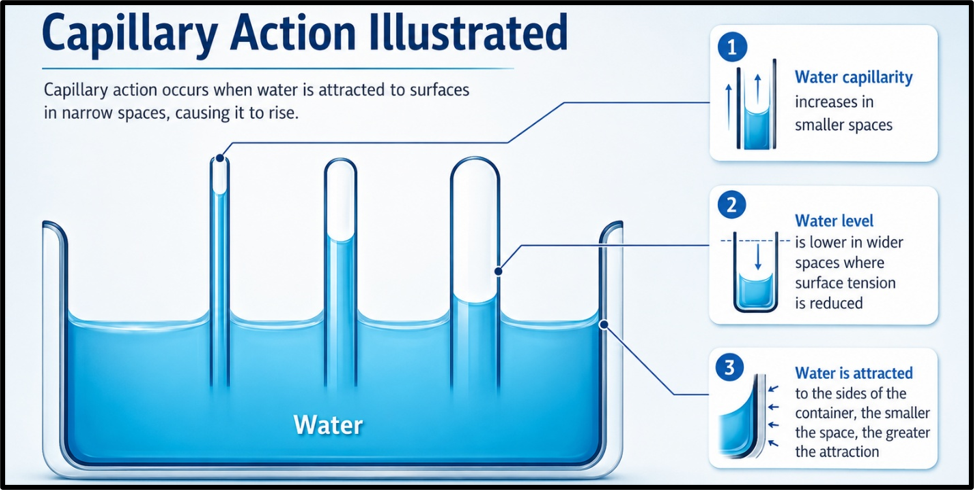
Capillarity is the ability of a liquid to flow in narrow spaces (capillary tubes) without any external force like gravity driving it. It results from the interplay of two forces:
- Adhesive forces: Attraction between the liquid molecules and the tube’s surface material.
- Cohesive forces: Attraction between the liquid molecules themselves.
| Type | When it occurs | Example |
| Capillary Rise | Adhesive forces > Cohesive forces → liquid climbs up the tube | Water rising in a thin glass capillary tube; ink rising in a pen |
| Capillary Fall | Cohesive forces > Adhesive forces → liquid is pushed down in the tube | Mercury in a glass tube (mercury cohesion is strong, it does not wet glass) |
Applications of capillarity: Plants transport water from roots to leaves through capillary action in xylem vessels; towels and sponges absorb water via wicking; soil moisture moves upward through capillary pores.
Viscosity
Pour honey and then water from the same height. Honey flows slowly, water rushes down. The property that creates this difference is viscosity — the internal friction of a fluid that resists its flow.
Viscosity arises from internal friction between adjacent layers of fluid moving at different velocities. Think of it as the ‘thickness’ or ‘stickiness’ of a fluid. High viscosity fluids (honey, syrup, tar) flow sluggishly; low viscosity fluids (water, alcohol, air) flow easily.
| Aspect | Liquids | Gases |
| Viscosity change with Temperature ↑ | Viscosity decreases (molecules move apart, less friction) | Viscosity increases (more molecular collisions at higher energy) |
Types of Viscosity:
- Dynamic (Absolute) Viscosity: Measures internal resistance to flow when an external force is applied. SI unit: Pascal-second (Pa·s) or Poise.
- Kinematic Viscosity: Ratio of dynamic viscosity to fluid density. Measures how quickly a fluid spreads under gravity. SI unit: m²/s or Stokes.
Types of Fluids based on Viscosity:
- Newtonian Fluids: Viscosity remains constant regardless of applied stress. Examples: water, air, most oils.
- Non-Newtonian Fluids: Viscosity changes with applied stress or flow rate. Examples: blood (shear-thinning), ketchup (becomes less viscous when shaken), quicksand, cornstarch mixture.
Flow of Fluids
When a fluid moves, it does so in two distinct modes depending on its speed and the geometry of the channel:
1. Laminar Flow (Steady Flow): The fluid moves in smooth, parallel layers with no mixing between layers. This is orderly, predictable flow seen at low velocities. Example: a gentle stream, blood flow in capillaries.
2. Turbulent Flow: The fluid moves chaotically with mixing, swirling, and eddies. This happens at high velocities or when flow encounters obstacles. Example: water flowing rapidly in a river, airflow over a blunt object.
Reynolds Number: A dimensionless number that predicts whether flow will be laminar or turbulent. Low Reynolds number → laminar; high Reynolds number → turbulent. Critical Velocity: The speed at which flow transitions from laminar to turbulent.
Bernoulli’s Theorem
Bernoulli’s Theorem is the crown jewel of fluid mechanics. It states:
“For an incompressible, non-viscous fluid flowing steadily along a streamline, the total mechanical energy — the sum of pressure energy, kinetic energy, and potential energy — remains constant at every point.”
Mathematically: P + ½ρv² + ρgh = constant
The critical insight: as the speed of a fluid increases, its pressure decreases — and vice versa. Nature is essentially trading pressure for speed and back.
| Application | How Bernoulli’s Theorem explains it |
| Aeroplane wings (Aerofoil) | The curved upper surface of a wing forces air to travel faster over it than below. Faster air → lower pressure on top. Higher pressure below → net upward lift force. |
| Venturi meter | A constriction in a pipe speeds up the fluid and drops its pressure. By measuring the pressure difference, the flow rate can be calculated. |
| Atomiser/Perfume spray | Air blown across a narrow tube creates low pressure at the top, drawing liquid up from the bottle. |
| Cricket ball swing | A rough side of the ball creates turbulence (low pressure); smooth side has laminar flow (higher pressure) → ball swings towards the rough side. |
Assumptions for Bernoulli’s Theorem:
- Incompressible fluid: density remains constant.
- Non-viscous fluid: no internal friction.
- Steady flow: velocity and pressure at any point do not change with time.
- Along a streamline: the equation applies only along one streamline at a time.
Torricelli’s Law
Torricelli’s Law is essentially Bernoulli’s Theorem applied to a tank with an opening. It states:
“The speed of a fluid flowing out of an opening in a tank is proportional to the square root of the vertical height of the fluid above the opening.”
v = √(2gh), where h is the height of fluid above the opening and g is acceleration due to gravity.
This means: the higher the water level in a tank, the faster the water exits. This principle is used in designing tanks, nozzles, drainage systems, and in calculating flow-discharge rates in hydraulic engineering.
Assumptions of Torricelli’s Law:
- The fluid is incompressible and ideal (no viscosity).
- Flow is steady.
- The opening is small compared to the tank’s cross-section.
- The tank is open to the atmosphere.
Ideal Gas and the Gas Laws
Gases are the most dynamic state of matter — their molecules are constantly in random, rapid motion, colliding with each other and with container walls.
To describe the behaviour of gases mathematically, scientists conceived the idea of an ‘Ideal Gas’ — a theoretical gas that behaves perfectly according to simple mathematical rules. Real gases approximate this ideal behaviour under conditions of high temperature and low pressure.
Characteristics of an Ideal Gas
- Negligible particle size: Gas molecules are treated as point particles — their actual volume is negligible compared to the space between them.
- No intermolecular forces: There are no attractive or repulsive forces between molecules — except during the instant of collision.
- Elastic collisions: All collisions between gas molecules and with container walls are perfectly elastic — no kinetic energy is lost.
- Constant random motion: Molecules move in all directions at various speeds.
The Ideal Gas Law
The Ideal Gas Law combines four earlier gas laws into one elegant equation:
PV = nRT
| Symbol | Quantity | Unit |
| P | Pressure of the gas | Pascal (Pa) |
| V | Volume of the gas | m³ |
| n | Number of moles of gas | mol |
| R | Universal Gas Constant | 8.314 J/(mol·K) |
| T | Absolute Temperature | Kelvin (K) |
Important: Real gases deviate from the Ideal Gas Law at high pressures and low temperatures — conditions where intermolecular forces and molecular volume become significant. The van der Waals equation corrects for these real-world deviations.
Boyle’s Law — Pressure and Volume
At constant temperature, the pressure of a given amount of gas is inversely proportional to its volume.
P ∝ 1/V (at constant T and n) → P₁V₁ = P₂V₂
Intuitive explanation: Squeeze a gas into a smaller space — the same molecules are now hitting a smaller wall area more frequently — so pressure rises.
Real-world examples:
- Breathing: During inhalation, the diaphragm contracts downward, increasing lung volume, reducing internal pressure below atmospheric pressure — so air rushes in. During exhalation, the reverse happens.
- Syringe: Pull the plunger outward → volume increases, pressure drops below atmospheric → fluid is drawn in.
Charles’s Law — Volume and Temperature
At constant pressure, the volume of a given amount of gas is directly proportional to its absolute temperature (in Kelvin).
V ∝ T (at constant P and n) → V₁/T₁ = V₂/T₂
Intuitive explanation: Heat a gas — the molecules move faster and hit the walls harder and more often — the gas expands to maintain the same pressure.
Real-world examples:
- Hot air balloon: Heating the air inside increases its volume and reduces its density, creating buoyancy — the balloon rises.
- Football in cold weather: In winter, the air inside contracts (volume decreases) and the ball feels deflated.
Gay-Lussac’s Law — Pressure and Temperature
At constant volume, the pressure of a given amount of gas is directly proportional to its absolute temperature.
P ∝ T (at constant V and n) → P₁/T₁ = P₂/T₂
Real-world examples:
- Car tyre pressure: On a hot summer day, the air inside the tyre heats up and expands, increasing tyre pressure — which is why manufacturers specify cold tyre pressure.
- Pressure cooker: Sealing the vessel at constant volume allows pressure to build as temperature rises, cooking food faster.
Avogadro’s Law — Volume and Amount of Gas
At constant temperature and pressure, the volume of a gas is directly proportional to the number of moles (amount) of gas present.
V ∝ n (at constant T and P) → V₁/n₁ = V₂/n₂
The deeper statement: Equal volumes of all gases, at the same temperature and pressure, contain the same number of molecules — regardless of the type of gas. This is profound: one litre of hydrogen and one litre of oxygen (at the same T and P) contain exactly the same number of molecules.
Real-world examples:
- Inflating a balloon: More air molecules (moles) pushed in → volume increases.
- Breathing: As you inhale more gas molecules, your lung volume increases.
Summary: The Gas Laws at a Glance
| Law | Constant Factors | Relationship | Formula | Real-Life Example |
| Boyle’s Law | T, n (Temperature & moles) | P ↑ → V ↓ (inversely proportional) | P₁V₁ = P₂V₂ | Syringe, breathing |
| Charles’s Law | P, n (Pressure & moles) | V ↑ → T ↑ (directly proportional) | V₁/T₁ = V₂/T₂ | Hot air balloon, deflated football |
| Gay-Lussac’s Law | V, n (Volume & moles) | P ↑ → T ↑ (directly proportional) | P₁/T₁ = P₂/T₂ | Car tyre, pressure cooker |
| Avogadro’s Law | T, P (Temp & Pressure) | V ↑ → n ↑ (directly proportional) | V₁/n₁ = V₂/n₂ | Inflating balloons, breathing |
| Ideal Gas Law | None (combines all laws) | PV = nRT | PV = nRT | Basis for all gas calculations |