
Waves and Electromagnetic Radiation
Think about this for a moment — when you drop a stone into still water, ripples spread outward in all directions. When you speak, your voice reaches the other person’s ear. When you switch on a light, the room is instantly illuminated. When your mobile phone rings — even in the middle of a vast empty field — it receives a signal. What do all these phenomena have in common?
They all involve WAVES. And in this section, we will understand waves so thoroughly that you will begin to see them everywhere around you.
Waves and its Types
A wave is a disturbance or oscillation that travels through space and matter, transferring energy from one point to another — without the transport of matter itself. This last part is crucial: the matter does not travel with the wave. Only the energy does.
Simple analogy: Imagine a stadium crowd doing a ‘Mexican Wave.’ Each person stands up and sits down in sequence. No one leaves their seat and moves around the stadium. Yet the wave travels from one end to the other perfectly. This is exactly how a wave works!
Key Properties of a Wave
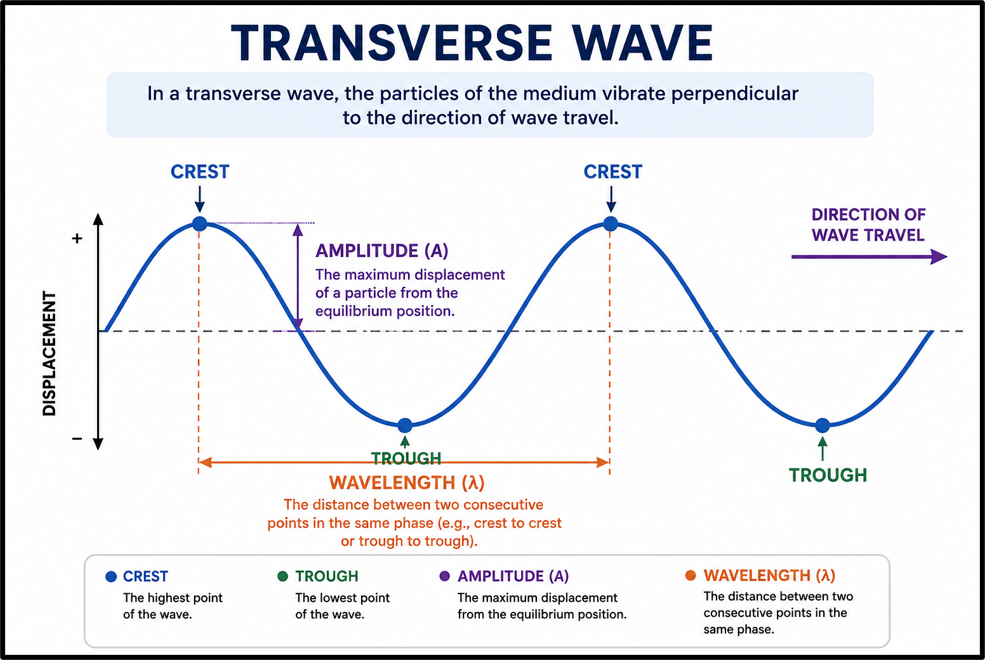
1. Wavelength (λ)
Wavelength is the distance between two consecutive points that are in the same phase of their oscillation — for example, from one crest (peak) to the next crest, or from one trough (valley) to the next. It is measured in metres (m).
2. Amplitude (A)
Amplitude is the maximum displacement of particles from their equilibrium (rest) position. Simply put, it is the ‘height’ of the wave. The greater the amplitude, the more energy the wave carries. A louder sound has greater amplitude than a softer sound — same concept.
3. Frequency (f)
Frequency is the number of complete waves (cycles) that pass a given point per second. It is measured in Hertz (Hz). Higher frequency means more waves per second — like a fast-moving ripple versus a slow ocean wave.
Frequency = Velocity / Wavelength
Frequency = 1 / Time Period
4. Time Period (T)
The time period is the time taken to complete one full oscillation or cycle. It is the inverse of frequency — if frequency is high, time period is small, and vice versa. Measured in seconds.
Time Period = 1 / Frequency
5. Wave Velocity (v)
Wave velocity is the distance travelled by the wave per unit time — essentially, how fast the wave moves through a medium. Measured in metres per second (m/s).
Wave Velocity = Wavelength × Frequency
Wave Properties at a Glance
| Property | Symbol | Unit / Formula |
| Wavelength | λ (lambda) | Metres (m) |
| Amplitude | A | Metres (m) |
| Frequency | f | Hertz (Hz) | f = v/λ = 1/T |
| Time Period | T | Seconds (s) | T = 1/f |
| Wave Velocity | v | m/s | v = λ × f |
Types of Waves: Mechanical vs. Electromagnetic
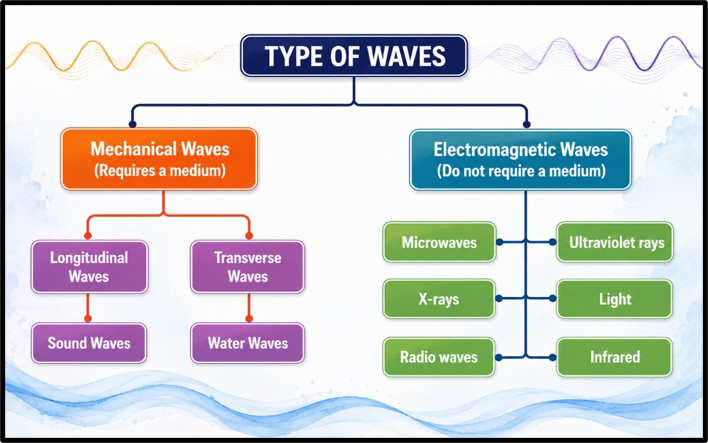
All waves can be broadly classified into two major categories: Mechanical Waves and Electromagnetic Waves. Understanding their differences is fundamental.
A. Mechanical Waves
Mechanical waves are disturbances that travel through a material medium — a solid, liquid, or gas — by the oscillation of particles within that medium. The key word here is ‘medium’: without a medium, a mechanical wave simply cannot exist.
Think of it this way: a mechanical wave is like a message passed through a chain of people holding hands. Each person nudges the next, but no one leaves their spot. Remove the people (the medium), and the message cannot pass at all.
Characteristics of Mechanical Waves:
- Medium Requirement: Mechanical waves cannot exist in a vacuum. They require a material medium (e.g., air, water, steel).
- Energy Transfer: They transfer energy from one point to another without any net movement of the medium’s particles. The particles simply oscillate around their equilibrium positions.
- Restoring Force: The disturbed particles return to equilibrium due to the elasticity of the medium.
- Examples: Sound waves (travel through air) and Seismic waves (travel through Earth’s interior).
B. Electromagnetic Waves
Electromagnetic (EM) waves are fundamentally different from mechanical waves — they do not require any medium to travel. They can propagate through a complete vacuum (empty space). This is why sunlight can reach us from the Sun across 150 million kilometres of empty space!
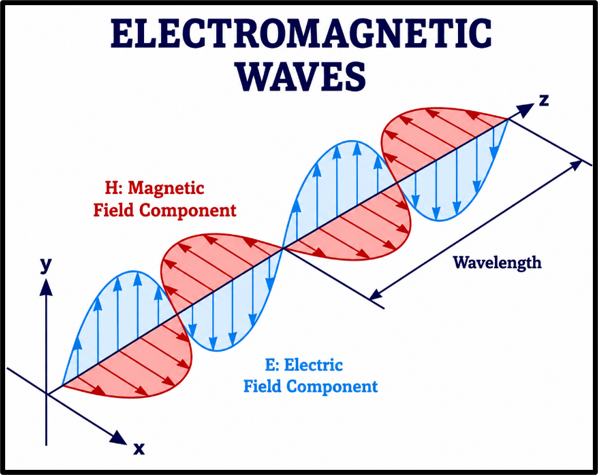
An EM wave consists of oscillating electric and magnetic fields that are perpendicular to each other AND perpendicular to the direction of wave propagation. This self-sustaining oscillation is what allows EM waves to travel without any medium.
Characteristics of Electromagnetic Waves:
- No Medium Required: They can travel through empty space (vacuum) — unlike mechanical waves.
- Self-Propagation: The oscillating electric field generates a magnetic field and vice versa, enabling continuous self-sustaining propagation.
- Constant Speed in Vacuum: In a vacuum, ALL electromagnetic waves travel at the speed of light = 3 × 10⁸ m/s (approximately 300,000 km/s).
- Energy and Momentum Transfer: EM waves carry energy and momentum, which can be transferred to objects upon interaction.
- Examples: Light waves, Radio waves, X-rays, Microwaves, Gamma rays.
Mechanical vs. Electromagnetic Waves — Head-to-Head Comparison
| Feature | Mechanical Waves | Electromagnetic Waves |
| Medium Required? | Yes — solid, liquid, or gas | No — can travel in vacuum |
| Nature | Oscillation of medium particles | Oscillating electric & magnetic fields |
| Speed in Vacuum | Cannot travel in vacuum | 3 × 10⁸ m/s (speed of light) |
| Examples | Sound waves, Seismic waves | Light, Radio, X-rays, Microwaves |
| Energy Transfer | Through particle interaction | Through oscillating EM fields |
| Can travel in space? | No | Yes |
Types of Mechanical Waves
Mechanical waves are further divided into two types based on how the particles of the medium oscillate relative to the direction the wave travels: Transverse Waves and Longitudinal Waves.
A. Transverse Waves
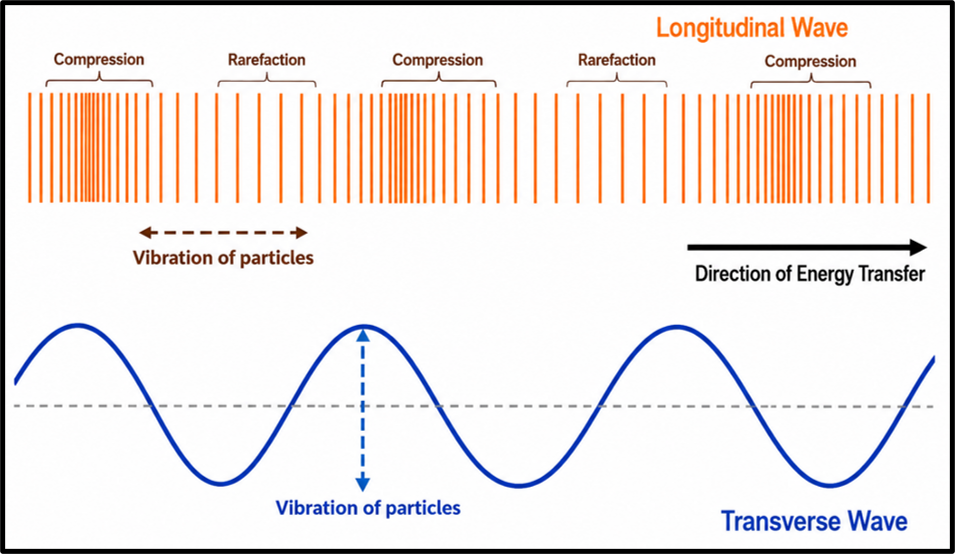
In transverse waves, the particles of the medium oscillate perpendicular (at 90°) to the direction of wave propagation. Imagine shaking one end of a stretched rope up and down — the wave travels horizontally along the rope, but the rope itself moves up and down.
Key features of Transverse Waves:
- Crest: The highest point of the wave (maximum positive displacement).
- Trough: The lowest point of the wave (maximum negative displacement).
- Examples: Waves on a string or guitar string, waves on water surface, and seismic S-waves (Secondary waves).
B. Longitudinal Waves
In longitudinal waves, the particles of the medium oscillate parallel to the direction of wave propagation — they move back and forth in the same direction the wave is travelling. Sound waves in air are the classic example.
Imagine a Slinky spring laid on a table. If you push and pull one end back and forth, you will see regions where the coils are compressed (squeezed together) and regions where they are stretched apart. The wave travels along the Slinky, but the coils only move backward and forward.
Key features of Longitudinal Waves:
- Compressions: Regions where the particles are close together (high pressure zones).
- Rarefactions: Regions where the particles are spread apart (low pressure zones).
- Examples: Sound waves in air and seismic P-waves (Primary waves).
| Seismic Waves (Earthquake Waves) P-waves (Primary waves) = Longitudinal waves — travel through solids, liquids, and gases. They arrive FIRST during an earthquake. S-waves (Secondary waves) = Transverse waves — travel only through solids. They arrive SECOND. The fact that S-waves cannot pass through Earth’s outer core helped scientists conclude that the outer core is liquid! |
The Electromagnetic Spectrum
The Electromagnetic Spectrum is the complete range of all electromagnetic waves arranged in order of their wavelengths and frequencies. From the longest wavelength to the shortest, the spectrum goes: Radio Waves → Microwaves → Infrared → Visible Light → Ultraviolet → X-Rays → Gamma Rays.
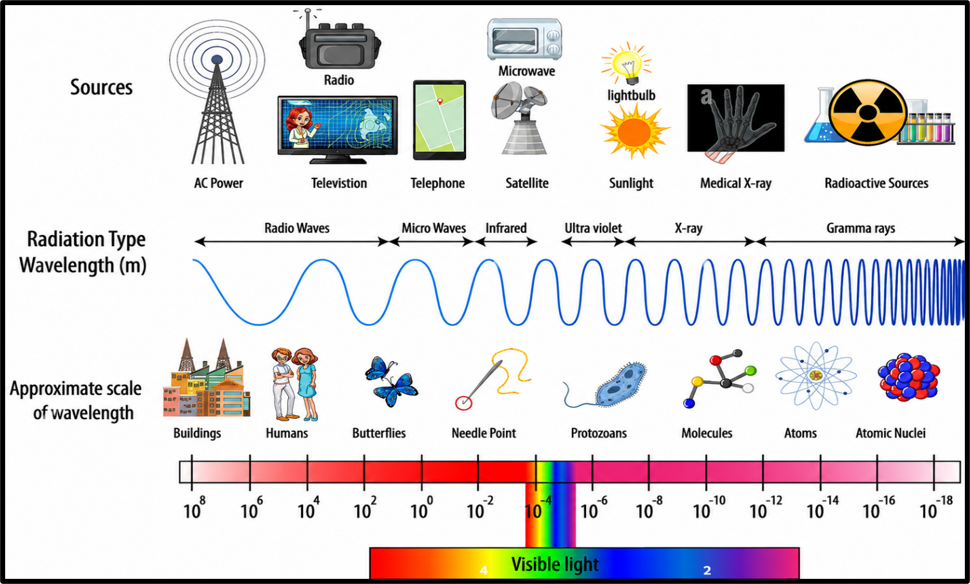
A simple mnemonic to remember this order:
‘Raging Martians Invaded Venus Using X-ray Guns’ — Radio, Microwave, Infrared, Visible, Ultraviolet, X-ray, Gamma!
Radio Waves
Wavelength: 1 mm to 100 km | Frequency: < 300 GHz | Energy: Lowest among all EM waves
Radio waves are the longest-wavelength electromagnetic waves in the entire electromagnetic spectrum. Their low energy and long wavelength allow them to travel vast distances and even pass through walls and buildings — which is why your FM radio works inside your home!
Applications:
- Communication: Radio and television broadcasting, cellular phone networks, Wi-Fi, Bluetooth, GPS navigation, and satellite communication.
- Radar (Radio Detection and Ranging): Used for navigation, weather tracking, and air traffic control. Radar sends out radio waves and detects the reflections to locate objects.
- Medical Imaging: Magnetic Resonance Imaging (MRI) — a powerful diagnostic tool that uses radio waves in conjunction with strong magnetic fields.
Advantages & Limitations:
Advantage:
- Can travel long distances and penetrate buildings — ideal for broadcasting.
- Easy to produce and detect using antennas.
Limitation:
- Subject to interference from other electronic devices.
- Limited bandwidth compared to higher-frequency waves — cannot carry as much data.
Microwaves
Wavelength: 1 mm to 1 m | Frequency: 300 MHz to 300 GHz | Energy: Higher than Radio Waves
Microwaves have shorter wavelengths and higher frequencies than radio waves. Despite their name, they are not necessarily ‘micro’ — their wavelengths can range from 1 mm to 1 metre. The famous household microwave oven is named after them.
How does a microwave oven work? Microwaves cause water molecules in food to vibrate rapidly, generating heat through friction. Since most food contains water, this heats food very efficiently from the inside out.
Applications:
- Communication: Satellite communication, mobile phone networks, Wi-Fi, and television broadcasting all use microwaves.
- Cooking: Microwave ovens heat food by agitating water molecules using microwave radiation.
- Radar Technology: Used for weather forecasting, air traffic control, and speed-detection radars (as used by traffic police).
- Medical Applications: Microwave therapy for targeted cancer treatment (microwave ablation).
Advantages & Limitations:
Advantage
- Can carry large volumes of data over long distances.
- Highly directional — allows focused, point-to-point communication.
- Less susceptible to interference than radio waves.
Limitation
- Can be blocked by large physical obstacles.
- Affected by weather conditions such as heavy rainfall — known as ‘rain fade’.
Infrared Waves (IR)
Wavelength: 700 nm to 1 mm | Frequency: 300 GHz to 430 THz | Energy: Higher than Microwaves
Infrared waves lie just beyond the red end of visible light — ‘infra’ means below, and these waves are just below red in terms of frequency.
Every object with a temperature above absolute zero (-273.15°C) emits infrared radiation. This is why infrared cameras can detect human bodies at night — our body heat radiates as IR!
Applications:
- Thermal Imaging: Night-vision cameras used by military and security forces detect IR radiation emitted by humans and animals in the dark.
- Remote Controls: TV remotes and AC remotes use infrared pulses to transmit signals to the device.
- Optical Fibre Communication: Infrared light is used in optical fibre cables to carry data over long distances.
- Heating: Infrared heaters, lamps, and dryers are used in homes and industries.
- Medical Use: Infrared therapy helps in muscle relaxation and pain relief.
- Food Processing: Used for drying and cooking food in industrial settings.
Advantages & Limitations:
Advantage
- Can penetrate smoke, fog, and thin layers of material — useful in firefighting and security.
- Efficient in heat-based energy transfer applications.
Limitation
- Limited to short-range communication (remote controls work only a few metres).
- Absorbed by water vapour in air, reducing effectiveness in humid conditions.
Visible Light
Wavelength: 380 nm to 700 nm | Frequency: 430 THz to 770 THz | Energy: Moderate
Visible light is the only portion of the electromagnetic spectrum that the human eye can detect. It enables us to see the world around us and forms the basis of all human vision. Within visible light, different wavelengths correspond to different colours.
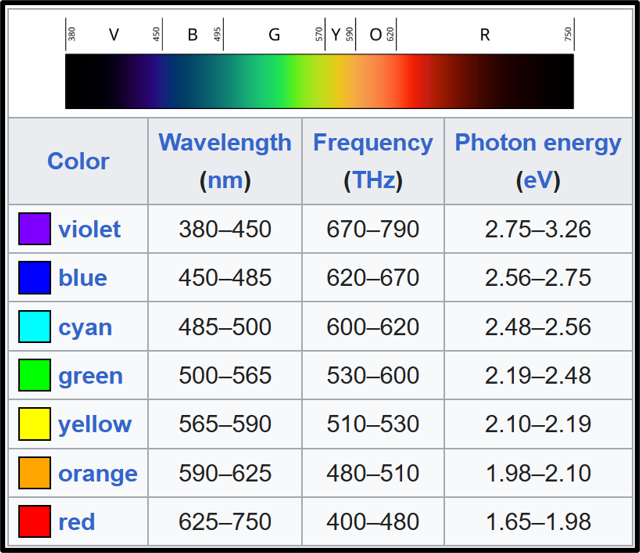
The visible spectrum consists of seven colours: VIBGYOR in reverse — Red (longest wavelength, lowest energy), Orange, Yellow, Green, Blue, Indigo, and Violet (shortest wavelength, highest energy). This is why violet light is more harmful to our eyes than red light.
Applications:
- Vision: Enables humans and animals to see the world.
- Photosynthesis: Plants use visible light (especially red and blue wavelengths) to synthesise food.
- Illumination: Used for lighting homes, streets, and workplaces.
- Optical Fibre Communication: Visible light signals transmit data through glass fibres at very high speeds.
- Photography and Entertainment: Essential in cameras, projectors, cinema screens, and visual displays.
- Medical Applications: Used in endoscopy, microscopy, and laser surgeries (e.g., LASIK eye surgery).
Ultraviolet Waves (UV)
Wavelength: 10 nm to 400 nm | Frequency: 7.5×10¹⁴ Hz to 3×10¹⁶ Hz | Energy: Higher than Visible Light
Ultraviolet waves are invisible to the human eye — they lie just beyond the violet end of the visible spectrum. ‘Ultra’ means beyond. UV waves carry significantly higher energy than visible light, which makes them useful for sterilisation but also harmful in excess exposure.
Applications:
- Medical Use: UVC radiation is used to sterilise medical equipment and surgical rooms by killing bacteria and viruses. UV light is also used to treat skin conditions like psoriasis.
- Disinfection: UV-based water purification systems are increasingly common in hospitals and homes.
- Forensics: UV light reveals fingerprints and body fluids that are invisible under normal light — essential in crime scene investigation.
- Industrial Uses: Used for curing (hardening) inks, adhesives, and coatings in manufacturing.
Types of UV Radiation — UVA, UVB, and UVC:
| Feature | UVA (Longwave) | UVB (Midwave) | UVC (Shortwave) |
| Wavelength Range | 315–400 nm | 280–315 nm | 100–280 nm |
| Energy Level | Lowest | Moderate | Highest |
| Penetration | Deep into skin layers | Outer skin layers | Absorbed by atmosphere |
| Effects on Skin | Ageing, wrinkles, indirect DNA damage | Sunburn, direct DNA damage, skin cancer | Highly harmful if exposure occurs |
| % reaching Earth | ~95% of UV from Sun | ~5% of UV from Sun | 0% — completely absorbed |
| Ozone Absorption | Not absorbed | Partially absorbed | Completely absorbed |
| Beneficial Effect | Stimulates pigment production | Vitamin D synthesis in skin | Sterilisation & disinfection |
| Protection Needed | Broad-spectrum sunscreen, clothing | Sunscreen, hats, shade | Controlled environments only |
X-Rays
Wavelength: 0.01 nm to 10 nm | Energy: Very High — can penetrate most materials
X-rays were discovered by Wilhelm Röntgen in 1895 — a landmark moment in the history of science. Their ability to penetrate soft tissue but be absorbed by denser materials like bone makes them invaluable in medicine. When you get an X-ray at a hospital, you’re seeing the bones because they absorb more X-rays than the surrounding soft tissue.
Applications:
- Medical Imaging: X-ray radiography diagnoses fractures, infections, and tumours. CT (Computed Tomography) scans use X-rays to create detailed cross-sectional images of the body.
- Industrial Use: Inspecting welds, detecting material flaws, and security screening at airports (luggage scanners).
- Scientific Research: X-ray crystallography studies atomic and molecular structures — it was this technique that helped determine the double helix structure of DNA!
- Art Restoration: X-rays detect hidden layers in paintings, helping authenticate and restore artworks.
Advantage & Limitation:
Advantage: Non-invasive imaging of internal body structures without surgery.
Limitation: Overexposure causes tissue damage and increases cancer risk. Lead aprons and shields are used as protection during medical X-rays.
Gamma Rays (γ-rays)
Wavelength: < 10⁻¹² m | Energy: HIGHEST among all EM waves — most energetic radiation known
Gamma rays are at the extreme end of the electromagnetic spectrum — the most energetic, shortest wavelength, and highest frequency. They originate from nuclear reactions and some of the most violent events in the universe. Their penetrating power is extraordinary — they can pass through metres of concrete and several centimetres of lead!
Sources of Gamma Rays:
- Radioactive Decay: e.g., gamma decay from radioactive isotopes like Cobalt-60.
- Nuclear Reactions: Both nuclear fission and nuclear fusion release gamma rays.
- Cosmic Phenomena: Supernovae explosions, black hole mergers, and gamma-ray bursts in space.
Applications:
- Medical Use: Radiation therapy uses gamma rays to target and destroy cancer cells (Gamma Knife surgery). PET (Positron Emission Tomography) scans also use gamma-ray detection for diagnostic imaging.
- Industrial Use: Non-destructive inspection of welds and structural integrity in buildings and pipelines.
- Sterilisation: Sterilising medical equipment (e.g., syringes, surgical tools) and food preservation using gamma irradiation.
- Scientific Research: Radioactive dating (carbon dating), analysis of radioactive isotopes.
Advantage & Limitation:
Advantage: Unmatched penetrating power — can pass through almost any material, including human tissue.
Limitation: Extremely dangerous. Can cause cell mutations, increased cancer risk, acute radiation sickness, severe tissue damage, and even death at high doses. Requires lead or thick concrete shielding for protection.
Master Comparison: The Complete Electromagnetic Spectrum
This table is your one-stop reference for all EM waves — study it carefully.
| Feature | Radio Waves | Microwaves | Infrared | Visible Light | UV Rays | X-Rays | Gamma Rays |
| Wavelength | 1 mm–100 km | 1 mm–1 m | 700 nm–1 mm | 380–700 nm | 10–400 nm | 0.01–10 nm | < 0.01 nm |
| Frequency | < 300 GHz | 300 MHz–300 GHz | 300 GHz–430 THz | 430–770 THz | 750 THz–30 PHz | 30 PHz–30 EHz | > 30 EHz |
| Energy | Lowest | Low | Moderate | Moderate | High | Very High | Highest |
| Penetration | Very low | Low | Low | Visible to eye | Moderate | High | Very high |
| Key Application | Broadcast, GPS, MRI | Cooking, Radar, Mobile | Remote controls, Night vision | Vision, Photography | Sterilisation, Vitamin D | Medical imaging, Security | Cancer therapy, Sterilisation |
| Effect on Humans | Minimal | Tissue heating | Skin warming, burns | Enables vision | Sunburn, DNA damage | Cell damage, cancer risk | Radiation sickness, death |
| Protection | None needed | Insulation, distance | Insulation, shielding | None needed | Sunscreen, clothing | Lead shielding | Lead + thick concrete |
Key Takeaways
- Waves transfer ENERGY, not matter — always remember this fundamental definition.
- Mechanical waves need a medium; EM waves do not — this distinction is frequently tested.
- All EM waves travel at the speed of light (3 × 10⁸ m/s) in a vacuum.
- The order of the EM spectrum from longest to shortest wavelength: Radio → Microwave → Infrared → Visible → UV → X-ray → Gamma.
- Higher frequency = shorter wavelength = more energy — this inverse relationship is key.
- Ozone layer absorbs UVC completely, UVB partially, UVA not at all.
- MRI uses radio waves, NOT X-rays — a common confusion in exams.
- VLC (Visible Light Communication / Li-Fi) is short-range, high-bandwidth, and has no electromagnetic interference.
- Gamma rays come from nuclear decay and cosmic events — used in cancer therapy and sterilisation.
- Seismic P-waves are longitudinal; S-waves are transverse — and S-waves cannot travel through Earth’s liquid outer core.
One Comment