
Chemical Bonding and Chemical Reactions
Let us begin with a very fundamental question: why do atoms combine with each other at all? Think of it this way — every atom in nature, just like every human being, has one deep desire: to be stable.
An atom achieves this stability by either gaining, losing, or sharing electrons to fill up its outermost shell. This act of electrons coming together and creating a force between atoms is what we call a Chemical Bond.
Simply put, a chemical bond is the force that holds two or more atoms together in a molecule or compound.
| ⭐ Note |
| Chemical bonding is foundational to understanding all of chemistry — from how medicines work to how metals conduct electricity. |
Types of Chemical Bonds
Now that we know why atoms bond, let’s understand how they bond. Nature has given atoms four main strategies to achieve stability, and each strategy gives rise to a different type of bond.
Think of these as four different ways people cooperate — sometimes they share, sometimes one person gives completely, and sometimes they rely on a common pool.
(a) Covalent Bond — The Great Sharing
Imagine two friends who are equally poor — neither can give anything to the other, but together they can share. That is exactly how a Covalent Bond works!
When two non-metal atoms — both of which need electrons — come together, neither is willing to donate electrons permanently. So they reach a compromise: they share one or more pairs of electrons.
This shared pair is counted in the outermost shell of both atoms simultaneously, making both feel satisfied.
Key Properties of Covalent Bonds:
- Formed exclusively between non-metals (e.g., H₂, O₂, N₂, H₂O, CO₂).
- They can be single (one shared pair), double (two pairs), or triple (three pairs) bonds depending on how many electron pairs are shared.
- They have lower melting and boiling points than ionic compounds — the molecules are held together by relatively weak intermolecular forces.
- They are generally poor conductors of electricity in their solid state because there are no free-moving ions.
| 💡 Analogy |
| Water (H₂O) is the most classic covalent molecule. The oxygen atom shares one electron pair with each of the two hydrogen atoms. This sharing is what makes water a liquid at room temperature — without covalent bonds, there would be no water on Earth! |
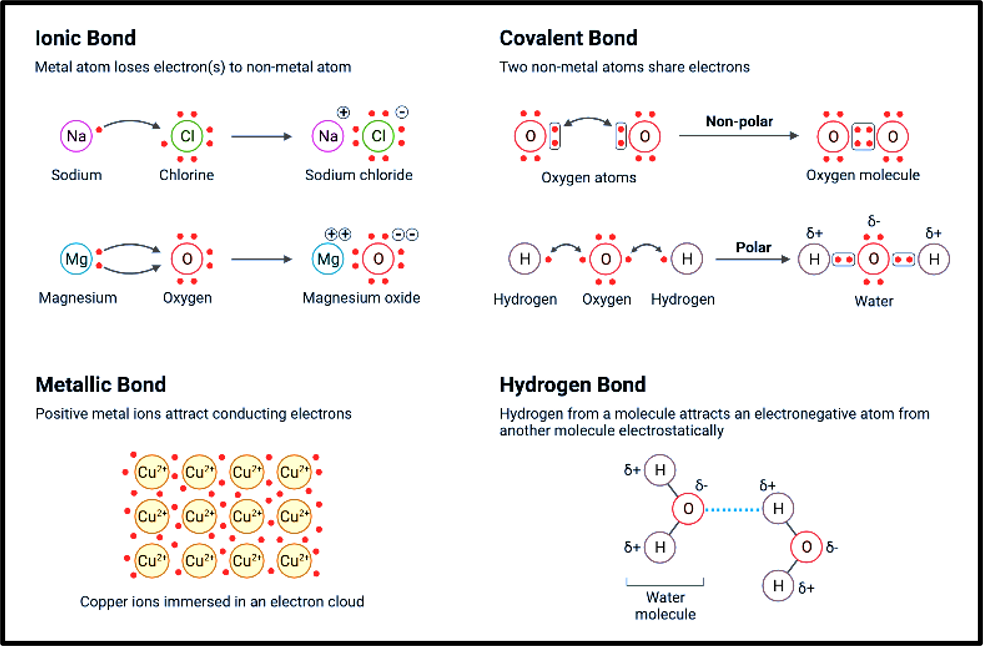
(b) Ionic Bond — The Transfer Game
Now imagine a scenario where one person is extremely rich (has extra electrons it desperately wants to give away) and the other is extremely needy (urgently needs electrons). This is the story of a metal and a non-metal.
The metal donates electrons to the non-metal, and in doing so, the metal becomes a positively charged ion (called a Cation) while the non-metal becomes a negatively charged ion (called an Anion).
These opposite charges attract each other powerfully — this electrostatic force of attraction is called an Ionic Bond.
Key Properties of Ionic Bonds:
- Formed between a metal and a non-metal (e.g., NaCl — common table salt, MgO — magnesium oxide).
- They have very high melting and boiling points because enormous energy is needed to break the strong electrostatic forces between ions.
- They dissolve in water easily — water molecules pull apart the ions.
- They are excellent conductors of electricity in solution or molten state because the ions are free to move and carry charge.
| 💡 Think About This |
| Every time you add salt to your food, you are handling an ionic compound — NaCl. Sodium (a metal) gave one electron to Chlorine (a non-metal). The result? A stable, crystalline, white compound that dissolves in water and conducts electricity in solution. This is ionic bonding in your kitchen! |
(c) Metallic Bond — The Sea of Electrons
Now imagine a hostel where students (electrons) are free to roam across all the rooms at will, and the rooms (metal ions with positive charge) remain fixed. This is almost exactly how a Metallic Bond works.
In metals, the outer electrons are so loosely held that they detach from individual atoms and form a “sea” of delocalised electrons that flow freely throughout the metallic structure.
The positive metal ions are embedded in this electron sea, and the attraction between the ions and the sea of electrons holds the metal together.
Key Properties of Metallic Bonds:
- Metals are excellent conductors of heat and electricity — the free-flowing electrons can carry energy rapidly.
- Metals are malleable (can be hammered into sheets) and ductile (can be drawn into wires) — the layers of ions can slide over each other while the electron sea maintains cohesion.
- They have high melting points because the metallic bond is strong (e.g., Iron, Copper).
(d) Hydrogen Bond — The Weak but Vital Connection
This is the most underestimated bond in chemistry, yet perhaps the most important one for life.
A Hydrogen Bond forms when a hydrogen atom, already covalently bonded to a highly electronegative atom (like Oxygen or Nitrogen), gets attracted to another electronegative atom nearby.
The electronegative atom pulls the shared electrons towards itself, leaving the hydrogen slightly positively charged (δ+). This partial positive hydrogen then attracts a nearby electronegative atom. It’s not a full bond — it’s more like a gentle, persistent pull.
Key Properties of Hydrogen Bonds:
- They are much weaker than covalent or ionic bonds, yet they are crucial in determining the structure and behaviour of many substances.
- They are responsible for water’s high surface tension, high boiling point, and its ability to act as a solvent — properties that make life on Earth possible.
- Hydrogen bonds are responsible for the double helix structure of DNA and the three-dimensional folding of proteins — both fundamental to life.
| 🔬 Why Hydrogen Bonds Matter |
| Hydrogen bonds explain why: (1) Ice floats on water (density anomaly), (2) Water has an unusually high boiling point for its molecular size, (3) DNA can replicate — the two strands held by hydrogen bonds can be ‘unzipped’ gently. |
Comparison of All Four Chemical Bonds
| Feature | Covalent Bond | Ionic Bond | Metallic Bond | Hydrogen Bond |
|---|---|---|---|---|
| Type of Atoms | Nonmetals | Metal + Nonmetal | Metal atoms only | H + Electronegative atom |
| Electron Movement | Shared between atoms | Transferred (donor → acceptor) | Delocalised / free electrons | Attraction between H and electroneg. atom |
| Bond Strength | Moderate to Strong | Strong | Moderate to Strong | Weak |
| Conductivity | Poor (solid state) | Good (solution/molten) | Excellent (solid state) | None |
| Melting Point | Low to Moderate | High | High | Low |
| Examples | H₂, O₂, N₂, H₂O | NaCl, MgO | Fe, Cu, Na | H₂O, DNA, Proteins |
Valency — The Combining Capacity of Atoms
Every atom has a certain capacity to combine with other atoms — just like how a specific plug fits only a specific socket. This combining capacity is called Valency.
More precisely, valency is the number of electrons an atom can gain, lose, or share in order to achieve the stable configuration in its outermost shell (like a noble gas).
Hydrogen, being the simplest element, is used as the standard reference — its valency is 1.
Characteristics of Valency:
- It is determined by the number of electrons in the outermost shell (valence shell). Atoms with 1–4 electrons usually lose electrons (positive valency); atoms with 5–7 electrons usually gain electrons (negative valency).
- Atoms strive to achieve a full outer shell — typically 8 electrons (the Octet rule) or 2 in the case of hydrogen and helium.
- Positive Valency: When an atom loses electrons (e.g., Na⁺ has a valency of +1).
- Negative Valency: When an atom gains electrons (e.g., Cl⁻ has a valency of −1).
| 📌 Significance |
| Valency is the key to predicting chemical formulas. Oxygen has valency 2, Hydrogen has valency 1 — so water is H₂O (two hydrogen atoms for one oxygen). This cross-multiplication method is a basic tool for writing formulas, and you are expected to know common valencies of elements. |
The Octet Rule — The Driving Force Behind All Bonding
Here is the single most important principle that explains why atoms bond at all. It is called the Octet Rule.
It simply states that atoms tend to gain, lose, or share electrons in order to have 8 electrons in their valence (outermost) shell — exactly like the electron configuration of noble gases such as Helium, Neon, and Argon.
Noble gases are chemically inert (they don’t react) precisely because they already have a full outer shell. All other atoms are trying to achieve this very state of completeness.
However, there are important exceptions to note:
- Incomplete Octet: Hydrogen (H), Helium (He), Lithium (Li), and Beryllium (Be) are stable with fewer than 8 electrons — H and He are satisfied with just 2 electrons.
- Despite these exceptions, the Octet Rule is the foundational principle explaining the chemical behaviour of the vast majority of elements.
Chemical Formula — The Language of Chemistry
Just as every language has its own script, chemistry has its own writing system — the Chemical Formula.
A chemical formula is a concise, symbolic representation of a chemical compound that tells us exactly which elements are present and in what proportions.
It uses element symbols (like H for Hydrogen, O for Oxygen, Na for Sodium) and subscripts (small numbers written below and to the right) to indicate the number of atoms.
For example, H₂O tells us that one molecule of water contains 2 Hydrogen atoms and 1 Oxygen atom.
Three Types of Chemical Formulas:
| Type | What It Shows | Example (Glucose) |
| Empirical Formula | Simplest whole-number ratio of atoms | CH₂O |
| Molecular Formula | Actual number of each atom in one molecule | C₆H₁₂O₆ |
| Structural Formula | Arrangement of atoms and bonds in a molecule | Shows each C–C, C–H, O–H bond |
Chemical Reactions — When Old Bonds Break and New Ones Form
A Chemical Reaction is one of the most fascinating events in nature. It is a process in which one or more substances — called Reactants — are transformed into entirely new substances — called Products.
The critical insight here is that atoms are not created or destroyed; they are merely rearranged. Old bonds between atoms are broken, and new bonds are formed.
Think of it like breaking up a Lego structure and building something completely new from the same bricks.
Key Characteristics of Chemical Reactions:
- Formation of New Substances: Products have properties different from reactants.
- Energy Changes: Reactions either release energy (Exothermic) or absorb energy (Endothermic). Combustion is exothermic; photosynthesis is endothermic.
- Rearrangement of Atoms: Atoms are neither created nor destroyed — this is the Law of Conservation of Mass.
- Observable Changes: Colour change, temperature change, gas formation, precipitate formation, or light emission.
A chemical reaction is represented symbolically by a Chemical Equation, with reactants on the left and products on the right, separated by an arrow (→) indicating the direction of the reaction:
Reactants ──[Conditions]──→ Products
| ⚖️ Balancing Chemical Equations |
| According to the Law of Conservation of Mass, a chemical equation MUST have an equal number of atoms of each element on both sides. This process is called ‘balancing’. For example: 2H₂ + O₂ → 2H₂O is balanced (4H and 2O on each side). An unbalanced equation is chemically invalid. |
Types of Chemical Reactions — The Eight Fundamental Patterns
Nature follows patterns — and chemical reactions are no exception. Based on how reactants transform into products, we can categorise reactions into distinct types. Understanding these types is not just academic; they explain everyday phenomena from rusting iron to baking bread to burning fuel.
1. Combination (Synthesis) Reaction — Two Become One
Think of a marriage — two separate individuals (or more) come together to form one new entity. That’s exactly what happens here: two or more reactants combine to form a single product.
General form: A + B → AB
Example: 2H₂ + O₂ → 2H₂O (Hydrogen and Oxygen combine to form Water)
2. Decomposition Reaction — One Breaks into Many
The exact reverse of combination. Here, a single compound breaks down into two or more simpler substances. It usually requires energy input — heat, light, or electricity.
General form: AB → A + B
Example: 2H₂O → 2H₂ + O₂ (Water decomposes into Hydrogen and Oxygen when electricity is passed — electrolysis)
3. Displacement (Substitution) Reaction — The Outsider Takes Over
Imagine a more reactive element kicking out a less reactive one from its compound — like a stronger competitor taking someone’s place. That’s displacement. A more reactive element replaces a less reactive one in a compound.
General form: A + BC → AC + B
Example: Zn + CuSO₄ → ZnSO₄ + Cu (Zinc is more reactive than Copper and displaces it)
4. Double Displacement (Metathesis) Reaction — The Great Exchange
Here two compounds simultaneously exchange their ions — like two couples at a dance exchanging partners. The result is two new compounds.
General form: AB + CD → AD + CB
Example: NaCl + AgNO₃ → NaNO₃ + AgCl ↓ (Silver Chloride precipitates out as a white solid)
5. Combustion Reaction — The Energy Releaser
This is the reaction that drives most of our energy systems — from cars to kitchens. A substance reacts with Oxygen (usually at high temperature), releasing heat and light energy. Hydrocarbons are the most common fuels in combustion reactions.
General form: Hydrocarbon + O₂ → CO₂ + H₂O + Energy
Example: CH₄ + 2O₂ → CO₂ + 2H₂O (Combustion of Methane — LPG cooking gas)
6. Redox (Oxidation-Reduction) Reaction — The Electron Transfer Duo
This is one of the most important reaction types.
In a Redox Reaction, electrons are transferred between substances. One substance loses electrons (is Oxidised) while the other gains electrons (is Reduced).
The key memory trick:
“OIL RIG” — Oxidation Is Loss (of electrons), Reduction Is Gain (of electrons).
Example: 2Mg + O₂ → 2MgO (Magnesium is Oxidised; Oxygen is Reduced)
7. Neutralisation Reaction — Acid Meets Base
When an Acid and a Base are mixed together, they cancel each other out — producing a Salt and Water. This is called Neutralisation, and it perfectly captures nature’s tendency to seek balance.
General form: Acid + Base → Salt + Water
Example: HCl + NaOH → NaCl + H₂O (This is exactly what happens when you take an antacid — the base neutralises the stomach acid)
8. Precipitation Reaction — The Solid Surprise
Two soluble salts are mixed in solution, and their ions combine to form an insoluble solid called a Precipitate, which falls to the bottom of the solution. This is widely used in analytical chemistry to identify ions.
Example: BaCl₂ + Na₂SO₄ → BaSO₄↓ + 2NaCl (White precipitate of Barium Sulfate forms)
Endothermic vs. Exothermic Reactions
| Feature | Endothermic | Exothermic |
| Energy Direction | Absorbs energy from surroundings | Releases energy to surroundings |
| Temperature of surroundings | Decreases (feels cold) | Increases (feels hot) |
| Example | Photosynthesis: 6CO₂ + 6H₂O + energy → C₆H₁₂O₆ + 6O₂ | Combustion: CH₄ + 2O₂ → CO₂ + 2H₂O + energy |
Reversible vs. Irreversible Reactions
- Reversible Reaction: Products can reform into reactants. The reaction proceeds in both directions, shown by ⇌. Example: 2H₂ + O₂ ⇌ 2H₂O
- Irreversible Reaction: Products cannot reform into reactants; the reaction proceeds in one direction only. Example: Combustion of wood.
Factors Affecting Chemical Reactions — Why Some React Faster
Have you ever wondered why food spoils faster in summer than in winter? Or why a powdered medicine dissolves faster than a tablet? The answer lies in the factors that govern the rate of chemical reactions. Understanding these factors is crucial — they explain industrial processes, environmental changes, and biological phenomena.
| Factor | How It Affects Rate | Real-World Example |
| Nature of Reactants | Ionic compounds react faster in solution than covalent ones (ionic bonds break easily) | Acids dissolve metals quickly |
| Temperature | Higher temp → more energy → more frequent, energetic collisions → faster rate (Arrhenius equation) | Food spoils faster in summer |
| Concentration | More reactant particles → more collisions → faster reaction | Concentrated acid reacts faster with metal than dilute acid |
| Pressure (gases) | Higher pressure → gas molecules closer → more collisions → faster reaction | Ammonia synthesis faster at high pressure |
| Surface Area | Smaller particles → larger exposed area → faster reaction | Powdered catalyst works better than solid lump |
| Catalysts | Lower activation energy → faster reaction (catalyst unchanged) | Enzymes speed up digestion in our bodies |
| Nature of Medium | Solvent polarity and pH influence how species interact | Sodium reacts violently with water, not with oil |
| Light (Photochemical) | Light provides energy to initiate certain reactions | Photosynthesis, photography, sunscreen reactions |
| Inhibitors | Slow or stop reactions by interfering with reactants/catalysts | Food preservatives slow microbial growth |
| Mixing/Stirring | Increases contact between reactants → faster reaction | Stirring sugar into tea speeds dissolution |
Law of Conservation of Mass
This is one of the most elegant laws in science. First stated by Antoine Lavoisier in the 18th century, the Law of Conservation of Mass declares that in any chemical reaction, the total mass of all reactants is always equal to the total mass of all products.
Matter cannot be created out of nothing, nor can it disappear into nothing. The atoms merely rearrange themselves. This law forms the very foundation of all balanced chemical equations.
Key Features:
- Total Mass Conservation: Mass of Reactants = Mass of Products, always.
- Atoms are Rearranged, Not Created or Destroyed: Atoms are reshuffled to form new molecules.
- Applies to Closed Systems: The law holds true only when no matter can enter or leave the system.
- Applies to Physical Changes Too: When ice melts, the mass of ice = mass of water formed.
| 🔢 Numerical Example |
| Combustion of Methane: CH₄ + 2O₂ → CO₂ + 2H₂O |
| Left side: 1 C + 4 H + 4 O = 16 + 32 = 48 g/mol (1 mole CH₄ + 2 moles O₂) |
| Right side: 1 C + 2 O + 4 H + 2 O = CO₂ + 2H₂O |
| Mass of reactants = Mass of products. The equation is balanced, confirming the law. |
Oxidising Agent and Reducing Agent
In redox reactions, atoms don’t just react — they play specific roles. The two key players are the Oxidising Agent and the Reducing Agent.
Think of them as the ‘electron acceptor’ and ‘electron donor’ respectively. Remember: they are defined by what they do to themselves in the process, not what they do to the other substance.
Oxidising Agent (Oxidant)
A substance that gains electrons from another and thereby gets itself reduced. It oxidises the other substance in the process.
- Often contains highly electronegative elements — O, Cl, F.
- Examples: O₂ (oxygen), H₂O₂ (hydrogen peroxide — used as bleach), KMnO₄ (potassium permanganate — strong oxidiser in acidic medium).
Reducing Agent (Reductant)
A substance that loses electrons to another and thereby gets itself oxidised. It reduces the other substance in the process.
- Often contains metals or elements with low electronegativity.
- Examples: H₂ (hydrogen), CO (carbon monoxide — reduces metal oxides in metallurgy), Na (sodium — strong reductant).
| Property | Oxidising Agent | Reducing Agent |
| Definition | Gains electrons → undergoes Reduction | Loses electrons → undergoes Oxidation |
| Role in Reaction | Oxidises the other substance | Reduces the other substance |
| Electron Transfer | Accepts electrons | Donates electrons |
| Common Examples | O₂, H₂O₂, KMnO₄, Cl₂ | H₂, CO, Na, C (carbon) |
Corrosion, Fermentation, and Rancidity
These three phenomena demonstrate how chemical reactions — both desirable and undesirable — shape our everyday world. From the rusting bridge to the rising bread to the stale oil, chemistry is at work everywhere.
Corrosion — When Metals ‘Fall Ill’
Corrosion is the gradual deterioration of metals due to chemical reactions with their environment — primarily with oxygen, moisture, and other corrosive substances.
The most familiar example is the rusting of iron (Fe₂O₃·xH₂O). Corrosion is a costly problem globally, leading to structural failures in bridges, buildings, pipelines, and equipment.
- Causes: Exposure to moisture and oxygen; acidic or saline conditions (coastal areas are most vulnerable).
- Prevention: Painting, galvanisation (coating with zinc), alloying (stainless steel = iron + chromium + nickel).
Fermentation — The Ancient Bio-Chemistry
Fermentation is a biological process in which microorganisms like yeast or bacteria convert sugars into alcohol, gases (CO₂), or acids — typically under anaerobic (no oxygen) conditions.
It requires specific enzymes (e.g., Zymase from yeast). Far from being a modern invention, fermentation is one of the oldest technologies in human history.
- Alcoholic Fermentation: Yeast converts glucose → Ethanol + CO₂. Used in brewing beer, wine, and making bread (CO₂ makes bread rise).
- Lactic Acid Fermentation: Bacteria convert lactose → Lactic Acid. Used in making curd, yogurt, and cheese.
- Applications: Bread, beer, wine, vinegar, yogurt, bioethanol production.
Rancidity — When Fats Go Bad
Rancidity is the spoilage of fats and oils due to oxidation or hydrolysis, leading to unpleasant smell, taste, and sometimes toxic by-products. You’ve experienced this when butter or cooking oil smells foul — that’s rancidity at work.
- Oxidative Rancidity: Reaction of fats/oils with Oxygen — the most common type.
- Hydrolytic Rancidity: Breakdown of fats in the presence of water and enzymes.
- Prevention: Airtight containers; antioxidants like BHT (Butylated Hydroxytoluene) or Vitamin E; refrigeration; nitrogen flushing (used in packaged snacks).
| Feature | Corrosion | Fermentation | Rancidity |
| Process Type | Chemical (oxidation of metals) | Biological (enzyme-mediated) | Chemical (oxidation / hydrolysis of fats) |
| Key Factors | O₂, moisture, acids | Sugars, microorganisms, enzymes | O₂, light, temperature, moisture |
| Outcome | Weakens/destroys metals | Produces useful food products | Spoils taste and smell of fats |
| Examples | Rusting of iron, tarnishing of silver | Beer, bread, yogurt, vinegar | Stale butter, rancid cooking oil |
Catalyst — The Reaction’s Silent Accelerator
A Catalyst is a substance that speeds up a chemical reaction by lowering its Activation Energy — but here’s the remarkable part — without itself being consumed in the process.
It’s like a matchmaker who brings two people together and helps them bond, but doesn’t become part of the couple. The catalyst comes in at the beginning and is fully recovered at the end.
Key Features of Catalysts:
- Increases Reaction Rate: By lowering the Activation Energy required.
- Not Consumed: Remains chemically unchanged at the end of the reaction.
- Selective: A specific catalyst works only for a specific reaction.
- No Effect on Equilibrium: Catalysts help reach equilibrium faster but do not alter the equilibrium position of reversible reactions.
Types of Catalysts:
- Homogeneous Catalyst: Same phase as reactants. Example: H₂SO₄ in esterification (both are liquids).
- Heterogeneous Catalyst: Different phase from reactants. Example: Solid Nickel catalyst used in hydrogenation of vegetable oils (catalyst is solid, reactants are liquid/gas).
- Autocatalyst: A product of the reaction itself acts as catalyst. Example: Mn²⁺ ions in the KMnO₄-oxalic acid reaction.
- Biocatalysts (Enzymes): Biological molecules (proteins) that catalyse biochemical reactions. Example: Amylase breaks down starch; Pepsin digests proteins in the stomach.
| 🔬 Catalysts in Industry |
| The Haber Process for Ammonia synthesis uses Iron as a heterogeneous catalyst. The Contact Process for Sulfuric Acid uses V₂O₅ (Vanadium Pentoxide). Catalytic Converters in car exhausts use Platinum and Palladium to convert toxic CO and NOₓ into CO₂ and N₂. |