
Matter: Properties and Classification
Everything you see around you — your chair, the air you breathe, the water you drink, the light from a star — is matter. Matter is anything that has mass and occupies space. It is the physical substance that makes up the universe.
In this chapter, we classify matter in two fundamental ways: by its physical state, and by its chemical composition.
Characteristics of Matter
Physical Characteristics
Physical characteristics are observable or measurable properties that do not change the chemical composition of a substance. They include:
- Mass: Amount of matter in a substance. Measured in grams (g), kilograms (kg).
- Volume: Space occupied by a substance. Measured in m³, litres (L), or mL.
- Density: Mass per unit volume (Density = Mass ÷ Volume). Units: kg/m³ or g/cm³.
- Melting Point: Temperature at which a solid becomes a liquid. E.g., ice melts at 0°C (273K).
- Boiling Point: Temperature at which a liquid becomes a gas. E.g., water boils at 100°C (373K).
- Colour: Determined by wavelengths of light a substance reflects.
- Hardness: Resistance to deformation or scratching. Diamond is the hardest natural substance.
- Solubility: Ability to dissolve in a solvent. E.g., salt dissolves in water.
- Electrical Conductivity: Ability to conduct electricity. Copper conducts; rubber insulates.
- Compressibility: Ability to reduce in volume under pressure. Gases are highly compressible; solids are not.
Chemical Characteristics
Chemical characteristics describe how matter reacts with other substances:
- Reactivity: Tendency to undergo chemical reactions. E.g., iron reacts with oxygen to form rust.
- Flammability: Ability to catch fire. Paper is flammable; water is not.
- pH Level: Measure of acidity/basicity. Scale 0–14: 0–6 acidic, 7 neutral, 8–14 basic.
- Redox: Tendency to lose electrons (oxidation) or gain electrons (reduction).
- Toxicity: Degree of harm to living organisms. E.g., cyanide is highly toxic.
- Corrosion Resistance: Ability to resist chemical degradation. Stainless steel resists better than regular steel.
Extensive vs. Intensive Properties
| Type | Definition | Examples |
| Extensive Properties | Depend on the AMOUNT of matter present | Mass, volume, length, shape, total energy |
| Intensive Properties | Do NOT depend on amount; intrinsic to the substance | Density, colour, boiling point, melting point |
Classification of Matter
Physical Classification of Matter — The Five States
Depending on the arrangement of particles and the energy they possess, matter exists in five states.
The three common ones — solid, liquid, gas — are familiar. Two exotic states — plasma and Bose-Einstein Condensate — occur under extreme conditions but are increasingly relevant to modern technology.
1. Solid
In a solid, particles are tightly packed in a regular, fixed arrangement. They vibrate in place but don’t move past each other. This is why solids maintain a definite shape and volume. Examples: ice, rock, wood, metals.
- Low energy; particles in fixed positions.
- Definite shape and volume; rigid structure.
- Cannot be compressed easily; strong intermolecular forces.
- High density compared to liquids and gases.
Solids are further divided into two types:
- Crystalline: Particles arranged in a well-ordered, repeating 3D pattern.
- Have definite geometric shape; melt at a specific temperature; anisotropic (properties vary with direction).
- E.g., NaCl, diamond, ice.
- Amorphous: Particles in a disordered arrangement.
- No definite shape; melt over a range of temperatures; isotropic (same properties in all directions). Called ‘pseudo-solids’ or ‘supercooled liquids’.
- E.g., glass, plastic, rubber.
2. Liquid
In a liquid, particles are close together but NOT in a fixed arrangement. They move past each other, which is why liquids flow and take the shape of their container — but retain a fixed volume. Examples: water, oil, mercury.
- Medium energy; particles move but stay close together.
- Definite volume but no definite shape (takes shape of container).
- Flows, slightly compressible, moderate intermolecular forces.
3. Gas
In a gas, particles are far apart and move freely in all directions. Gases have no fixed shape OR volume — they expand to fill any container. Examples: air, oxygen, carbon dioxide.
- High energy; particles move rapidly and freely.
- No definite shape or volume; highly compressible.
- Low density; weak intermolecular forces.
4. Plasma
Plasma is sometimes called the fourth state of matter. It consists of positively charged ions and free electrons — essentially a gas that has been ionised by extreme heat or energy.
It is actually the MOST common state of matter in the universe (stars are made of plasma!). Examples: lightning, the Sun, plasma TVs, neon lights, auroras.
- Very high energy; particles are ionised (electrons stripped away).
- No definite shape or volume; conducts electricity.
- Influenced by magnetic and electric fields.
5. Bose-Einstein Condensate (BEC)
This is the fifth, exotic state of matter, first predicted by Satyendra Nath Bose and Albert Einstein in 1924 and achieved in laboratory conditions in 1995.
When certain atoms are cooled to near absolute zero (−273.15°C or 0 Kelvin), they all fall into the same quantum state and behave as a single ‘super atom’. It is the coldest state of matter known.
- Extremely low energy; near absolute zero.
- Exhibits unusual quantum properties: superfluidity (flows with zero viscosity) and superconductivity.
- Laboratory created using rubidium and sodium atoms.
| State | Particle Arrangement | Energy | Key Properties | Examples |
| Solid | Tightly packed, fixed | Low | Definite shape & volume; rigid; incompressible | Ice, rock, wood |
| Liquid | Close, not fixed | Medium | Definite volume; no fixed shape; flows | Water, oil, mercury |
| Gas | Far apart, free | High | No shape/volume; compressible; low density | Air, O₂, CO₂ |
| Plasma | Ions + free electrons | Very high | Conducts electricity; affected by magnetic fields | Sun, lightning, auroras |
| BEC | Same quantum state | Extremely low (≈ 0K) | Superfluidity; superconductivity; quantum phenomena | Lab-created Rb, Na |
Chemical Classification of Matter
Chemically, all matter falls into two broad categories: Pure Substances and Mixtures. Understanding this classification is fundamental — it tells us about the composition of matter and how we can separate it.
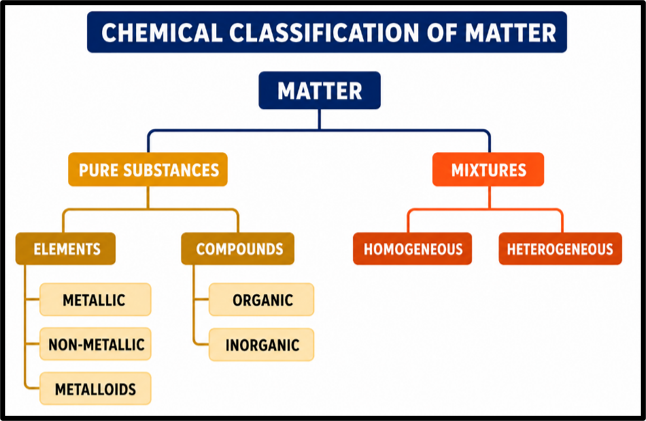
| Category | Sub-type | Description | Examples |
| Pure Substances | Elements | One type of atom; cannot be broken down chemically | H, O₂, Au, Fe |
| Pure Substances | Compounds | Two or more elements chemically bonded in fixed ratios | H₂O, NaCl, CO₂ |
| Mixtures | Homogeneous | Uniform composition; components not visibly distinguishable | Saltwater, air, alloys |
| Mixtures | Heterogeneous | Non-uniform composition; components distinguishable | Sand & water, salad |
Pure Substances — Elements and Compounds
Elements
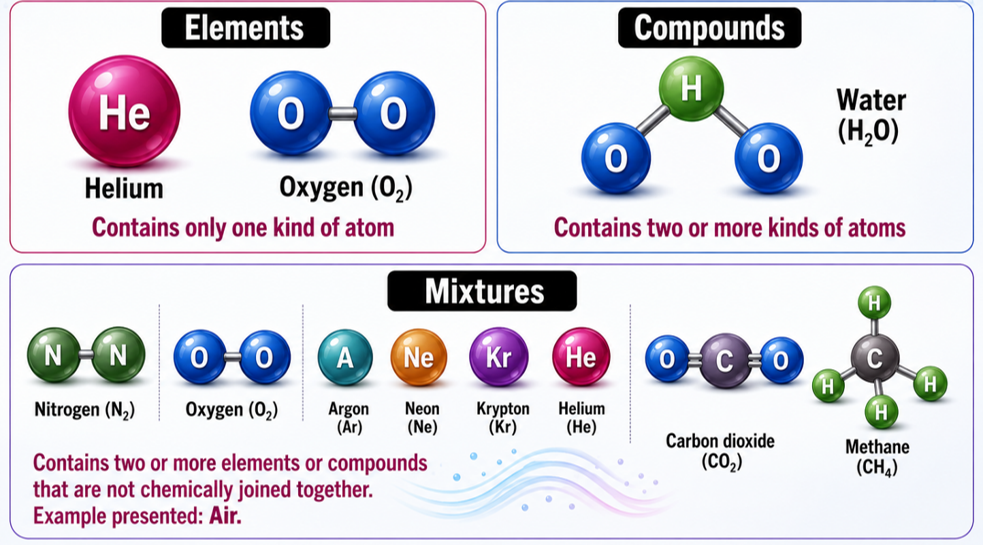
An element is a pure substance made of only one type of atom. It cannot be broken down into simpler substances by chemical means.
There are 118 known elements, arranged in the Periodic Table. Each has unique properties. Examples: hydrogen (H), oxygen (O₂), gold (Au), iron (Fe).
Elements are classified into three types:
- Metals: Good conductors of heat and electricity; malleable (can be hammered into shapes); ductile (can be drawn into wires). E.g., iron, gold, aluminium.
- Non-metals: Poor conductors; brittle when solid. E.g., carbon, sulfur, nitrogen.
- Metalloids: Exhibit properties of BOTH metals and non-metals. E.g., silicon (used in semiconductors), boron.
Compounds
A compound is a pure substance composed of two or more different types of elements chemically bonded together in fixed ratios. The resulting compound has properties entirely different from its constituent elements.
Sodium (Na) is a dangerous reactive metal; chlorine (Cl) is a toxic gas — yet combined as sodium chloride (NaCl), they form ordinary table salt!
- Elements in a compound are held together by ionic, covalent, or metallic bonds.
- Compounds can be broken down into their constituent elements only by chemical methods such as electrolysis.
- Organic — Organic Compounds contain carbon atoms bonded to hydrogen (and often O, N, S, P). E.g., glucose (C₆H₁₂O₆), methane (CH₄). Life is built on organic chemistry.
- Inorganic — Inorganic Compounds generally do not contain C-H bonds. Includes compounds of metals, non-metals, and minerals. E.g., NaCl, CO₂, Fe₂O₃.
| Property | Element | Compound |
| Definition | Pure substance with one type of atom | Two or more elements chemically combined |
| Composition | Only one type of atom | Two or more types of atoms in fixed ratio |
| Separation | Cannot be broken down chemically | Can be broken into elements by chemical means |
| Properties | Unique to that element | Different from constituent elements |
| Examples | O₂, Au, Fe | H₂O, NaCl, CO₂ |
Mixtures
A mixture is a combination of two or more substances that are physically blended — NOT chemically combined. Each component retains its own identity and properties. Air is a mixture: you can separate its components (oxygen, nitrogen, argon) physically, but they are not chemically bonded.
- No Chemical Bonding: Components are NOT chemically bonded to each other.
- Variable Composition: The proportion of components can vary.
- Retained Properties: Each component keeps its original chemical properties.
- No Fixed Melting/Boiling Points: Depend on the proportions of components.
- Separable by Physical Methods: Filtration, distillation, etc.
Homogeneous Mixtures
In homogeneous mixtures, the composition is uniform throughout — you cannot see individual components. Also called solutions.
Examples: saltwater, air (mixture of gases), alloys like brass (copper + zinc) and bronze (copper + tin).
Heterogeneous Mixtures
In heterogeneous mixtures, the composition is NOT uniform — you can see and sometimes physically pick out the individual components.
Examples: sand and water, oil and water, salad.
| Feature | Pure Substance | Mixture |
| Composition | One type of atom/molecule | Two or more different substances |
| Separation | Only by chemical means | By physical methods |
| Uniformity | Always uniform | Can be uniform or non-uniform |
| Melting/Boiling pt | Fixed (specific to substance) | No fixed values |
| Chemical props | Distinct, fixed chemical properties | Components retain their own properties |
| Examples | H₂O, O₂, Au | Air, sand+water, salad |
| Feature | Mixture | Compound |
| Composition | Variable, not fixed | Fixed ratio of elements |
| Separation | Physical methods (filtration, distillation) | Chemical methods (electrolysis) |
| Properties | Components retain individual properties | Properties differ from constituent elements |
| Formation | No energy change needed | Energy change during bond formation |
| Examples | Sand+salt, air | H₂O, CO₂, NaCl |
Separation of Mixtures — Techniques and Principles
Since the components of a mixture retain their individual physical properties, we can exploit those differences to separate them. Here are the key methods:
| Technique | Principle Used | Application / Example |
| Filtration | Difference in particle size | Separating insoluble solid from liquid: sand from water, coffee grounds from coffee |
| Distillation | Difference in boiling points | Separating alcohol from water; crude oil into petrol, diesel, etc. |
| Evaporation | Liquid evaporates; solid remains | Extracting salt from seawater; sugar from solution |
| Chromatography | Differing solubility/affinity for stationary & mobile phases | Separating plant pigments; ink dyes; forensic analysis |
| Centrifugation | Difference in density (denser particles sink under spinning) | Cream from milk; separating blood components (plasma, RBCs) |
| Magnetic Separation | Magnetic properties of certain substances | Iron from sand; magnetic metals from industrial waste |
| Decantation | Difference in density (immiscible liquids or solid-liquid) | Oil and water; muddy water and sediment |
| Sedimentation | Heavier particles settle at bottom over time | Sand in water; wastewater treatment |
| Crystallisation | Solubility decreases with temperature | Purifying sugar; growing salt crystals |
| Sublimation | Certain solids vaporise directly (solid → gas) | Separating iodine from sand; camphor from impurities |
Changes in Matter — Physical vs. Chemical
Matter is constantly changing. These changes fall into two fundamental categories: physical changes (which change form but not composition) and chemical changes (which result in entirely new substances).
Physical Changes
Physical changes affect the form or appearance of a substance WITHOUT altering its chemical identity.
The atoms and molecules are the same before and after — just arranged or spaced differently.
- No new substance is formed.
- Usually reversible — you can undo them.
- Involve changes in state, shape, or size.
Examples: melting of ice → liquid water (still H₂O); boiling of water; cutting paper; dissolving salt in water (the NaCl molecules are still there — evaporate the water and you get salt back).
Chemical Changes
Chemical changes result in the formation of one or more NEW substances with different chemical properties and compositions.
The original atoms are still there, but they have rearranged to form entirely new compounds.
- New substances are formed.
- Usually irreversible — you cannot easily ‘un-bake’ a cake.
- Involve breaking and forming chemical bonds; significant energy change.
Examples: burning wood (produces CO₂ and water, not wood anymore); rusting of iron; souring of milk (lactose → lactic acid); cooking an egg.
| Feature | Physical Change | Chemical Change |
| Composition | Remains the same | Changes; new substances formed |
| Reversibility | Usually reversible | Usually irreversible |
| Energy Change | Minimal | Significant (absorbed or released) |
| New Substance | No | Yes |
| Examples | Melting, boiling, dissolving | Rusting, combustion, digestion, cooking |