
Acids, Bases, Salts and pH Chemistry
This section deals with three of the most practically important classes of chemical compounds in chemistry.
Every day, without realising it, you interact with acids (the lemon in your water, the acid in your stomach), bases (the soap in your hand, the antacid you take for acidity), and salts (the common salt on your food). Understanding these substances — their nature, properties, and behaviour — is fundamental to both science and daily life.
Acids — The Proton Donors
An Acid is a substance that releases Hydrogen ions (H⁺) or protons when dissolved in water. In a broader definition, acids are proton donors — they give away H⁺ ions to other substances.
The sour taste of tamarind, lemon, and vinegar? That’s all due to acids. The burning sensation when acid spills on skin? That’s the corrosive power of acids.
Key Properties of Acids:
- Taste: Sour (e.g., lemon juice has Citric Acid; vinegar has Acetic Acid).
- Effect on Litmus: Turn Blue litmus paper Red.
- pH Scale: All acids have a pH below 7.
- Reactivity: React with metals to produce H₂ gas; react with bases to form Salt + Water (neutralisation); react with carbonates to release CO₂.
- Electrical Conductivity: Conduct electricity in aqueous solution due to the presence of ions.
- Corrosive Nature: Strong acids corrode metals and skin — handle with extreme care.
Types of Acids — Multiple Classifications
| Basis of Classification | Type | Examples |
| Source | Organic Acids (from living organisms) | Citric acid (lemons), Lactic acid (curd), Acetic acid (vinegar) |
| Inorganic / Mineral Acids (non-living). | HCl, H₂SO₄, HNO₃ | |
| Strength | Strong Acids (completely dissociate in water) | HCl, H₂SO₄, HNO₃ |
| Weak Acids (partially dissociate) | CH₃COOH (acetic), H₂CO₃ (carbonic) | |
| Concentration | Concentrated (high proportion of acid) | Conc. H₂SO₄ — used in car batteries |
| Dilute (low proportion of acid) | Dilute HCl — used in labs | |
| Composition | Monoprotic (releases 1 H⁺ per molecule) | HCl, HNO₃ |
| Diprotic (releases 2 H⁺ per molecule) | H₂SO₄, H₂S | |
| Triprotic (releases 3 H⁺ per molecule) | H₃PO₄ (phosphoric acid) |
| 📋 Common Acids and Their Uses |
| • Hydrochloric Acid (HCl): Found in stomach; aids digestion; used in metal cleaning. |
| • Sulfuric Acid (H₂SO₄): Used in car batteries; essential in fertiliser production; called the ‘King of Chemicals’. |
| • Acetic Acid (CH₃COOH): Component of vinegar (5% solution); used as preservative. |
| • Citric Acid: Found in citrus fruits; used as natural preservative and flavouring. |
| • Carbonic Acid (H₂CO₃): Present in carbonated drinks (CO₂ dissolved in water). |
Bases — The Proton Acceptors
A Base is a substance that produces Hydroxide ions (OH⁻) in an aqueous solution. In broader terms, bases are proton acceptors — they take up H⁺ ions from acids.
Bases taste bitter (think of the bitterness of baking soda) and feel slippery or soapy to the touch — that soapy feel of soap is literally because soap is a base! Bases are the chemical opposite of acids, and when they meet, they neutralise each other.
Key Properties of Bases:
- Taste: Bitter (e.g., baking soda NaHCO₃).
- Texture: Slippery or soapy to touch.
- Effect on Litmus: Turn Red litmus paper Blue.
- pH Scale: All bases have a pH greater than 7.
- Reactivity: React with acids to form Salt + Water; react with some metals (Al, Zn) to produce H₂ gas.
- Caustic Nature: Strong bases (like NaOH) corrode organic materials and metals.
Types of Bases
- Strong Bases: Completely dissociate in water. Examples: NaOH (Sodium Hydroxide — caustic soda), KOH (Potassium Hydroxide).
- Weak Bases: Partially dissociate in water. Examples: NH₄OH (Ammonium Hydroxide), Ca(OH)₂ (Calcium Hydroxide — lime water).
- Alkalis: Soluble bases that dissolve in water to produce OH⁻ ions. All alkalis are bases, but not all bases are alkalis.
- Insoluble Bases: Do not dissolve well in water. Examples: Mg(OH)₂, Zn(OH)₂.
| 📋 Common Bases and Their Uses |
| • Sodium Hydroxide (NaOH): Soap making, drain cleaners, paper manufacturing. |
| • Potassium Hydroxide (KOH): Manufacturing fertilisers and batteries. |
| • Calcium Hydroxide (Ca(OH)₂ — Slaked Lime): Whitewashing walls, treating acidic soils in agriculture. |
| • Magnesium Hydroxide (Mg(OH)₂ — Milk of Magnesia): Used as an antacid (neutralises excess stomach acid). |
| • Ammonium Hydroxide (NH₄OH): Found in household cleaning solutions. |
Salts — The Product of Neutralisation
Whenever an acid and a base react, they produce two things: Water and a Salt.
A Salt is an ionic compound formed when the H⁺ ions of an acid are replaced by metal ions or ammonium ions (NH₄⁺) during a neutralisation reaction.
Salts consist of positively charged Cations and negatively charged Anions. The most familiar salt in the world is common table salt — NaCl (Sodium Chloride) — formed when HCl reacts with NaOH.
Properties of Salts:
- Appearance: Generally crystalline solids.
- Solubility: Some are highly soluble (NaCl); others sparingly soluble (BaSO₄ — used in X-ray imaging).
- Taste: Varies — salty (NaCl), bitter (MgSO₄), sweet but toxic (lead acetate — never taste!).
- Conductivity: Conduct electricity when dissolved in water or molten, due to free ions.
- Melting/Boiling Points: Generally high due to strong ionic bonds.
- pH Nature: Can be neutral, acidic, or basic depending on the strength of the parent acid and base.
Types of Salts — Based on Various Parameters
| Classification | Type | Explanation | Example |
| Acid-Base Origin | Neutral Salt | Strong acid + Strong base → pH ≈ 7 | NaCl (HCl + NaOH) |
| Acidic Salt | Strong acid + Weak base → pH < 7 | NH₄Cl (HCl + NH₃) | |
| Basic Salt | Weak acid + Strong base → pH > 7 | CH₃COONa (CH₃COOH + NaOH) | |
| Composition | Simple Salt | One type of cation + one anion | NaCl, KNO₃ |
| Double Salt | Two cations or two anions in crystal | Potash Alum KAl(SO₄)₂·12H₂O | |
| Solubility | Soluble Salt | Dissolves readily in water | NaCl, KNO₃ |
| Insoluble Salt | Does not dissolve readily | AgCl, CaCO₃ |
Master Comparison: Acids vs. Bases vs. Salts
| Feature | Acids | Bases | Salts |
| Definition | Release H⁺ in solution (proton donors) | Release OH⁻ in solution (proton acceptors) | Ionic compounds from acid-base neutralisation |
| Taste | Sour (lemon, vinegar) | Bitter and slippery (soap) | Salty / varies |
| pH | Below 7 | Above 7 | Neutral, acidic, or basic depending on origin |
| Litmus Effect | Turns Blue litmus → Red | Turns Red litmus → Blue | Acidic salt → Red; Basic salt → Blue |
| Conductivity | Good (in aqueous solution) | Good (in aqueous solution) | Good (when dissolved or molten) |
| Examples | HCl, H₂SO₄, CH₃COOH | NaOH, NH₃, Ca(OH)₂ | NaCl, K₂SO₄, Mg(NO₃)₂ |
The pH Scale — Measuring Acidity and Basicity
How do we measure exactly how acidic or how basic a solution is? That’s where the pH Scale comes in. The term ‘pH’ stands for ‘potenz Hydrogen’ (German for ‘power of Hydrogen’).
The pH scale ranges from 0 to 14 and measures the concentration of H⁺ ions in a solution.
A solution with a high concentration of H⁺ is acidic (low pH); a solution with a low concentration of H⁺ is basic (high pH). At pH 7, the solution is perfectly neutral (pure water).
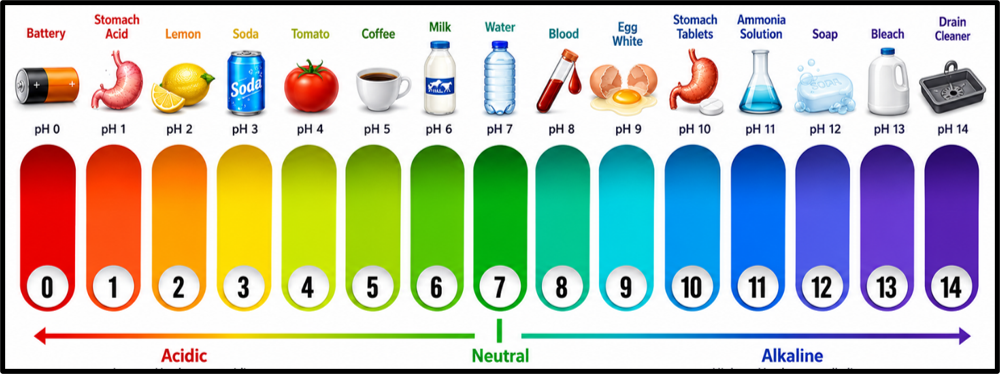
| pH Value | Solution Type | Examples |
| 0 – 3 | Strongly Acidic | Battery acid (pH~1), Stomach acid (pH~2) |
| 4 – 6 | Weakly Acidic | Vinegar (pH~3), Orange juice (pH~4), Coffee (pH~5), Urine (pH~6) |
| 7 | Neutral | Pure water (pH = 7), Blood (pH ≈ 7.4 — slightly basic) |
| 8 – 10 | Weakly Basic | Baking soda (pH~9), Seawater (pH~8) |
| 11 – 14 | Strongly Basic | Milk of Magnesia (pH~10), Bleach (pH~12), Liquid drain cleaner (pH~14) |
Why is pH So Important? — Real-World Significance:
- Biology: Human blood must stay at pH 7.4 — even a slight shift causes serious health disorders. Enzyme activity is pH-specific.
- Agriculture: Soil pH directly affects plant growth and nutrient availability. Most crops grow best at pH 6–7.
- Industry: pH control is critical in food production, pharmaceuticals, fermentation, and cosmetics.
- Environment: Acid rain (pH < 5.6) damages ecosystems; ocean acidification threatens marine life.
- Water Treatment: Drinking water is maintained at pH 6.5–8.5 for safety.
Indicators — The Colour Messengers of pH
An Indicator is a substance that changes colour depending on whether a solution is acidic, neutral, or basic. They are invaluable tools in the laboratory for quick identification of the nature of a substance.
| Indicator | In Acidic Solution | In Neutral Solution | In Basic Solution |
| Litmus (natural — from lichens) | Red | Purple | Blue |
| Phenolphthalein (synthetic) | Colourless | Colourless | Pink / Magenta |
| Methyl Orange (synthetic) | Red | Orange-Yellow | Yellow |
| Bromothymol Blue (synthetic) | Yellow | Green | Blue |
| Universal Indicator (mixed) | Red (strongly acidic) | Green (neutral) | Purple (strongly basic) |
| 🌿 Natural Indicators |
| Before synthetic indicators, nature provided the tools! Litmus is extracted from lichens. Turmeric turns red in basic solutions (test: add NaOH to turmeric paste — it turns red). Red cabbage juice is a wide-range natural indicator that changes from red (acidic) to blue-green (basic). These are great examples linking science and traditional knowledge. |
Buffer Solution — The Body’s pH Guardian
Imagine a solution so smart that even when you add a small amount of acid or base to it, its pH barely changes. That’s a Buffer Solution. A buffer resists changes in pH when small amounts of acid (H⁺) or base (OH⁻) are added to it. Buffers are absolutely critical for biological systems — without them, the chemical reactions in our bodies would be derailed by tiny fluctuations in pH.
Types of Buffer Solutions:
- Acidic Buffer: Contains a Weak Acid + its conjugate base (salt with strong base).
- Maintains pH below 7.
- Example: Acetic acid (CH₃COOH) + Sodium Acetate (CH₃COONa).
- Basic Buffer: Contains a Weak Base + its conjugate acid (salt with strong acid).
- Maintains pH above 7.
- Example: Ammonia (NH₃) + Ammonium Chloride (NH₄Cl).
How Does a Buffer Work?
The buffer works through a clever two-way neutralisation mechanism:
- When small amounts of acid (H⁺) are added, the conjugate base in the buffer reacts with the added H⁺ and neutralises it, preventing a large drop in pH.
- When small amounts of base (OH⁻) are added, the weak acid in the buffer reacts with the added OH⁻ and neutralises it, preventing a large rise in pH.
This dual mechanism allows the buffer to maintain a relatively constant pH.
Applications of Buffer Solutions
| Domain | Application | Specific Example |
| Biological Systems | Maintain stable blood pH at ~7.4 | Bicarbonate buffer (H₂CO₃ / HCO₃⁻) in blood — most critical buffer in the human body |
| Medical / Pharma | Maintaining pH in drug formulations | Aspirin, eye drops, and IV fluids are buffered for safety |
| Industrial | Fermentation, electroplating, dyeing | Buffer ensures correct pH for microbial activity in bioethanol production |
| Chemical Analysis | Titration experiments | Buffers maintain constant pH during analysis |
| Food Industry | Maintain flavour and preserve food | Citrate buffers in fruit juices and soft drinks |