
Metals, Non-Metals, and Metallurgy
The Periodic Table is the single most important organising tool in chemistry. Think of it as a well-organised library — every element is shelved not randomly, but according to its atomic number, electron configuration, and recurring chemical properties. The periodic table doesn’t just list elements — it predicts their behaviour and relationships.
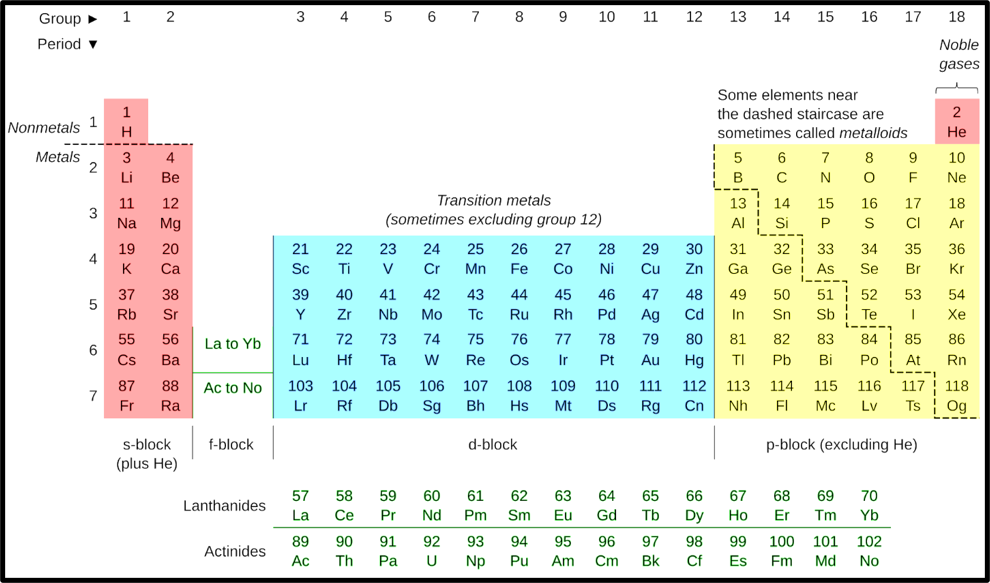
Based on their properties, all elements are broadly grouped into three categories:
- Metals — the ‘doers’ of the element world, reactive, conductive, and structurally strong
- Non-Metals — the ‘connectors’ — they build organic life and atmospheric chemistry
- Metalloids — the ‘bridge builders’ — sitting at the boundary, behaving like both
Quick Comparison at a Glance:
| Feature | Metals | Non-Metals | Metalloids |
| Appearance | Lustrous | Dull | Lustrous or dull |
| Malleability | Malleable | Brittle | Brittle |
| Conductivity | Good conductor | Poor conductor | Semi-conductor |
| Melting & Boiling Point | High | Low | Intermediate |
| State at Room Temp | Solid (except Mercury) | Solid, Liquid, Gas | Solid |
| Examples | Iron, Gold | Oxygen, Sulfur | Silicon, Boron |
Metals
When you hear the word ‘metal’, what comes to mind? Iron bridges? Gold jewellery? Copper wires? You are right on all counts.
Metals are a class of elements typically found in solid state at room temperature (with one glorious exception — mercury, which stays liquid), and they are defined by their extraordinary strength, conductivity, and versatility.
Physical Properties of Metals
Here is an important trick — whenever you look at the physical properties of metals, think of the word “LMDCHSS” — Lustre, Malleability, Ductility, Conductivity, High density, Sonorous, Solid. Let us explore each:
- Lustre: Metals have a shiny, reflective appearance when polished. This is why gold and silver are used in jewellery — they catch light beautifully. When you see a freshly cut metal surface gleaming, that shine is due to free electrons interacting with light.
- Malleability: Metals can be hammered or rolled into thin sheets without breaking. Gold is the most malleable metal — 1 gram of gold can be beaten into a sheet covering 1 square metre! This is why gold leaf is used to decorate temples and artworks.
- Ductility: Metals can be stretched into thin wires. A single gram of gold can be drawn into 2 kilometres of wire. Copper’s ductility is why it dominates electrical wiring.
- Conductivity (Thermal & Electrical): Metals have free electrons that can move readily — this makes them excellent conductors of both heat and electricity. Silver is the best conductor of electricity, followed by copper. This is also why metal cooking pans get hot quickly.
- High Density: Most metals are dense — they pack a lot of mass into a small volume. This is why metal objects feel heavy compared to non-metallic objects of the same size.
- High Melting and Boiling Points: Metals generally require high temperatures to change state. Tungsten (W) has the highest melting point of any element at 3,422°C — which is why it is used in light bulb filaments!
- Sonorous: Metals produce a ringing or bell-like sound when struck. Think of school bells, temple bells, and musical instruments like brass instruments — all exploit this property.
- Solid State: Almost all metals are solid at room temperature. The only exception is Mercury (Hg), which remains liquid.
Chemical Properties of Metals
The chemical behaviour of metals is largely governed by one core tendency — they want to lose electrons. This makes them electropositive in nature. Let us see what happens when metals interact with the world around them:
- Reaction with Oxygen: Metals react with oxygen to form metallic oxides, which are usually basic in nature. For example: 4Na + O₂ → 2Na₂O (sodium oxide). This is why sodium glows yellow when it burns in air.
- Reaction with Water: Metals react with water to form metal hydroxides and release hydrogen gas. Sodium reacts so vigorously that it skates across the water surface while fizzing — this is a favourite demonstration in chemistry labs.
- Reaction with Acids: Metals dissolve in acids, producing hydrogen gas and a salt. For example, zinc + hydrochloric acid → zinc chloride + hydrogen. This is the basic principle behind acid-testing to identify metals.
- Electropositive Nature: Metals lose electrons easily and form positive ions called cations. This is the defining chemical characteristic that separates metals from non-metals.
- Formation of Alloys: Metals can be mixed to form alloys — combinations with improved properties. Bronze (copper + tin) was so important that an entire era of human history is named after it: the Bronze Age!
Classification of Metals — Not All Metals Are Equal!
Here is where it gets really interesting. Metals are not a uniform group — they come in many flavours, each with distinct behaviour, reactivity, and applications.
Think of it like a cricket team: all players are on the same side, but each has a different role.
Let us meet them one by one.
Ferrous Metals — The Iron Family
The word ‘ferrous’ comes from the Latin ‘ferrum’, meaning iron. These are metals that contain iron as their primary component. Examples: iron, steel, cast iron, wrought iron.
Think of every bridge, railway track, and building frame — that is ferrous metals at work.
- Magnetic in nature — this is what makes iron useful in motors and electromagnetic devices
- High tensile strength — they resist being pulled apart, making them ideal for structural applications
- Prone to rusting — iron reacts with moisture and oxygen to form iron oxide (rust), EXCEPT stainless steel which resists corrosion
India’s entire railway infrastructure relies on ferrous metals. The Iron and Steel industry is a key topic in GS-I (Geography) and GS-III (Economy). Bhilai, Rourkela, Durgapur — know these steel plant locations!
Non-Ferrous Metals — Beyond Iron
Non-ferrous metals simply mean metals that do not contain iron. Examples: aluminium, copper, zinc, lead, tin.
Their key advantages are that they are non-magnetic, corrosion-resistant, and often lightweight. Copper wires in your home, aluminium in aircraft bodies, zinc in galvanisation — all non-ferrous metals.
Noble Metals — The Aristocrats of Chemistry
Noble metals — gold (Au), silver (Ag), and platinum (Pt) — are called ‘noble’ not because they are royalty, but because they refuse to react. They have high resistance to corrosion and oxidation.
Gold has been found in Egyptian tombs from 5,000 years ago — still shining. That is the power of chemical inertness. They retain their metallic lustre and do not tarnish, which is why they are used in electronics for reliable connectors.
Alkali Metals — Group 1: The Hyperactive Ones
Alkali metals (Lithium, Sodium, Potassium — Li, Na, K) are the most reactive metals on the periodic table. They are soft enough to cut with a knife and so reactive that they must be stored in kerosene oil to prevent contact with air and moisture.
They react vigorously with water, producing hydroxides and hydrogen gas. Sodium exploding in water is one of chemistry’s most spectacular demonstrations!
- Lithium (Li): Used in lithium-ion batteries — the backbone of electric vehicles and smartphones
- Sodium (Na): Used in streetlights (sodium vapour lamps produce that characteristic yellow glow)
- Potassium (K): Essential in fertilisers — potash fertilisers replenish soil potassium
Alkaline Earth Metals — Group 2: A Step Calmer
Alkaline earth metals (Magnesium, Calcium, Barium — Mg, Ca, Ba) are reactive, but less so than Group 1. They are shiny silvery-white solids.
Calcium is literally the most abundant metal in your body (bones and teeth). They form basic oxides — remember, calcium oxide is quicklime, used in construction and water purification.
- Magnesium: Used in alloys and fireworks — burns with a brilliant white flame (why photographers once used ‘flash powder’)
- Calcium: Used in cement/construction — calcium carbonate (limestone) → calcium oxide (lime) → cement
- Barium: Used in ‘barium meal’ for medical imaging of the gastrointestinal tract
Transition Metals — The Colourful Middle-Grounders
Transition metals occupy the middle of the periodic table (Groups 3-12) and are perhaps the most versatile.
Iron, copper, nickel, chromium — these are the metals that run the modern industrial world. What makes them special is their ability to exhibit variable oxidation states — meaning the same metal can form different types of compounds depending on conditions.
This is why copper can appear red (Cu metal), blue (Cu²⁺ in solution), or green (Cu₂(OH)₂CO₃, the patina on old copper structures).
- Iron (Fe): Construction, bridges, reinforcement — the backbone of infrastructure
- Copper (Cu): Electrical wiring — best among affordable conductors; also used in plumbing
- Chromium (Cr): Added to steel to make stainless steel; used in chrome plating for corrosion resistance
They form colourful compounds: Blue CuSO₄, green FeSO₄, orange Cr₂O₇²⁻ — transition metal compounds are the pigments of classic paintings and pottery glazes!
Post-Transition Metals — The Middle Children
Located between transition metals and metalloids, post-transition metals (aluminium, tin, lead, bismuth) exhibit a blend of metallic and non-metallic properties. They are generally softer and have lower melting points than transition metals.
Aluminium is the star here — it is the most abundant metal in Earth’s crust and is used everywhere from aircraft to aluminium foil.
- Aluminium, Gallium, Indium: Critical for semiconductors, LED lighting, and solar panels — at the heart of the green energy revolution
- Tin and Lead: Used in soldering (joining electronic components); lead is used as radiation shielding in X-ray rooms
- Bronze (Sn + Cu): One of humanity’s oldest alloys, still used in sculptures, coins, and bearings
Rare Earth Metals — The 21st Century’s Most Critical Resources
Rare earth metals are a group of 17 elements — the 15 lanthanides plus scandium and yttrium. Despite the name, they are not particularly rare in the Earth’s crust, but they occur in low concentrations, making their extraction difficult.
Examples: Neodymium (Nd), Samarium (Sm), Europium (Eu).
- Neodymium: Used in the most powerful permanent magnets in the world — inside every electric motor, wind turbine, and EV. Critical for India’s clean energy transition
- Lasers and LED screens: Europium gives the red colour in LED/LCD displays; terbium gives green
- China’s stranglehold: China controls ~85% of global rare earth production — a major geopolitical flashpoint. India’s search for rare earth deposits in Andhra Pradesh is strategically significant
Current Affairs: Rare Earth Metals are a recurring theme in India’s foreign policy (critical minerals diplomacy), EV battery supply chains, and India-China strategic competition. The government’s Critical Minerals Mission is directly linked to this topic.
Actinides — The Radioactive Family
Actinides are metallic elements whose nuclei are unstable and decay over time — releasing radiation. The most important are Uranium (U), Thorium (Th), and Plutonium (Pu).
These are not just chemistry — they are strategic national assets. India’s three-stage nuclear power programme is built on thorium — and India has the world’s largest thorium reserves (largely in Kerala’s coastal sands).
- Uranium: Fuel for conventional nuclear reactors; used in weapons-grade enrichment
- Thorium: India’s strategic advantage — the basis for Stage 3 of India’s nuclear programme
- Plutonium: Produced in reactors from uranium; used in fast breeder reactors
Heavy Metals and Light Metals — The Density Divide
- Heavy Metals (Lead, Mercury, Cadmium): High atomic weight and density, often toxic.
- Lead in batteries, Mercury in thermometers (being phased out due to toxicity), Cadmium in electroplating.
- Heavy metal contamination of groundwater is a major environmental concern in India.
- Light Metals (Aluminium, Magnesium, Titanium): Low density but strong and corrosion-resistant.
- Titanium alloys have revolutionised aerospace and biomedical implants — titanium joints are compatible with human bone because the body doesn’t reject them!
Classification of Metals Based on Reactivity — Summary Table:
| Type | Examples | Properties | Reactivity |
| Alkali Metals | Li, Na, K, Rb, Cs | Soft, low melting points, low density | MOST reactive |
| Alkaline Earth Metals | Mg, Ca, Sr, Ba | Harder, higher melting points | Very reactive (< alkali) |
| Transition Metals | Fe, Cu, Ag, Au, Zn | Strong, good conductors, form coloured compounds | Moderate to low |
| Post-Transition Metals | Sn, Pb, Bi | Softer, lower melting points | Low |
| Noble Metals | Au, Pt, Ag | Highly corrosion-resistant, used in jewellery & electronics | LEAST reactive |
| Rare Earth Metals | Ce, Nd, La | Used in magnets and electronics | Moderate |
| Actinides | U, Th, Pu | Radioactive metals | Variable |
The Reactivity Series
Imagine you have lined up all metals in a queue according to their eagerness to react. The most desperate to react stands at the front; the laziest stands at the back.
That queue is the Reactivity Series — a list of metals arranged in order of their reactivity from most reactive to least reactive.
The Reactivity Series helps us predict:
- Which metal will react with water and at what speed
- Which metal will displace another in a solution (displacement reactions)
- Which metal is harder to extract from its ore (less reactive = easier)
- Which metals can be used in specific industrial applications
| Rank | Metal | Reactivity Behaviour |
| 1 | Potassium (K) | Highly reactive — explodes on contact with water and air |
| 2 | Sodium (Na) | Very reactive — catches fire when placed in water |
| 3 | Calcium (Ca) | Reacts vigorously with water, releasing hydrogen gas |
| 4 | Magnesium (Mg) | Reacts slowly with water but faster with acids |
| 5 | Aluminium (Al) | Reacts with acids; forms a protective oxide layer (passivation) |
| 6 | Zinc (Zn) | Moderate reactivity — reacts with acids and steam |
| 7 | Iron (Fe) | Reacts slowly with acids and water — rusts in moist air |
| 8 | Lead (Pb) | Reacts slowly with acids; low reactivity overall |
| 9 | Copper (Cu) | Does not react with water or dilute acids |
| 10 | Silver (Ag) | Least reactive among common metals; does not corrode easily |
| 11 | Gold (Au) | Chemically inert — does not react with most substances including acids |
Golden Rule
Metals above hydrogen in the reactivity series react with dilute acids to produce hydrogen gas. Metals below hydrogen (copper, silver, gold) do NOT react with dilute acids. This is why gold and silver jewellery doesn’t corrode!
(Hydrogen is not shown in the Reactivity Series, imagine it to be placed between Lead and Copper)
A practical application of the reactivity series: Displacement Reactions.
If you dip an iron nail into copper sulphate solution, the iron displaces the copper because iron is higher in the reactivity series. The solution turns from blue to pale green as Fe²⁺ replaces Cu²⁺. This principle is used industrially to extract copper from low-grade ores.
Metallurgy
Here is a question: if iron exists abundantly in Earth’s crust, why can’t we just dig it up and use it directly?
Because metals in nature are found not in their pure form but as ores — compounds of metals mixed with other minerals, earth, and impurities.
Metallurgy is the science and art of extracting metals from their ores, refining them, and converting them into useful forms.
Think of metallurgy as a multi-stage journey from rock to finished product. Let us trace that journey step by step.
Stage 1: Extraction of Metals
There are three primary methods of extraction, chosen based on the metal’s reactivity and the nature of its ore:
A) Pyrometallurgy — Using Heat
‘Pyro’ means fire. Pyrometallurgy uses high temperatures to extract metals from their ores. This is the oldest metallurgical method — humans have used fire to extract metals for thousands of years.
Think of the ancient blacksmiths smelting iron from ore in furnaces.
- Roasting: Heating the ore in the presence of air to convert it into a metal oxide and remove unwanted sulphur or other elements. Example: roasting zinc sulphide (ZnS) converts it to zinc oxide (ZnO), which can then be more easily reduced to zinc metal.
- Smelting: Melting the ore at very high temperatures in a furnace to separate the metal. The classic example is smelting iron ore (Fe₂O₃) in a blast furnace to produce pig iron. Coke (carbon) acts as fuel AND reducing agent. The blast furnace is the symbol of the Industrial Revolution.
- Reduction: Removing oxygen from metal oxides to obtain pure metal. Carbon or carbon monoxide acts as the reducing agent. Example: CuO + C → Cu + CO₂. The metal oxide is ‘reduced’ to the pure metal.
- Refining: Purification of the extracted metal through processes like electrolytic refining. This gives us highly pure copper for electrical uses.
B) Hydrometallurgy — Using Liquid Solutions
‘Hydro’ means water. Hydrometallurgy uses aqueous (water-based) solutions to extract metals. This is particularly useful for low-grade ores where heating would be inefficient.
- Leaching: Dissolving the metal from ore using a chemical solvent (acid, base, or water). Famous example: gold leaching using cyanide solutions — cyanide dissolves gold selectively from the ore. (Note: this method is environmentally controversial and subject to regulation in India.)
- Solvent Extraction: Separating a desired metal from the leach solution using another solvent. Example: extracting copper from a leach solution into an organic solvent.
- Precipitation: Adding a chemical reagent to make the dissolved metal come out of solution as a solid. Example: adding sodium chloride to precipitate silver from solution.
C) Electrometallurgy — Using Electricity
Electrometallurgy uses electrical energy to extract metals. This is the method of choice for highly reactive metals that cannot be extracted by heat alone. The most important example: aluminium extraction from bauxite ore.
Aluminium is so reactive that carbon cannot reduce aluminium oxide — only electricity can do it. The Hall-Heroult process uses massive amounts of electricity, which is why aluminium smelters are built near hydroelectric plants!
Stage 2: Refining — Making Metals Pure
Extracted metals are often impure. Refining removes impurities to give us metals of the quality needed for specific applications. Three key methods:
- Electrolytic Refining: The classic refining method. The impure metal is the anode and the pure metal deposits at the cathode as electricity passes through an electrolyte solution. Copper refining works this way — the impurities (gold, silver) fall as ‘anode mud’ at the bottom and can be separately recovered!
- Zone Refining: A narrow molten zone is moved slowly along a metal rod. Impurities preferentially stay in the liquid zone and migrate to one end. This gives ultra-high purity metals, essential for semiconductor-grade silicon and germanium.
- Distillation: Used for metals with volatile impurities or for metals with low boiling points. Zinc can be purified this way since it vapourises before many of its impurities.
Stage 3: Alloying and Heat Treatment — Enhancing Performance
Pure metals are often NOT ideal for practical applications. Pure iron, for instance, is too soft and brittle for construction.
This is where alloying comes in — mixing metals (and sometimes non-metals) to create materials with superior properties.
Heat Treatment is the other lever — by controlling heating and cooling cycles, engineers can dramatically change a metal’s properties:
- Annealing: Slowly cooling a heated metal to relieve internal stresses and make it softer and more workable. Think of a blacksmith who heats steel red-hot then lets it cool in air — the metal becomes more workable.
- Quenching: Rapidly cooling a heated metal in water or oil. This increases hardness significantly — but also makes the metal brittle. Quenched steel tools are very hard but can crack under impact.
- Tempering: Reheating a quenched metal to a lower temperature to reduce brittleness while retaining hardness. This is the goldilocks of heat treatment — combining toughness and hardness. Sword blades are tempered this way.
Stage 4: Shaping and Forming — Making It Usable
Once the metal is ready, it needs to be shaped into useful products. Several techniques are used:
- Casting: Pouring molten metal into a mould to solidify in a desired shape. Sand casting (ancient technique, still used for machine parts) and die casting (high precision, high pressure — used for engine blocks and door knobs).
- Forging: Shaping metal by applying compressive force — hammering or pressing. Forged steel is denser and stronger than cast steel. Crankshafts, connecting rods, and aircraft landing gear are forged.
- Rolling: Passing metal through rollers to reduce thickness. Aluminium foil, steel sheets for car bodies, railway rails — all produced by rolling.
- Extrusion: Forcing molten metal through a die to create continuous profiles. Aluminium window frames, pipes, and rods are extruded.
- Drawing: Pulling metal through a die to reduce diameter and increase length. Copper electrical wire is produced by drawing — this is literally ductility in industrial action!
- Welding: Joining two pieces by melting their edges and fusing them together. The backbone of manufacturing — from car assembly to spacecraft construction.
Stage 5: Corrosion Protection — Defending the Metal
After all that work to extract and shape a metal, the last thing you want is for it to corrode away! Two main protection strategies:
- Coating: Applying a protective layer — paint, galvanisation (zinc coating), or chromium plating. Galvanised iron pipes and sheets resist rust because zinc preferentially corrodes (sacrificial protection), protecting the underlying iron.
- Alloying: Adding chromium or nickel to steel creates stainless steel — the chromium forms a microscopic oxide layer that self-repairs when scratched!
Alloys
Here is a beautiful idea from chemistry: combining two or more elements — where at least one is a metal — creates a material with properties superior to any of the individual components. This is an alloy.
Pure copper is too soft for coins. Pure tin is too brittle for weapons. But mix them together and you get bronze — hard, durable, and workable enough to define an entire era of human civilisation.
Types of Alloys
- Binary Alloys: Two elements — e.g., Brass (Cu + Zn), Bronze (Cu + Sn)
- Ternary Alloys: Three elements — e.g., Stainless Steel (Fe + C + Cr)
- High-Performance Alloys: Designed for extreme conditions — e.g., Inconel (Ni + Cr + Fe) used in jet engines and rocket nozzles where temperatures exceed 1000°C
Common Alloys and Their Applications
| Alloy | Composition | Key Properties | Major Uses |
| Steel (Carbon) | Fe + C | Strong and durable | Construction, manufacturing |
| Stainless Steel | Fe + Cr + Ni (+ Mo) | Corrosion-resistant | Utensils, surgical instruments |
| Bronze | Cu + Sn | Hard, corrosion-resistant | Coins, sculptures, bells |
| Brass | Cu + Zn | Malleable, good conductivity | Coins, locks, plumbing |
| Aluminium Alloys | Al + Cu/Mg/Zn | Lightweight, strong | Aerospace, automotive, cans |
| Titanium Alloys | Ti + Al + V | High strength-to-weight ratio | Aerospace, medical implants |
| Solder | Sn + Pb (or Cu) | Low melting point | Electronics, plumbing joints |
| Nickel Alloys | Ni + Cr + Fe + Mo | Heat & corrosion resistant | Turbines, chemical industry |
| White Gold | Au + Pd or Ni | Durable, white colour | Jewellery |
Why Are Alloys Better Than Pure Metals?
- Improved Strength: Carbon in steel dramatically increases its strength over pure iron — steel is roughly 1000 times stronger than pure iron in practical applications
- Enhanced Corrosion Resistance: Chromium in stainless steel creates a self-healing passive oxide layer — making it ‘stainless’ even in corrosive environments
- Increased Durability: Brass and bronze last far longer than their component metals in isolation
- Tailored Properties: By adjusting proportions, alloys can be engineered for specific needs — lightweight aluminium alloys for aircraft, ultra-high-strength titanium alloys for medical implants, high-temperature nickel alloys for turbines
Non-Metals
Here is a paradox: non-metals are often dull, brittle, and poor conductors — and yet, life on Earth would be impossible without them.
Oxygen keeps you breathing. Carbon builds every organic molecule in your body. Nitrogen is 78% of the air you inhale. Hydrogen is literally the most abundant element in the universe.
Non-metals are located on the right side of the periodic table (except hydrogen, which sits on the left despite being a non-metal).
Physical Properties of Non-Metals
- State: Non-metals exist in all three states at room temperature — Gases (O₂, N₂, Cl₂), Liquids (Bromine Br₂ — the only liquid non-metal), and Solids (Carbon, Sulfur, Phosphorus)
- Appearance: Generally dull and non-lustrous — except iodine, which has a shiny (almost metallic) surface, leading to its classification as a metalloid by some scientists
- Conductivity: Poor conductors of heat and electricity — except graphite, a form of carbon that conducts electricity remarkably well because of its layered structure with free pi electrons. Graphite is used in electrodes and pencil ‘lead’
- Density: Generally lower densities compared to metals — this is why most non-metals float or are gaseous
- Hardness: Brittle in solid form — break rather than bend. Except diamond (another form of carbon), which is the hardest natural substance known — used in cutting tools and drill bits
- Melting & Boiling Points: Generally lower than metals — except again for carbon in the diamond form, which has an extremely high melting point
Chemical Properties of Non-Metals
- Electron Affinity — Electronegative Nature: While metals lose electrons, non-metals gain electrons to form anions. Fluorine is the most electronegative element of all — it attracts electrons more strongly than any other element
- Oxides: Non-metals form acidic or neutral oxides. CO₂ (carbon dioxide) dissolves in water to form carbonic acid — this is why acid rain is linked to CO₂ and SO₂ emissions! SO₂ (sulphur dioxide) forms sulfurous acid in the atmosphere
- Reactivity with Metals: Non-metals react with metals to form ionic compounds — e.g., NaCl (table salt = sodium + chlorine). Chlorine ‘grabs’ the electron that sodium ‘gives’
- Reactivity with Other Non-Metals: Non-metals react with each other to form covalent compounds — e.g., H₂O (water = hydrogen + oxygen sharing electrons), CH₄ (methane)
- High Electronegativity: Non-metals strongly attract electrons in chemical bonds — fluorine > oxygen > nitrogen > chlorine, in decreasing order
Classification of Non-Metals
A) Reactive Non-Metals — The Chemistry Champions
Reactive non-metals are the most chemically active non-metals — they eagerly participate in reactions.
This group includes halogens (Group 17) and other reactive non-metals like oxygen, nitrogen, sulfur, and phosphorus. Halogens are particularly interesting — the word comes from the Greek for ‘salt-former’, and true to their name, they readily combine with metals to form salts.
- Hydrogen (H): The simplest and most abundant element in the universe — combines with oxygen to form water, and is the backbone of all organic molecules. Also the fuel of the future (hydrogen fuel cells)!
- Oxygen (O): Essential for aerobic respiration and combustion. Liquid oxygen is used as rocket propellant — the Chandrayaan and ISRO missions depend on it
- Chlorine (Cl): Used as a disinfectant in water treatment, in PVC plastic production, and in pharmaceuticals. A double-edged element — lifesaving in water purification, deadly as a chemical weapon in WWI
- Fluorine (F): Found in toothpaste (prevents tooth decay) and Teflon (non-stick coating). The most reactive of all elements — it reacts with virtually everything, even glass under certain conditions!
- Sulfur (S): Used in sulfuric acid (the most produced industrial chemical in the world), vulcanisation of rubber (converting soft latex into hard, durable rubber — used in car tyres), and gunpowder
B) Noble Gases — The Perfect Loners
Noble gases (Helium, Neon, Argon, Krypton, Xenon) are the most stable elements in the periodic table. Their outer electron shells are completely full — so they have no need to gain or lose electrons.
They exist as monatomic gases — single atoms, not molecules. They are colourless, odourless, tasteless, and chemically inert under normal conditions.
- Helium (He): Used in balloons, airships (safe, non-flammable unlike hydrogen!), and as a coolant in MRI machines and superconducting magnets
- Neon (Ne): Used in neon signs — when electricity passes through neon gas, it emits a characteristic red-orange glow
- Argon (Ar): Provides an inert atmosphere for welding (prevents the hot metal from oxidising), and fills incandescent light bulbs
- Krypton (Kr) and Xenon (Xe): Used in high-intensity lighting (stadium lights, photography flashes) and laser applications; Xenon propellant is used in ion thrusters of spacecraft!
C) Other Non-Metals — The Diverse Group
This group includes elements with diverse and fascinating properties:
- Carbon (C): The ultimate shape-shifter of chemistry! Found as graphite (soft, conducts electricity), diamond (hardest natural substance), fullerenes (C₆₀ ‘Buckyballs’), and graphene (single-layer graphite — the wonder material of nanotechnology, 200 times stronger than steel!)
- Nitrogen (N): 78% of Earth’s atmosphere; essential for making fertilisers (Haber process converts N₂ to ammonia); used as an inert gas in food packaging to prevent spoilage. Liquid nitrogen (-196°C) is used for cryogenic preservation
- Phosphorus (P): Found in matches (red and white phosphorus), fertilisers (phosphates are essential plant nutrients), detergents, and DNA (the phosphate backbone of DNA!)
- Bromine (Br): The only liquid non-metal at room temperature (and one of only two liquid elements — the other being mercury). Used in flame retardants, photography, and pharmaceuticals
Classification of Non-Metals — Summary Table:
| Type | Examples | Key Properties |
| Reactive Non-Metals | O, S, Cl, F, N, H, P | Highly reactive; form compounds like acids, salts, oxides; exist as diatomic/polyatomic molecules |
| Noble Gases (Inert) | He, Ne, Ar, Kr, Xe, Rn | Colourless, odourless, tasteless; extremely low reactivity; full valence shells; exist as monatomic gases |
| Other Non-Metals | C, N, P, Br | Diverse properties — can be solid, liquid or gas; moderate to low reactivity; wide range of compounds |
Metalloids — The Fence-Sitters that Changed the World
Here is the most fascinating category, and arguably the most important for the 21st century economy.
Metalloids are elements that sit on the boundary between metals and non-metals in the periodic table, and they literally can’t decide which side to be on! They can behave like metals under some conditions and like non-metals under others.
There are six recognised metalloids in the modern periodic table: Boron (B), Silicon (Si), Germanium (Ge), Arsenic (As), Antimony (Sb), and Tellurium (Te).
Remember them with: “B-SiGe-As-Sb-Te”.
Properties of Metalloids
- Appearance: Typically shiny like metals but brittle like non-metals — silicon wafers, for example, look metallic but will shatter if dropped
- Electrical Conductivity — The Semiconductor Property: This is the property that makes metalloids revolutionary. They are semiconductors — they conduct electricity better than non-metals but not as well as metals. Crucially, their conductivity can be controlled by temperature, light, or doping — this is the foundation of ALL modern electronics!
- Reactivity: Depends on what they are reacting with. Silicon behaves like a metal with fluorine (forms SiF₄) but like a non-metal with sodium (forms Na₄Si)
- Amphoteric Oxides: Metalloids form amphoteric oxides — oxides that can react with both acids AND bases. Silicon dioxide (SiO₂, i.e., glass) reacts with HF (acid) and also with NaOH (base). This dual nature mirrors their ‘both-and’ character
Why Semiconductors Matter: The discovery that silicon’s conductivity could be ‘tuned’ by adding tiny amounts of impurities (doping) — a process called doping — enabled the invention of the transistor (1947), the integrated circuit (1958), the microprocessor (1971), and the modern smartphone.
Every digital device you use runs on the semiconductor properties of metalloids. This is why Silicon Valley is called Silicon Valley!
Metalloids and Their Applications — The Technology Backbone
| Metalloid | Key Applications |
| Boron (B) | Borosilicate glass (heat-resistant, e.g., Pyrex), detergents, dopant in semiconductors |
| Silicon (Si) | Backbone of electronics (chips, transistors, solar panels), construction materials like concrete |
| Germanium (Ge) | Fibre optics, infrared optics, semiconductors — critical in early transistor technology |
| Arsenic (As) | Pesticides, wood preservatives, semiconductors; arsenic-based drugs used in cancer treatment |
| Antimony (Sb) | Flame retardants, alloys, lead-acid batteries |
| Tellurium (Te) | Thermoelectric devices (converting heat to electricity), advanced thin-film solar panels |
The Semiconductor Revolution — Silicon’s Story
Silicon deserves special mention. It is the second most abundant element in Earth’s crust (after oxygen) and the material upon which modern civilisation runs.
Pure silicon is not very useful — but when you add trace amounts of phosphorus (n-type doping, adding free electrons) or boron (p-type doping, creating ‘holes’ that act like positive charges), you create a semiconductor whose conductivity can be switched on and off.
This switching behaviour is the basis of transistors, which are the building blocks of every computer chip. A modern processor contains billions of transistors in an area the size of a fingernail.
Applications of Metalloids — Sector-wise
- Semiconductor Industry: Silicon and germanium — the backbone of electronics, computing, and communications. India’s Semiconductor Mission (India Semiconductor Mission, 2021) aims to establish domestic chip fabrication — directly linked to this topic!
- Alloys: Antimony and arsenic improve the mechanical strength and properties of metals — antimony hardens lead in car batteries
- Glass and Ceramics: Boron (in borosilicate glass) and silicon are essential in heat-resistant glass (Pyrex, laboratory glassware, telescope mirrors)
- Medical Use: Arsenic trioxide is used in treating acute promyelocytic leukaemia — a remarkable example of a toxic element used as medicine in controlled doses
- Energy: Tellurium is used in cadmium telluride (CdTe) solar panels and in thermoelectric generators that convert waste heat into electricity — crucial for sustainable energy