
International Morality
Imagine you are an IAS officer at the Ministry of External Affairs. A neighbouring country is bombing its own civilians. Another refuses to repay India a loan. A third demands India vote against its own ally at the UN. How should India behave? What moral rules govern relations between nations? This is the essence of International Morality.
International morality refers to morals or codes of conduct governing relations between nations. The world is divided into many independent territorial political communities — and the moral rules governing how they treat each other constitute international morality. It draws from IR theory, history, political science, and ethics.
| Why This section Matters for UPSC GS Paper IV tests ethics not just in governance but also in India’s foreign policy. Questions appear regularly on: Panchsheel, UN Charter, Just War Theory, India’s stance on Bangladesh, Sri Lanka, Palestine. Core question to always ask: ‘What is the ETHICAL thing for a nation to do in this situation?’ |
Key Foundational Concepts
Sovereignty — The Supreme Authority of a State
Sovereignty is the supreme, unfettered political authority a state exercises within its territory — the ultimate will of the people. It operates in three dimensions:
| Dimension | What It Means |
| International Legal | Reciprocal recognition between states — ‘you are a legitimate state, I treat you as such’ |
| Constitutional / Domestic | Ultimate source of legal authority within the state — Parliament, Constitution, Supreme Court |
| Empirical | Effective capacity to exercise unilateral control and formulate independent policies |
| State vs. Government — A Critical Distinction! Government: Temporary — changes after elections (Modi govt, UPA govt, Vajpayee govt). State: Permanent — lives as long as the political community (India as a state since 1947, regardless of which government holds power). In international law, it is STATES that sign treaties, declare war, and hold sovereignty — not governments. |
Nation vs. State — A Critical Distinction
| Concept | Core Meaning | Example |
| Nation | Group sharing territory, history, culture, language, religion — thinks of itself as ‘a people’ | The Indian people, the Arab people, the French people |
| State | Constitutional/legal machinery that governs; the institutional arrangement | The Indian state, the Pakistani state, the French state |
| Nation-State | When nation and state coincide — most modern countries are nation-states | France, Germany, Japan |
| Multi-national State | State comprising many nations — prone to civil conflicts and secessionist pressures | USA, Canada, Australia; the former USSR |
Three Perspectives on Studying International Relations
Moral aspects enter into all three perspectives. This section uses all three lenses to understand International Morality.
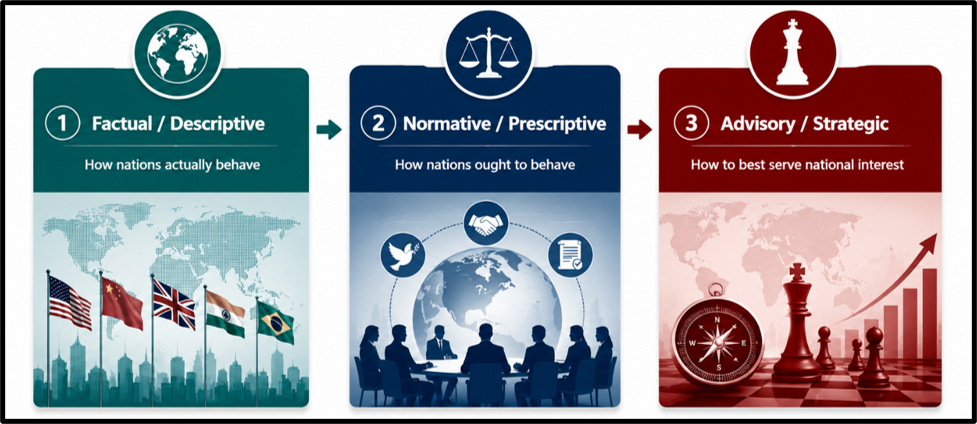
Theories of International Relations (IR)
The debate between Realism and Idealism is IR’s central intellectual battle — a centuries-long argument about whether nations are fundamentally self-interested or morally capable. This debate shapes every aspect of international morality
REALISM — The World As It Is
| REALISM Key Thinkers: Thucydides, Machiavelli, Hobbes, Hegel, Treitschke, Morgenthau |
| Core Idea: The international arena is anarchic — no world government exists. Each state must look out for itself, maximize power, and ensure survival. National interest and power are the only reliable foreign policy guides. View on Morality: Morality is either irrelevant, impossible, or merely instrumental. States do not value justice — they value power and security. ‘Nice guys finish last.’ |
Historical Lineage of Realism
| Thinker | Period | Key Contribution |
| Thucydides | ~ 460-400 BC | History of Peloponnesian War — ‘strength defines right’; warned against BOTH naive idealism AND unrestrained cynicism |
| Machiavelli | 15th-16th C | The Prince — raison d’etat: rulers must follow what is good for the state, not moral scruples; ‘effectual truth over imagined truth’ |
| Hegel | 19th C | ‘The state has no higher duty than maintaining itself’ — ethical sanction for national self-interest over others |
| Treitschke | 19th C | The state IS power; its supreme moral duty is maintaining power; realpolitik — national interest as the only principle |
| Hans Morgenthau | 20th C | Six principles of realism; ‘international politics is a struggle for power’; prudence over moral crusades |
| Kenneth Waltz | 20th C | Neo-realism: states seek survival not power-maximisation; the system’s anarchic structure determines behaviour |
Types of Realism
| Type | What It Claims | UPSC Relevance |
| Descriptive Realism | States DO NOT behave morally in reality — they lack moral motivation or cannot afford it in competitive struggles | Explains why powerful nations routinely violate international norms with impunity |
| Prescriptive Realism | States SHOULD be amoral — prudent smart self-regard is the right approach; avoid both rigid morality AND rigid immorality | Basis for critique of India’s Panchsheel — ‘too idealistic, too naive, divorced from power realities’ |
| Realpolitik | Foreign policy based solely on advancing national interest, regardless of morality | Applied to USA’s interventions in Iraq, Libya; China’s Belt and Road strategy |
| Raison d’etat | ‘Reason of state’ — rulers must do whatever is necessary for state survival, ignoring ethics | Explains Machiavellian statecraft; justification for intelligence agencies’ covert operations |
Hans Morgenthau’s Six Principles of Realism
| Principle 1: Objective Laws of Human Nature Realism is grounded in objective, unchanging human nature. Politics follows discoverable laws — it is a science, not mere ideology. |
| ▼ |
| Principle 2: Interest Defined as Power Political leaders think and act in terms of ‘interest defined as power’ — providing a rational lens delinked from ideology or personal traits of individual leaders. |
| ▼ |
| Principle 3: Power is Contextual The concept of power takes various forms depending on times and circumstances — political and cultural context determines its substance and how it is deployed. |
| ▼ |
| Principle 4: Ethics Must Be Filtered Through Prudence ‘Universal moral principles cannot be applied to states in abstract formulation — they must be filtered through concrete circumstances of time and place.’ No political morality without prudence. |
| ▼ |
| Principle 5: Prudence Over Moral Superiority All state actors — including your own — must be seen as pursuing interests defined as power, not as moral crusaders. Avoid ideological confrontation. Factor in others’ interests. |
| ▼ |
| Principle 6: Power Cannot Subordinate Ethics — But Ethics Remains Relevant ‘A man who was nothing but political man would be a beast; nothing but moral man would be a fool.’ Political art requires a fine balance of power AND morality. |
Three Criticisms of Morgenthau’s Realism
- Flawed view of human nature: Not all individuals are in single-minded pursuit of power — they are shaped by family traditions, education, and diverse goals.
- Internal contradiction: Morgenthau introduces a normative principle (rationality as ‘good’) into a supposedly descriptive theory. You cannot derive ‘ought’ from ‘is’.
- Ambiguous concept of power: If power is just a means to something else, it doesn’t define the nature of politics — the theory becomes circular and cannot explain foreign policy independently.
IDEALISM — The World as It Should Be
| IDEALISM (Liberal Internationalism / Utopianism) Key Thinkers: Plato, Aristotle, Cicero, Immanuel Kant, Woodrow Wilson |
| Core Idea: Nations can and should behave morally. Universal values exist — peace, justice, human rights, cooperation. International law and institutions can constrain state behaviour and create a peaceful world order. View on Morality: Morality is central. Universal moral principles should guide states. Treaties must be honoured. War should be outlawed. Human rights must be respected everywhere. |
Immanuel Kant’s Four Idealist Principles for International Morality
- Non-interference: No state shall by force interfere with the internal affairs of another state.
- No feudal hierarchy among states: It would be fatal to divide states according to the principle of feudal lord and vassal.
- No acts that destroy future peace: During war, no acts that would make mutual confidence in subsequent peace impossible.
- Disarmament: Governments must reduce military spending. Standing armies shall in time be totally abolished.
The Rise, Fall, and Rebirth of Idealism
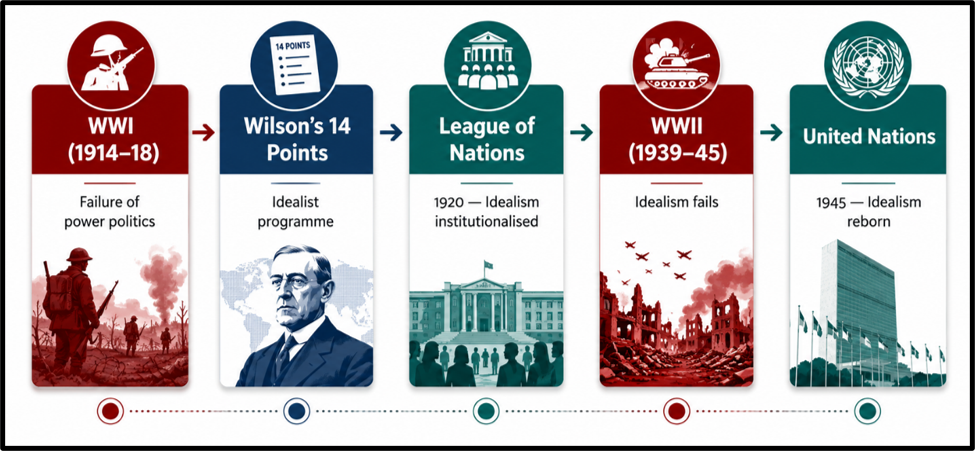
| The Idealist Lesson USA never joined the League of Nations. Japan and Germany left. The League could not prevent WWII. This devastated faith in idealism. Classical realism dominated IR theory after WWII (Morgenthau, Kennan). Yet the United Nations (1945) is the most powerful expression of idealism — the world’s collective moral conscience institutionalised. CONCLUSION: Pure idealism fails. Pure realism is barbarism. The answer lies in a principled, realistic blend. |
E. H. CARR — The Great Challenger to Idealism
E. H. Carr in The Twenty Years’ Crisis devastated post-WWI idealism with four powerful arguments:
| E. H. Carr’s Four Arguments Against Idealism |
| 1. No Universal Moral Standards: What nations regard as moral principles is always determined by their interests. These ‘universal’ values are not universal — they are interest-driven claims disguised as morality. 2. Universal Values Are Masks for Self-Interest: Those claiming to represent ‘universal interests’ are actually acting in their own interests, identifying themselves with the interest of the world. 3. No Harmony of Interests — Only Conflict: The world is torn by particular interests of different groups. Order is based on power, not morality. Dominant nations impose international moral norms on weaker ones. 4. ‘Peace’ Favours the Status Quo Powers: Satisfied powers preach peace. Unsatisfied powers prepare for war. True peace = satisfying the unsatisfied — not just preaching to the status quo. |
| Pure realism can offer nothing but a naked struggle for power which makes any kind of international society impossible. — E. H. Carr — acknowledging that his own realist critique has limits |
NEO-REALISM — Kenneth Waltz
| NEO-REALISM (Structural Realism) Key Thinkers: Kenneth N. Waltz — Theory of International Politics |
| Core Idea: States in the international system, like firms in a domestic economy, seek SURVIVAL. The structure of the system — anarchy (absence of central authority) — forces all states to behave similarly, regardless of their internal political systems. View on Morality: Anarchy forces self-help. States won’t willingly cooperate if gains from cooperation may be unequal — creating dependence. Security subordinates economic gain to political interest. |
| Classical Realism vs. Neo-realism Classical Realism (Morgenthau): States maximize power because human nature is power-hungry. Neo-realism (Waltz): States seek security/survival because the STRUCTURE of the anarchic system compels them — not human nature. Major defeat: Fall of the USSR (1991) disproved Waltz’s claim that the bipolar world was stable and would persist. |
NEO-LIBERALISM
Liberal institutionalists (neoliberals) believe states can seek security through international institutions — arms control agreements (START I, START II), WTO, IMF, World Bank.
Robert Keohane showed using game theory that complex interdependence can widen states’ perception of their own self-interest — cooperation is rational, not just moral.
POSTMODERNISM & FEMINISM — New Perspectives
| School | Core Claim | Relevance to International Morality |
| Postmodernism | Rejects rational-scientific worldview; denies objective knowledge in social sciences; mainstream values reflect power of dominant sections | Critiques IR theories as ideological constructs serving Western/dominant interests; deconstructs ‘universal’ international morality |
| Feminism (Three Waves) | 1st: Legal equality and voting rights. 2nd: Workplace equality. 3rd: Equal rights regardless of race, class, sexual orientation | Adds gender lens — women as victims of war, excluded from peace talks, as agents of global change; challenges masculinist assumptions in IR |
Tenets of International Morality
The UN Charter — The Constitution of International Morality
The United Nations Charter (1945) is the most authoritative document encoding international morality. Born from the devastation of two World Wars, it represents humanity’s collective moral conscience. Its principles are the currently accepted maxims of international morality.
| UN Preamble — The Moral Foundation (Key Points) -Save succeeding generations from the scourge of war (WWII killed 70-85 million people) -Reaffirm faith in fundamental human rights, dignity and worth of the human person -Establish conditions for justice and respect for international law -Promote social progress and better standards of life in larger freedom -Practice tolerance and live together in peace as good neighbours -Ensure armed force shall not be used, save in the common interest |
Purposes of the United Nations (Article 1)
- Maintain international peace and security — collective measures to prevent threats, suppress aggression, settle disputes peacefully.
- Develop friendly relations among nations — based on equal rights and self-determination of peoples.
- International cooperation — solve economic, social, cultural, humanitarian problems; promote human rights without distinction of race, sex, language, or religion.
- Centre for harmonizing — coordinate actions of nations toward these common ends.
Principles for Member States — UN Charter
| UN Principle | Plain Language Meaning |
| Sovereign equality of all Members | Every nation — big or small, powerful or weak — has equal status in the UN |
| Fulfill obligations in good faith | Honor Charter commitments sincerely, not merely on paper |
| Settle disputes by peaceful means | No nation should resort to violence when negotiations, mediation, arbitration are available |
| Refrain from threat or use of force | Do not threaten or attack the territorial integrity or political independence of any state |
| Assist UN; do not assist sanctioned states | Support UN enforcement actions; do not help states that UN is acting against |
| Non-intervention in domestic affairs | UN itself will not interfere in matters within a state’s internal jurisdiction (with exceptions under Chapter VII) |
John Rawls’s Code of International Morality
John Rawls in The Law of Peoples proposes a minimalist code — the lowest common denominator that all states, liberal and non-liberal alike, should observe to be in good standing in the international community.
| Rawls’s Eight Norms of International Morality |
| 1. States are free and independent — their freedom must be respected by others. 2. States should observe treaties and undertakings. 3. States are equal and parties to the agreements that bind them. 4. States have a duty of non-intervention. 5. States have the right of self-defence — but no right to instigate war for other reasons. 6. States should honour human rights. 7. States should observe specified restrictions in the conduct of war. 8. States have a duty to assist peoples living under unfavourable conditions preventing a just or decent social regime. |
| Rawls Category | Definition | International Status |
| Liberal States | Full democratic rights, freedoms, due process; respects all individual rights | Full members; highest international standing |
| Illiberal but Decent States | Do not guarantee liberal rights but sincerely work for common welfare; allow some representation | Accorded legitimacy; not pressured to become liberal |
| Outlaw Regimes | Impose philosophical/cultural views on all; recognise no limits on their powers; refuse to tolerate other ways of life | Condemned; no legitimacy; subject to international pressure |
| Burdened Societies | Countries in unfavourable circumstances (famine, immiseration) preventing just institutions | Well-ordered societies have a moral duty to help them |
Ethics of War — Three Schools of Thought
War is the most extreme moral challenge in international relations. Three fundamentally different ethical schools answer: ‘Can war ever be morally justified?’
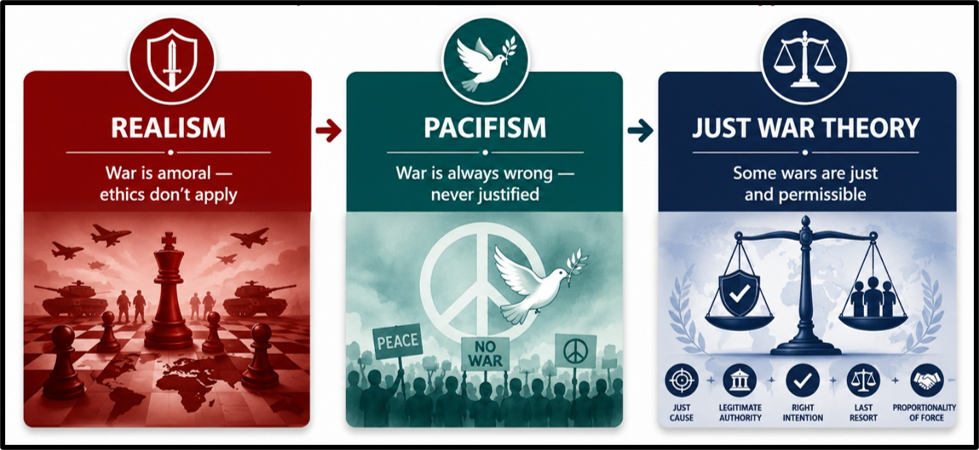
PACIFISM — Principled Opposition to All War
Pacifism totally opposes war. Pacifists argue that no moral grounds can ever justify war. Famous pacifists: Mahatma Gandhi and Martin Luther King Jr..
| Criticism of Pacifism | Pacifist Counter-Argument |
| Pacifist is a free-rider — enjoys citizenship benefits without sharing its security burden | Morality requires agents to avoid what they consider unjust. Many pacifists have braved prison and social boycott — they share burdens differently. |
| Pacifism is over-optimistic — Nazis could not have been defeated without war | Organised non-violent civil disobedience + international economic sanctions can effectively counter invaders. No invader can run factories or infrastructure against total non-cooperation. |
| Failure to resist aggression rewards aggressors and fails to protect the defenseless | Gandhi’s campaign against British rule and MLK’s civil rights movement demonstrate that non-violence can defeat determined oppression. |
| Pacifism is morally selfish — preserving personal purity at the expense of others | Genuine pacifists seek a humane world, not personal purity. Their concern for others IS their motivation. |
JUST WAR THEORY — The Moral Framework
Founded by Aristotle, Cicero, and Augustine, developed by Hugo Grotius. Its tenets are now codified in international law — the UN Charter, Hague Conventions, and Geneva Conventions.
| JUS AD BELLUM Justice of Resorting to War — 6 Requirements |
| 1. Just Cause War only for: self-defence from external attack; defence of others from attack; protection of innocents from brutal regimes; punishment for an uncorrected grievous wrong. Nazi invasion of Poland (1939) and Iraq’s invasion of Kuwait (1990) are clear cases of unjust aggression. 2. Right Intention Just cause must be the SOLE motive. No ulterior motives — land-grabbing, revenge, ethnic hatred are inadmissible. The state must intend to bring about a just peace. 3. Proper Authority War must be declared by the legitimate sovereign authority of the state — not rogue generals or non-state actors. 4. Last Resort War only AFTER exhausting all peaceful alternatives — especially diplomatic negotiations. 5. Probability of Success Avoid war if it clearly will not improve the situation. Prevents futile mass violence. Often operates against small, weak states. 6. Proportionality Expected benefits must be proportional to the human costs — to all combatants and third parties. If destruction outweighs the gain, the war is unjust. |
| Theory Note: Deontology + Consequentialism Combined Rules 1-3 (Just Cause, Right Intention, Proper Authority) = DEONTOLOGICAL — duty-based first-principle requirements. Rules 4-6 (Last Resort, Probability of Success, Proportionality) = CONSEQUENTIALIST — expected consequences must justify war. Just War Theory is remarkably sophisticated: it combines both major ethical traditions in a single framework. |
| JUS IN BELLO Justice in the Conduct of War |
| Obedience to International Laws on Weapons Chemical and biological weapons are treaty-forbidden. Nuclear weapons — not clearly prohibited, but their use would provoke massive international backlash and is virtually universally condemned. Discrimination and Non-Combatant Immunity Soldiers must attack ONLY legitimate military, political, and industrial targets. Almost all wars since 1900 had more civilian than military casualties. Deliberately targeting civilians is a war crime. Benevolent Quarantine for POWs Enemy soldiers who surrender must be treated humanely per Geneva Conventions — no torture, starvation, rape, or medical experimentation. US treatment of detainees at Guantanamo Bay remains deeply controversial. Prohibition of Evil Practices Forbidden: mass rape campaigns; genocide or ethnic cleansing; using poison or treachery; forcing POWs to fight their own side; using weapons whose effects cannot be controlled (biological agents). No Reprisals When Country A violates jus in bello, Country B cannot retaliate by also violating it. Also: states cannot use wartime emergency as cover to violate their own citizens’ fundamental rights. |
| JUS POST BELLUM Justice in the Termination of War |
| Proportionality Peace terms must be proportional to the offence that triggered the war. The harsh Treaty of Versailles (WWI) led directly to WWII — a defining lesson in disproportionate peace terms. Discrimination Peace agreement must distinguish leaders and soldiers of the defeated nation from its civilians. No sweeping socio-economic sanctions that punish ordinary citizens for their leaders’ crimes. Punishment If the defeated country blatantly violated human rights, its leaders should be prosecuted for war crimes — in appropriate courts, including the International Criminal Court (established by the 1998 Treaty of Rome). Compensation Reasonable reparations can be imposed on the defeated aggressor — but not a general tax on all civilians. Enough resources must remain for the defeated nation’s own reconstruction. Rehabilitation Post-war is an opportunity to reform institutions: demilitarization, police and judicial retraining, human rights education, creation of a minimally just society governed by a legitimate regime. |
| Pro-Coercive Regime Change | Anti-Coercive Regime Change (Sceptics) |
| The war causing regime change must itself be just and properly conducted | Almost impossible to transplant liberal democracy through military force |
| Regime being replaced must be illegitimate — it forfeits its state rights | Creates power vacuums, civil wars, and often worse instability (Iraq after Saddam is Exhibit A) |
| Goal must be building a reasonably just new regime | Who decides when ‘the preconditions are met’? USA and its allies decided for Iraq — is that legitimate? |
| Human rights must be respected during war and the transition | Coercive regime change is essentially neo-imperialism disguised as humanitarian intervention |
New Dimensions of International Morality
| New Dimension | The Moral Question It Raises |
| Transfer of resources from rich to poor nations | Do wealthy nations have a moral duty to fund development in poor countries? |
| Removing inequities in international economic exchanges | Is the current international economic order — trade, finance, WTO, IMF — fair to developing nations? |
| Greater voice for poor nations in international agencies | Why do rich countries dominate IMF, World Bank, WTO? Is this morally defensible? |
| Humanitarian assistance (famine, immiseration) | Does the international community have a duty to feed the hungry, regardless of national borders? |
| Intervention in states committing genocide or ethnic cleansing | When a state kills its own people, does sovereignty protect it from outside intervention? |
| Naturalization of migrants and immigrants | Do migrants have a moral right to citizenship in countries they settle in? |
| Cosmopolitan vs. national approach to morality | Should moral egalitarianism respect national borders, or should all humans have equal moral standing? |
International Economic Equity
The world is starkly divided between rich and poor nations. The poverty of former colonies is largely due to imperial exploitation. This historical inequality is now embedded in international economic institutions — IMF, World Bank, WTO — where rich nations hold disproportionate power.
| Post-WWII (1945 onwards) World Bank + IMF created. Aid linked to reconstruction and basic development goals. |
| ▼ |
| Cold War Era (1950s-1989) Aid weaponized — used as geopolitical tool by USA and USSR. Foreign policy distorted aid effectiveness. |
| ▼ |
| 1970s — Structural Adjustment Aid linked to neoliberal reforms (privatisation, trade liberalisation). Harsh impact on poor people. |
| ▼ |
| Late 1990s — Poverty Reduction Model New focus: not just income, but education, health, political participation. Empowerment-based approach. |
| ▼ |
| Millennium Development Goals (MDGs, 2000) 8 Goals: eradicate extreme poverty; universal primary education; gender equality; child health; maternal health; combat HIV/AIDS and malaria; environmental sustainability; global partnership for development. |
| ▼ |
| Sustainable Development Goals (SDGs, 2015–2030) 17 integrated goals addressing poverty, inequality, climate change, sustainable growth, peace, and global partnerships. |
| The 0.7% Commitment — A Moral Promise Unfulfilled 1958 — World Council of Churches: Rich countries should allocate 1% of national income as aid. 1970 — UN General Assembly: Agreed target of 0.7% of GNI as Official Development Assistance (ODA). Reality today: Very few rich countries meet even the 0.7% target. Aid remains far below agreed levels. Approximately 700 million people (8.5% of global population) still live on less than $2.15 per day. Raising the volume and quality of aid is a moral, strategic, and economic imperative. |
Genocide, Ethnic Cleansing & Humanitarian Intervention
| Situation | International Response and Moral Dimension |
| Nazi genocide — 6 million Jews killed | Established ‘Never Again’ principle — but genocide happened again in Cambodia, Rwanda, Bosnia |
| Ethnic cleansing in Yugoslavia (1990s) | Serbs and Croats drove each other out in a cycle of atrocities. NATO intervened on humanitarian grounds — controversial but widely accepted as necessary. |
| Iraq (2003) | USA-led coercive0 regime change — no UN mandate. Led to chaos. Most controversial intervention of the 21st century. |
| Bangladesh (1971) — India decisive response | India intervened as Pakistan used brutal military force; 10 million refugees entered India. Indira Gandhi withstood Nixon/Kissinger pressure. The US Seventh Fleet entered Bay of Bengal. |
| Sri Lanka Tamil genocide | India abstained on UN resolutions condemning human rights violations. Deeply inconsistent with India’s Gandhian tradition of solidarity with the oppressed. |
Immigration and National Boundaries
Some liberals argue moral egalitarianism should not be confined to national boundaries — nationality is an ‘accident of birth’ like race or gender, and cannot justify differential moral treatment.
This raises: Do illegal immigrants have a moral right to citizenship? This is live in the USA (Latin American immigrants) and in India (Bangladeshi infiltration into Assam, West Bengal, North-East).
| Three Arguments FOR Confining Moral Egalitarianism to National Boundaries |
| (A) National community as source of moral language: Duties towards fellow nationals differ because national community is the very source of language and values used in making moral judgments. Without national community, morality has no moorings. (B) National community as basis for well-being and protection: Distinct duties to fellow nationals arise from the necessity of protecting the national community and its way of life — a prerequisite for moral functioning. (C) Right of national self-determination includes right to close borders: A community sharing a culture and history has the right to preserve its distinct identity — even against needier outsiders. Admission and exclusion are at the core of national independence and self-determination. |
Moral Roots of India’s Foreign Policy
India’s foreign policy was shaped primarily by Jawaharlal Nehru, but deeply influenced by Mahatma Gandhi’s moral philosophy.
India’s approach represented a unique fusion of idealism and moral courage that won it global respect disproportionate to its economic and military strength.
Four Gandhian Pillars of India’s Foreign Policy
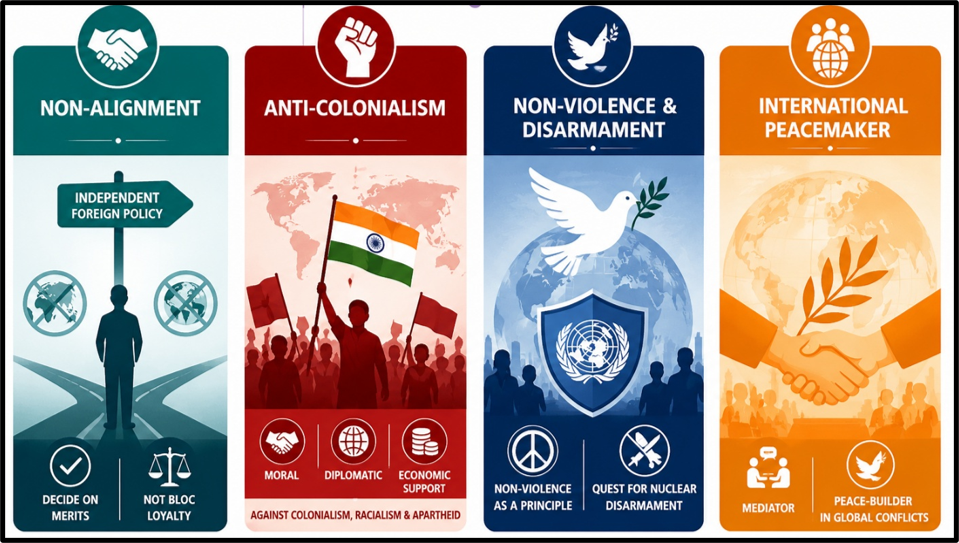
Panchsheel — Five Principles of Peaceful Coexistence (1954)
| # | Principle of Panchsheel |
| 1 | Mutual respect for each other’s territorial integrity and sovereignty |
| 2 | Mutual non-aggression |
| 3 | Mutual non-interference in each other’s internal affairs |
| 4 | Equality and mutual benefit |
| 5 | Peace and coexistence |
| Panchsheel — The Rise and Tragic Fall Signed with China in April 1954. Nehru: ‘If these principles were recognised in the mutual relations of all countries, there would hardly be any conflict and certainly no war.’ The five principles were incorporated into the ten principles of the Asian-African Conference (Bandung, 1955) and became the basis of the Non-Aligned Movement (NAM, Belgrade, 1961). TRAGIC IRONY: China — the very partner who signed Panchsheel — attacked India in 1962. The agreement lapsed and was never renewed. Lesson: Panchsheel had a strong strain of naivete and misconceived idealism divorced from harsh power realities. |
Critical Assessment of India’s Foreign Policy Decisions
| Area | The Idealist Mistake | The Realist Cost |
| Kashmir (1948) | India referred the Kashmir issue to UN — treating a political organ as an impartial judicial body | Lost a strategic advantage; the dispute remains unresolved 75 years later, Pakistan uses it to bleed India |
| China (1950s) | ‘Hindi-Chini Bhai-Bhai’ — naive trust in the Panchsheel partner | China attacked India in 1962; India was militarily humiliated; borders still disputed |
| Tibet | Failed to support Tibet’s autonomous status vis-a-vis China | Lost a crucial strategic buffer and powerful bargaining position — permanently |
| Bangladesh (1971) | India acted DECISIVELY — withstood Nixon/Kissinger pressure; US Seventh Fleet entered Bay of Bengal | A RARE SUCCESS — pragmatic policy driven by genuine humanitarian need and national interest |
| Sri Lanka Tamils | India abstained on UN resolutions condemning Tamil genocide | Morally inconsistent with Gandhian legacy; India seen as abandoning its own civilizational community |
| Pakistan Terrorism | Responses ‘confined to hand-wringing and breast-beating’ | India seen as amiable but ineffectual — a soft target for foreign and indigenous terrorist groups |
| Any criticism of Panchsheel may seem like flogging a dead horse. But its strong strain of naivete and misconceived idealism divorced from harsh realities continue to plague India’s foreign policy. |
India on Palestine — Gandhi’s Moral Statement (1938)
| My sympathy does not blind me to the requirements of justice. Palestine belongs to the Arabs in the same sense that England belongs to the English or France to the French. It is wrong and inhuman to impose the Jews on the Arabs… Surely it would be a crime against humanity to reduce the proud Arabs so that Palestine can be restored to the Jews partly or wholly as their national home. — Mahatma Gandhi — Harijan, November 11, 1938 |
India’s stance on Palestine is guided by this Gandhian moral position. However, it is a bit morally inconsistent: Gandhi held that English, French, and Arabs are entitled to homelands — but advised Jews to live wherever history placed them. Was this purely ethical, or partly strategic (appealing to Muslim support for the Indian independence movement)?
Today, India also recognises Israel and is a large buyer of Israeli military equipment — pragmatically balancing ideology with geopolitical interest.