
India and Central Asia
Locating the Region: Why Central Asia Matters
Central Asia is the landlocked cluster of five republics — Kazakhstan, Uzbekistan, Turkmenistan, Kyrgyzstan and Tajikistan — that sit at the very heart of the Eurasian landmass. Sealed off from the open sea and ringed by great powers, the region has, for over two millennia, been a corridor of trade, faith and empire rather than a mere periphery. For India it is not a distant abstraction but a part of its extended neighbourhood: a space with which the subcontinent shared deep civilisational bonds long before modern borders were drawn.
The strategic logic of the region is captured by the classical Heartland theory. In 1904, the geographer Halford Mackinder argued that whoever commands the Eurasian heartland controls the pivot on which world power turns. Central Asia lies at the centre of that pivot. This single idea explains why the region has been fought over repeatedly — from the ancient Silk Route, through the nineteenth-century imperial rivalry, to today’s contest among Russia, China and the United States. Understanding India’s engagement means understanding this permanent geopolitical gravity.
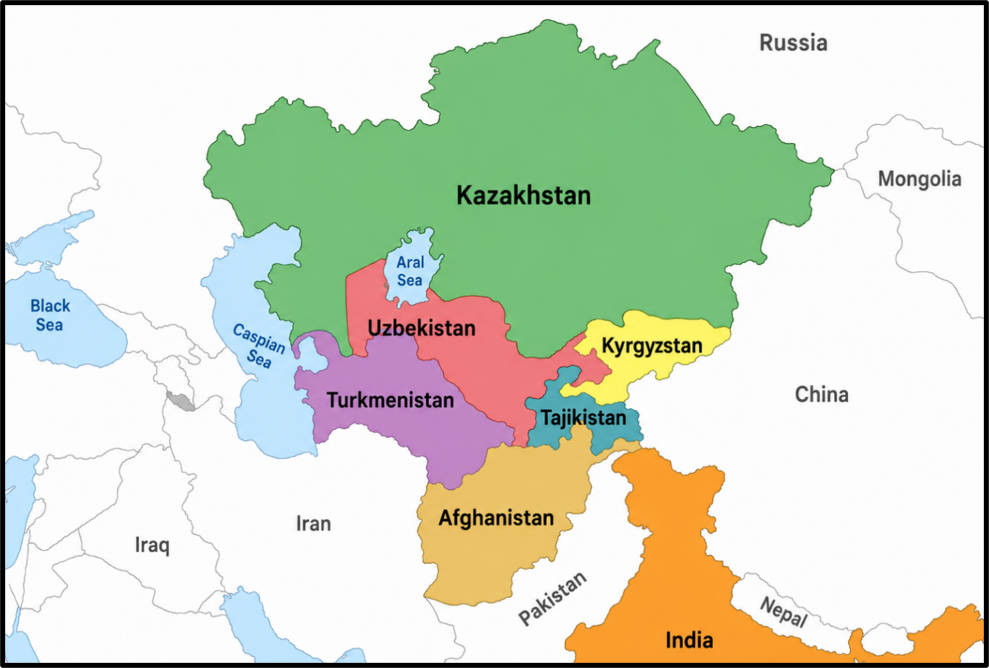
| Snapshot: The Five Republics Kazakhstan — the largest and most resource-rich; the world’s leading uranium producer (roughly two-fifths of global output). Uzbekistan — the demographic and cultural core; gas and gold reserves; the most populous republic. Turkmenistan — holds among the world’s largest natural-gas reserves; the source of the TAPI pipeline. Kyrgyzstan — mountainous and strategically located; site of past US and Russian military bases. Tajikistan — borders Afghanistan and China; central to India’s security engagement (Farkhor, Ayni). |
Historical Foundations: From the Silk Road to the New Great Game
India’s ties with Central Asia are among the oldest civilisational relationships in Asia. They form the essential backdrop to every contemporary policy, because in this region history is never merely history — it is a live source of goodwill and shared memory that Indian diplomacy consciously invokes.
The Ancient and Medieval Bonds
Contact reaches back to the Bronze Age: late-Harappan artefacts found at the site of Altyn-Depe in Turkmenistan point to interaction between the Indus civilisation and the region.
From around the second century BCE, groups migrated southward into India, bringing domesticated horses. The great artery of exchange was the Silk Route, whose southern branch linked India to Central Asia while its other branches reached out to China and Europe.
Along this route came the Sakas, Parthians and Kushanas. The Kushanas built a powerful, unified kingdom spanning northern India and Central Asia and became great patrons of Buddhism, which spread from India through Central Asia into China under their patronage.
In the reverse direction, India exported cotton, shawls, dyes and Ayurvedic medicine, and imported horses, gold and dry fruits. Craftsmen migrating from Central Asia brought embroidery skills that helped make Kashmir a lasting centre of the shawl trade — a small but telling example of how deeply the two regions were once woven together.
The Great Game: Anglo–Russian Rivalry
In the eighteenth and nineteenth centuries the region was annexed by the Tsar of Russia. Russian expansion southward — the capture of Tashkent in 1865 and consolidation of the trans-Caspian region by 1881 — alarmed the British Empire in India, which feared a Russian advance toward the subcontinent.
The resulting contest of espionage, buffer-building and proxy wars is remembered as the Great Game. Afghanistan was deliberately fashioned into a buffer state, and the Wakhan Corridor was drawn to keep the two empires apart.
The Great Game unfolded in three phases: the formation of a buffer zone; a phase of intense espionage (roughly 1907–1917); and, after 1917, firm Russian control that opened Central Asia’s vast cotton lands to Soviet industry.
| Concept: Soviet Rule Was Not Ordinary Colonialism From 1865 to 1918 Central Asia was a Russian colony; thereafter it came under direct Soviet rule. Scholars note that this was a mixture of imperialism and state-building rather than pure extraction — the Soviets invested heavily in education, electricity and industrialisation even as they exploited cotton and energy. Authority was maintained by channelling resources through local clan and sub-regional institutions (the so-called patrimonial states). After the USSR divided the region into five ethnic republics — controlling their foreign policy from Moscow — these networks were so entrenched that even Gorbachev’s reforms produced little unrest. This legacy explains the region’s later drift toward authoritarian rule and its distinctive ‘local rules’. |
Independence and the Revival of the Great Game
The collapse of the Soviet Union in 1991 gave the five republics independence and the strategic space to seek partners beyond Moscow. But the vacuum quickly refilled.
After the 9/11 attacks, the region became a hub for the United States’ Global War on Terror, drawing in American air and refuelling bases. The old rivalry was thus revived in a new form — a New Great Game played among the United States, Russia and China, each seeking to buy local loyalties and block its rivals. It is into this crowded arena that independent India had to re-enter.
The Evolution of India’s Central Asia Policy
India’s approach has matured through distinct phases, moving from a security-driven, defensive posture to a broad framework of connectivity and economic diplomacy. Tracing this evolution is the key to answering why the relationship, though warm, remained under-realised for so long.
The Look North Policy (1990s)
As the Cold War ended India adopted a concentric-circle view of foreign policy — immediate neighbourhood first, then the extended neighbourhood, then the great powers — within which Central Asia sat as an extended neighbour.
In 1995, during a visit to Turkmenistan, Prime Minister P. V. Narasimha Rao unveiled the Look North Policy, reaffirming the shared cultural legacy of the two regions. India also offered its own democracy, secularism and multiculturalism as a model the newly independent, multi-ethnic republics might emulate — a way of using soft power to counter the danger of religious extremism.
The overriding fear of the decade was that instability in Afghanistan — which fell to the Taliban in 1996, recognised by Pakistan — would spill extremism into the Muslim-majority republics and hand Pakistan the strategic depth it sought against India.
Tajikistan slid into civil war. In response India, with Russia and Iran, backed the Northern Alliance, built a military hospital near the Farkhor airbase in Tajikistan, and made use of the Ayni airbase for humanitarian support — the beginning of a durable India–Tajikistan security relationship.
| Why the Look North Policy Stayed Weak Several forces blunted the policy: Deteriorating security — Taliban rule, the Tajik civil war, and Pakistan-sponsored militancy in Kashmir forced India to view the region through a narrow security lens rather than an economic one. Competing priorities — after the Cold War India concentrated on rebuilding ties with the US and on its Look East Policy, leaving the north under-attended. No direct access — a hostile Pakistan and an unstable Afghanistan blocked overland routes to a landlocked region. China’s head start — Beijing had already begun deep economic penetration, narrowing the space left for India. |
The Connect Central Asia Policy (2012)
By the 2000s two things had changed: India’s liberalised economy was growing and hungry for resources, and the US presence had temporarily suppressed extremism. India recognised that the security-heavy Look North approach could not deliver, and that a policy built on economic diplomacy — while retaining a security component — was needed.
In June 2012, at the first India–Central Asia Dialogue in Bishkek, India announced the Connect Central Asia Policy (CCAP), a broad-based framework for re-engagement.
The thrust of the CCAP is connectivity for energy security, anchored on the International North–South Transport Corridor. It also spans political engagement, strategic and security cooperation (joint and counter-terrorism exercises, intelligence sharing), youth and IT-skills exchanges, medical and educational partnerships, and cultural ties. In effect the CCAP gave India a comprehensive, all-dimensional template to re-enter the region.
The Arc of India’s Policy — at a glance
| Ancient–Medieval: Silk Route civilisational bonds (trade, Buddhism, culture) |
▼
| Cold War: Engagement filtered through the USSR; non-alignment limits depth |
▼
| 1990s: LOOK NORTH POLICY — security-driven, defensive, under-realised |
▼
| 2012: CONNECT CENTRAL ASIA POLICY — connectivity + economics + security |
▼
| 2022 onward: India–Central Asia Summit — institutionalised, leader-level partnership |
Significance of Central Asia for India
The importance of the region operates at three levels — historical, geopolitical and economic — which together make Central Asia what one might call a litmus test of India’s aspiration to be a genuine Eurasian and global power.
The strands are deeply interlinked: energy needs drive connectivity, connectivity requires stability, and stability depends on the security cooperation that culture and goodwill make possible.
Strategic and Geopolitical
- Heartland location: the region links West Asia, Eurasia and South Asia, giving India a foothold in the pivot of the continent and a stake in the balance among Russia, China and the US.
- Countering strategic encirclement: a core Indian objective is to prevent Pakistan from using Central Asia to gain strategic depth, and to ensure no single power monopolises the region.
- Afghan stability: India and the republics share an interest in a stable Afghanistan; the US withdrawal has raised the stakes for regional coordination.
- Multilateral platforms: membership of the Shanghai Cooperation Organisation gives India a seat at the region’s principal security-and-economic table, including counter-terror cooperation through its RATS mechanism.
Economic and Energy
- Energy basket: the region is rich in oil, gas and uranium. Kazakhstan is the world’s largest uranium producer and a partner in civil-nuclear fuel supply; Turkmenistan holds among the world’s largest gas reserves and is the source of the TAPI pipeline; Uzbekistan offers gas and gold.
- Critical minerals: gold, copper, iron, aluminium and other minerals vital to Indian industry and the clean-energy transition.
- Alternative market: engagement offers the republics an alternative to Chinese economic dominance, and India a new export destination and investment frontier.
Connectivity and Civilisational
- Corridors: the INSTC and Chabahar Port are designed to bypass a hostile Pakistan and reach the region via Iran and Afghanistan.
- Soft power and diaspora: Indian films, music and traditional medicine (Ayurveda, Siddha) enjoy genuine popularity; people-to-people ties, students and shared heritage sustain a reservoir of goodwill unmatched by other partners.
Areas of Cooperation
Contemporary engagement spans several reinforcing pillars. The table below organises the principal instruments; the paragraphs that follow draw out the most important of them.
| Dimension | Key Instruments & Initiatives |
| Trade & Connectivity | International North–South Transport Corridor (INSTC); Chabahar Port; Ashgabat Agreement; TIR Convention; e-network for tele-education and tele-medicine |
| Energy | TAPI gas pipeline (Turkmenistan); uranium supply from Kazakhstan; joint gas exploration with Uzbekistan; ‘One Sun, One World, One Grid’ solar cooperation |
| Defence & Security | Joint exercises — DUSTLIK (Uzbekistan), Khanjar (Kyrgyzstan), Kazind (Kazakhstan); intelligence-sharing; SCO–RATS counter-terror cooperation |
| Health | Vaccine diplomacy; ‘One Earth, One Health’; friendship hospitals; traditional medicine outreach |
| Culture & People | Connect Central Asia Policy’s people-to-people focus; student exchanges; centres of higher learning; popular Indian cinema and music |
Trade and Connectivity
Because the region is landlocked and Pakistan blocks the direct overland route, connectivity is the master key to the entire relationship. The International North–South Transport Corridor (INSTC) — a multimodal rail-road-sea network linking India through Iran and Russia to Central Asia and Europe — is India’s flagship answer, allowing it to reach the region without Pakistani transit and offering a counter to China’s Belt and Road.
Iran is the lynchpin: Chabahar Port and the Zaranj–Delaram highway operationalise access via Afghanistan and Iran. India has also joined the Ashgabat Agreement, a multimodal transit accord for the movement of goods between Central Asia and the Persian Gulf.
Energy Cooperation
Energy security is the economic heart of the CCAP. India seeks to diversify its imports toward this resource-rich neighbourhood. The TAPI pipeline (Turkmenistan–Afghanistan–Pakistan–India) would carry less carbon-intensive gas from among the world’s largest reserves; Kazakhstan supplies uranium for India’s civil-nuclear programme; and India and Uzbekistan have agreed to jointly explore and develop gas reserves.
Pipeline diplomacy, however, carries two structural burdens: India’s lack of direct geographical access, and the passage of pipelines through the volatile Afghanistan–Pakistan corridor, which multiplies security costs and pits Russian and American energy strategies against each other.
Defence and Security
Security cooperation has deepened through regular bilateral exercises — DUSTLIK with Uzbekistan, Khanjar with Kyrgyzstan and Kazind with Kazakhstan — alongside intelligence-sharing and counter-terror coordination under the SCO’s Regional Anti-Terrorism Structure.
The shared concern is the region’s proximity to the Golden Crescent and the twin threats of narco-terrorism and extremist spillover from Afghanistan.
Health and Cultural Cooperation
The COVID period saw India extend vaccine diplomacy and champion the principle of ‘One Earth, One Health’, warmly received by the region’s leaders.
Culturally, the Connect Central Asia Policy has consciously foregrounded people-to-people interaction: students travel in both directions, Indian films and Hindi music remain popular, and traditional systems of medicine extend India’s soft-power footprint. This civilisational goodwill is the quiet foundation on which the harder strands of cooperation rest.
The Crowded Arena: Interests of Other Powers
India does not operate in a vacuum. Central Asia is a theatre of the New Great Game, and India’s room for manoeuvre is defined by the interests of three larger actors. Grasping their strategies is essential to explaining both the opportunities and the constraints on Indian policy.
| Power | Core Interest | Principal Instruments |
| Russia | Preserve a privileged role and ‘regional primacy’ in the post-Soviet space | CSTO (a security bloc positioned against NATO); Eurasian Economic Union; energy pipeline networks; deep cultural-linguistic legacy |
| China | Secure resources and stabilise its restive Xinjiang (XAR) province | Belt and Road / OBOR investments; SCO and RATS; resolution and demilitarisation of borders; ‘Go West’ development programme |
| United States | Limit Russian and Chinese dominance; access Afghanistan; diversify energy routes | Post-9/11 military bases; Baku–Tbilisi–Ceyhan pipeline; a shift after 2008 from ‘democracy promotion’ to pure security engagement |
Two dynamics matter most for India.
- First, China’s economic dominance: after the Cold War Beijing resolved its border disputes, demilitarised its frontiers, flooded weak Central Asian economies with manufactured goods and extracted resources in return, cementing a presence India now struggles to match. China’s deeper motive is the security of Xinjiang — it needs a stable region so that Uyghur militancy is not inflamed — which it pursues under the umbrella of the SCO.
- Second, the Russia–China equation: the two cooperate to keep the US in check, yet Russia is wary of becoming a junior partner as China’s economic weight grows. India’s opening lies precisely here — the US prefers to engage India as a means of balancing both Russia and China, giving New Delhi leverage it can quietly exploit.
Issues and Challenges
Despite genuine warmth, the relationship remains under-realised. The obstacles are structural rather than sentimental, and they cluster around geography, competition and capacity.
- The connectivity handicap: a hostile Pakistan and an unstable Afghanistan block the natural overland routes; the INSTC has been slow to mature and Chabahar remains under-utilised. This is the single greatest constraint on the entire relationship.
- Modest trade: trade with the region remains only around two billion dollars — a fraction of its potential and dwarfed by China’s footprint — reflecting weak logistics and limited economic presence.
- Chinese dominance: China’s Belt and Road investments and entrenched commercial ties have expanded its influence and sidelined Indian interests.
- The security environment: extremism linked to the Taliban and other actors, plus proximity to the Golden Crescent, keeps the risk of instability and narco-terrorism high.
- Geopolitical marginalisation: the China–Russia alignment and divisions among the republics weaken regional unity and dilute India’s leverage.
- Ignoring the ‘local rules’: India has at times misread the way these authoritarian states actually operate. The setback over the Ayni airbase — where India’s hope of a military foothold faltered — is the classic example of underestimating local political realities.
The Way Forward
A more effective strategy must convert historical goodwill into structural presence. The priorities interlock: connectivity enables trade, trade underwrites influence, and influence secures the stability on which everything else depends.
- Make connectivity work: fully operationalise the INSTC and Chabahar; explore pragmatic trilateral arrangements (including with Iran) to move energy and goods, and reduce dependence on any single blocked route.
- Deepen the security footprint: consolidate defence ties, revisit the case for facilities such as those in Tajikistan following the US withdrawal, and coordinate with Russia to counterbalance China’s growing military weight.
- Engage Afghanistan pragmatically: some working relationship with the powers that control Afghan territory is unavoidable if connectivity and market access to the region are to be secured.
- Scale trade and finance: push for a free-trade arrangement with the Eurasian Economic Union, develop a common-market approach, and provide trade-finance tools to lift volumes well beyond current levels.
- Position as the BRI alternative: offer joint ventures in space, AI, defence technology, renewable energy and pharmaceuticals — high-value cooperation the region welcomes as a counterweight to dependence on China.
- Leverage soft power and food security: expand friendship hospitals, medical and educational exchanges, and use India’s food-grain surpluses to build goodwill during global supply shocks.
- Institutionalise the dialogue: sustain and build on the leader-level India–Central Asia Summit mechanism, converting episodic engagement into a permanent architecture.
Conclusion
India’s engagement with Central Asia is best read as an attempt to reclaim a relationship that geography and history gifted but the modern era interrupted. The bonds are ancient and the goodwill is real, yet the hard realities of landlocked access, Chinese dominance and a persistently fragile security environment have kept the partnership below its potential.
The task ahead is to translate civilisational affinity into concrete connectivity, energy and economic ties. Because the region sits at the very pivot of Eurasia, India’s success there is, in the end, a measure of its own arrival as a serious continental and global power.