
Anatomy and Dynamics of Left-Wing Extremism
Organisational Structure
To fight the Naxalite movement, one must first understand that it is not a loose band of rebels but a tightly organised, militarised political party built deliberately on the Maoist template of the three magic weapons — the Party, the army and the united front.
Everything the movement does flows from this architecture. We will look at each limb in turn: the Party command, the armed wing, the front organisations, and the contested world of urban Naxalism.
The Pyramid of Command: Politburo, Central Committee and the Committee Chain
Since the merger that created it, the Communist Party of India (Maoist) is the single party at the apex of the movement. It is organised as a strict, top-down pyramid modelled on Leninist ‘democratic centralism’ — decisions flow downward and discipline is absolute.
Understanding this chain matters, because the State’s strategy has been precisely to decapitate it from the top.
| Tier | Role |
| Politburo | The highest decision-making body — a small group of the most senior leaders who set overall strategy and ideology. |
| Central Committee (CC) | The apex policy and command organ below the Politburo; its members head zones and functions across the country. |
| Regional Bureaus / Special Zonal & State Committees | Translate central policy into theatre-level command — e.g. the powerful Dandakaranya Special Zonal Committee (DKSZC) covering the Bastar heartland. |
| Divisional, Area and Village-level Committees / Cells | The grassroots machinery that runs local mobilisation, recruitment, intelligence and the parallel administration. |
Alongside the fighting cadres sits a second, quieter tier — the ‘Jan Militia’, a large village-based reserve of part-time supporters who provide logistics, shelter, intelligence and manpower without being full-time armed guerrillas. It is this civilian scaffolding that historically made the movement so hard to uproot: killing a guerrilla is one thing; dismantling a village’s embedded support network is quite another.
The People’s Liberation Guerrilla Army
The movement’s armed struggle — the second magic weapon — is carried out by its military wing, the People’s Liberation Guerrilla Army (PLGA), raised in 2000. The PLGA is not a rabble; it is structured in ascending tiers of capability, from village defenders up to conventional-style formations:
| Force | Composition and role |
| Basic Force | The lowest tier — local squads and the gathering of sympathisers and part-time fighters at village level. |
| Secondary Force | Area committees plus guerrilla squads — the mainstay of hit-and-run operations. |
| Main Force | The elite tier, structured like a regular army on a battalion and platoon format, with a dedicated intelligence unit; used for the large set-piece ambushes. |
Two features deserve note.
- First, the PLGA has always relied on a strikingly high proportion of women — historically 40 to 50 per cent of cadres — reflecting both genuine recruitment among marginalised tribal women and the movement’s propaganda claim of emancipation.
- Second, its historic strength figures (once estimated in the several thousands, backed by a Jan Militia many times larger) must today be treated as obsolete: the force has been hollowed out by killings, surrenders and arrests, as the dated block below records.
Frontal Organisations, Mass Organisations and the Legal-Front Strategy
The third magic weapon — the united front — is where the movement fights not with guns but with ideas, law and propaganda. This is the above-ground, ostensibly ‘legal’ face of the insurgency, and arguably its most durable asset.
Frontal organisations are bodies that publicly deny any link to the CPI (Maoist) while being covertly tied into its structure. They operate under the garb of human-rights, students’, workers’ and cultural groups — historically bodies such as the Revolutionary Democratic Front (RDF), radical students’ and youth federations, and workers’ associations. Their tasks are to:
- mobilise sympathy by campaigning on issues such as land acquisition, displacement, SEZ policy and alleged human-rights violations by security forces;
- recruit intellectuals, students and activists into the movement;
- raise funds and provide urban shelter and logistics for underground cadres;
- wage a propaganda war — the movement maintains a powerful propaganda machinery, active even in the national capital, that swings into action against every State step to check it, while staying conveniently silent when Naxalites kill civilians.
This is the legal-front strategy: exploit the openness of a democracy — its free press, its courts, its civil-society space — to shield and sustain a movement dedicated to overthrowing that same democracy. The movement is adept at using legal processes and the sluggishness of the judicial system to escape conviction. Legally, the CPI (Maoist) and its formations and front organisations stand banned under the Unlawful Activities (Prevention) Act, 1967, though the precise status of individual outfits has at times been contested in the courts — a genuine grey zone we return to in the assessment of civil liberties.
The Urban Perspective Document and the ‘Urban Naxal’ Debate
It is commonly assumed that Naxalism is purely a jungle phenomenon of the undeveloped countryside. That is only half the picture. Urban work has always been part of Maoist strategy. This was set out explicitly in a 2004 internal document titled ‘Urban Perspective: Our Work in Urban Areas’, which defined the cities’ role: to supply leadership, recruits, funds, shelter and a united front for the rural war.
The urban strategy targets industrial workers and the urban poor for a mass base, and simultaneously cultivates intellectuals, students, middle-class professionals, and organisations working on the grievances of Dalits, women and religious minorities to build ‘tactical united fronts’.
The ideologues who run this network — often academics and activists operating behind human-rights fronts — are, in the security establishment’s view, more dangerous over the long run than the armed cadres, because they keep the movement’s ideas alive.
From this comes the contested label ‘Urban Naxal’. Because the term touches the boundary between security and civil liberty, an aspirant should be able to present both sides fairly:
| The security argument | The civil-liberties counter-argument |
| Urban ideologues provide the movement’s ideological, logistical and financial backbone, radicalise the middle class, and channel foreign-funded NGO money — a real, deliberate strategy, not a fantasy. | The label is vague and elastic, and risks being used to criminalise dissent, activism and legitimate human-rights work, chilling free speech guaranteed under the Constitution. |
| The State must be able to act against those who materially support an armed, banned insurgency, even if they never carry a weapon. | Guilt must rest on evidence of material support to violence, tested in court — not on ideological sympathy or association alone. |
The debate crystallised around the Bhima-Koregaon case, in which activists and intellectuals were arrested from 2018 onward under the Unlawful Activities (Prevention) Act on allegations of Maoist links.
A balanced answer holds both truths: urban support networks are real and strategically vital to the movement, and the power to act against them must be disciplined by evidence and due process so that it does not become a tool against ordinary dissent.
| Current Status (as of July 2026) The organisational description above is structural and will endure; the leadership figures below are volatile and are kept separate. The command pyramid has been all but decapitated within a single year: |
- General Secretary Nambala Keshava Rao ‘Basavaraju’ was killed in an operation in Chhattisgarh in May 2025.
- His successor Thippiri Tirupathi ‘Devuji’, who took over in September 2025, surrendered in February 2026.
- The movement’s feared military commander Madvi Hidma was killed in November 2025.
- By reported accounts the Politburo and Central Committee have been reduced to a bare handful of leaders; in 2025 alone over 2,000 cadres surrendered, and the PLGA’s earlier strength estimates no longer hold.
Geography and Trends
Naxalism has always been a geography as much as an ideology. It lives in a specific kind of terrain — forested, mineral-rich, tribal, and remote from the reach of the State. To understand where it thrives, and how dramatically its map has shrunk, is to understand the whole trajectory of the conflict.
The Red Corridor
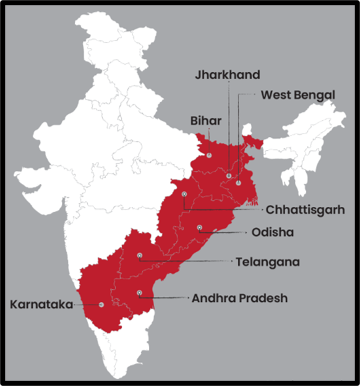
The belt worst affected by the insurgency is popularly called the Red Corridor — a broad, contiguous swathe of the eastern, central and southern parts of India. Two features define it almost everywhere: a high tribal (adivasi) population, and severe social and economic disparity.
At its core lies the Dandakaranya region — the dense forest tri-junction where Chhattisgarh, Odisha, Maharashtra and Telangana meet — which became the movement’s fortress and headquarters.
The Government does not treat all affected districts alike. The Ministry of Home Affairs classifies them into graded categories, so that money and forces can be concentrated where violence is worst.
In the most recent framework these are:
- ‘Most Affected Districts’ — the small hard core where violence persists;
- ‘Districts of Concern’ — where a residual or re-emerging threat is watched;
- ‘Other LWE-Affected Districts’ — the wider periphery under monitoring.
This grading is the tool through which schemes such as security-related funding are targeted, and it is revised as the situation improves — which, over the last decade, it has done at remarkable speed.
Incidents, Fatalities and the Trend Line
The single clearest way to grasp the movement’s rise and fall is the violence curve, which peaked around 2010 and has fallen almost vertically since:
| Year | Incidents of violence | Total deaths (civilians + security forces) | Marker |
| 2010 | 1,936 | 1,005 | Peak of the insurgency |
| 2024 | 374 | 150 | Chhattisgarh alone: 267 incidents |
| 2025 | 234 | ≈ 100 | Over 2,000 cadres surrendered |
| Change 2010→2025 | ≈ −88% | ≈ −90% | Near-collapse of armed violence |
The geographic shrinkage is just as stark. The number of LWE-affected districts fell from about 126 in 2013 to single digits by early 2026, while the ‘most affected’ core was cut to just three. Read together, the two trends tell one story: the movement has lost both its capacity for violence and its territorial spread at the same time.
Shrinkage to the Core: Bastar, Abujhmad and the Jharkhand–Bihar Tri-junction
As the wider corridor was cleared, the insurgency retreated into a few last redoubts — the places hardest for the State to reach. Three matter most:
▸ The Bastar division of Chhattisgarh — the final stronghold, containing the three most-affected districts of Bijapur, Sukma and Narayanpur; the epicentre of both Maoist strength and the State’s decisive operations.
▸ Abujhmad — a vast, largely unsurveyed and unmapped forest straddling Narayanpur and neighbouring districts — a natural fortress that long served as the movement’s safest sanctuary and training ground.
▸ The Jharkhand–Bihar–Odisha tri-junction — including the Saranda forest, a secondary refuge to which surviving leaders have withdrawn as Bastar was squeezed.
The lesson of the geography is that the conflict has been compressed from a corridor spanning a dozen States into a handful of forest pockets — a change that makes the endgame possible but also concentrates the remaining danger in the most difficult terrain.
Modus Operandi and Resources
How does the movement actually fight, and how does it pay for the fight? Its methods flow directly from Maoist doctrine — guerrilla warfare — while its resources come from a shadow economy of extortion layered over India’s mineral belt. We take the two in turn.
The Repertoire of Violence: IEDs, Ambushes, Jan Adalats and Sabotage
The Naxalites practise guerrilla warfare — the classic method of a weaker force against a stronger one: ambushes, sabotage, raids, hit-and-run attacks and extreme mobility, refusing open battle and striking where the State is thin. Their principal instruments are:
- Improvised Explosive Devices (IEDs) and landmines — the single biggest killer of security personnel; deep-planted pressure mines on forest roads are especially hard to detect.
- Ambushes on security convoys, often during the annual Tactical Counter Offensive Campaign (TCOC) from March to the early monsoon.
- Attacks on the symbols and sinews of the State — police stations, and infrastructure such as railways, roads, power transmission and mobile towers — and the forcible obstruction of development works like road-building, to keep the State out.
- Jan Adalats (‘people’s courts’) — summary tribunals through which the movement dispenses its own brutal justice, punishes alleged ‘informers’, and enforces its parallel authority.
Target selection follows a logic: hit the security forces to demoralise them and seize their weapons; hit infrastructure to freeze development and preserve the vacuum the movement feeds on; and hit ‘informers’ among civilians to terrorise the population into silence. It is this deliberate targeting of civilians that gives the insurgency its terrorist edge, alongside its insurgent character.
| The Tactical Counter Offensive Campaign (TCOC) Every year, from roughly March until the early monsoon in July, the Maoists historically launched a concentrated wave of attacks called the TCOC. The dry-season timing suits jungle movement and ambush. Its purpose is threefold: to exhibit and consolidate strength, to throw security forces into disarray, and to cover an annual recruitment drive. Some of the deadliest attacks on record fell within TCOC windows. |
The War Chest: How the Movement is Financed
An insurgency runs on money, and the Naxalite economy is essentially one of organised extortion layered over the resource wealth of the very regions it claims to protect. Left-wing extremism is most intense precisely in areas rich in coal, iron ore, bauxite, manganese, nickel and copper — Odisha and Jharkhand alone hold more than half the country’s coal reserves — which gives the movement enormous scope for levy and protection money.
| Source of funds | How it works |
| Levy / extortion on contractors | A fixed ‘tax’ on road, infrastructure and government-project contractors working in the movement’s areas of influence — the largest single stream. |
| Mining and mineral trade | Protection money from iron-ore and coal operators and illegal mining in the mineral belt. |
| Tendu patta (leaf) trade | Seasonal levy on contractors who collect tendu leaves (used to roll bidis) from Maoist-influence forests. |
| Protection money, kidnapping and abduction | Coercive payments from the wealthy, sometimes backed by kidnapping for ransom. |
| Laundering via overground workers | Extorted cash is moved and laundered into movable and immovable assets through overground sympathisers, chiefly in Bihar and Jharkhand. |
The scale is, by its nature, impossible to fix precisely; estimates are ‘guesstimates’ built from seized cash-books. Figures cited by senior police and intelligence officers have ranged from a few hundred crore rupees a year in a single State to an all-India figure once put as high as the low thousands of crore rupees at the movement’s peak.
Whatever the exact number, the point for an answer is that the finance is substantial, resource-linked and criminal — which is why choking it, through agencies such as the National Investigation Agency and the Enforcement Directorate, became a central plank of the State’s strategy.
Arms and Alliances: Procurement and External Links
The movement arms itself from three main channels: weapons looted from police and paramilitary forces in ambushes and armoury raids; crude local manufacture of arms and vast quantities of IEDs; and purchase through the grey arms market. Beyond its own borders, it has cultivated a web of alliances — a ‘strategic united front’ against the Indian State:
| Linkage | Nature |
| North-East insurgent groups | Fraternal ties with groups such as the RPF/PLA of Manipur and the NSCN (IM) of Nagaland, chiefly for sourcing arms. |
| Jammu & Kashmir militant groups | Expressions of solidarity as part of a common front against the Indian State. |
| Foreign Maoist parties | Ideological links with Maoist organisations abroad, notably the Communist Party of the Philippines, and others. |
| CCOMPOSA | Membership of the Coordination Committee of Maoist Parties and Organisations of South Asia, grouping Maoist outfits of India, Nepal, Bangladesh and Sri Lanka to spread ‘protracted people’s war’ across the region. |
Root Causes Revisited
The general theory of why deprivation breeds extremism — relative deprivation, structural violence, the governance deficit — we have already studied earlier.
What follows is narrower and sharper: the specific grievances that feed the Naxalite fire, the State’s own missteps that fanned it, and the hard question of whether the Maoists are what they claim to be.
Land, Forest and Displacement
At the movement’s emotional core is a single slogan — ‘Jal, Jangal, Jameen’ (water, forest, land) — the tribal claim to the resources of their own habitat. The grievances clustered here are the movement’s most powerful recruiting sergeant:
- Failed land reform — loopholes in land-ceiling laws left the landless poor without title to the land they till, while powerful groups encroached on public and forest land.
- Tribal dispossession — weak enforcement of laws protecting tribal land, and inadequate compensation for land acquired for mines and projects.
- Development-induced displacement — mining and industrial projects that uproot tribal communities from forests they have lived in for generations, as seen in resource conflicts in Odisha’s Niyamgiri hills and Chhattisgarh’s Hasdeo Arand.
The legal shields meant to prevent all this — the special protections for Scheduled Areas, tribal self-governance in Scheduled Areas, and community forest rights — exist on paper, but their weak implementation is itself a driver.
The detailed treatment of these tribal-rights instruments and their gaps sits within the study of the tribal question; here it is enough to see that the movement grows in the space between the promise of these laws and their delivery.
The Governance Vacuum, Police Excess and the Salwa Judum Experience
Grievance alone does not make an insurgency; it needs a vacuum to grow in, and the State has too often supplied one. Three failures stand out.
First, the absent state: in remote areas the everyday institutions that signal governance — police stations, schools, health centres, development blocks, banks — function poorly or not at all, and the movement steps into the void with its own parallel authority.
Second, police excess and corruption: allegations of high-handedness, custodial abuse and petty corruption erode trust and hand the movement a steady stream of recruits and propaganda. The absence of a responsive State is felt not as neutrality but as hostility.
Third, and most instructive, is the failure of a State counter-strategy that itself became a cause — the Salwa Judum. Launched in Chhattisgarh in 2005, it was a State-backed vigilante campaign that armed local tribal youth as Special Police Officers (SPOs), popularly the ‘Koya Commandos’, to fight the Maoists. The result was catastrophic: it militarised civilians, split tribal society against itself, displaced tens of thousands, and generated fresh atrocities and fresh recruits for the very insurgency it was meant to defeat.
| Case Study — Nandini Sundar v. State of Chhattisgarh (2011) In this landmark judgment, the Supreme Court struck down the Salwa Judum and the practice of appointing barely-trained tribal youth as armed Special Police Officers for counter-insurgency. It held that arming poorly-trained civilians for a dangerous policing role violated Article 14 (equality) and Article 21 (right to life and dignity) — of the SPOs themselves and of the wider population. The Court ordered the State to disband and disarm the Salwa Judum, recall all firearms issued to SPOs, and cease using them in anti-Maoist operations. The case is the definitive statement that the State cannot outsource its monopoly on force to vigilantes, and that fighting an insurgency by lawless means only deepens it. It is essential citation for any answer on the human-rights dimension of internal security. |
Are the Maoists Messiahs of the Downtrodden? A Critical Assessment
The movement presents itself as the armed conscience of India’s poorest — fighting for the tribal, the landless, the exploited. A mature answer neither swallows this claim nor dismisses the grievances it rests on. It weighs both sides.
What is genuine: the grievances the movement names are real. Land alienation, displacement, tribal dispossession, the absent state and police excess are not Maoist inventions; they are documented failures, and it is precisely because they are real that the movement finds recruits at all. To deny this is to misunderstand the problem.
What is hollow: the claim that the movement exists to relieve that suffering. On the evidence, its real aim is political power, not social uplift. It has a vested interest in keeping poverty and underdevelopment alive, because development and a functioning State are what shrink its territory — which is why it blocks roads, schools, health centres and other development works by force.
It denies the very tribals it claims to champion both democracy (coercing panchayat leaders, boycotting elections) and development, and rules them through the fear of the gun and the Jan Adalat rather than through consent.
The considered verdict, then, is that Naxalism is best understood as a movement that instrumentalises real suffering for the seizure of power. Recognising the genuine grievances is essential — addressing them is the heart of any lasting solution — but that is a wholly different thing from accepting the movement’s account of itself. The State’s task is the hard one: answer the grievance without conceding the ideology — the theme the response and way-forward sections take up next.