
Shanghai Cooperation Organisation (SCO)
| Snapshot — Key Facts & Milestones | |
| Founded | 15 June 2001, in Shanghai (MEA) |
| Predecessor | The “Shanghai Five” grouping, formed in 1996 |
| Members (2025) | Ten — China, Russia, Kazakhstan, Kyrgyzstan, Tajikistan, Uzbekistan, India, Pakistan, Iran (2023) and Belarus, the 10th, admitted in 2024 |
| Secretariat | Beijing, China |
| Security organ | Regional Anti-Terrorist Structure (RATS), headquartered in Tashkent |
| Official languages | Russian and Chinese |
| India’s status | Observer from 2005; full member since 2017; chaired the SCO in 2023 (MEA) |
A Eurasian Heavyweight
The SCO is one of the world’s largest regional organisations by territory and population, spanning much of Eurasia. It began as a border-management dialogue and has grown into a broad platform for security, counter-terrorism and connectivity cooperation.
For India it is a rare table at which it sits alongside China, Russia, Pakistan, Iran and the Central Asian states at once — an asset and a diplomatic tightrope in equal measure.
Origins and Evolution
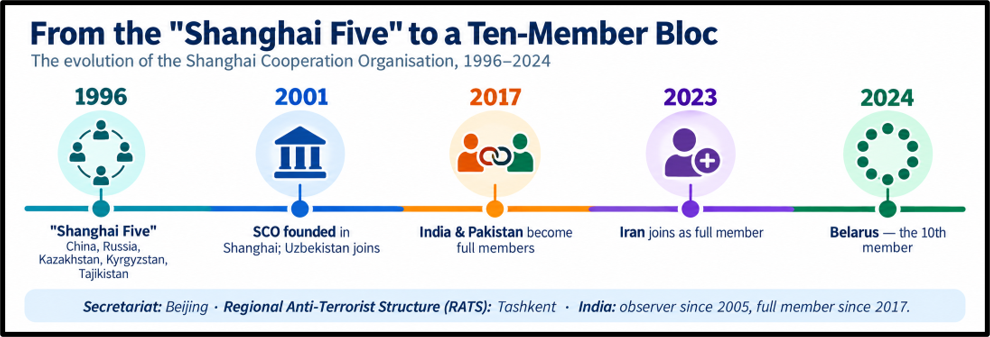
The SCO traces to the “Shanghai Five” — China, Russia, Kazakhstan, Kyrgyzstan and Tajikistan — formed in 1996 to settle post-Soviet border questions and build confidence. With the addition of Uzbekistan, the group was reconstituted as the Shanghai Cooperation Organisation on 15 June 2001.
It then expanded well beyond Central Asia: India and Pakistan became full members in 2017, Iran in 2023, and Belarus became the tenth member in 2024. The organisation’s ethos is captured in the “Shanghai Spirit” of mutual trust, equality and consensus.
Structure and the “Three Evils”
The SCO’s apex body is the Council of Heads of State, supported by the Council of Heads of Government and a network of ministerial meetings. Two standing institutions anchor its work: the Secretariat in Beijing, which handles administration and coordination, and the Regional Anti-Terrorist Structure (RATS) in Tashkent. Security cooperation is framed around combating the “three evils” — terrorism, separatism and extremism.
India and the SCO
India joined as an observer in 2005 and became a full member in 2017. It contributes about 5.9% of the SCO budget and holds quota posts in both the Beijing Secretariat and the Tashkent RATS. India chaired the SCO in 2023, hosting the summit in virtual format under the theme of a “SECURE” SCO.
New Delhi uses the platform to pursue counter-terrorism cooperation and connectivity into Central Asia (via the International North-South Transport Corridor and Chabahar), while carefully guarding its positions — notably, India has declined to endorse China’s Belt and Road Initiative in SCO documents.
Challenges
- A China-Russia tilt: the SCO is often read as a China- and Russia-led, non-Western grouping, which can sit awkwardly with India’s partnerships in the West and the Quad.
- Bilateral friction inside the tent: India’s tensions with both Pakistan and China limit how much genuine security cooperation is possible.
- The BRI divide: India’s refusal to endorse the Belt and Road Initiative — on sovereignty grounds over the China-Pakistan Economic Corridor — repeatedly surfaces in joint statements.
- Consensus and dilution: a large, diverse membership makes binding, action-oriented outcomes hard to reach.
Way Forward
- Leverage RATS for practical intelligence-sharing and counter-terrorism, India’s clearest area of convergence.
- Push connectivity on India’s terms through the INSTC and Chabahar to reach energy-rich Central Asia without endorsing the BRI.
- Use the SCO as a hedging platform for strategic autonomy — engaging Russia, Iran and Central Asia while sustaining Western ties.
4 Comments