
United Nations Convention to Combat Desertification (UNCCD)
The United Nations Convention to Combat Desertification (UNCCD) is the global community’s answer to that crisis: a treaty devoted not to the air or the oceans, but to the land itself. For a UPSC aspirant, it is the third — and often the least understood — of the three Rio Conventions, and a reliable source of both Prelims facts and Mains argument.
Snapshot: Key Facts & Milestones
| Feature | Detail |
| Full name | United Nations Convention to Combat Desertification (in those countries experiencing serious drought and/or desertification, particularly in Africa) |
| Focus (DLDD) | Desertification, Land Degradation and Drought |
| Adopted | 17 June 1994, Paris; opened for signature on 14 October 1994 |
| Entered into force | 26 December 1996 |
| Legal status | The only legally binding international agreement linking environment and development to sustainable land management |
| Parties | 197 (196 countries + the European Union) |
| One of the three | Rio Conventions — with the UNFCCC (climate) and the CBD (biodiversity) |
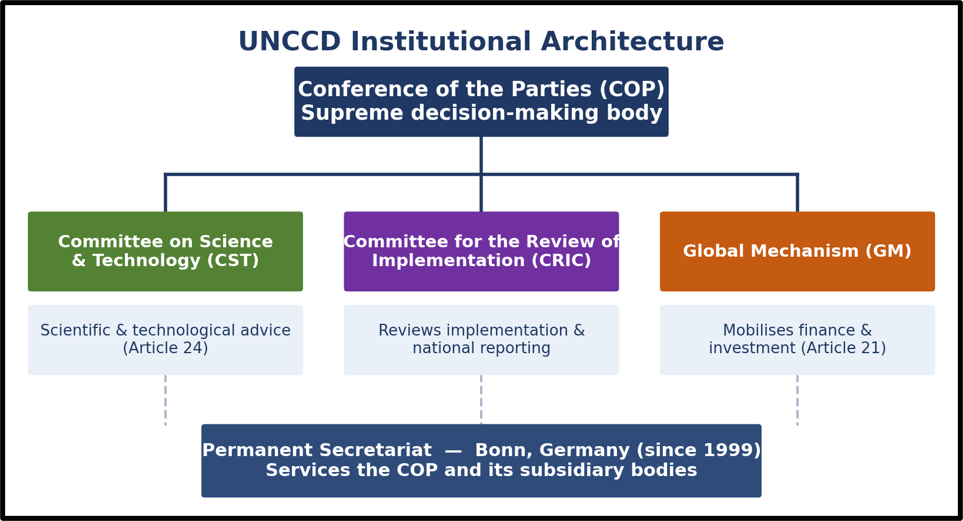
| Supreme body | Conference of the Parties (COP) |
| Secretariat | Bonn, Germany (since 1999) |
| Flagship goal | Land Degradation Neutrality (LDN), anchored in SDG Target 15.3 |
| Latest COP | COP17, Ulaanbaatar, Mongolia (17–28 August 2026) |
| India | Party since 1996; Annex II (Asia); hosted COP14 (New Delhi, 2019) |
What Is the UNCCD?
The UNCCD is an international treaty dedicated to protecting and restoring land, and to securing the livelihoods that depend on it. According to the UNCCD Secretariat, it is the only legally binding international agreement linking environment and development to sustainable land management, and the sole global framework created specifically to tackle desertification and the effects of drought. It presently has 197 Parties — 196 countries and the European Union.
The Convention’s working shorthand is DLDD — Desertification, Land Degradation and Drought. A crucial exam distinction is that “desertification” under the UNCCD does not mean the natural spread of existing deserts. It means land degradation in arid, semi-arid and dry sub-humid areas (the “drylands”) caused by climatic variations and, above all, human activity.
The Secretariat notes that the overwhelming majority of Parties — roughly 86% (169 of 196 country Parties) — are affected by DLDD, which explains why a convention once seen as “Africa’s treaty” is now genuinely universal.
Why the land agenda matters
- A development treaty, not only an environmental one: uniquely among the Rio siblings, the UNCCD ties ecology directly to poverty, food security and migration, giving it a strong human-development core.
- A bottom-up design: it pioneered a participatory model in which affected local communities, not just national governments, shape action on the ground.
- A convergence point: land is where climate adaptation, biodiversity and water security physically meet, making the UNCCD a natural bridge across the wider climate and environment diplomacy landscape.
The Three Rio Conventions: Placing the UNCCD
The UNCCD is best understood as one leg of a tripod. The 1992 Rio Earth Summit (UNCED) produced three legally binding conventions, each guarding a different pillar of the planet. Together they are called the Rio Conventions, and questions that ask you to match a convention to its mandate are a Prelims favourite.
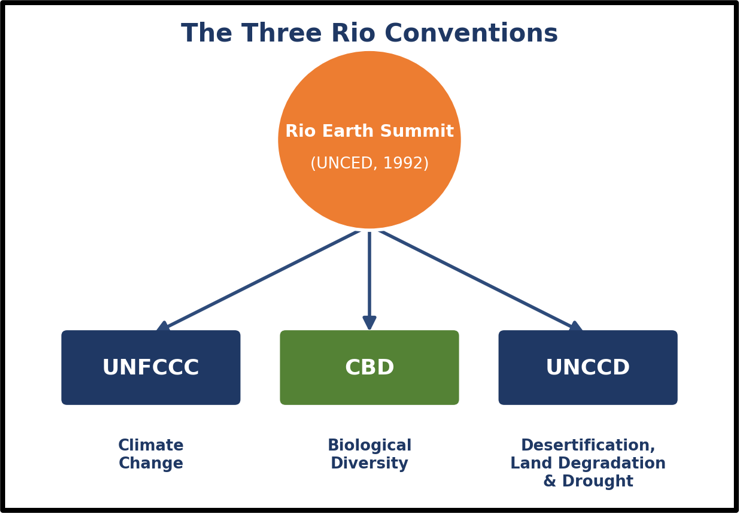
A neat memory hook: UNFCCC = air, CBD = life, UNCCD = land. For deeper study, pair this with our notes on the UNFCCC, the Paris Agreement, and biodiversity conservation.
Origin and Historical Evolution
The UNCCD did not appear overnight; it was the culmination of nearly two decades of growing alarm about the world’s drylands. The UNCCD’s own account of its history traces the story from a 1977 conference through the Rio process to a working convention in 1997.
| Year / Date | Key Development |
| 1977 | First UN Conference on Desertification (UNCOD), Nairobi, adopts the Plan of Action to Combat Desertification (PACD). |
| 1991 | UNEP review finds that land degradation in the world’s drylands had intensified despite earlier efforts. |
| 1992 | Rio Earth Summit (UNCED) calls for a convention; Agenda 21, Chapter 12 addresses desertification and drought. |
| December 1992 | UN General Assembly Resolution 47/188 establishes the Intergovernmental Negotiating Committee (INCD). |
| 17 June 1994 | UNCCD adopted in Paris; opened for signature on 14 October 1994. |
| 26 December 1996 | The Convention enters into force internationally. |
| October 1997 | COP1 held in Rome, Italy — the Convention becomes operational. |
The first international response came in 1977, when the UN Conference on Desertification (UNCOD) in Nairobi adopted a Plan of Action to Combat Desertification. It achieved little, and by 1991 the UN Environment Programme concluded that dryland degradation had only intensified.
Momentum finally arrived at the 1992 Rio Earth Summit, whose Agenda 21 devoted Chapter 12 to desertification and called for a dedicated convention. In December 1992 the UN General Assembly (Resolution 47/188) established an Intergovernmental Negotiating Committee to draft it.
The Convention was adopted in Paris on 17 June 1994 and opened for signature that October. It entered into force on 26 December 1996, and the first Conference of the Parties met in Rome in 1997, giving the treaty its institutions and marking the point at which it became fully operational. The simple chain worth memorising is: 1977 Nairobi → 1992 Rio → 1994 adoption → 1996 entry into force → 1997 COP1.
Objectives and Guiding Principles
The Convention’s core objective is to combat desertification and mitigate the effects of drought in affected countries, through effective action at all levels, in order to contribute to sustainable development. Four principles give the treaty its distinctive character:
- Participation: decisions and programmes must involve affected populations and local communities, not just central ministries — a bottom-up ethic.
- Partnership: developed and developing countries cooperate in a spirit of shared responsibility, with support for finance and technology transfer.
- Integration: anti-desertification measures are woven into national development, poverty-reduction and food-security strategies rather than treated as a stand-alone environmental add-on.
- Regional focus: implementation is tailored to regional realities through Regional Implementation Annexes (below), acknowledging that the Sahel and South Asia face very different pressures.
Institutional Architecture
The UNCCD works through a compact set of bodies.
Regional Implementation Annexes and National Action Programmes
Because desertification looks so different across the world, the Convention is delivered through five Regional Implementation Annexes. Each tailors action to a region’s ecology and institutions. India belongs to Annex II (Asia).
| Regional Annex | Region covered |
| Annex I | Africa |
| Annex II | Asia — India’s annex |
| Annex III | Latin America and the Caribbean |
| Annex IV | Northern Mediterranean |
| Annex V | Central and Eastern Europe |
The chief instrument on the ground is the National Action Programme (NAP). Each affected country prepares a NAP identifying the drivers of degradation and the practical measures to counter them, and integrates it with wider development planning. NAPs embody the Convention’s participatory philosophy: they are meant to be built with the communities who live on the land, not merely for them.
Land Degradation Neutrality (LDN) and SDG 15.3
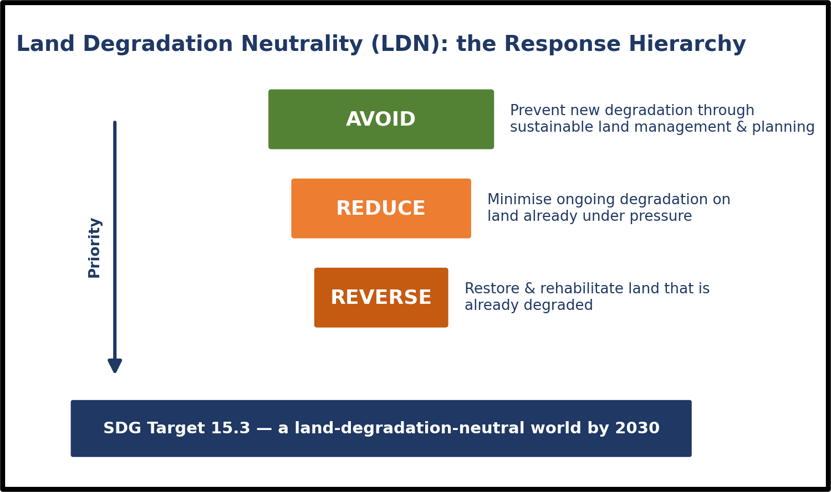
If one idea now defines the modern UNCCD, it is Land Degradation Neutrality. LDN is a state in which the amount and quality of healthy, productive land remains stable or increases over a given period: any new degradation is balanced by restoration elsewhere, so there is no net loss. It reframes the fight against desertification from merely slowing damage to achieving a measurable balance.
LDN is operationalised through a response hierarchy — avoid, reduce and reverse degradation, in that order of priority — and is embedded in the global development agenda as Sustainable Development Goal Target 15.3, which commits the world to “a land-degradation-neutral world” by 2030.
The turning point came at COP12 (Ankara, 2015), which formally integrated the SDGs and LDN into the Convention’s work, giving the UNCCD a clear, quantifiable target for the first time. Countries pursue it through voluntary national LDN targets supported by the Global Mechanism’s target-setting programme.
The UNCCD Strategic Framework 2018–2030
To align itself with the 2030 Agenda, the Convention adopted a long-term roadmap — the UNCCD Strategic Framework 2018–2030 — at COP13 (Ordos, China, 2017). It replaced the earlier Ten-Year Strategy (2008–2018) and set out to improve the condition of affected ecosystems, combat desertification, promote sustainable land management and, crucially, achieve LDN. It also links land restoration to co-benefits such as biodiversity, climate resilience and secure livelihoods, positioning the UNCCD as a partner to the other Rio Conventions rather than a silo.
Evolution of the Conferences of the Parties (COPs)
Seventeen ordinary COPs have been held since 1997. You do not need to memorise every outcome; you do need the venues (a Prelims staple) and the handful of turning points that shaped the Convention. Two extraordinary sessions have also been convened — in New York (2007) and Bonn (2021) — which should not be confused with the numbered ordinary COPs.
| COP | Year | Venue |
| COP1 | 1997 | Rome, Italy |
| COP2 | 1998 | Dakar, Senegal |
| COP3 | 1999 | Recife, Brazil |
| COP4 | 2000 | Bonn, Germany |
| COP5 | 2001 | Geneva, Switzerland |
| COP6 | 2003 | Havana, Cuba |
| COP7 | 2005 | Nairobi, Kenya |
| COP8 | 2007 | Madrid, Spain |
| COP9 | 2009 | Buenos Aires, Argentina |
| COP10 | 2011 | Changwon, Republic of Korea |
| COP11 | 2013 | Windhoek, Namibia |
| COP12 | 2015 | Ankara, Türkiye |
| COP13 | 2017 | Ordos, China |
| COP14 | 2019 | New Delhi, India |
| COP15 | 2022 | Abidjan, Côte d’Ivoire |
| COP16 | 2024 | Riyadh, Saudi Arabia |
| COP17 | 2026 | Ulaanbaatar, Mongolia |
The turning points worth knowing
| COP / Venue / Year | Key Development |
| COP1 — Rome, 1997 | Institutional foundations laid; Permanent Secretariat and Global Mechanism set up. |
| COP5 — Geneva, 2001 | Establishes the CRIC (Committee for the Review of the Implementation of the Convention) to review implementation. |
| COP8 — Madrid, 2007 | Adopts the 10-Year Strategic Plan (2008–2018). |
| COP11 — Windhoek, 2013 | Creates the Science-Policy Interface (SPI). |
| COP12 — Ankara, 2015 | Integrates SDG 15.3 and Land Degradation Neutrality (LDN). |
| COP13 — Ordos, 2017 | Adopts the UNCCD Strategic Framework 2018–2030. |
| COP14 — New Delhi, 2019 | India hosts; Delhi Declaration adopted; 26-million-hectare restoration pledge. |
| COP15 — Abidjan, 2022 | Abidjan Call; sharper focus on drought, land tenure and gender. |
| COP16 — Riyadh, 2024 | Riyadh Global Drought Resilience Partnership; first decision focused on rangelands. |
| COP17 — Ulaanbaatar, 2026 | Rangelands and pastoralists take centre stage; drought regime deferred to COP18. |
- COP5, Geneva 2001 — created the CRIC to review implementation.
- COP8, Madrid 2007 — adopted the Ten-Year Strategic Plan (2008–2018).
- COP11, Windhoek 2013 — established the Science-Policy Interface.
- COP12, Ankara 2015 — integrated SDG 15.3 and Land Degradation Neutrality.
- COP13, Ordos 2017 — adopted the Strategic Framework 2018–2030.
The recent COPs (2019–2026)
The last four COPs trace a clear shift from setting targets to delivering finance and widening the agenda. COP14 (New Delhi, 2019), hosted by India, produced the Delhi Declaration and saw the Prime Minister raise India’s restoration ambition from 21 to 26 million hectares by 2030.
At COP15 (Abidjan, 2022), held under the theme “Land. Life. Legacy”, heads of state issued the Abidjan Call, with sharper attention to drought, land tenure, gender and sand-and-dust storms. COP16 (Riyadh, 2024) made drought the headline: it launched the Riyadh Global Drought Resilience Partnership, mobilising about US$12.15 billion (including a US$10 billion pledge from the Arab Coordination Group) and took the Convention’s first dedicated decision on rangelands.
Most recently, COP17 (Ulaanbaatar, 17–28 August 2026), under the theme “Restoring Land. Restoring Hope”, put rangelands and pastoralists at the centre of the agenda, in step with the UN International Year of Rangelands and Pastoralists (2026). Parties recognised a Coalition of Rangeland States and advanced the strategic framework beyond 2030, while negotiations on a dedicated global drought regime were carried forward to COP18. (Notably, the widely reported “Ulaanbaatar Declaration” was a statement issued by pastoralist communities at the summit, not an official decision of the Conference of the Parties.)
India and the UNCCD
India is one of the Convention’s most significant players — a large, densely populated country where land degradation directly threatens food and water security, and, increasingly, a leader in restoration. India ratified the UNCCD in 1996 and falls under Annex II (Asia), with the Ministry of Environment, Forest and Climate Change serving as the national coordinating authority.
The scale of the problem
The picture is sobering. According to the Space Applications Centre (ISRO) Desertification and Land Degradation Atlas of India, about 97.84 million hectares — nearly a third of the country’s geographical area — were under land degradation or desertification in 2018–19. Detailed treatment of the drivers sits in our notes on the causes of soil degradation and land degradation and conservation.
India’s commitments and leadership
- Hosting COP14 (2019): India hosted the fourteenth COP in New Delhi and steered the Delhi Declaration.
- The 26-million-hectare pledge: at COP14 the Prime Minister raised India’s restoration target from 21 to 26 million hectares of degraded land by 2030, scaling up the Bonn Challenge commitment made in 2015.
- A climate co-benefit: the government has linked this restoration effort to an additional carbon sink of 2.5 to 3 billion tonnes of CO₂ equivalent, tying the land agenda to India’s climate goals.
- Convergence on the ground: delivery runs through existing programmes — afforestation and Green India, watershed development, CAMPA and the restoration of degraded grasslands such as the Banni in the Rann of Kutch.
| Current status (2026) As of mid-2026, India reported restoring about 21.76 million hectares of degraded land — roughly 84% of its 26-million-hectare target — keeping it broadly on course to meet its 2030 pledge and its wider commitment to Land Degradation Neutrality. |
UNCCD vs UNFCCC vs CBD: Quick Revision
A single table to lock in the comparison the examiner loves to test.
| Feature | UNCCD | UNFCCC | CBD |
| Guards | Land / drylands | Climate system | Biodiversity |
| Adopted | 1994 | 1992 | 1992 |
| Into force | 1996 | 1994 | 1993 |
| Flagship goal | Land Degradation Neutrality (SDG 15.3) | Limit global warming (net-zero) | Conservation & fair benefit-sharing |
| Secretariat | Bonn, Germany | Bonn, Germany | Montreal, Canada |
| Key offshoots | LDN; NAPs | Kyoto Protocol; Paris Agreement | Cartagena & Nagoya Protocols |
Challenges and the Way Forward
For all its reach, the UNCCD has long been seen as the weakest-funded of the Rio Conventions, and its story is as much about implementation gaps as about ambition. Several tensions are worth carrying into a Mains answer.
- The finance gap: restoration is capital-intensive and long-term, yet the private sector still supplies only a small fraction of land-restoration funding; the Riyadh partnership is an attempt to close that gap.
- Weak enforcement: like its siblings, the Convention relies on voluntary national targets and self-reporting, with no binding penalties — progress depends on political will.
- Data and monitoring: measuring “neutrality” demands reliable, comparable land data; satellite mapping (as India’s ISRO atlas shows) is improving this, but gaps remain in many countries.
- Competing land demands: food production, urbanisation, mining and biofuel cultivation all pull against restoration, making land-use trade-offs politically hard.
- Drought as the new frontier: the recent pivot from desertification to proactive drought resilience is promising, but a binding global drought regime remains unfinished business, deferred again at COP17.
The way forward lies in treating land as the common ground of the three Rio agendas — restoring it delivers climate mitigation, biodiversity and water security at once — and in matching that vision with predictable finance, secure land tenure for local communities, and honest measurement. On each count, India’s blend of a large restoration pledge, satellite-based monitoring and community-linked programmes offers a template worth watching.