
The Stone Age
There’s often a misconception in history — people think the ‘Stone Age’ was merely a time for making stone tools. But in reality, it was the early chapter of human thought, survival, and progress
Let’s now explore this fascinating phase — the Stone Age, which marks the beginning of human tool-making and adaptation to nature.
🧱 What is the Stone Age?
- The Stone Age is a prehistoric period — That means the time before written records — when early humans used tools made primarily of stone, along with wood and bones.
- It began about 2 million years ago with Homo habilis, who made the first known stone tools, and it lasted until humans started using metals (the beginning of the Chalcolithic/Bronze Age).
- Important: The Stone Age didn’t begin or end at the same time across the world. It varied by region.
📚 Classification of the Stone Age (Based on Tool Technology)
Like history is divided into Ancient, Medieval, and Modern — the Stone Age too is divided based on the type and technology of stone tools used:
| Period | Global Timeline | Indian Timeline | Type of Tools Used |
|---|---|---|---|
| Palaeolithic (Old Stone Age) | ~2 million years ago – 10,000 BCE | 6,00,000 BCE – 10,000 BCE | Large, hand-sized tools, rough and heavy |
| Mesolithic (Middle Stone Age) | 10,000 BCE – 4,000 BCE | 10,000 BCE – 4,000 BCE | Microliths – small, sharp, refined tools |
| Neolithic (New Stone Age) | ~7,000 BCE – onwards | 7,000 BCE – 1,000 BCE | Polished stone tools, more farming-based |
🧬 Palaeolithic Age (Old Stone Age): The Longest Phase of Human Life
You’ll be amazed to know that 99% of the time humans have spent on Earth was during the Palaeolithic Age!
🕰️ Time Frame
- Globally: ~2 million years ago to 10,000 BCE
- In India: 6,00,000 BCE to 10,000 BCE
🌍 Climate Context
- This age overlaps with the Ice Age, i.e., the Pleistocene Epoch which is divided into:
- Early Pleistocene (2.6 million – 8,00,000 years ago)
- Middle Pleistocene (8,00,000 – 1,25,000 years ago)
- Late Pleistocene (1,25,000 – 12,000 years ago)
🔧 Tools of the Palaeolithic People
- Used hand-sized stones, often flaked to create sharp edges.
- Also used wood and bone tools.
- Tools found mainly in river terraces (where large pebbles were available).
👣 Lifestyle of Palaeolithic Humans
| Aspect | Details |
|---|---|
| Occupation | Hunter-gatherers, depended on wild animals, plants, tubers, fish. |
| Mobility | Nomadic — moved with seasons and availability of food/water. |
| Shelter | Lived in rock shelters, caves, or huts made of wood, grass, bones. |
| Clothing | Wore animal skins or tree bark. |
| Fire Use | Evidence from Kurnool caves (Andhra Pradesh) shows use of fire — for warmth, cooking, and protection. |
🪓 Three Phases of the Palaeolithic Age in India
To better understand the evolution of tools and lifestyle, Indian historians divide it into:
| Phase | Time Frame | Key Tools and Features |
|---|---|---|
| Lower Palaeolithic | 6,00,000 – 1,50,000 BCE | Handaxes, Cleavers, Choppers |
| Middle Palaeolithic | 1,50,000 – 35,000 BCE | Tools made from flakes – points, borers, scrapers |
| Upper Palaeolithic | 35,000 – 10,000 BCE | More refined flakes and blade tools; warmer climate |
“This development indicates that humans were not merely surviving — they were thinking, creating new tools — and this very thought marks the beginning of civilization.”
👤 Important Personality: Robert Bruce Foote – Father of Indian Prehistory
The person who first opened the door to Indian prehistory was Robert Bruce Foote
- British Geologist & Archaeologist, joined Geological Survey of India in 1858.
- In 1863, at Pallavaram (Chennai), he discovered a chipped stone tool.
- Sent it to London for verification — it was later confirmed to be from the Palaeolithic period.
- Hence, he is called Father of Indian Prehistory.
🏢 Geological Survey of India (GSI)
| Feature | Description |
|---|---|
| Established | 1851, for exploration of coal deposits for the Railways |
| Current Role | Part of the Ministry of Mines, surveys geology and mineral resources |
| HQ | Kolkata, with 6 regional offices (Nagpur, Hyderabad, Shillong etc.) |
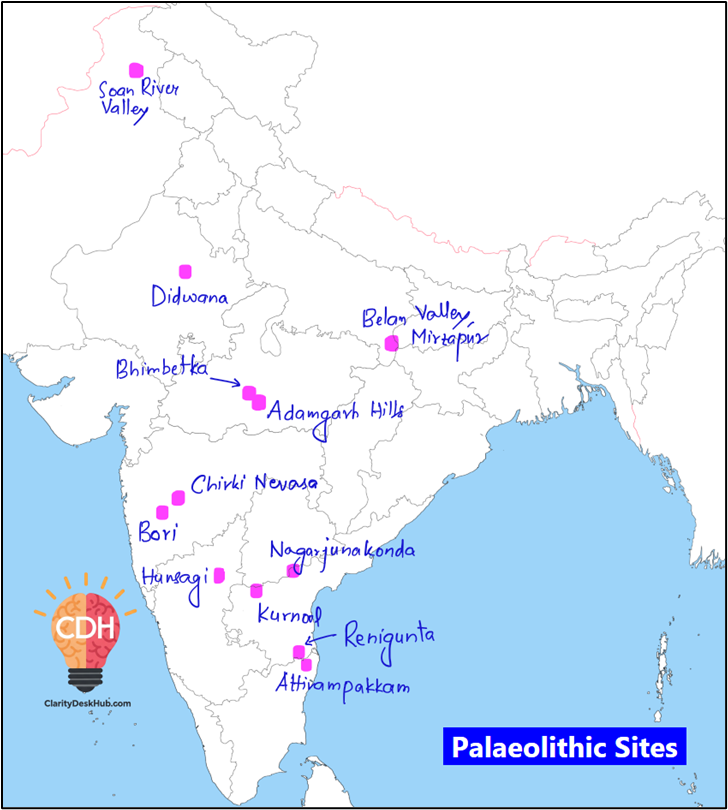
🗺️ Important Palaeolithic Sites in India
It is often asked — where in India have stone tools been found?
| Region | Site Name |
|---|---|
| Pakistan (Punjab region) | Soan river valley |
| Rajasthan | Desert area of Didwana |
| Uttar Pradesh | Belan Valley, Mirzapur |
| Madhya Pradesh | Bhimbetka, Adamgarh hills |
| Maharashtra | Bori, Chirki Nevasa |
| Karnataka | Hunsagi |
| Andhra Pradesh | Kurnool, Nagarjunakonda, Renigunta |
| Tamil Nadu | Attirampakkam, near Chennai |
You’ll notice that most sites are located on hill slopes and river valleys — because both water and large pebbles were available there.
🏹 The Mesolithic Age (Middle Stone Age): Hunters, Herders & Hints of Farming
Timeframe: 10,000 BCE – 4,000 BCE
This age was a transitional phase — neither fully living in the wild, nor entirely forming villages. Here, humans stopped fighting nature and began to understand it.
🔄 What Changed from the Palaeolithic Age?
- The Upper Palaeolithic Age ended around 10,000 BCE, which also marked the end of the Ice Age.
- As the climate warmed, the earth’s surface changed dramatically:
- Ice sheets retreated.
- Grasslands emerged in many regions.
- The environment became warmer and drier, which changed both flora and fauna.
Where once people sheltered in caves to escape the cold, greenery has now appeared — bringing with it new ways of life.
🐕 Domestication of Animals: The First Step Towards Settlement
- With the rise of grasslands, grass-eating animals like deer, goats, sheep, and cattle increased in number.
- Humans began observing their patterns — what they ate, when they mated, how they moved.
- Eventually, humans started herding these animals — the beginning of animal domestication.
- The first animal to be domesticated was the wild ancestor of the dog.
📍 Indian Evidence:
- Adamgarh (Madhya Pradesh) and Bagor (Rajasthan) give the earliest evidence of domesticated animals — around 5000 BCE.
“This was a shift in mindset — from hunting to herding — and that’s where the foundation of development was laid.”
🌾 Early Cultivation: Nature Ke Saath Milke Jeena
- Nature grew grain-bearing grasses like:
- Wheat
- Barley
- Rice (in select regions)
- Humans collected these naturally occurring grains, and some bright minds among them likely thought:
“Can we cultivate this ourselves?”
This led to primitive cultivation — the very first steps toward agriculture.
“Revolution doesn’t happen overnight — in the Mesolithic Age, the revolution took place in thought — a new understanding formed between tools and nature”
🧰 Tools of the Mesolithic Age: The Microlith Revolution
| Feature | Details |
|---|---|
| Tool Type | Microliths — tiny stone tools (less than 5 cm in size) |
| Technology | Assembled onto wooden shafts to make composite tools |
| New Tools | Bows and arrows, fish hooks, scrapers, etc. |
| Purpose | Hunting small game, fishing, processing food |
“Earlier, people hunted by grabbing stones — now they could aim from a distance using bow and arrow — this is the evolution of technology and survival.”
👣 Lifestyle of Mesolithic People
| Aspect | Description |
|---|---|
| Occupation | Hunting, gathering, fishing, primitive farming, animal herding |
| Shelter | Continued living in rock shelters, caves, and huts made of wood, grass, bone |
| Mobility | Semi-nomadic — more seasonal movement than constant roaming |
| Clothing | Animal skin and tree bark, like in the Palaeolithic period |
| Food Shift | From large animals → small game, fish, and early grains |
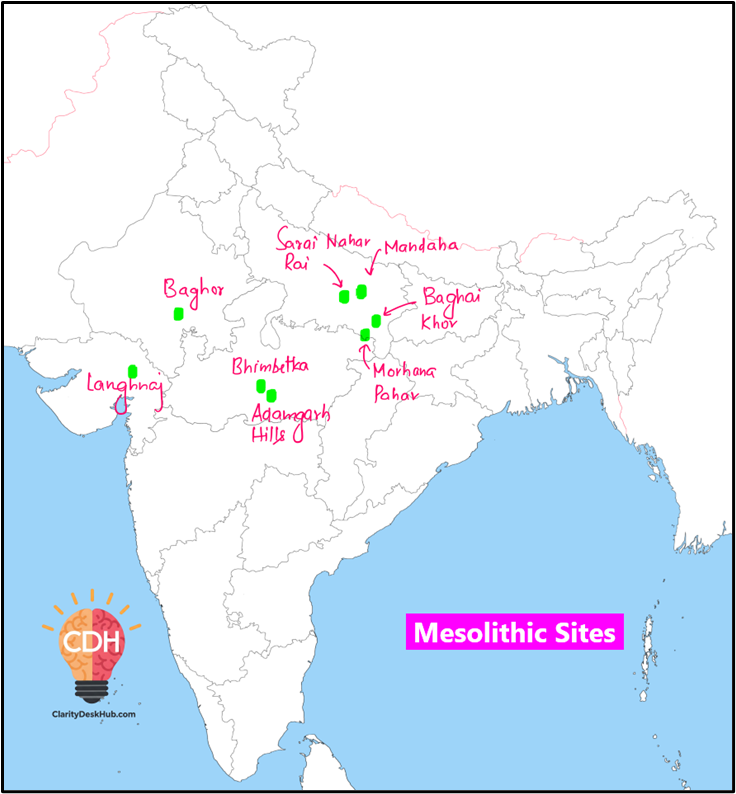
🗺️ Important Mesolithic Sites in India
“Was this revolution confined only to Rajasthan and Madhya Pradesh? Not at all — let’s explore traces of this age across different parts of the country.”
| State | Site Name(s) |
|---|---|
| Uttar Pradesh | Mahadaha, Sarai Nahar Rai (Ganga Valley) |
| Morhana Pahar, Baghai Khor (Belan Valley) | |
| Madhya Pradesh | Bhimbetka, Adamgarh hills |
| Rajasthan | Bagor |
| Gujarat | Langhnaj |
“You’ll observe that people in the Mesolithic Age became smarter than before — tools were smaller, targets more precise, and life a little more settled.”
🧭 What Comes Next?
We now stand at a crucial crossroads:
“When humans first began farming and wanted to live with their animals — a new era began — known as the Neolithic Age (New Stone Age)”
🌾 The Neolithic Age: The First Food Producers of History
“Where humans fought against nature in the Palaeolithic and Mesolithic ages, in the Neolithic age they made peace with it — and shaped a new model of life: one based on agriculture and domestic living.”
⏳ Timeline and Geographic Context
| Context | Period |
|---|---|
| Global Neolithic Age | ~10,000–9,000 BCE |
| Indian Subcontinent | ~7,000 BCE to 1,000 BCE |
📍 Mehrgarh (in Baluchistan, Pakistan) is India’s earliest Neolithic settlement — dated to 7000 BCE.
🔧 Neolithic Tools: A Step Towards Precision
- Neolithic tools were polished stone tools, especially stone axes, used for:
- Cutting trees
- Hunting more efficiently
- Agricultural activities
- They also used:
- Microlithic blades
- Stone hoes to break the ground for farming
“These tools weren’t just for survival — they were newly crafted instruments designed for sustainable living.”
🌱 Occupation: Agriculture & Domestication — The Real Game-Changers
| Practice | Details |
|---|---|
| Agriculture | Wheat, barley, millet, rice were cultivated in different regions |
| Domestication of Animals | Cattle, sheep, goats, pigs — vital for food and farming |
| Rice Cultivation | Started extensively in eastern India (e.g., Allahabad district – 6000 BCE) |
| Cotton Cultivation | Found earliest in the world at Mehrgarh (5000 BCE) |
📝 UPSC Note:
While Mehrgarh gives the earliest evidence of agriculture, if Lahuradeva (UP) is an option in MCQs, it is considered correct — based on carbonised rice remains.
🏠 Settled Life Begins: From Nomads to Villagers
“When farming begins, one must connect with the land — and that’s where the foundation of the ‘village’ is laid.”
- With crops to tend and animals to care for, people now needed to:
- Stay in one place → Sedentary life
- Live in mud-brick houses (more permanent than grass huts)
👕 Weaving and Clothing
- With cotton available, Neolithic people developed the art of weaving
- They now wore clothes made from cotton and wool
- This marked a leap in social sophistication
🍲 Pottery: A Need Born of Agriculture
- Once grains were harvested, there was a need to:
- Store them
- Cook them
Types of Pottery:
- Handmade in the early Neolithic
- Later, wheel-made
- Types include:
- Black burnished ware
- Grey ware
- Mat-impressed ware
Also used: Mortars and pestles for grinding food.
All of this was part of the understanding that had learned to create the essentials of life
🛠️ Technological Advancements in Neolithic Age
- Arts of weaving, pottery, and house-building
- Tools and techniques to:
- Grow cereals like wheat and millet
- Domesticate animals
- People now relied less on hunting-gathering, and more on subsistence farming
🧠 Gordon Childe, an Australian archaeologist, coined the term Neolithic Revolution to highlight how this transformation laid the foundation of civilisation.
🧪 Evidence from Archaeological Sites: Grain & Bones
| Site | Agricultural Finds |
|---|---|
| Mehrgarh | Wheat, barley; bones of cattle, sheep, goats |
| Koldihwa (UP) | Rice; animal bones |
| Mahagara (UP) | Rice; cattle hoof marks on clay floors |
| Gufkral (J&K) | Wheat and lentils |
| Burzahom (J&K) | Wheat, lentils, dog, cattle, goat, buffalo |
| Chirand (Bihar) | Wheat, barley, green gram; buffalo, ox |
| Hallur (Karnataka) | Millet; cattle, pigs, sheep, goats |
| Paiyampalli (TN) | Black gram, millet; cattle, pigs, sheep |
🧭 Types of Neolithic Settlements in India
The pattern of Neolithic sites can be understood not just through geography, but also through the design of their stone axes.
| Region | Axe Characteristics |
|---|---|
| North-Western | Rectangular axes with curved cutting edge |
| Southern | Axes with oval sides and pointed butts |
| North-Eastern | Shouldered hoes, rectangular butts, polished axes |
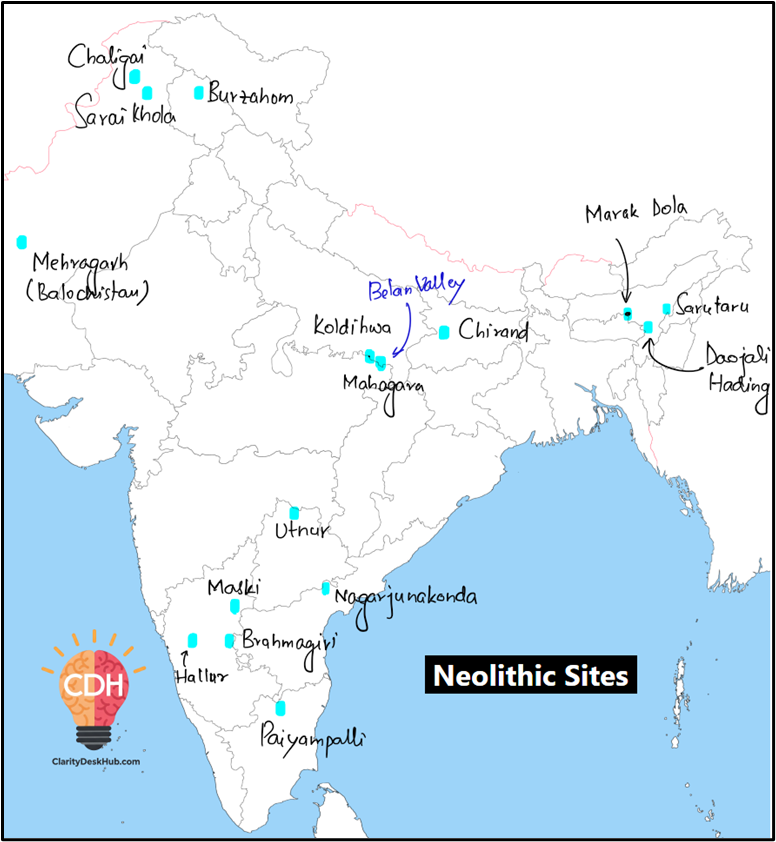
🗺️ Key Regional Neolithic Cultures
🧊 North-Western India
- Includes
- Mehrgarh (Baluchistan)
- Chaligai (Swat Valley, Pakistan) and Sarai Khola (Taxila Valley, Pakistan)
- Burzahom (Kashmir)
- Burzahom Highlights:1
- People lived in pit dwellings (dug with steps — insulation from cold)
- Practised hunting and fishing
- Dogs buried with humans → belief in afterlife
- Used bone tools
🐄 Southern India
- Includes areas south of the Godavari River
- Focused more on cattle rearing
- Sites:
- Hallur, Maski, Brahmagiri in Karnatka
- Utnur in Telangana
- Nagarjunakonda in Andra Pradesh
- Paiyampalli in Tamil Nadu
🌿 North-Eastern India
- Sites: Daojali Hading and Sarutaru (Assam), Marak Dola (Meghalaya)
- Daojali Hading Highlights:
- Stone tools like mortars and pestles (indicating grain use)
- Artifacts like jadeite (imported from China) and fossil wood
- Sign of cultural exchange with Southeast Asia
Bihar-UP Region
- Important Sites
- Koldihwa and Mahagara in Belan Valley (UP)
- Chirand in Bihar
🧱 Limitations of the Neolithic People
- Depended primarily on stone tools → couldn’t settle far from hill regions or river valleys
- Agricultural output was only for subsistence, not surplus
- Technology still limited to basic utility, not luxury
🔚 Conclusion: Neolithic Age
This was an age of civilizational leap — when humans first learned to shape life for themselves. The revolution didn’t arrive with fanfare, but it quietly changed everything — and that’s what we call the Neolithic Revolution
- UPSC Prelims 2021 ↩︎
For chapter-wise Ancient and medieval History Notes for UPSC Prelims and Mains, refer to the complete Ancient and Medieval History notes page.
these notes are so well prepared… feels like a teacher is sitting in front of you. Good Job!!!!!
Thank You for your kind words!