
Hydrogen Economy
Here is the puzzle that makes hydrogen fascinating. It is the most abundant element in the universe — and yet, on Earth, you cannot mine it or drill for it. It is always locked up inside something else: inside water (H₂O), inside methane (CH₄).
To get pure hydrogen, you must spend energy to free it. So is hydrogen an energy source, or something else entirely? That question is the heart of this section, and we will answer it carefully.
| The single most important idea in this section Hydrogen is NOT an energy source. It is an energy CARRIER — like a battery, or like electricity. You put energy in to make it, and you get energy back when you use it. |
Let us define the term.
Hydrogen energy refers to the use of hydrogen (H₂) as a clean energy carrier for power generation, transportation and industrial applications.
It is seen as a key pillar of future low-carbon energy systems, for two headline reasons — its very high energy content, and zero carbon emissions at the point of use.
That phrase ‘at the point of use’ is doing quiet, important work. When hydrogen burns, the only thing that comes out is water. No CO₂, no soot, nothing.
The emissions question simply shifts backward — to how the hydrogen was made. Hold that thought; it returns when we discuss the colours of hydrogen.
Key Features of Hydrogen as a Fuel
- Highest energy content per unit mass (~120 MJ/kg) — nearly 3 times that of petrol or diesel.
- Clean & environment-friendly: on combustion it produces only water and water vapour — no CO₂, SO₂ or particulate matter.
- Renewable compatibility: can be made from water using solar/wind → ‘green hydrogen’.
- Energy-carrier property: stores energy from other sources and transports it over long distances — a bridge between generation and consumption.
- Versatility: usable in transport (fuel-cell vehicles), power generation and industry (steel, fertilisers); works in both combustion engines and fuel cells.
- High efficiency in fuel cells (~60%): far higher than conventional thermal plants; avoids combustion losses.
- Lightweight: the lightest element — useful for space rockets and aviation.
- Quick refuelling: minutes, like petrol — an advantage over battery EVs.
- Abundant; supports decarbonisation: the most abundant element in the universe; essential for net-zero in heavy industry and long-distance transport.
Hydrogen: Energy Carrier, Not Energy Source
This is the conceptual spine of this section, so let us be precise. An energy source exists naturally and gives energy directly — sunlight, coal, wind, hydropower. It needs no prior energy input to exist. An energy carrier is a medium that stores, transports and delivers energy, but must itself be produced using other energy sources — electricity, batteries, and hydrogen.
Why Hydrogen is a Carrier
| Hydrogen doesn’t occur freely on Earth — it is locked in water (H₂O) and hydrocarbons (CH₄) |
| ▼ |
| To free it we must spend energy: Electrolysis (uses electricity) OR Steam Methane Reforming (uses natural gas) |
| ▼ |
| So hydrogen generates no energy on its own — it stores energy already used to produce it |
Why It Still Matters Enormously
- Enables clean energy transition: green hydrogen gives zero emissions at point of use; cuts fossil dependence; supports net-zero.
- Facilitates renewable integration: solar/wind are intermittent — hydrogen stores their surplus as a long-term storage medium (batteries are short-duration).
- Decarbonises hard-to-abate sectors: steel (replaces coke → green steel), fertilisers (ammonia), heavy transport (trucks, ships, aviation), refineries.
- Energy storage & grid stability: enables seasonal storage, reconverted to electricity on demand.
- Enhances energy security: produced domestically from water + renewables, cutting fossil imports.
The Colours of Hydrogen
Now for the most charming idea in this section. Hydrogen the gas is always colourless — but we give it a colour based on how it was produced and how dirty that process was. The colour is an emissions label, not a physical colour. Let us walk the rainbow:
- Grey: from natural gas via Steam Methane Reforming (SMR), without carbon capture. The most widely used and cheapest — but high CO₂. Used in refining, ammonia, chemicals.
- Blue: grey’s cleaner cousin — SMR with Carbon Capture, Utilisation & Storage (CCUS). Lower (not zero) emissions; a transitional fuel.
- Green: electrolysis of water using renewable energy (solar/wind/hydro). Zero greenhouse gas — the cleanest, the future fuel. Central to net-zero. Used for green steel, green ammonia, FCEVs, energy storage, fuel-cell power.
- Brown: from lignite (brown coal) via gasification — very high emissions.
- Black: from bituminous (hard) coal via gasification — very high emissions.
- Turquoise: from methane pyrolysis (heating methane without oxygen). No direct CO₂ — produces solid carbon instead of gas. Emerging technology.
- Pink / Red / Purple: electrolysis powered by nuclear energy — low emissions, continuous baseload power, but carries nuclear-safety and waste concerns.
- Yellow: electrolysis powered specifically by solar energy — zero emissions, supports off-grid systems.
- White: naturally occurring ‘geological’ hydrogen in the Earth’s crust (from water-rock reactions like serpentinisation, radiolysis, organic decomposition). Still exploratory; minimal extraction emissions.
| How to never confuse the colours Sort them by the input. Fossil + capture? Grey (no capture) vs Blue (with capture). Coal? Brown (lignite) and Black (hard coal) — both very dirty. Electrolysis, sorted by the electricity: Green (renewables), Yellow (solar), Pink (nuclear). The two oddities: Turquoise (methane pyrolysis → solid carbon) and White (found in nature). Input decides the colour; the colour decides the emissions. |
Comparison of the Main Types
| Type | Source | Production Method | Carbon Emissions | Status / Remarks |
| Grey | Natural gas | Steam Methane Reforming (SMR) | High | Most widely used; cheapest |
| Blue | Natural gas | SMR + CCUS | Moderate (reduced) | Transitional fuel |
| Green | Water + renewables | Electrolysis | Zero | Cleanest; future fuel |
| Brown | Lignite (brown coal) | Coal gasification | Very High | Highly polluting |
| Black | Hard coal (bituminous) | Coal gasification | Very High | Similar to brown |
| Turquoise | Methane | Methane pyrolysis | Low (solid carbon formed) | Emerging technology |
| Pink / Red | Water + nuclear | Electrolysis (nuclear power) | Low | Depends on nuclear acceptance |
| Yellow | Water + solar | Electrolysis | Variable | Renewable if solar-based |
| White | Naturally occurring | Extraction from geological deposits | Negligible | Experimental / exploratory |
Production Methods of Hydrogen
Fossil-Fuel-Based Methods
- Steam Methane Reforming (SMR): the most common industrial method. Methane + steam at 700–1000°C: CH₄ + H₂O → CO + 3H₂, followed by the water-gas shift CO + H₂O → CO₂ + H₂. Produces grey hydrogen (or blue, if CCUS is added).
- Partial oxidation: methane + limited oxygen: CH₄ + ½O₂ → CO + 2H₂. Faster than SMR but less efficient.
- Coal gasification: coal + oxygen + steam → syngas: C + H₂O → CO + H₂, then CO + H₂O → CO₂ + H₂. Produces brown/black hydrogen with high emissions.
Renewable & Low-Carbon Methods
- Electrolysis of water: electricity splits water: 2H₂O → 2H₂ + O₂. Renewable-powered → green hydrogen; nuclear-powered → pink hydrogen.
- Methane pyrolysis: CH₄ → C + 2H₂ (no oxygen). Produces turquoise hydrogen and solid carbon instead of CO₂.
- Biomass gasification / fermentation: organic matter → hydrogen; renewable, relatively low emissions, but lower efficiency.
- Photoelectrochemical & photobiological (emerging): sunlight or microorganisms produce hydrogen; still in R&D.
Hydrogen Fuel Cells
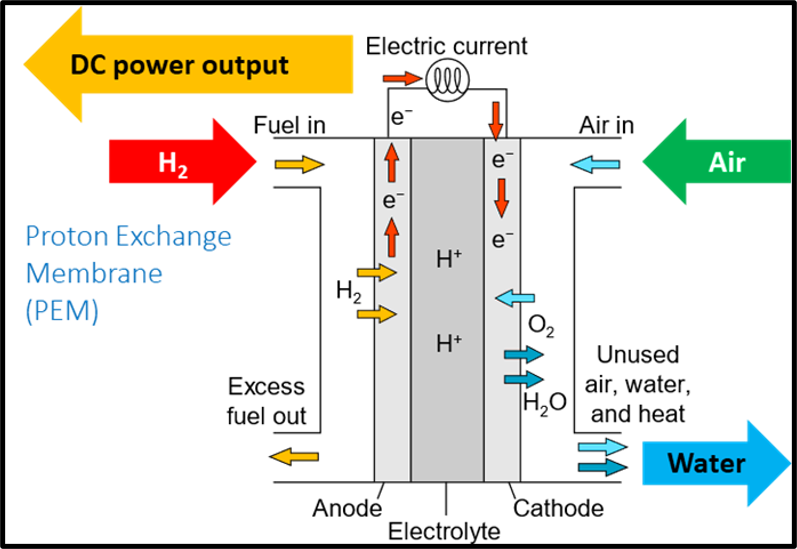
If electrolysis splits water using electricity, a fuel cell does the exact reverse — it combines hydrogen and oxygen to produce electricity, with only water and heat as by-products. A hydrogen fuel cell is an electrochemical device that converts the chemical energy of hydrogen directly into electricity. Crucially — unlike a battery, it does not store energy; it keeps generating electricity as long as fuel is supplied.
Components
- Anode (negative): hydrogen is supplied here and splits into protons (H⁺) and electrons (e⁻) — the oxidation site.
- Cathode (positive): oxygen/air is supplied here; it combines with H⁺ and e⁻ to form water.
- Electrolyte (membrane): proton-conducting; lets only H⁺ pass and forces electrons through the external circuit.
- Catalyst: usually platinum-based; speeds up the electrode reactions.
- External circuit: the path of electron flow (anode → cathode) that generates electric current.
- Gas Diffusion Layer (GDL): distributes gases evenly, removes product water, ensures catalyst-reactant contact.
- Bipolar plates & fuel-cell stack: conduct electricity between cells, channel gas/heat, give structure; stacking many cells raises voltage and power.
Working Process
| Hydrogen enters the anode → splits into protons (H⁺) and electrons (e⁻) |
| ▼ |
| Electrons flow through the external circuit → generate electric current |
| ▼ |
| Protons pass through the electrolyte membrane to the cathode |
| ▼ |
| At the cathode: protons + oxygen + electrons → water (H₂O) |
Types of Hydrogen Fuel Cells
| Type | Electrolyte | Temperature | Key Feature | Applications |
| PEMFC | Polymer membrane | Low | Fast start, compact | Vehicles |
| SOFC | Ceramic | High | High efficiency | Power plants |
| AFC | Alkaline solution | Low | High efficiency | Space |
| PAFC | Phosphoric acid | Medium | Stable | Commercial power |
| MCFC | Molten salts | High | Large-scale use | Industry |
| DMFC | Polymer membrane | Low | Uses methanol | Portable devices |
Applications, Advantages & Disadvantages
- Applications: transport (FCEVs — cars, buses, trucks, trains); power generation (backup, distributed); portable devices (laptops); space (electricity + drinking water as by-product).
- Advantages: zero carbon (if green hydrogen); higher efficiency than combustion engines; fast refuelling; quiet operation; continuous supply while fuelled; versatile; low maintenance.
- Disadvantages: high cost (platinum catalysts); emissions if hydrogen is fossil-based; difficult storage/transport (high-pressure/cryogenic); poor refuelling infrastructure; safety (flammability); durability issues; energy losses across production-storage-conversion.
Green-hydrogen derivatives — e-methanol for shipping: e-Methanol is a synthetic “electrofuel” — green hydrogen combined with captured carbon dioxide to make methanol. When the CO₂ comes from biogenic sources the fuel is close to carbon-neutral over its life cycle, making it a leading candidate to replace heavy fuel oil in shipping and to support the International Maritime Organization’s decarbonisation goals. Such derivatives (e-methanol, green ammonia) also create assured offtake that anchors demand for green hydrogen.
Hydrogen-Enriched CNG (HCNG)
A clever halfway step. HCNG is a mixture of compressed natural gas (CNG) and hydrogen (typically 4–9% by energy). Adding hydrogen raises the fuel’s hydrogen-to-carbon (H/C) ratio, and since hydrogen has a flame speed up to 8 times higher than CNG, combustion becomes more efficient.
- Policy in India: up to 18% hydrogen blending (by volume) permitted in CNG engines; approved by MoRTH; included under the Central Motor Vehicles Rules (CMVR), 1989; promoted under the National Green Hydrogen Mission. Delhi was the first Indian city to run buses on HCNG.
- Advantages: cuts CO (up to 70%), hydrocarbons and NOx; faster combustion and higher octane → better efficiency; up to ~5% fuel savings vs CNG; ideal for heavy-duty vehicles.
- Challenges: limited hydrogen infrastructure; engine modification/calibration needed; higher initial cost; safety and storage considerations.
National Green Hydrogen Mission
India’s flagship play in this space. The National Green Hydrogen Mission was launched by MNRE in 2023, with the ambition of making India a global hub for the production, utilisation and export of green hydrogen.
- Objectives: promote green-hydrogen production from renewables; cut fossil-fuel imports; decarbonise steel, transport and fertilisers; position India as a global exporter.
- Key targets (by 2030): 5 MMT of green hydrogen per year; ~125 GW of added renewable capacity; ~50 MMT annual CO₂ reduction; large-scale employment.
Read in Detail: National Green Hydrogen Mission (NGHM) – CDH IAS
Challenges of the Hydrogen Economy
A balanced answer must acknowledge that the hydrogen dream is still expensive and immature. The honest hurdles:
- High production cost: green hydrogen via electrolysis is costly (renewable power + electrolysers), still uncompetitive with fossil fuels.
- Energy-efficiency losses: the electricity → hydrogen → electricity round-trip wastes significant energy.
- Storage challenges: low volumetric energy density; needs high-pressure or cryogenic storage.
- Transportation issues: leakage risk and pipeline embrittlement; limited infrastructure.
- Infrastructure gaps, safety concerns (flammable, invisible flame), and current dependence on fossil-based (grey) hydrogen — limiting real environmental benefit today.
- Technological limitations, large water requirement (a problem in water-scarce regions), and the lack of standardised regulations and global frameworks.
The Fuel of the Future, Today’s Hard Problem
So, what is hydrogen, finally? It is not a source we discovered; it is a carrier we must earn — by spending clean energy to free it from water. Its promise is genuinely extraordinary: a fuel whose only exhaust is water, that can decarbonise the steel mill, the cargo ship and the fertiliser plant — the very sectors that electricity alone cannot easily reach.
This article forms part of the broader Environment syllabus for UPSC preparation.