
Rock Art
Introduction
Rock art refers to paintings, drawings, and bruising found on natural surfaces such as → Caves, Rock shelters, Boulders
These are the oldest art forms practised by humans anywhere in the world, including India.
Chronological span
In India, the chronology of rock art can be traced back to the Upper Palaeolithic period, making it tens of thousands of years old.
Geographical concentration
The largest concentration of rock art sites in India is found:
- In the Vindhyan ranges of Madhya Pradesh
- And their extension into the Kaimurean Hills of Uttar Pradesh
This region provided:
- Natural rock shelters
- Abundant stone surfaces
- A favourable environment for early human settlement
Discovery and Study of Rock Art in India
Rock art may be ancient, but its scientific discovery is modern.
- The first discovery of rock art in India was made in 1867 by Archibald Carlleyle, an official of the Archaeological Survey of India, in the sandstone hills of the Vindhyas, in present-day Mirzapur district of Uttar Pradesh.
- A major breakthrough came in 1957, when Vishnu Wakankar discovered and began systematic study of the Bhimbetka rock shelters.
Because of his pioneering work, he is rightly known as the “Father of Rock Art Studies in India.”
👉 For UPSC, remember: Carlleyle = first discovery; Wakankar = systematic study.
Types of Rock Art
Rock art is not limited to painting alone. It appears in multiple forms, depending on technique and surface use.
1. Pictographs
- Paintings and drawings on cave walls and ceilings
- Represent ideas, events, or symbolic meanings
👉 Bhimbetka paintings are classic examples.
2. Petroglyphs
- Created by bruising the rock surface
- Techniques include rubbing, hammering, pecking, or scooping
- Usually found on hard granite surfaces
3. Petroforms
- Arrangements of stones placed deliberately to form patterns
4. Geoglyphs
- Large designs created on the ground
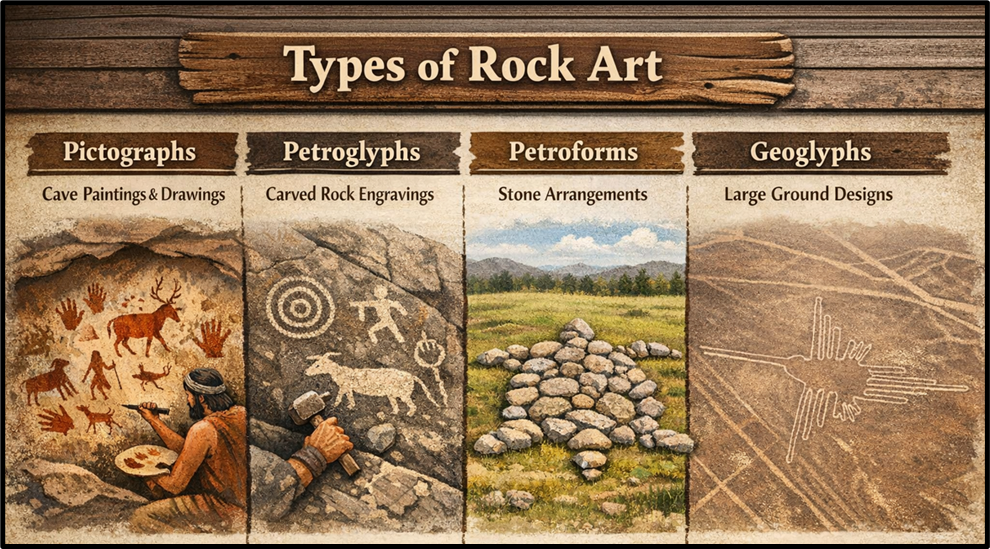
The last two—petroforms and geoglyphs—are relatively minor in India and are often grouped under land art.
Superimpositions – A key concept
In many rock shelters, paintings and bruising appear in multiple layers, meaning:
- A single rock surface was reused over centuries
- New paintings were added over older ones
Such layered compositions are called superimpositions, and they are extremely important for understanding chronology.
Classification of Rock Art
Broadly, rock art is divided into:
- Pre-historic Rock Art
- Historic Rock Art
First, our focus will be on Pre-historic Rock Art, because it reveals the earliest human mind at work. So! Let’s move on:
Pre-historic Rock Art: Meaning and Scope
Pre-historic rock art reflects:
- Artistic expression of early humans
- Their lifestyle, beliefs, rituals, and environment
It is not “art for art’s sake” but art as survival, memory, and communication.
Prehistoric periods in India
The prehistoric period in India includes:
- Palaeolithic (Old Stone Age)
- Mesolithic (Middle Stone Age)
- Neolithic (New Stone Age)
- Chalcolithic period
Phases of Pre-historic Rock Art
1. Palaeolithic Phase (c. 30,000–10,000 BCE)
- Simplest form of rock art
- Dominated by → Animal figures, Geometric patterns
- Limited human representation
👉 Reflects a hunter-gatherer life and survival concerns.
2. Mesolithic Phase (c. 10,000–6,000 BCE)
- Art becomes more sophisticated and lively
- Features:
- Detailed hunting scenes
- Groups of human figures
- Movement and narrative
👉 This phase shows collective life and social activity.
3. Neolithic Phase (from c. 6,000 BCE onwards)
- Art reflects settled agricultural life
- Themes shift towards:
- Domesticated animals
- Community activities
- Early symbols of belief systems
👉 Artistic expression mirrors economic and social transformation.
Features of Pre-historic Rock Art
A. Materials and Tools
- Natural pigments were used, derived from → Minerals, Plants, Earth-based materials
Colour usage in Indian pictographs
- Red: most dominant colour
- White: second most common, often used to fill figures
- Red was usually used for outlining
⚠️ No blue colour was used at all—this is a very important factual point for exams.
- Paintings were done on → Unplastered, Unprimed, Unpolished rock surfaces
This shows remarkable confidence and spontaneity in expression.
B. Themes and Subjects
Pre-historic paintings mainly depict:
- Animals – central to hunting life
- Human figures – dancing, hunting, fighting
- Communal scenes – group activities
- Geometric patterns and symbols
Many symbols likely had → Ritualistic, Magical, Communicative purposes
👉 These were not random drawings; they were meaningful visual codes.
Distribution of Pre-historic Rock Art in India
Central India – The Core Zone
Central India has the highest concentration of prehistoric rock art in the country.
This is mainly because of:
- Abundance of rock shelters
- Favourable climatic conditions
- Continuous human habitation
The major hill ranges here are → Satpura, Vindhya, Kaimur
Among all sites, Bhimbetka stands out as the most important and best-documented.
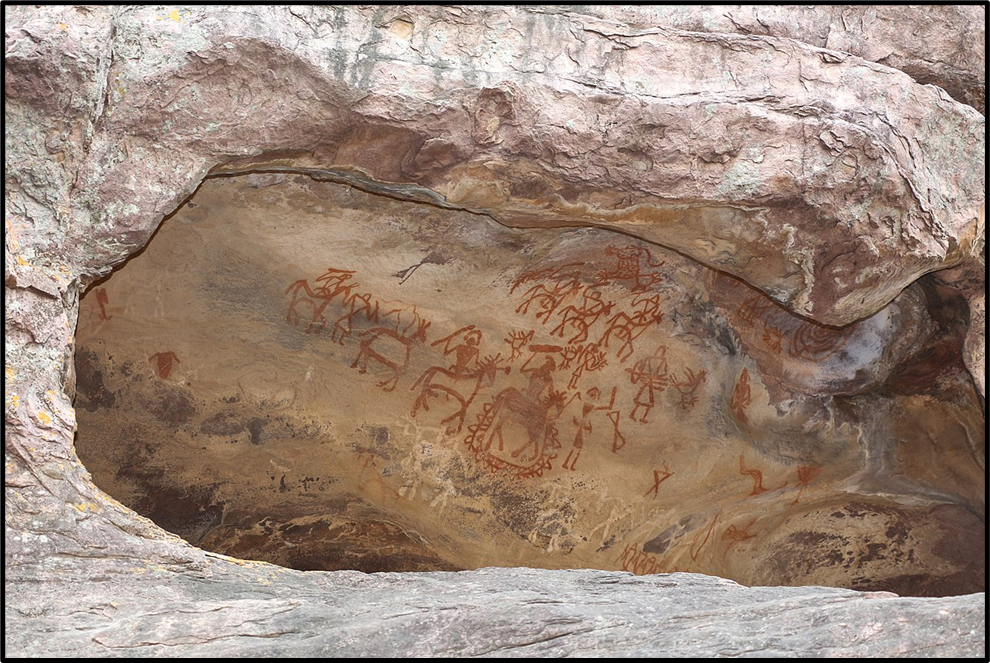
Bhimbetka Cave Paintings
Location and Meaning
- The word Bhimbetka means “Bhima’s resting place” or “Bhima’s lounge”, linking the site to the Mahabharata tradition.
- It is located:
- In the foothills of the Vindhyan Mountains
- South of Bhopal, Madhya Pradesh
- Inside the Ratapani Wildlife Sanctuary
Bhimbetka is regarded as India’s most famous prehistoric art site and contains the oldest-known rock art in the country.
Discovery
- Discovered in 1957 by Vishnu Wakankar
This discovery completely transformed the study of Indian prehistory.
Historical Significance
- Bhimbetka shows continuous human settlement from the Stone Age onwards
- There are more than 754 rock shelters
- Many shelters contain multiple layers of paintings, proving long-term reuse
Colour preference
- Though multiple shades exist:
- Red and white were the most preferred colours
- This aligns with broader prehistoric Indian trends
Bhimbetka as a Record of Cultural Evolution
Bhimbetka is unique because it shows sequential development across historical periods.
Upper Palaeolithic Phase
- Oldest paintings
- Linear animal figures
- Stick-like human forms
- Minimal detail
👉 Represents early hunter-gatherers.
Mesolithic Phase
- Smaller but more dynamic paintings
- Hunting scenes
- Handprints and fists
- Increased human interaction
👉 Reflects growing social complexity.
Neolithic–Chalcolithic Phase (Copper–Stone Age)
- Paintings reflect → Agriculture, Pottery, Tools
👉 Indicates transition from nomadic life to settled cultivation.
Early Historic Phase
- Decorative and symbolic paintings
- Religious motifs → Tree worship, Magical sky chariots
👉 Provides glimpses of early spiritual and religious thought.
📌 UPSC insight: Bhimbetka visually narrates the journey from hunter-gatherers → farmers → early religious society.
Famous Paintings at Bhimbetka
Fighters
- Depicts human figures with primitive weapons
- Bow and arrow appear here for the first time
- Indicates technological progress
Zoo Rock Painting
- One of the densest painted shelters
- Depicts animals such as → Elephants, Rhinoceros, Bison, Deer
Boar Rock
- Shows a mythical boar with disproportionately large horns
- Suggests symbolic or mythological imagination
Auditorium Rock Shelter
- Largest shelter at Bhimbetka
- Contains:
- Two petroglyphs, considered among the oldest rock art in India and the world
- Ancient cupules (cup-shaped hollows), made by pounding the rock
👉 Cupules are among the earliest known human-made markings globally.
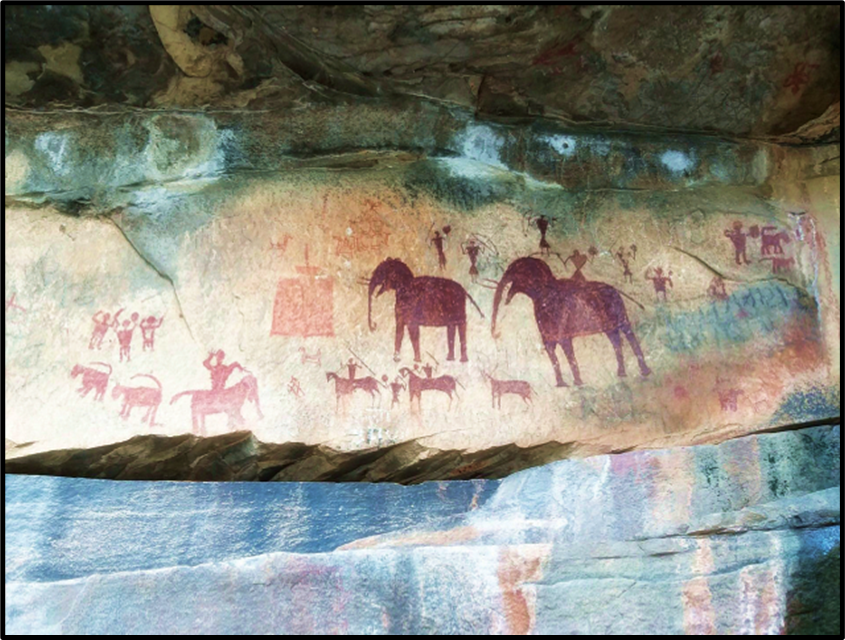
Mirzapur Rock Paintings (Uttar Pradesh)
Location
- Located in the Kaimur Hills
- In the Son River Valley, Uttar Pradesh
Discovery
- Discovered in 1867 by Archibald Carlleyle
Themes and Depictions
- Around 250 rock shelters
- Depictions include → Elephants, Boars, Tigers, Human figures
Notable Painting: Primitive Hunters
- Dates to around 5000 BCE (Mesolithic Age)
- Shows a group of humans chasing animals
- Emphasises cooperative hunting
Pachmarhi Hills (Madhya Pradesh)
Location
- Situated in the Satpura Range
- Part of the Pachmarhi Biosphere Reserve, which includes:
- Bori Sanctuary
- Satpura National Park
- Pachmarhi Sanctuary
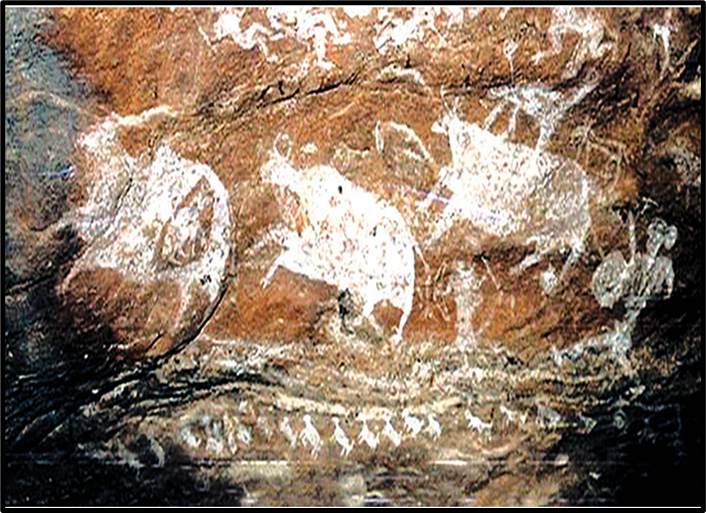
Significant Painting
- Rows of Cows (c. 5000 BCE)
- Shows a cowherd driving cattle to pasture
- Strong evidence of → Pastoral life, Early domestication
Rock Art in Other Regions of India
South India
Prehistoric paintings found at → Betamcharla, Adoni, Tirupati, Warangal, Kazipet, Hasan Parti (Andhra Pradesh), Bellary (Karnataka), Edakkal Caves
North India
- Kumaon Hills (Uttarakhand)
- Rock shelters in Kashmir
- Mangar Bani hill (Aravalli Range, Haryana), where cave paintings were discovered in 2021
Historic-phase Rock Art
Historic rock art differs clearly from prehistoric art.
Key Features
- Presence of scripts, such as → Brahmi, Kharoshti, Nagari
- Religious icons and symbols
Regional Examples
- Ladakh and Chilas (North India):
- Buddhist themes
- Kharoshti and Brahmi inscriptions
- Scenes of royal processions and daily life
- Badami (South India) and Mahadev Hills (Central India):
- Comparable to classical Indian frescoes
- Show stylistic similarities with:
- Kushana
- Gupta sculptural traditions
👉 This shows continuity between rock art and classical Indian art.
Rock Art Preservation: Challenges and Concerns
Rock art is extremely fragile.
Natural threats → Weathering, Erosion, Climatic impact
Human threats →Tourism pressure, Vandalism, Unregulated access
Way forward → Strict regulations, Protective enclosures, Awareness and conservation measures
👉 Preservation is not optional—it is civilisational responsibility.
For chapter-wise Art and Culture Notes for UPSC Prelims and Mains, refer to the complete Art and Culture notes page.