
Folk and Tribal Paintings
Indian art is not confined to royal courts or grand monuments. A large, vibrant part of it lives in villages, forests, and tribal settlements. This is where folk and tribal paintings emerge—art forms created by common people, for common people.
At their core, folk paintings are expressions of everyday life. They use a simple visual language to educate, narrate stories, and entertain village communities. These are not artworks made for galleries; they are meant to be lived with—on walls, floors, household objects, and ritual spaces.
Over generations, these traditions are passed down informally, often within families. The materials used—natural colours, mud, rice paste, leaves, or cloth—are locally available. Seasonal festivals, agricultural cycles, and life events like birth or marriage strongly influence these artistic expressions.
Tribal paintings, on the other hand, are deeply rooted in the belief systems, myths, and lived experiences of tribal communities. They reflect a worldview where nature, spirits, ancestors, and daily life coexist seamlessly.
Because both folk and tribal artists rely on local knowledge and personal experimentation, rather than formal training, these traditions are collectively referred to as “vernacular art.”
Here is a clean, one-line introductory map for Major Folk Painting Styles, matching the same UPSC-oriented, pre-reading orientation style you’ve been using for murals, miniatures, and contributors.
You can place this immediately after the heading “Major Folk Painting Styles”.
Major Folk Painting Styles of India
- Madhubani Painting – A ritualistic wall-painting tradition of Mithila marked by dense compositions, symbolic motifs, and vibrant natural colours.
- Pattachitra – A narrative cloth-painting tradition of Odisha closely associated with Jagannath worship and intricate mythological storytelling.
- Kalamkari Painting – A hand-painted and block-printed textile art of Andhra Pradesh using natural dyes to depict epics and temple narratives.
- Pichwai Painting – Devotional temple hangings from Nathdwara portraying episodes from Krishna’s life with elaborate detailing and seasonal themes.
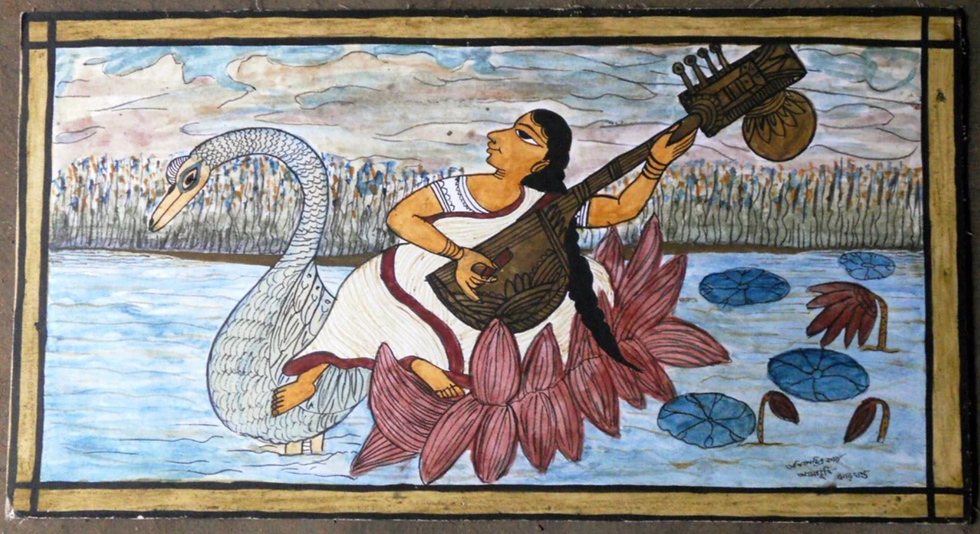
- Kalighat Pat Art1 – A bold, linear folk art of 19th-century Bengal reflecting religious themes, social satire, and urban life.
- Chitrakathi Painting – A storytelling painting tradition of Maharashtra where visual panels accompany oral narration of epics and legends.
- Thangka Painting – A Tibetan Buddhist scroll painting used as a ritual and teaching aid, depicting Buddhas, mandalas, and spiritual lineages.
- Bhojpuri Painting – A vibrant wall-painting tradition of the Bhojpur region centred on marriage rituals, fertility, and domestic life.
- Tikuli Painting – A decorative folk art from Bihar using glass-based bindis and metallic foils to create ornamental images.
- Sanjhi Art – A stencilled folk-art tradition of Mathura associated with Krishna worship and intricate cut-paper designs.
- Manjusha Art – A ritualistic snake-themed painting tradition of Bhagalpur linked with Bishari Puja and local folk beliefs.
- Mandana Art – A symbolic wall and floor painting of Rajasthan and Madhya Pradesh created to invoke prosperity and ward off evil.
- Floor Paintings (Rangoli Traditions) – A pan-Indian ritual art form using powders or petals on floors to mark auspicious occasions and festivals.
Let’s discuss them one by one in detail:
Madhubani Painting (Mithila Painting)
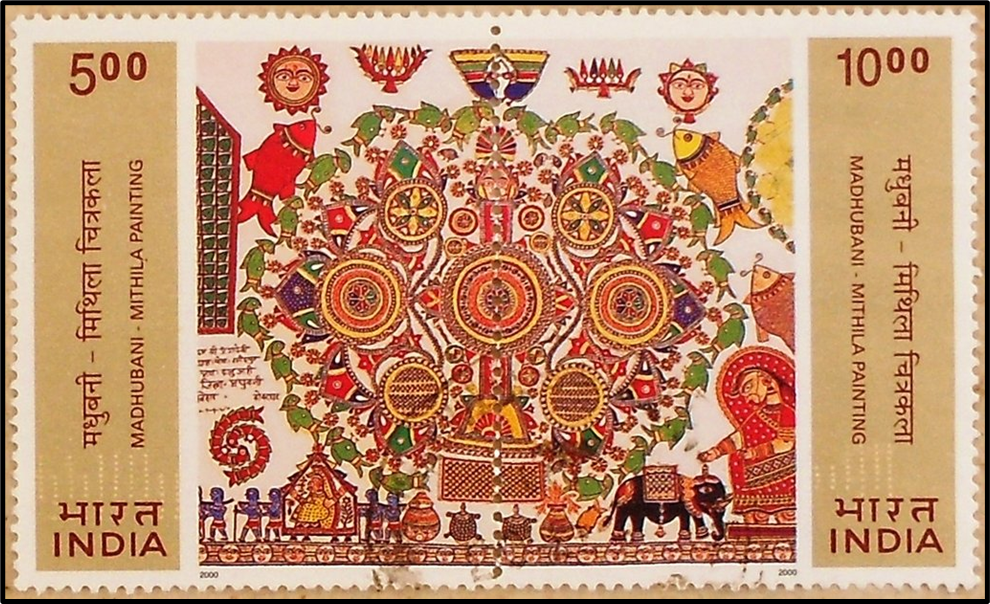
One of the most celebrated folk painting traditions of India is Madhubani painting, which originated in the Mithila region of Bihar. This region is traditionally associated with Goddess Sita, which explains the strong presence of Ramayana themes in these paintings.
Origin and Social Context
- Madhubani paintings were traditionally drawn on mud walls and floors of houses.
- They marked festivals, marriages, and significant life events.
- The tradition was primarily carried forward by women, with skills passed from mother to daughter.
- For centuries, this art remained unknown outside the region until it was documented in 1934 by William G. Archer after a major earthquake in Bihar.
Distinct Styles of Madhubani
Madhubani is not a single uniform style; it consists of five distinct traditions:
- Tantrik
- Depicts religious and mystical symbols
- Displayed during auspicious occasions
- Kohbar
- Associated with weddings
- Painted in the nuptial chamber (kohbar ghar)
- Uses fertility symbols like lotus, fish, and tortoise (symbol of love)
- Bharni
- Literally means “filling”
- Figures of Hindu deities painted in bright, flat colours
- Godna
- Simplest style
- Uses bamboo pen and kajal
- Depicts plants, animals, birds, and natural forms
- Katchni
- Practised mainly by the Kayastha community
- Also called line art
- Uses only black and vermilion, with parallel lines and dots
Main Features
- Dense compositions where no space is left empty
- Themes from epics and mythology, especially Sita’s exile
- Use of natural dyes, pigments, and rice paste
- Now practiced on cloth, handmade paper, and canvas
- Awarded Geographical Indication (GI) status, highlighting its regional identity
Pattachitra Painting
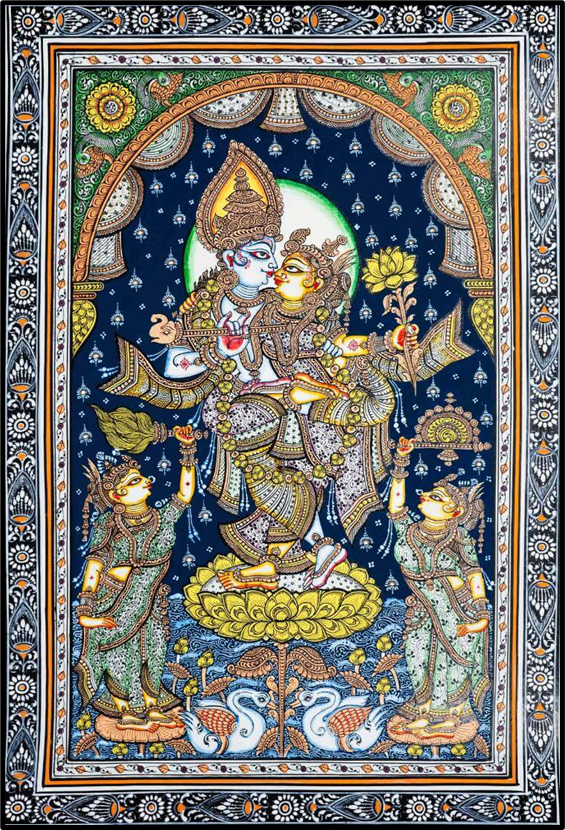
The word Pattachitra literally means “cloth painting.” This tradition belongs to Odisha and is closely linked to the worship of Lord Jagannath of Puri.
Key Characteristics
- Traditionally painted by the Chitrakar community
- Executed on cloth or palm leaves
- Palm-leaf Pattachitra is called Talapattachira
- Known for fine detailing, decorative borders, and mythological narratives
Major Themes
- Thia Badhia – Depiction of the Jagannath temple
- Krishna Lila – Childhood exploits of Lord Krishna
- Dasabatara Patti – Ten avatars of Lord Vishnu
- Panchamukhi – Five-headed form of Lord Ganesh
Pattachitra stands out for its storytelling quality, where each painting unfolds like a visual scripture.
Kalamkari Paintings
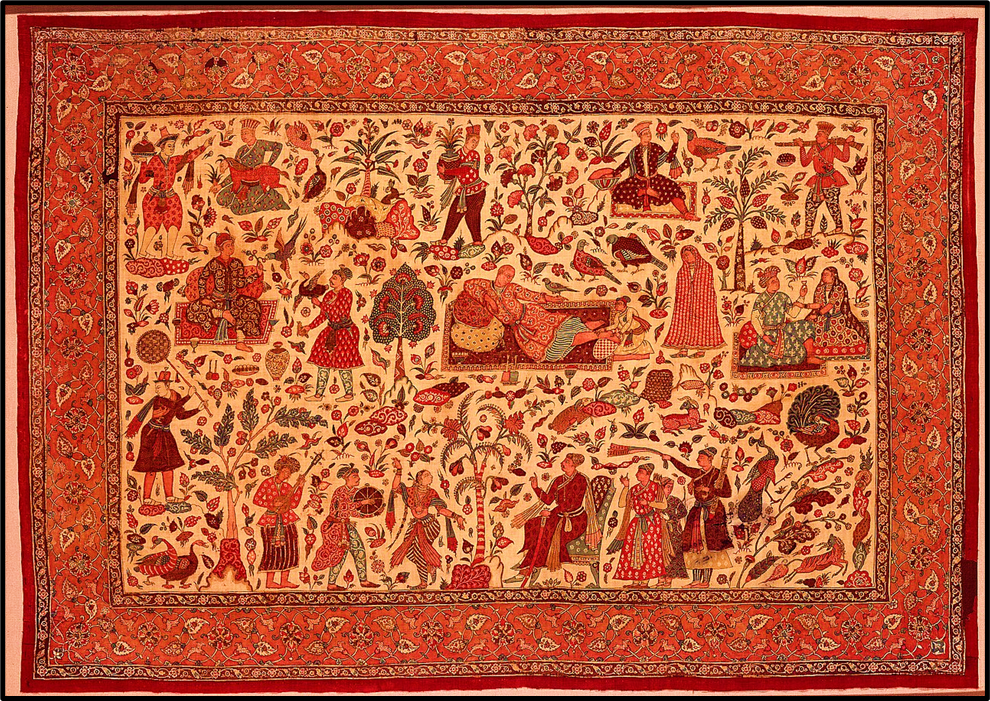
Kalamkari literally means “pen work”, derived from kalam (pen) and kari (work). This art form originated in Andhra Pradesh and flourished from the 15th century onward under royal patronage.
Historical Development
- Grew around temples, where painted cloth panels were used for storytelling
- Skills passed down from father to son
- Entire process uses natural dyes and vegetable colours
Visual Features
- Earthy colour palette: indigo, black, green, mustard
- Themes from epics, mythology, nature, and folklore
Types of Kalamkari
- Srikalahasti style
- Freehand drawing using a pen
- Strong narrative and religious themes
- Machilipatnam style
- Uses wooden blocks for printing
- More decorative and repetitive designs
Under the influence of the Golconda Sultanate, the Machilipatnam tradition also incorporated Persian motifs, showing how folk art absorbs external cultural influences without losing its core identity.
Manjusha Art
Manjusha art is an ancient and highly ritualistic folk tradition from Bhagalpur. Its roots go back to Anga Pradesh, one of the early Mahajanapadas, spanning parts of present-day Bihar, Jharkhand, and West Bengal.
The word Manjusha in Sanskrit means “box.” These paintings were traditionally drawn on boxes used by devotees to store ritual items for Bishari Puja, a festival dedicated to the Snake God—a protector figure in local belief systems.
Social Organisation and Ritual Function
A striking feature of Manjusha art is community participation:
- Kumbhakar community: makes earthen pots (kalash) and paints them with Manjusha motifs.
- Malakar community: creates temple-shaped boxes and decorates them with the same motifs.
During Bishari Puja, both the kalash and the Manjusha boxes are worshipped to seek strength, protection, and well-being.
Visual Features
- Uses only three colours: pink, green, and yellow
- Dominant motif: the swirling snake, hence often called snake painting
- Borders are distinctive—filled with leaves, triangles, and snake patterns
Contemporary Preservation
In an effort to revive and popularise this tradition, Manjusha motifs now appear on commercial products, including the exterior of the Vikramshila Express.
👉 UPSC insight: Manjusha art is a textbook example of ritual-centric folk art intertwined with mythology and community roles.
Mandana Art
Mandana art is a traditional wall and floor painting practice found in Rajasthan and Madhya Pradesh, especially among the Meena community. It is also known as Meena paintings.
Cultural Context
- Created primarily by women
- Skills passed from mother to daughter
- Serves both decorative and protective purposes—believed to ward off evil influences
Materials and Symbolism
Mandana paintings rely entirely on natural materials:
- Geru mitti (red ochre) → symbolises fertility and auspiciousness
- Khadiya mitti (white chalk) → symbol of purity
Motifs
- Geometric patterns
- Peacocks, tigers
- Human figures and deities
👉 Conceptually, Mandana reflects how sacred symbolism is woven into everyday domestic spaces.
Floor Paintings
Floor paintings form one of the most ancient and widespread folk art traditions in India. Practised across regions, they are typically made during festivals, rituals, and auspicious occasions as an invocation of deities.
Materials and Practice
- Traditionally made with rice powder
- Also use coloured powders or flower petals
- Knowledge passed orally and through practice from generation to generation
Regional Names
Although commonly called Rangoli, floor paintings are known by different names across India:
- Chawk Purna – Uttar Pradesh
- Aipan – Uttarakhand
- Mandana – Rajasthan
- Muggulu – Andhra Pradesh
- Aripana – Bihar
- Rangoli – Maharashtra
- Alpana – West Bengal
- Athiya – Gujarat
- Rangwalli – Karnataka
- Kolam – Tamil Nadu
- Arooph – Himachal Pradesh
- Kalamezhuthu – Kerala
Major Tribal Paintings
Tribal paintings in India are not created for aesthetic pleasure alone. They are inseparable from ritual, ecology, belief systems, and collective memory. Unlike classical art, which often celebrates ideal forms, tribal art records life as it is lived—through symbols, repetition, rhythm, and community participation.
Let us now understand the major tribal painting traditions, one by one but before that let’s have an overview of Major Tribal paintings:
- Warli Painting – A minimalist, ritual wall-painting tradition of Maharashtra using geometric forms to depict everyday life and community celebrations.
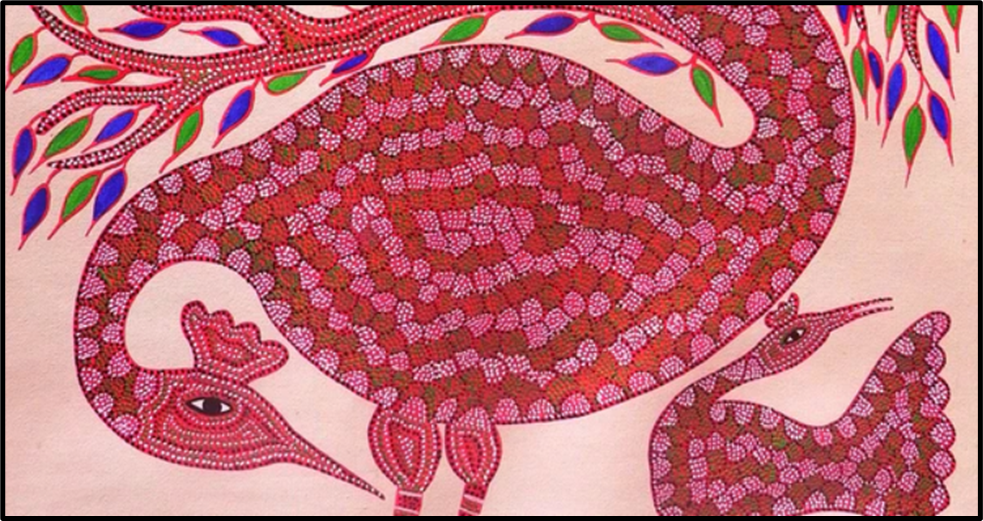
- Gond Painting – A vibrant narrative art of Central India where myths, nature, and folklore are rendered through intricate dots and rhythmic patterns.
- Phad Painting – A travelling narrative scroll tradition of Rajasthan that visually recounts heroic legends and local deities through song and performance.
- Chittara Painting – A ceremonial wall and floor painting of Karnataka created by women to celebrate nature, fertility, and community festivals.
- Pithora Painting – A highly ritualistic tribal mural of western India painted to invoke divine blessings, prosperity, and protection.
- Paitkar Painting – A scroll-based tribal art of Jharkhand associated with death rituals, cosmology, and storytelling through sequential imagery.
- Bhil Art – A dot-based expressive painting tradition reflecting the Bhil worldview of nature, cosmic forces, and ancestral beliefs.
- Khovar Art – A matriarchal marriage-related wall art of Jharkhand created by scraping designs into layered mud surfaces.
- Saura Painting – A symbolic village-painting tradition of Odisha depicting community life and rituals with simple, linear human forms.
- Santhal Painting – A mystical scroll-painting tradition used for ritual singing, healing, and ancestral communication.
- Kurumba Painting – A ritual temple art of the Nilgiris portraying honey-hunting, subsistence life, and the sacred bond between tribe and nature.
Warli Painting
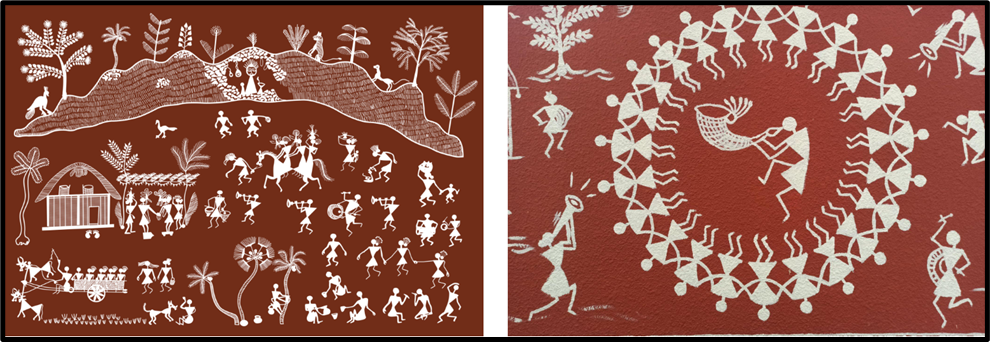
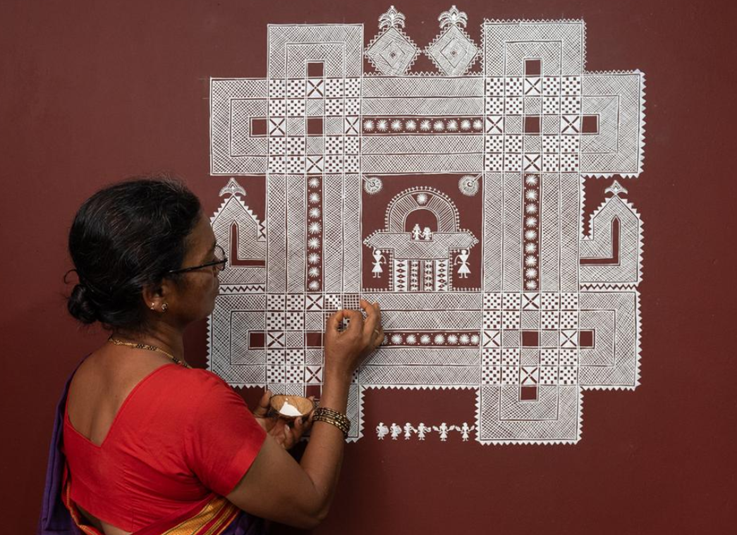
Warli painting belongs to the Warli tribe of Maharashtra and adjoining regions.
Key Characteristics
- Executed on mud walls and floors
- Painted mainly by women
- Uses white rice paste on a red or yellow ochre background
- Composed of simple geometric shapes—circles, triangles, lines, and dots
Central Motif and Composition
- The painting revolves around a chaukat (chauk)—a sacred square
- Scenes expand spirally from the centre
- Depicts harvesting, weddings, dancing, hunting, and daily life
Conceptual Significance
- Largely secular, unlike most tribal arts
- Avoids elaborate religious iconography
- Resembles prehistoric cave paintings in its linear, monochromatic style
Warli painting received the Geographical Indication (GI) tag in 2011, representing Maharashtra, Gujarat, Dadra and Nagar Haveli, and Daman and Diu.
👉 UPSC insight: Warli is about community life, not gods.
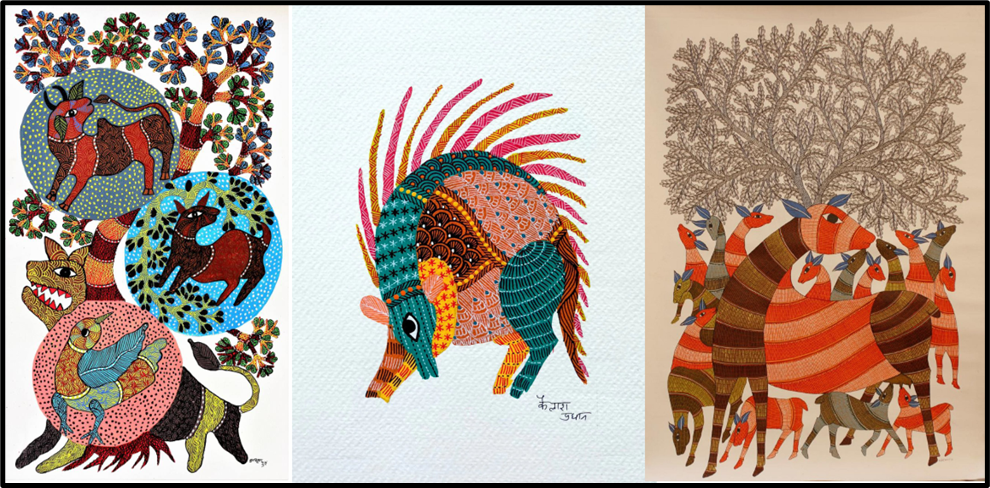
Gond Painting
Gond painting originates from the Gond tribe of Madhya Pradesh.
Visual Style
- Rich, vibrant colours
- Surfaces filled with intricate dots, dashes, and lines
- No empty space—every form is animated
Themes
- Tribal folklore and myths
- Animals, trees, birds, and natural forces
- Rituals, festivals, and important events
The Gond worldview sees nature as living and conscious, which is why animals and trees appear dynamic and expressive.
Phad Painting
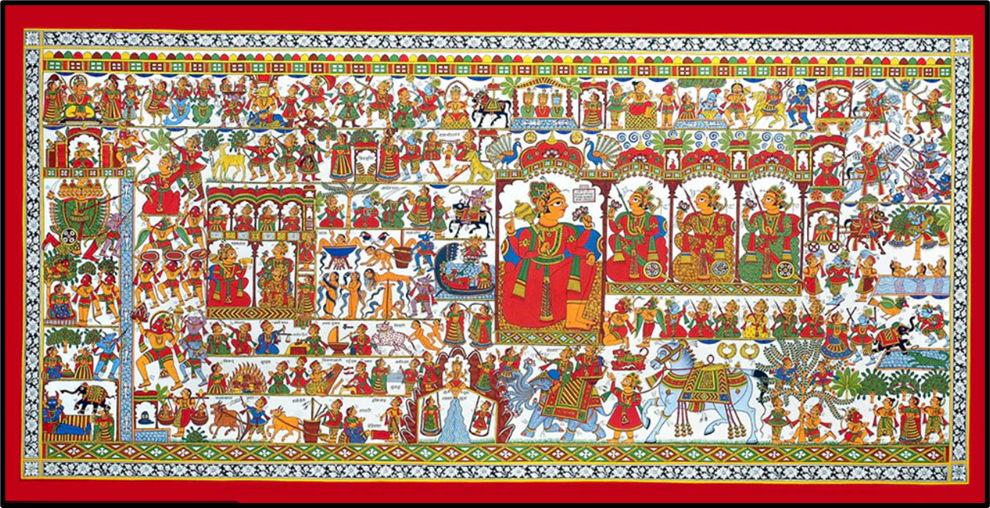
Phad painting is a narrative scroll painting tradition from Rajasthan.
Technique and Performance
- Painted on horizontal cloth scrolls
- Dominant colours: red, yellow, and orange
- Scrolls are carried from village to village
- Stories narrated by traditional singers, using visuals
Themes
- Local deities and heroes
- Adventure tales, heroic deeds, legendary romances
- Rural life, flora, and fauna
👉 Phad is not static art—it is performative storytelling.
Chittara Painting
Chittara painting is practised by women of the Deewaru community in Karnataka.
Cultural Context
- Associated with Bhoomi Hunnime, a nature-worship festival
- Painted on outer walls and floors of huts
Materials and Style
- Natural substances: rice paste, rocks, red mud
- Patterns include → Long lines, Cross-hatchings, Symmetrical designs
Themes
- Animals and plants
- Religious ceremonies
- Human activities and festivals
Pithora Painting
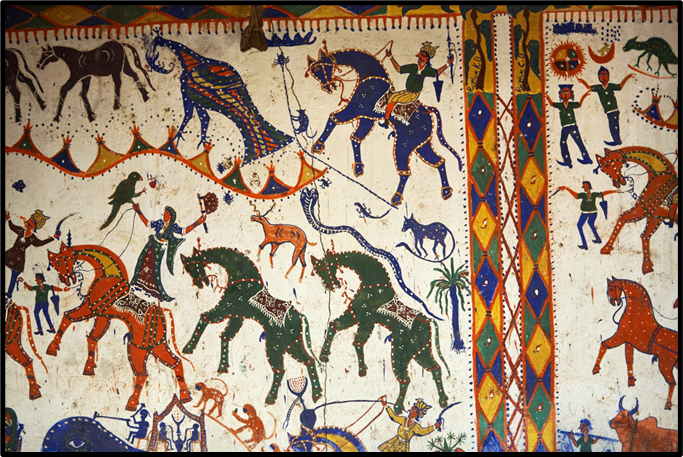
Pithora painting belongs to the Rathvas, Bhils, and Bhilalas of Gujarat and Madhya Pradesh.
Ritual Nature
- More ritual than decorative
- Invokes Baba Pithora (Babo Pithoro) for prosperity, safety, and health
Social Roles
- Supervised by a priest called Badwa
- Young unmarried girls prepare the walls
- Artist known as Lakhara paints the figures
Paintings are framed and preserved as sacred enclosures, symbolising gratitude to the deity.
Paitkar Painting
Paitkar painting is a form of Pata Chitra (scroll painting) practised in East Singhbhum.
Themes
- Origins of life
- Hindu deities like Shiva and Durga
- Local deities such as Manasa (snake goddess)
- Tribal rituals, festivals, and lifestyle
The Santhal tribe believes Paitkar paintings can help guide the souls of the dead to heaven.
Style
- Natural colours
- Thick contour lines
- Human figures dominate the space
- Extended eyes
Traditionally practised by men, passed from father to son.
Bhil Art
Bhil art is practised by the Bhil tribes across → Madhya Pradesh, Rajasthan, Gujarat, Maharashtra
Features
- Extensive use of dots
- Vibrant, natural colours
- Motifs: Sun, Moon, gods, animals, forests
Dots symbolise seeds, continuity, and life energy.
Khovar Art
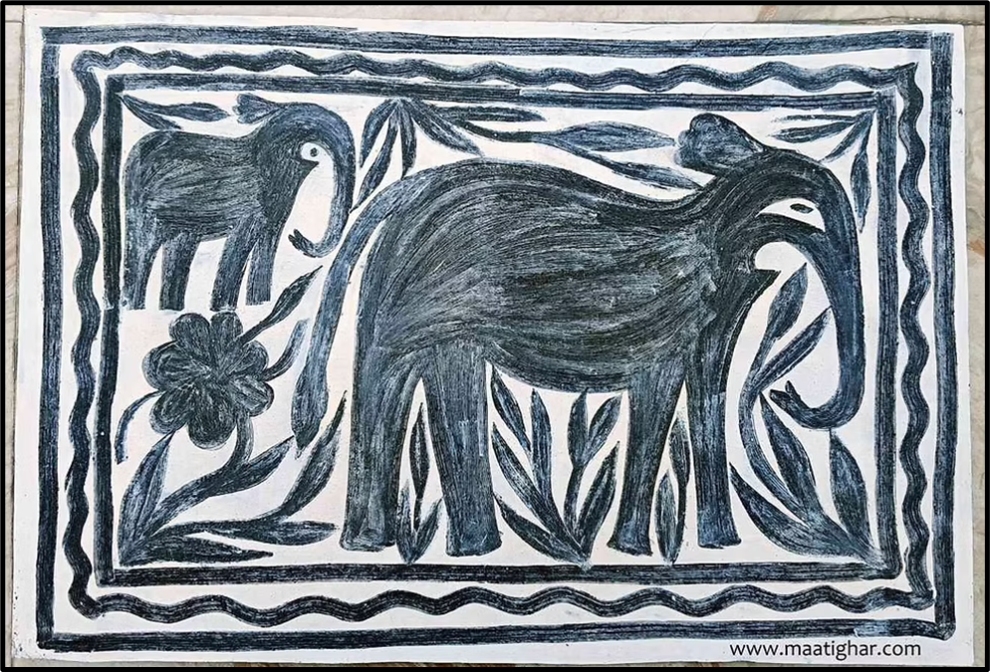
Khovar art is a matriarchal tribal art from Jharkhand.
Meaning and Technique
- Kho → cave
- Var → husband
Painted by women to decorate wedding chambers.
Process
- Wall coated with black mud, then white mud
- Upper layer peeled to create designs
Motifs
- Animals, snakes, peacocks, cows
Saura Painting
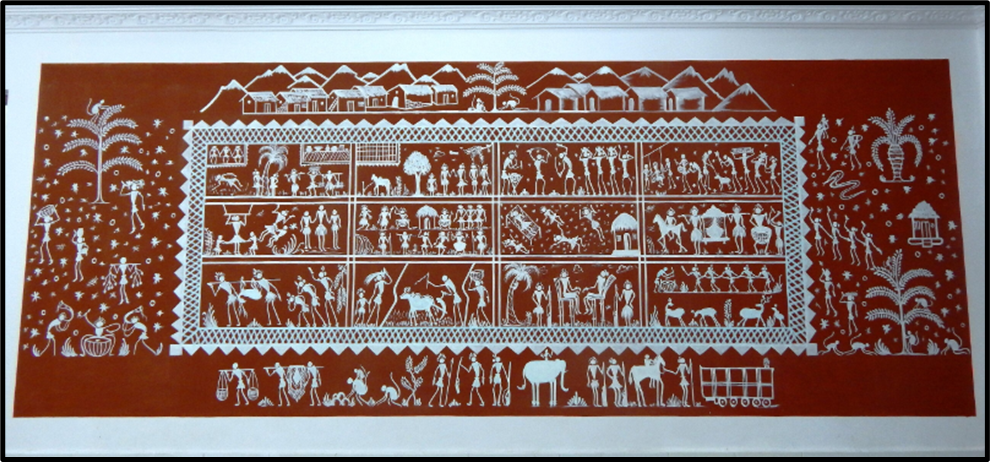
Saura painting, also called Ikons, belongs to the Saura tribe of Odisha, and is also found in Maharashtra, Madhya Pradesh, and Jharkhand.
Features
- Background of red or yellow ochre
- Simple human figures
- Depicts village life
Unlike Warli, Saura paintings do not use geometric shapes.
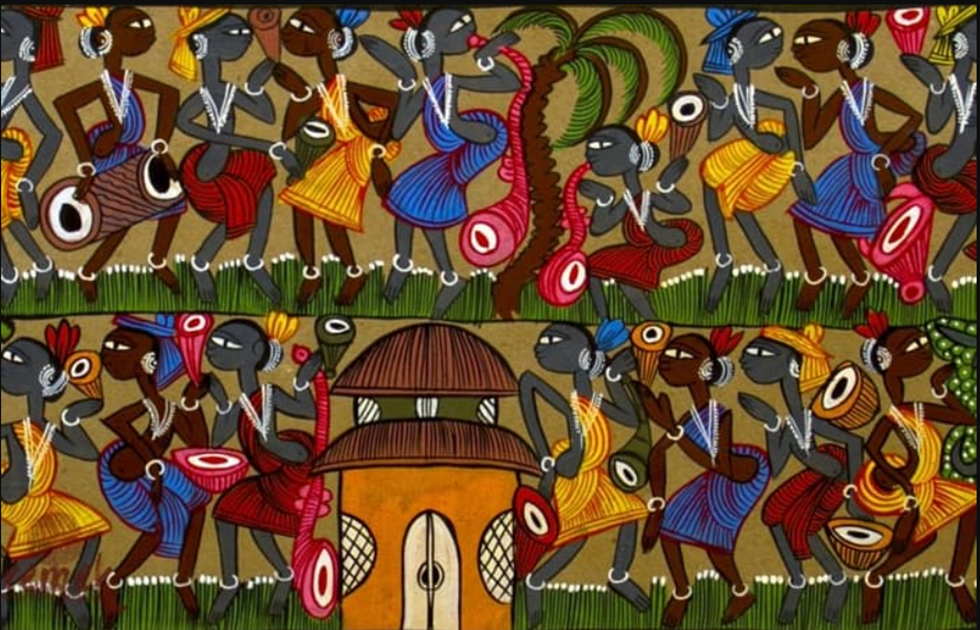
Santhal Painting
The Santhals, the largest group of the Mundas, are spread across Bihar, Chhattisgarh, Odisha, and West Bengal.
Practice
- Painted on Pata (cloth scrolls)
- Artists travel village to village singing Pater Gaan
Artists
- Created by Jadu Patuas (magic painters)
- Paintings meant to → Ensure good harvest, Ward off disease, Honour the dead
Santhal art is imaginative and surreal—free from naturalistic constraints.
Kurumba Painting
Kurumba painting is a ritualistic tribal art of the Kurumba community of the Nilgiris.
Historical Context
- Linked to Eluthu Paarai, a 3000-year-old rock art site
- Depicts honey gathering, farming, and cooking
Key Features
- Themes of nature and livelihood
- Honey-gathering is especially prominent
- Practised only by male priests
- Used to decorate temples
- UPSC Prelims 1995 ↩︎
For chapter-wise Art and Culture Notes for UPSC Prelims and Mains, refer to the complete Art and Culture notes page.