
Evolution of Dance in India
When we speak of Indian dance, we are not merely speaking of movement. We are speaking of history in motion, philosophy in rhythm, and society in symbolic expression. Dance in India has never been just entertainment; it has been devotion, diplomacy, resistance, storytelling, and identity.
Let us understand this journey:
Historical Roots of Indian Dance
Indian dance is as old as Indian civilisation itself.
🪨 Prehistoric Evidence – Bhimbetka
The cave paintings at Bhimbetka Rock Shelters show human figures in dancing postures.
👉 What does this mean?
Even prehistoric humans used rhythm and coordinated body movement. Dance was likely connected to rituals, hunting celebrations, or community bonding.
This proves that dance in India is not borrowed; it is indigenous and deeply rooted.
🗿 Harappan Evidence – Dancing Girl
The famous bronze statue of the Dancing Girl from Mohenjo-daro (Harappan Civilization) reflects → Confidence, Poise, Rhythmic awareness, Ornamentation
This is not a primitive representation. It suggests a developed aesthetic culture where dance was known and valued.
📜 Classical References
- Arthashastra by Kautilya mentions dancers being employed as spies. → This shows dance was institutionalised and socially recognised.
- Temple traditions across India had Devadasis — women dedicated to temple service through dance.
- During medieval times, dance was known as Paturbazi.
- Male dancers: Mohanrao, Rangrao, Desirao, Kanhurao
- Female dancers: Patur or Patar
- Sufi traditions refer to Sama — a mystical dance practice associated with spiritual ecstasy.
👉 Therefore, dance was → Religious, Political, Cultural, Mystical. It was woven into the fabric of society.
Dance as Social and Spiritual Expression
Indian dance has always operated in three dimensions:
| Dimension | Function |
|---|---|
| Religious | Devotion, temple rituals |
| Social | Festivals, marriage, community events |
| Political | Royal courts, cultural diplomacy |
Dance is a visual scripture. If sculpture is frozen movement, dance is moving sculpture.
Classification of Indian Dances
India classifies its dances into four broad categories:
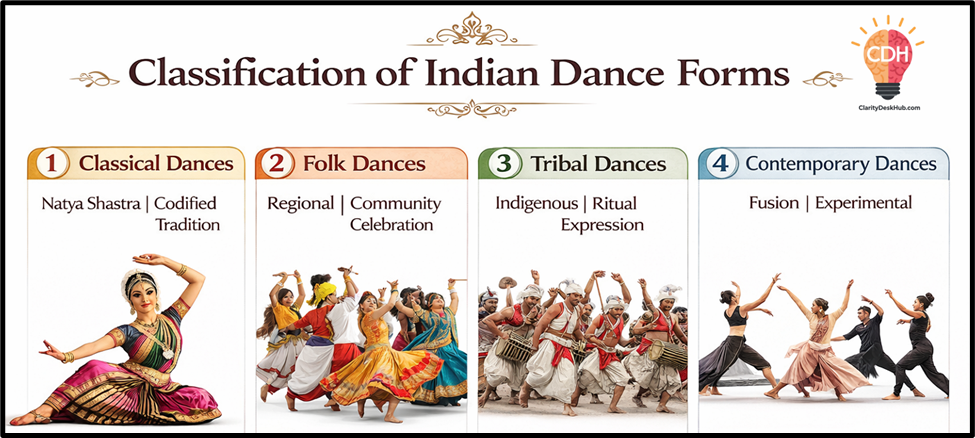
1️⃣ Classical Dances
These:
- Derive from the Sanskrit text Natya Shastra
- Are codified; Follow strict technique; Have religious foundations
They are considered religious performance arts of Hinduism.
Characteristics:
- Structured mudras (hand gestures)
- Rasa theory (aesthetic emotion)
- Bhava (expression)
- Costume and symbolism
- Guru-shishya parampara
Classical dance is not spontaneous; it is disciplined spiritual practice.
2️⃣ Folk Dances
Folk dances are → Region-specific; Community-based; Linked to agricultural cycles; Performed during festivals.
Each state has its own style. For example:
- Punjab → energetic harvest dances
- Gujarat → circular group dances
- Assam → seasonal celebration dances
They reflect local identity and collective joy.
3️⃣ Tribal Dances
Tribal dances are:
- Connected to nature; Linked to hunting, farming, ancestor worship
- Less formalised; Deeply symbolic
They reflect ecological and environmental contexts of tribes.
If classical dance is refined scripture, tribal dance is primal expression.
4️⃣ Contemporary Dances
Contemporary dance represents:
- Fusion of classical + folk + tribal + modern forms
- Experimental choreography
- Urban influences
- Theatre-based interpretations
It shows that Indian dance is not static; it evolves.
Philosophical Depth of Indian Dance
To truly understand Indian dance, one must grasp three core ideas:
🔹Rasa: The emotional essence experienced by the audience.
🔹Bhava: The emotion expressed by the performer.
🔹Natya: Dramatic representation of life.
Indian dance is not about physical perfection. It is about evoking experience.
Dance becomes a bridge between → performer and audience; human and divine; body and soul
This topic is covered under the Art and Culture notes series designed for UPSC Prelims and Mains preparation.