
Key Terms in World History
Feudalism
To understand Feudalism, do not look at it merely as a chapter in a history book. Instead, look at it as a survival strategy.
Imagine a world where the great Roman Empire has collapsed, there is no police, no central army, and no stable currency. In such a state of “anarchy,” how does a society survive? The answer the medieval world found was Feudalism.
The Essence of Feudalism: Etymology and Definition
The word ‘Feudalism’ finds its roots in the Latin term feodum, which literally translates to ‘land granted for service.’ At its core, it was a socio-political and economic contract.
In simple terms, it was an exchange: “I give you land and protection; you give me loyalty and military service.” It flourished between the 7th and 14th centuries, creating a rigid yet stable structure that filled the vacuum left by the fallen Roman eagles.
The Genesis: Why did Feudalism Emerge?
History never happens in a vacuum. There were specific material and psychological conditions that forced Europe into this system:
- The Collapse of Central Authority: After the fall of the Western Roman Empire in 476 AD, the “Big State” vanished. There was no one to enforce laws over long distances. Power, therefore, became localized.
- The Climate of Fear (Invasions): Europe was being hammered by “barbarian” invasions—the Vikings from the North, the Magyars from the East, and the Saracens from the South. When a Viking is at your door, you don’t call a distant King; you run to the local strongman who has a castle and a sword.
- Land as the Only ‘Currency’: Trade had dried up, and cities were decaying. Money became scarce. If a King wanted to maintain an army, he couldn’t pay them in gold; he had to pay them in land (fiefs).
- Cultural & Religious Sanction: The Germanic tribal tradition of “Comitatus” (loyalty to a chief) provided the social blueprint, while the Catholic Church provided the moral glue, suggesting that this hierarchy was part of a “Divine Order.”
The Structural Architecture: How did it Work?
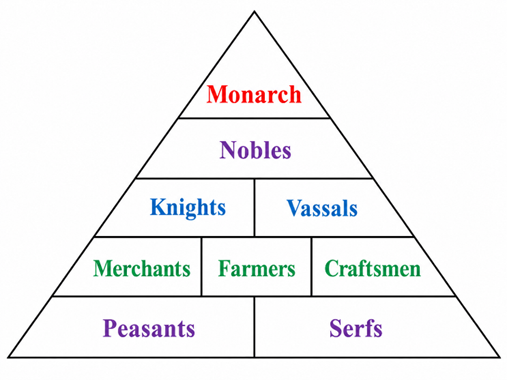
Feudalism was organized like a rigid pyramid. This wasn’t just a social ladder; it was a chain of command.
The Hierarchy of Relationships
- The King: Theoretically owned all the land but was often a “land-poor” ruler who depended on his nobles.
- Powerful Nobles (Lords): The real power players who held vast estates.
- Vassals/Knights: The professional warrior class. They received smaller pieces of land in exchange for 40 days of military service a year.
- Peasants and Serfs: The foundation of the pyramid. They weren’t slaves (they couldn’t be sold), but they were “bound to the land.”
The Manorial System (The Economic Engine)
While Feudalism was the political side, Manorialism was the economic side. Each manor (a lord’s estate) was a self-sufficient universe.
- Demesne: The land the lord kept for himself, worked by serfs.
- Self-Sufficiency: The manor produced its own food, clothes, and tools. This was “localized production” at its peak, but it also meant that trade was almost non-existent.
A Multidimensional Analysis: Impact and Consequences
Was Feudalism “good” or “bad”? As students of history, we must avoid such binary traps. Let us look at its dual nature:
The Positive Dimensions (The Order in Chaos)
- Stability: In a violent age, it provided a framework for law and defense.
- The Code of Chivalry: It transformed “thugs with swords” into “knights with honor.” This code emphasized loyalty, bravery, and the protection of the weak, which laid the early foundations for modern European etiquette.
- Preservation of Knowledge: Within the safety of feudal grants, monasteries flourished, acting as “cold storage” for ancient Greco-Roman knowledge.
The Negative Dimensions (The Cost of Stability)
- Institutionalized Inequality: A person’s destiny was decided by their birth. If you were born a serf, you died a serf. There was zero social mobility.
- Economic Stagnation: Because the goal was self-sufficiency, there was no incentive to innovate. Agriculture remained primitive, and the “profit motive” was absent.
- Political Fragmentation: The King was often just a “first among equals.” This delayed the formation of strong, united nation-states.
The Sunset of Feudalism: Why did it Decline?
No system is eternal. By the 13th and 14th centuries, the “Feudal Contract” began to crack due to several “shocks”:
- The Black Death (1347–1351): This plague was a demographic catastrophe but an economic catalyst. When one-third of the population died, labor became expensive. Serfs realized their value and began demanding wages or fleeing to cities.
- The Return of Money: As trade revived (Crusades played a role here), a new class emerged—the Bourgeoisie (Middle Class). Kings could now tax trade, collect money, and hire professional armies. They no longer needed troublesome knights.
- Technological Change: The introduction of gunpowder and the longbow made the “Knight in shining armor” obsolete. A castle wall could now be breached by a cannon.
- Centralization: Monarchs in England and France began to bypass the lords and deal directly with the people through royal courts and national bureaucracies.
Conclusion: The Historical Bridge
Feudalism was the bridge between the Classical World (Rome) and the Modern World (Nation-states). It was a harsh, rigid, and often oppressive system, yet it was the necessary “scaffolding” that allowed Europe to rebuild itself. Its decline didn’t just end an era; it gave birth to the concepts of private property, contractual law, and eventually, the capitalist transition.
When you look at the modern world’s obsession with “contracts” and “property rights,” remember—the seeds were sown in the muddy fields of a medieval manor.
Socialism
If Feudalism was about the “land,” and Capitalism was about the “capital,” then Socialism is fundamentally about the “society.”
Think of it this way: if you are walking down a street and see one person living in a palace while ten people are sleeping on the pavement outside, your heart feels a pinch. That “pinch” of conscience, when translated into a political and economic system, is what we call Socialism. It is the quest for a world where “we” is more important than “I.”
The Genesis: Why did Socialism Emerge?
To understand Socialism, you must understand the Industrial Revolution. While the steam engine and factories brought immense wealth, they also brought “Satanic Mills.”
- The Disparity of Wealth: Imagine a factory owner getting richer by the hour while the workers—including children—worked 16 hours a day in hazardous conditions for pennies. This gap between the Haves and the Have-nots became unbearable.
- The Failure of Liberalism: Early Liberalism (Capitalism) said, “Let everyone compete freely.” But how can a person with no shoes compete with someone on a horse? Socialists argued that “Individual Liberty” is a hollow concept if a person is starving.
- The Urban Misery: Rapid industrialization led to overcrowded slums and widespread poverty. Socialism emerged as a systematic “rebellion” against this inhumanity.
The Core Pillars: What defines Socialism?
Socialism isn’t just about being “nice”; it is a structural redesign of how a country runs.
- Public Ownership (The Heart): Instead of a few billionaires owning all the factories and mines, Socialism argues that these “means of production” should belong to the state or the community. If the people own the resources, the profits benefit everyone.
- Central Planning (The Brain):
- In Capitalism, the market decides what to produce (usually whatever makes the most profit).
- In Socialism, the Government plans production based on what the society needs—like hospitals and schools—rather than luxury cars for a few.
- Economic Equality: The goal is to flatten the pyramid. It focuses on “distributive justice”—ensuring that basic needs like healthcare, education, and housing are not “products” to be bought, but “rights” to be enjoyed.
The Spectrum: Many Shades of Red
Socialism is not a monolith; it is a rainbow of ideologies ranging from peaceful reform to violent revolution.
A. The Evolutionary Path (Peaceful)
- Utopian Socialism: The early dreamers (like Saint-Simon and Fourier). they believed that if they set up “ideal communities,” the world would see their beauty and follow suit. It was noble but lacked a practical roadmap.
- Fabian & Democratic Socialism: This is the path of the “Ballot,” not the “Bullet.” Think of Nehru in India or the Labour Party in the UK. They believe in changing the system gradually through laws and elections.
- Christian Socialism: This views the “Brotherhood of Man” through a religious lens, arguing that Jesus’s teachings naturally lead to sharing and equality.
B. The Revolutionary Path (Radical)
- Marxism/Leninism: Karl Marx argued that the rich would never give up power voluntarily. Therefore, a Revolution is inevitable. The workers (Proletariat) must seize the state and establish their own rule.
C. The Alternative Shades
- Green Socialism: A modern blend. It says we can’t have equality on a dead planet. It links social justice with environmental conservation.
- Market Socialism: A fascinating “middle path” where the state owns the factories, but those factories compete in a market to stay efficient (similar to certain phases in Yugoslavia or China).
Critical Analysis: The Dual Face of Socialism
As intellectual seekers, we must look at both the “light” and the “shadow” of this ideology.
The Great Contributions
- Humanizing Capitalism: Today, even capitalist countries have “minimum wages” and “labor laws.” Why? Because of the pressure created by the Socialist movement.
- Social Safety Nets: The idea that the state should provide “free education” or “universal healthcare” is a gift of Socialist thinking.
The Serious Challenges
- The Incentive Problem: Critics ask: “If everyone gets the same salary regardless of how hard they work, why would anyone innovate?” This can lead to a “culture of laziness” and stagnation.
- Economic Inefficiency: Without “Market Prices,” it is very hard for a central planner to know exactly how many shoes or loaves of bread to produce. This often leads to shortages or waste.
- The Authoritarian Trap: When you give the State total control over the economy, you also give it total control over the people. In many cases (like the USSR), Socialism unfortunately turned into a dictatorship.
Conclusion: The Synthesis
Today, pure “Orthodox Socialism” is rare, and pure “Laissez-faire Capitalism” is also dead. Most of the world lives in a “Mixed Economy.”
Socialism taught us a vital lesson: Wealth without welfare is a recipe for disaster. Whether it is through the Nordic Model in Scandinavia or the Welfare State in India, the “soul” of Socialism—the desire for a dignified life for the last person in the queue—continues to guide modern governance.
It reminds us that the economy exists for the people, not the other way around.
Now, let us move toward the most radical and perhaps the most debated destination in the journey of political thought: Communism.
Communism
If Socialism is a “reform” of the house, Communism is the “demolition and rebuilding” of it. While Socialism says the state should manage resources for the people, Communism envisions a time when the state itself will no longer be necessary. It is the ultimate utopia where there is no “mine” or “thine,” only “ours.”
The Vision: What is Communism?
The term refers to a socio-political and economic ideology aiming for a classless and stateless society. It was famously systematized by Karl Marx and Friedrich Engels in the mid-19th century.
Marx saw history as a series of “class struggles.” He believed that just as Feudalism gave way to Capitalism, Capitalism would inevitably collapse under its own contradictions, leading to Communism. In this final stage, the motto would be:
“From each according to his ability, to each according to his needs.”
The Blueprint: Key Characteristics
To achieve this “perfect equality,” Marx and his successors proposed a radical restructuring of society. Try to understand the logic behind these points:
- Abolition of Private Property: In Communism, you can own your toothbrush (personal property), but you cannot own a factory or 500 acres of land (private productive property). Why? Because Marx argued that owning the “means of production” allows you to exploit others.
- The End of Inheritance: To ensure that every child starts at the same baseline, inheritance is abolished. You shouldn’t be a billionaire just because your father was one.
- Centralized Command: The state takes total control of finance (banks), communication, and transport. These are the “nervous system” of an economy; if the community controls them, it controls the direction of society.
- Labor and Education: Communism demands that everyone contributes work. In return, the state provides free, compulsory education, effectively ending the dark era of child labor.
- Closing the Urban-Rural Gap: It seeks to distribute the population and resources more evenly, so that villages aren’t neglected and cities aren’t overcrowded.
The Branches: One Theory, Many Realities
Communism is like a tree; the roots are Marxist, but the branches grew differently depending on the soil (the country).
| Branch | Key Focus | Notable Figure |
|---|---|---|
| Marxism | The original theory: Worker revolution against Capitalists. | Karl Marx |
| Marxism-Leninism | Introduced the “Vanguard Party”—a disciplined group to lead the revolution. | Vladimir Lenin |
| Stalinism | Focused on rapid industrialization, total state terror, and a personality cult. | Joseph Stalin |
| Maoism | Shifted the focus from factory workers to peasants. Emphasized “protracted people’s war.” | Mao Zedong |
| Trotskyism | Argued for “Permanent Revolution”—socialism must be international, not just in one country. | Leon Trotsky |
The Conceptual Maze: Socialism vs. Communism vs. Communalism
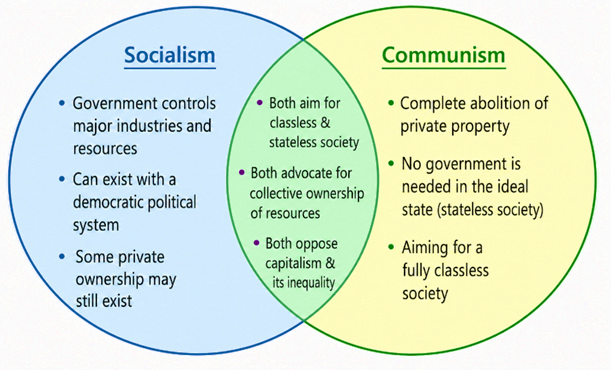
Many students get confused here. Let’s clear the fog. Look at this comparison:
The “State” Factor
- Socialism: Needs a strong state to distribute wealth.
- Communism: Sees the state as a temporary tool that will eventually “wither away” once everyone learns to live collectively.
The “Property” Factor
- Socialism: Allows some private property but regulates big industries.
- Communism: Abolishes all private ownership of productive assets.
The “Identity” Factor (Communalism)
In the Indian context, this is vital. Communalism has nothing to do with “Common Ownership.” It is about identity (religion, ethnicity).
- Communism wants to unite people based on Class (“Workers of the world, unite!”).
- Communalism divides people based on Identity (“My religion/group vs. yours”).
- Note: While Communism is an economic theory, Communalism is a social/political mobilization based on group loyalty, which often leads to conflict (like the Partition of 1947).
Critical Analysis: The Dream vs. The Nightmare
Now, I must ask you to look at the “consequences.”
- The Achievement: In countries like the USSR and China, Communism successfully lifted millions out of feudal poverty, achieved 100% literacy, and defeated Nazism.
- The Tragedy: Because the system required total control to work, it often led to Authoritarianism. Dissent was crushed, and without a “market price” to guide production, millions died in man-made famines (like the “Great Leap Forward” in China).
Conclusion: What remains today?
Pure Communism—the stateless, classless utopia—has never been fully achieved anywhere. What we saw in the 20th century were “Socialist States” trying to reach Communism.
Today, the world has moved toward a “synthesis.” Even China has embraced market elements. However, the core Marxist critique remains relevant: as long as there is extreme inequality and exploitation, the ghost of Communism will continue to haunt the halls of Capitalism.
It serves as a permanent reminder that an economy without a social soul is unsustainable.
Do you see any similarities between the “Self-Sufficient Manor” of Feudalism and the “Commune” of Communism, or do you think they are fundamentally opposites?
After discussing ideologies like Socialism and Communism that focus on “equality,” we now turn to a system that focused on something entirely different: Power and Gold.
Imagine you are a King in the 16th century. You want a massive army and a grand palace. You cannot print paper money like we do today; your strength is measured only by the weight of gold and silver in your vault. This mindset—where the world’s wealth is seen as a fixed pie, and you must grab the biggest slice—is what we call Mercantilism.
Mercantilism
The Core Philosophy: “Bullionism” and the Zero-Sum Game
Mercantilism was the dominant economic logic in Europe from the 16th to the 18th centuries. Its foundation rested on two pillars:
- Wealth = Precious Metals: A nation’s power was directly proportional to its stock of gold and silver (Bullion).
- Zero-Sum Logic: Mercantilists believed that the total wealth of the world was limited. For one country to get richer, another must get poorer. This made trade a form of “economic warfare.”
To win this war, the strategy was simple: Maximize Exports and Minimize Imports. You want everyone to buy your goods (bringing gold in) but you don’t want to buy anything from them (keeping gold from going out).
The Features of a Mercantile State
How did a country ensure it stayed ahead? They didn’t leave it to the “free market.” The State was the ultimate controller.
- Protectionism: High taxes (tariffs) were placed on foreign goods to make them expensive, forcing people to buy local products.
- State Monopolies: The King would grant a “charter” to a specific company (like the British East India Company) giving it the exclusive right to trade in a certain region. No competition was allowed.
- Economic Nationalism: Everything was done for the “Glory of the State.” The individual merchant’s profit was secondary to the nation’s strength.
- Colonialism: This is the most “dark” and “analytical” part of the system. In this logic, colonies were not seen as partners, but as resource banks.
A Case Study in Exploitation: The American Revolution
If you want to understand why the United States exists today, look at British Mercantilism. The American Revolution was not just a fight for “freedom”; it was a revolt against being a captive market.
The British saw their American colonies as “milch cows.” They imposed several measures to ensure the colonies only benefited the “Mother Country”:
- The Navigation Acts: Colonists were told: “You can only ship your goods on British ships, and you can only sell to British ports.” This killed their profit margins.
- The Sugar and Stamp Acts: Britain needed money to pay for its wars, so it taxed the colonists on everything from molasses to newspapers.
- The Proclamation of 1763: Britain even told the colonists they couldn’t move West to find new land, as it would be too hard to regulate and protect.
The famous slogan “No Taxation without Representation” was the political face of an economic scream: “Stop strangling our economy for your gold vaults!”
Mercantilism in the East: The Company Raj
For us in India, Mercantilism is a lived history. The British East India Company was the ultimate mercantilist machine.
- It would buy Indian spices and textiles for cheap.
- It would sell them in Europe for gold.
- Eventually, it stopped even “buying” goods with gold and started using the Land Revenue (Diwani rights) collected from Indians to buy Indian goods.
This was the “Drain of Wealth” that Indian nationalists like Dadabhai Naoroji later critiqued. It was mercantilism taken to its logical, colonial extreme.
Critical Analysis: The Success and the Scandal
The Analytical Perspective (The “Why”)
Mercantilism helped build the first “Nation-States.” It provided the funds for the Navy, the bureaucracy, and the infrastructure of modern Europe. It turned small islands like Britain into global giants.
The Critique (The “Cost”)
- Inefficiency: When you give one company a monopoly, they have no reason to improve quality or lower prices. Corruption becomes inevitable.
- Human Cost: To keep costs low and exports high, mercantilist powers turned to Slavery and the Triangular Trade. Millions of lives were sacrificed for the “Balance of Trade.”
- War: Because everyone wanted a “favourable balance,” Europe was in a state of constant war for colonies and trade routes.
Conclusion: The Legacy
By the late 18th century, a man named Adam Smith wrote The Wealth of Nations, arguing that wealth isn’t gold—it’s the goods and services a society produces. He argued that if everyone trades freely, everyone gets richer. This was the birth of Capitalism.
However, even today, we see “Neo-Mercantilism.” When countries engage in “Trade Wars,” impose high tariffs, or try to devalue their currency to boost exports, they are essentially using the same logic as the 17th-century Kings.
Mercantilism proved that while gold can build an empire, it cannot sustain a global family.
One final thought for you to ponder: If a country today focuses only on exports and refuses to import, is it being “self-reliant” (Atmanirbhar) or is it just being “Mercantilist”? Where do we draw the line?
Now, we arrive at a concept that is perhaps the most painful chapter in the history of the Global South, yet the most “successful” one for the West: Imperialism.
If Mercantilism was the desire for gold, and the Industrial Revolution was the machine to produce wealth, then Imperialism was the global system created to feed those machines and protect that wealth.
Imperialism
Think of it like this: A giant factory in Manchester is hungry. It doesn’t eat food; it eats cotton, rubber, and minerals. And once it “spits out” finished shirts or tires, it needs someone to buy them.
If the people at home are too poor to buy everything, the factory owner looks at the map of the world and says, “I will make those people in Asia and Africa my suppliers AND my customers.” That, in essence, is the soul of Modern Imperialism.
Defining the Beast: The Nature of Imperialism
Imperialism is not just “winning a war.” It is the systematic exertion of influence—political, economic, and cultural—by a powerful nation over a weaker one.
- Territorial Hunger: It wasn’t enough to trade; the imperial powers wanted to own the land. Whether it was Britain in India or Belgium in the Congo, the goal was total administrative dominance.
- Economic Extraction: This was the primary motive. As the economist Utsa Patnaik famously calculated, Britain drained roughly $45 trillion from India. A colony was essentially an “account” from which the metropole (mother country) kept withdrawing money.
- The “Civilizing Mission” (Cultural Imperialism): To justify this theft, the imperialists created a narrative. They said, “We are not here to rob you; we are here to civilize you.” They introduced English education and Western laws, not necessarily to empower the locals, but to create a class of people who were “Indian in blood and color, but English in taste and intellect.”
The Engine: Imperialism and the Industrial Revolution
There is a “mother-child” relationship between the Industrial Revolution and Imperialism. One could not have reached its peak without the other.
- The Hunger for Raw Materials: The textile mills of Leeds and Manchester would have stopped spinning without cotton from the fields of Berar (India) or Egypt.
- The Captive Market: By the mid-19th century, European markets were saturated. They needed new “consumers.” They forced colonies to buy their machine-made goods, often destroying the local handicrafts in the process. (The famous story of the Indian weaver’s thumb is a metaphor for this destruction).
- Financial Imperialism: It wasn’t just about goods; it was about capital. Banks like HSBC were established to finance this global trade, ensuring that even the interest on loans flowed back to the imperial centers.
The “Tools of Empire”: Technology as a Force Multiplier
In the 18th century, an Indian king and a British general were somewhat equal in terms of weaponry. But by the 19th century, the Industrial Revolution handed the Imperialist a “God-mode” key.
- The Maxim Gun: This was the world’s first automatic machine gun. It allowed a few hundred British or French soldiers to defeat thousands of indigenous warriors. It turned warfare into a “slaughter of the un-industrialized.”
- The Suez Canal & Steamships: The French-built Suez Canal (1869) was a “shortcut” that changed history. It brought London weeks closer to Mumbai, making trade and troop movements lightning-fast.
- The Telegraph (The All Red Line): For the first time in history, an Emperor in London could send an order to a General in Delhi in minutes. The telegraph was the “nervous system” of the empire, preventing rebellions before they could even start.
- The Railway: While we often see railways as a “gift” of the British, their primary purpose was to move raw materials out and troops in. It was the “extraction veins” of the colony.
Analytical Perspective: The “Scientific” Control
Imperialism wasn’t just brute force; it was “Scientific.”
- Resource Mapping: They established Botanical Gardens (like the one in Kew or Kolkata) not for beauty, but to study which plants (like Tea or Rubber) could be grown commercially to maximize profit. This was early Bioprospecting.
- Standardization of Time: By imposing Greenwich Mean Time (GMT) across the globe, they synchronized the entire world to the heartbeat of London. This was essential for the efficiency of the global railway and naval networks.
Conclusion: A Double-Edged Legacy
As we conclude this section, let us analyze the fallout.
Imperialism left behind a “Grown-up” infrastructure—railways, courts, and a unified language. But this came at a civilizational cost. It shattered local economies, created artificial borders (leading to modern-day ethnic conflicts), and left deep psychological scars of “cultural inferiority.”
It proves a vital historical lesson: Technology without Ethics is simply a more efficient way to oppress. The Industrial Revolution gave Europe the “muscles,” and Imperialism gave it the “reach.” The world we live in today, with its divide between the developed North and the developing South, is the direct descendant of this 19th-century marriage between the Machine and the Empire.
A thought for you: If a modern tech company controls all your data and influences your decisions without ever “annexing” your house, is that a new form of “Digital Imperialism”? Think about it.
One Comment