
Modern Era-Renaissance and Reformation
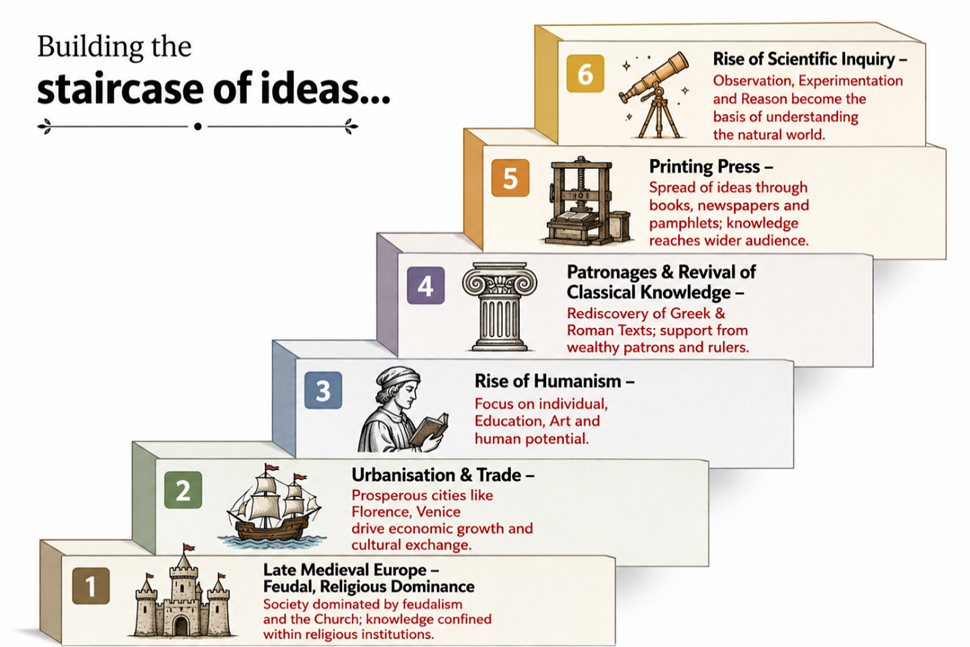
Let us understand the dawn of the Modern Era, a period that did not just change the map of Europe, but fundamentally altered the “software” of the human mind. When we talk about the Renaissance (roughly from the 14th to the 17th century), we are talking about the bridge between the medieval “Dark Ages” and the modern “Enlightened” world.
In the words of historians, this was not just a chronological shift, but a psychological one. It was a transition from a God-centered universe to a Man-centered universe.
The Renaissance and the Modern Era (14th–17th Century)
The Context: What exactly was the “Rebirth”?
The word Renaissance literally means “Rebirth.” But one must ask: what was being born again? It was the revival of the classical wisdom of Ancient Greece and Rome. For nearly a thousand years during the Middle Ages, this knowledge lay dormant under the weight of rigid ecclesiastical (church) orthodoxy.
The Renaissance was the moment when Europe “woke up,” rubbed its eyes, and decided to look at the world through the lens of Reason rather than just Faith.
The Catalysts: Why did it happen then?
History never happens in a vacuum. There were specific socio-economic and technological “shocks” that triggered this movement:
- The Decay of Feudalism: The old structure where your birth determined your destiny began to crumble. This created a “social vacuum” that allowed for mobility. People were no longer just “serfs”; they could be scholars, artists, or merchants.
- The Rise of the Merchant Class: Trade with the East made cities like Florence and Venice incredibly wealthy. This new “Middle Class” became patrons. They had the money to tell Michelangelo, “Stop worrying about bread; paint the ceiling of the Sistine Chapel.”
- The Fall of Constantinople (1453): When the Ottomans took the city, Greek scholars fled to Italy, carrying with them ancient manuscripts. This was the “intellectual fuel” for the Renaissance.
- Gutenberg’s Printing Press (1440): This was the “Internet” of the 15th century. Before this, books were hand-copied and expensive. Now, ideas could travel faster than the Church could suppress them.
- The Spirit of Inquiry: Explorers like Columbus and scientists like Copernicus proved that the world was larger and different from what traditional scriptures suggested.
Core Features: The “DNA” of the Renaissance
If we were to map the Renaissance mind, it would stand on four major pillars:
- Humanism: The belief that “Man is the measure of all things.” It shifted the focus from the “Afterlife” to the “Present life.”
- Secularism: A gradual separation of daily life and statecraft from religious dogma. It wasn’t necessarily “atheism,” but a focus on worldly affairs.
- Rationalism & Scientific Inquiry: The shift from “Why does it happen?” (answered by ‘God’s will’) to “How does it happen?” (answered by observation and logic).
- Individualism: The celebration of human genius and personal achievement.
Multidimensional Impact: Art, Science, and Politics
The Renaissance was not confined to books; it manifested in every sphere of human endeavor.
A. The Revolution in Art and Literature
Medieval art was flat and symbolic. Renaissance art, however, embraced Realism and Perspective.
- Leonardo da Vinci used his knowledge of anatomy to make his subjects look “alive.”
- Michelangelo showed the divinity in the human form (e.g., The Statue of David).
- Literature moved from Latin (the language of the elite) to Vernacular languages (the language of the people), making knowledge democratic.
B. The Scientific Breakout
This era laid the tracks for the Scientific Revolution.
- Copernicus challenged the “Geocentric” view (Earth-centered) with the Heliocentric model (Sun-centered).
- Galileo used the telescope to prove these theories, despite facing the Inquisition.
- Francis Bacon gave us the Scientific Method—the idea that truth is found through experimentation, not just old texts.
C. The Realist Turn in Politics
In the Medieval era, a King was seen as “God’s representative.” Niccolò Machiavelli, in his seminal work The Prince, stripped away this divinity. He argued that politics is about power, pragmatism, and statecraft, not just morality. This was the birth of Modern Political Realism.
Key Figures: The Architects of Change
| Figure | Contribution | Impact |
| Leonardo da Vinci | The “Renaissance Man” (Polymath) | Blended art with science and engineering. |
| Johannes Gutenberg | The Printing Press | Revolutionized the dissemination of knowledge. |
| Michelangelo | Sculpture and Frescoes | Redefined human aesthetics and grandeur. |
| Galileo Galilei | Observational Astronomy | Established the empirical basis for science. |
| Desiderius Erasmus | Humanist Scholarship | Promoted critical thinking and religious reform. |
Critical Analysis and Conclusion
In a historical sense, the Renaissance was the “parent” of the Enlightenment and the Industrial Revolution. By breaking the monopoly of the Church over the human mind, it paved the way for individual rights, democracy, and modern capitalism.
However, a critical scholar must also note that while the Renaissance celebrated “Man,” it was largely an elite movement. The common peasant in 15th-century Europe likely didn’t know who Da Vinci was. Furthermore, this era of “exploration” also laid the groundwork for Colonialism, as European powers used their new scientific and maritime prowess to dominate other continents.
In Conclusion: The Renaissance was the “Great Awakening” of Europe. It took a society that was looking “upward” toward the heavens and taught it to look “forward” toward progress and “inward” toward the self. It didn’t just change what people thought—it changed how they thought.
Now, if we look at the modern world today—our smartphones, our democratic rights, our scientific temper—we can see that we are all, in a way, children of the Renaissance.
Do you think that in our current age of Artificial Intelligence, we are perhaps entering a “Second Renaissance” where the definition of “Humanism” itself might change?
Continuing our journey into the making of the Modern World, we now arrive at a movement that didn’t just change how people prayed, but how they lived, how they were governed, and how they identified themselves. If the Renaissance was the “Intellectual Rebirth” of Europe, the Reformation was its “Spiritual Revolution.”
The Reformation
The Reformation (16th century) was a massive religious upheaval that shattered the monopoly of the Roman Catholic Church. For centuries, the Pope in Rome was the ultimate authority—not just in heaven, but often on earth too. The Reformation was the moment when Western Christianity split into two major camps: the Catholics and the Protestants.
Think of it as a “Great Divorce” in European history. It wasn’t just about theology; it was about power, money, and identity.
The Dimensions of Discontent: Why did it happen?
To understand the Reformation, we must look at it through four lenses. It wasn’t just a “monk getting angry”; it was a structural collapse of the old order.
A. The Religious Dimension: The “Indulgence” Crisis
The Church had become a massive bureaucracy. Practices like Simony (selling church offices) and Indulgences (selling “certificates” to reduce punishment for sins) created a perception of corruption. For a common man, it felt like salvation was being sold in the marketplace.
B. The Political Dimension: The Rise of Sovereignty
Powerful monarchs in England, France, and Germany were tired of taking orders from a Pope in Italy. They wanted to be the “Boss” in their own land. Supporting the Reformation was, for many princes, a way to say: “My kingdom, my rules.”
C. The Economic Dimension: The Wealth Drain
Europe’s kings and merchants resented the heavy “tithes” (taxes) flowing out of their countries to Rome to build grand cathedrals like St. Peter’s Basilica. They wanted that capital to stay at home for their own development.
D. The Social & Intellectual Dimension: The “Press” of Progress
The Printing Press was the “social media” of the 16th century. When Martin Luther wrote his arguments, they weren’t just whispered in a corner; they were printed and distributed by the thousands. People began to read the Bible for themselves, bypassing the priest as the “middleman.”
The Reformist vs. Anti-Reformist Mindset
It is vital to distinguish between these two temperaments, as they still shape political discourse today:
| Feature | Reformism | Anti-Reformism (Traditionalism) |
| Philosophy | Believes institutions must evolve to stay relevant. | Believes traditions are the anchor of society. |
| Authority | Questions the status quo; values individual logic. | Respects established hierarchy and Church/State authority. |
| Approach | Progressive, often advocating for broader rights. | Conservative, prioritizing order over change. |
| Iconic Figures | J.S. Mill, Robert Owen. | Edmund Burke, Benjamin Disraeli. |
Key Architects of the Schism
- Martin Luther: The German monk who nailed his “95 Theses” to a church door. His philosophy was simple: Sola Fide (Faith alone) and Sola Scriptura (Scripture alone). He removed the Church’s “agency” in a person’s salvation.
- John Calvin: He took the movement to Switzerland and introduced Predestination—the idea that God has already chosen who will be saved. This created a very disciplined, hardworking class of people (often linked to the “Protestant Work Ethic”).
- Henry VIII: His role was purely political. He wanted an annulment of his marriage, the Pope said “No,” so Henry simply started his own church—the Church of England.
The Aftermath: How it reshaped the World
The consequences were both bloody and beautiful:
- Religious Wars: Europe saw decades of brutal conflict (like the Thirty Years’ War). It proved that when religion and politics mix, the result is often fire.
- The Rise of the Nation-State: As the Pope’s power faded, the King’s power grew. People started identifying as “English” or “German” rather than just “Christians.” This is the seed of Nationalism.
- Growth of Individualism: If I can interpret the Bible myself, I am an individual with my own agency. This mindset eventually led to the demand for Human Rights and Democracy.
- A Global Link: Interestingly, the Reformation’s challenge to “Central Authority” set a precedent that would centuries later inspire Decolonization movements. If the Pope could be challenged, why not the Colonial Empire?
The “Black Death” Paradox: Out of Tragedy, Transformation
We cannot talk about the Renaissance and Reformation without mentioning the Black Death (Bubonic Plague) of the 14th century. It seems dark, but this pandemic was a hidden catalyst for the Modern Era:
- Labor Scarcity: So many people died that “labor” became expensive. For the first time, the peasant had bargaining power. This killed Feudalism.
- The Rise of the Middle Class: Surviving artisans and traders found themselves in high demand, leading to a redistribution of wealth.
- Skepticism of the Church: When the Church couldn’t stop the plague with prayers, people started looking for scientific and medical explanations.
- Investment in Art & Science: Survivors often inherited the wealth of those who died, leading to a sudden surge in private investment in education and the arts.
Conclusion
In summary, the Renaissance gave us the “Eye” to see the world’s beauty and logic, while the Reformation gave us the “Voice” to challenge authority.
When you combine the two, you get the Modern Man: an individual who is rational, skeptical, nationalistic, and free. The tragic backdrop of the Black Death reminds us that history often moves through cycles of destruction followed by intense creativity. The Europe that emerged by the 17th century was no longer a collection of “faithful subjects,” but a continent of “aspiring citizens.”