
Evolution of Geomorphological Thought
Today, when we study geomorphology, we rely on precise tools, satellite data, and theories of plate tectonics. But remember, this field didn’t emerge overnight. It evolved over centuries—from the philosophical speculations of ancient thinkers to scientific theories of geologists in the 18th and 19th centuries. Let’s trace this journey step by step.
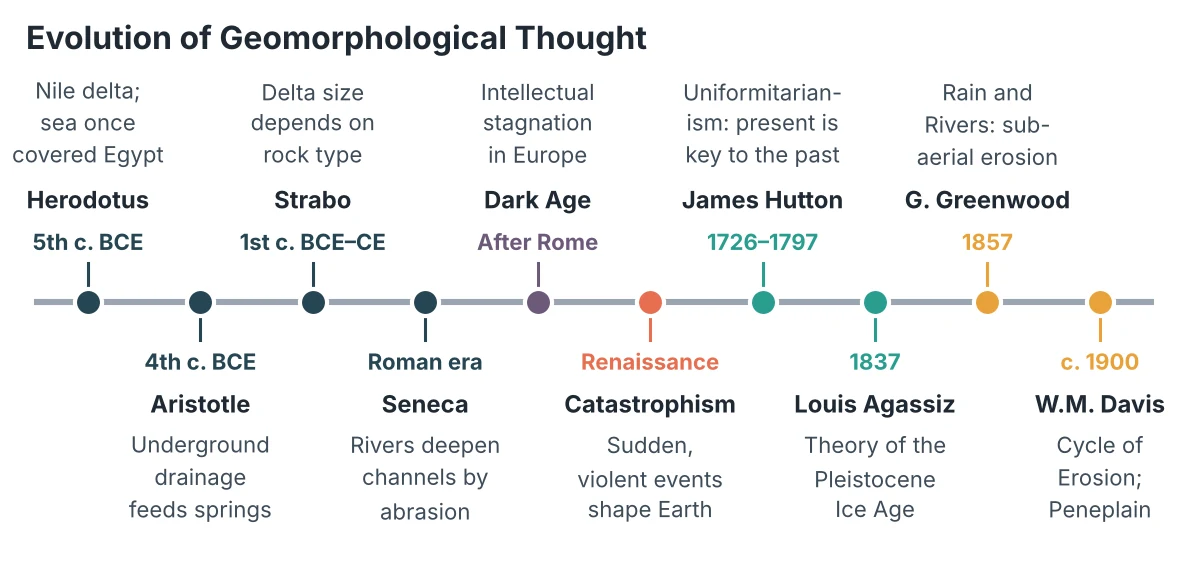
🏺Ancient Period: The Seeds of Geomorphology
Even though modern geomorphology began in the 18th–19th centuries, its roots go way back—to the ancient civilizations of Greece, Rome, and Egypt, where historians and philosophers began reflecting on landforms, though not scientifically, but observationally and philosophically.
📜 Herodotus (Greek Historian – 5th Century BCE)
- Observed the Nile River during his travels in Egypt.
- Called Egypt “the gift of the Nile“—highlighting the role of river deposition in shaping land.
- Described the Nile’s triangular mouth region as the “Delta,” a name already used by the Ionians.
- Noted that deltas gradually grow seaward due to continuous deposition.
- By studying sea shells on the hills of Egypt, far from the coast, he inferred that Egypt was once a gulf of the sea, gradually filled up by Nile silt. This reflects the transgressional (sea advances) and regressional (sea retreats) phases.
🧠 Takeaway: Herodotus indirectly touched upon coastal evolution, deltaic formation, and marine transgression-regression—concepts that are foundational even today.
📜 Aristotle (Greek Philosopher – 4th Century BCE)
- Tried to explain origin of streams, springs, and the behavior of sea and drainage.
- Stated that limestone terrains cannot support surface drainage due to subterranean channels— (a concept later known as karst topography); rainwater percolates underground, supplying springs; and condensation of underground air and vapour may also contribute to spring formation.
- Recognized seasonal and ephemeral nature of streams.
🧠 Takeaway: Aristotle introduced early ideas about hydrology, subsurface drainage, and the nature of runoff in permeable terrains.
📜 Strabo (Greek Geographer and Historian – 1st Century BCE – 1st Century CE)
- Studied river deposition and delta formation.
- Proposed that the size and shape of a delta depend on the type of rocks the river passes through.
- Weaker rocks → More erosion → Larger delta.
- Resistant rocks → Less erosion → Smaller delta.
🧠 Takeaway: This is an early conceptualization of differential erosion—a central idea in modern geomorphology.
📜 Seneca (Roman Philosopher)
- Suggested that rivers deepen their channels through abrasion (घर्षण).
🧠 Takeaway: Hinted at the process of river incision and mechanical erosion.
🕯️ Dark Age: A Long Silence
- After the fall of the Roman Empire, Europe entered a phase of intellectual stagnation.
- During this time, Arab scholars preserved and occasionally added to geomorphological knowledge, but overall, scholarly work on landforms continued, notably in the medieval Islamic world.
🌋 Age of Catastrophism (Early Modern Europe)
- With the Renaissance, curiosity revived—but early scientists explained landforms through Catastrophism.
What is Catastrophism?
- The belief that Earth’s features were formed suddenly through violent events like massive floods, volcanic eruptions, etc.
- Earth’s age was thought to be just a few thousand years.
🧠 Problem: This model lacked long-term geological understanding. It was heavily shaped by religious beliefs and a very short time-scale, though Cuvier later grounded it in fossil evidence.
⛰️ Age of Uniformitarianism – Birth of Scientific Geomorphology
Now comes the game-changing phase—when thinkers began questioning catastrophism and laid the foundation of modern geomorphology.
👨🎓 Pre-Hutton Thinkers: Precursors to Uniformitarianism
These thinkers offered scientific observations before the formal theory was born:
- Leonardo da Vinci: Rivers erode vertically, creating valleys, and deposit materials downstream.
- Buffon: Opposed the “young Earth” theory and proposed rivers as powerful erosional agents—capable of reducing even high mountains to sea level.
- Targioni Tozzetti: Said rivers have irregular courses due to varied rock types and implied concept of differential erosion.
- Guettard: Not all river sediments reach the sea; some are deposited in floodplains.
- Desmarest: Argued that rivers carved their own valleys over time and introduced the idea of gradual valley development through stages (partially accurate).
📘 James Hutton (1726–1797) – Father of Modern Geology
- Proposed the theory of Uniformitarianism (the term itself was coined later, in the 1830s, by William Whewell).
Core Idea: “The present is the key to the past”; geological processes like erosion, sedimentation, and uplift work slowly but continuously, just like today.
Impact: Rejected the idea of sudden catastrophes as the only explanation and introduced the concept of cyclical geological history—landforms evolve in repetitive stages.
🧠 Takeaway: Hutton’s theory transformed geomorphology from speculation to science.
Modern Age: 19th Century Onwards
By the early 19th century, Geomorphology had matured enough to emerge as an independent discipline, closely allied to Geology. During this time, two distinct schools of thought developed: European School of Geomorphology and American School of Geomorphology.
Let’s understand each one, their thinkers, and their contributions.
🏔️ European School of Geomorphology
This school contributed primarily through empirical observations of glacial, marine, fluvial, and arid processes across Europe. It laid the foundation for understanding various natural agents of erosion and landform evolution.
❄️ Ice Age and Glaciation Studies
- Louis Agassiz: Credited with establishing and popularising (1837) the theory of the Pleistocene Ice Age, building on earlier work of Venetz and Charpentier. He showed that glaciers had once covered large parts of Europe, shaping the landscape dramatically.
- James Geikie: Expanded on Agassiz’s work and proposed that the Ice Age was not a single event, but had multiple glacial periods, separated by warmer interglacial phases.
- A. Penck & E. Brückner: Studied glaciations in the Alps and identified four major glacial periods during the Pleistocene: Gunz, Mindel, Riss, Würm, each separated by interglacials. This became the standard framework for Pleistocene chronology for decades, though deep-sea (marine isotope) records now show many more glacial cycles.
🌊 Marine Erosion and Sub-Aerial Processes
- Sir Andrew Ramsay: Studied marine erosion in Wales and southwest England and described marine platforms (flat terraces cut by sea waves)—important for understanding coastal geomorphology.
- Col. George Greenwood: Focused on sub-aerial erosion, i.e., the wearing down of exposed land by weathering, rain and rivers, as against marine erosion (his book Rain and Rivers, 1857).
🌊 Fluvial Studies – Rivers and Their Behavior
- Jukes: Proposed a key classification of rivers:
- Transverse Rivers: Flow across geological structures.
- Longitudinal Rivers: Flow parallel to geological structures.
- Said longitudinal rivers are subsequent, i.e., they develop after transverse rivers based on structural controls.
🧠 Summary of European School: Focused on glacial, marine, and fluvial erosion, with deep empirical fieldwork. They provided classification systems and natural history interpretations, especially about the Ice Age and coastal formations.
🌄 American School of Geomorphology
This school was more theoretical and model-based, laying the conceptual and analytical foundations of modern geomorphology. Often called the Golden Age of Geomorphology due to its lasting influence.
🧠 Major J.W. Powell
- Studied the Colorado Plateau and Uinta Mountains.
- Introduced structural classification of landforms, linking rock structure to landscape type.
- Proposed genetic classification of valleys:
- Antecedent Valleys: Rivers maintain their course despite uplift.
- Superimposed Valleys: Rivers cut through older buried structures.
- Consequent Valleys: Rivers flow according to slope of new land.
- Introduced the concept of Base Level: the lowest point a river can erode to, usually defined by sea level.
🌊 C.A. Malott
- Elaborated Powell’s idea of base level (Powell himself had separated a “grand” base level from local and temporary ones) by classifying it into Ultimate Base Level (sea level), Local Base Level (temporary limits, e.g., lakes, resistant rocks) and Temporary Base Level (minor obstacles).
- Argued that rivers can reduce entire landmasses to base level, over geological timescales.
📝 Earlier (around 1900, i.e. before Malott’s work), W.M. Davis coined this nearly-flat surface as a Peneplain — a low-relief landscape near base level.
📈 G.K. Gilbert
- One of the first geomorphologists to use quantitative analysis.
- Proposed the graded profile of a river: a balance between load, volume, velocity, and slope.
- Showed how rivers adjust their gradient based on these variables.
🧠 Key Insight: Introduced dynamic equilibrium — a major principle in modern process geomorphology.
🧮 C.E. Dutton
- Coined the term Isostasy: the idea that Earth’s crust is in gravitational equilibrium, where uplifted regions and downwarped regions adjust based on density and thickness — like icebergs floating in water.
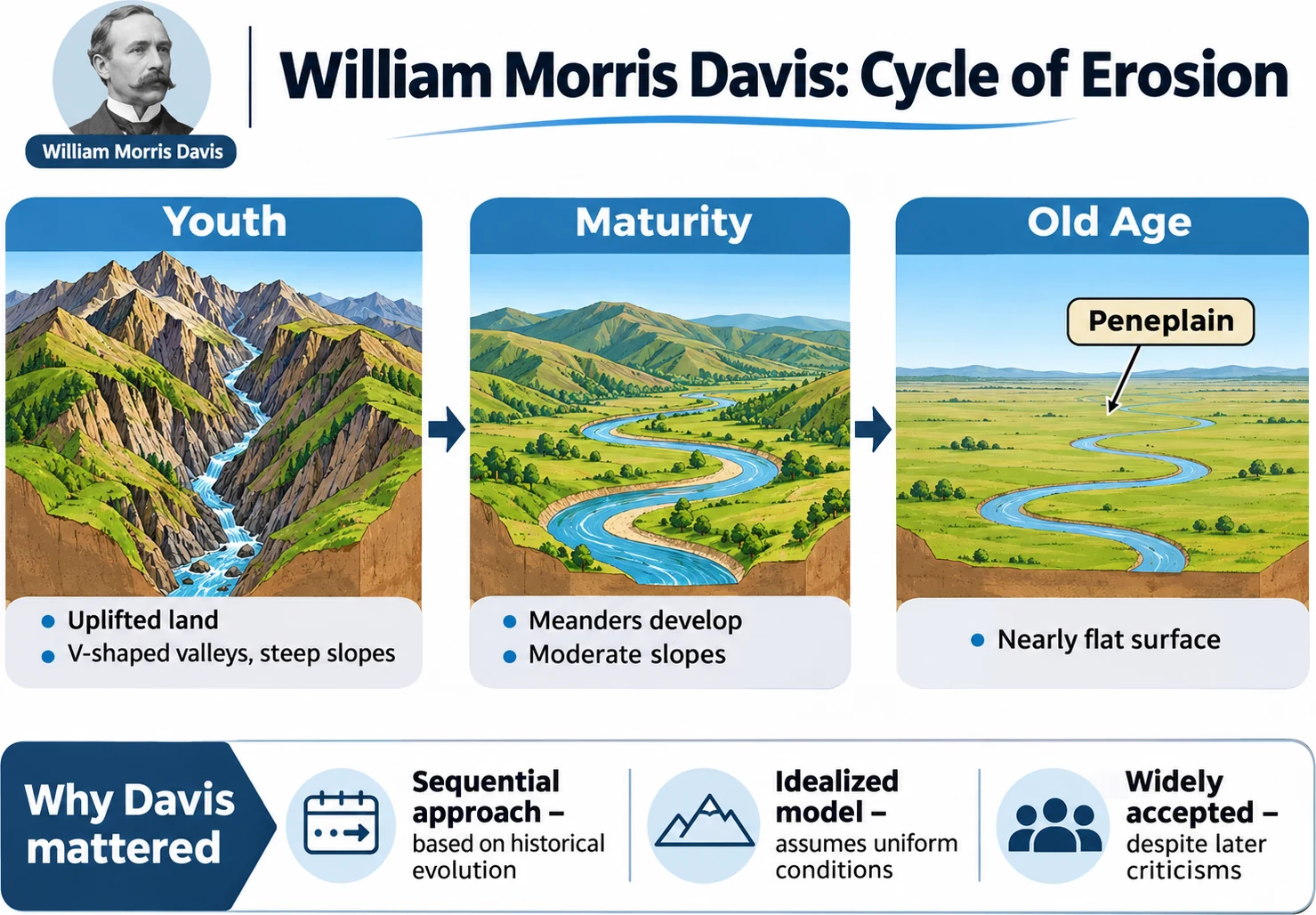
🌍 William Morris Davis – The Architect of Geomorphology
- Known as the Father of American Geomorphology.
- Gave the first general theory of landscape evolution: The Cycle of Erosion or Geographical Cycle
🧠 Key Components: Landscapes evolve through sequential stages:
- Youth: Uplifted land, V-shaped valleys, steep slopes.
- Maturity: Rivers develop meanders, moderate slopes.
- Old Age: Landscape is reduced to a peneplain (nearly flat surface).
His approach was sequential (based on historical evolution), idealized (assumes uniform conditions) and widely accepted (despite later criticisms).
Summary Table
| Phase / School | Key Thinkers / Contributors | Key Contributions |
|---|---|---|
| Ancient Period | Herodotus, Aristotle, Strabo, Seneca | Early observational ideas: delta formation, sea level changes, erosion, underground drainage, differential erosion |
| Dark Age | – | Intellectual stagnation; geomorphic knowledge preserved and transmitted by Arab geographers |
| Age of Catastrophism | – | Belief in sudden, divine events shaping landforms; Earth considered geologically young |
| Pre-Hutton Thinkers | Leonardo da Vinci, Buffon, Targioni Tozzetti, Guettard, Desmarest | Scientific hints of erosion, deposition, differential erosion, long-term landform evolution |
| James Hutton | James Hutton | Uniformitarianism – slow, continuous processes shape Earth; “present is the key to the past”; cyclicity in landform evolution |
| European School | Agassiz, Geikie, Penck & Brückner, Ramsay, Greenwood, Jukes | Ice Age studies (Gunz–Würm glaciations), marine erosion, glacial and fluvial processes, river classifications |
| American School | Powell, Malott, Gilbert, Dutton, Davis | Base level theory, graded river profiles, isostasy, structural valley classification, Davis’s Geographical Cycle (youth–maturity–old age) |
One Comment