
French Revolution and the Rise of Napolean
To understand the French Revolution (1789–1799), we must look at it not merely as a series of violent dates, but as a profound psychological and structural shift. It was the moment when the “subject” of a King decided to become a “citizen” of a Nation.
Imagine a pressure cooker where the steam (social frustration) has no outlet, the flame (economic crisis) is high, and the lid (the Monarchy) is jammed. Eventually, it doesn’t just leak; it explodes. That explosion changed the map of human consciousness forever.
The Context: A Society in Contradiction
Before 1789, France followed the Ancien Régime (Old Order). It was a world of rigid hierarchies where your birth determined your worth. To understand the “Why” of the revolution, we must look at the structural decay of the French state.
The Social Hierarchy (The Three Estates)
French society was divided into three layers, creating a pyramid of exploitation:
- The First Estate (Clergy): The Church owned 10% of the land and paid no taxes.
- The Second Estate (Nobility): They held all high offices, lived in the splendor of Versailles, and were also tax-exempt.
- The Third Estate (The Masses): This included everyone from wealthy lawyers (bourgeoisie) to starving peasants. They made up 95% of the population but bore 100% of the tax burden.
The Multi-Dimensional Causes
History never happens due to a single reason. It is always a “perfect storm” of various factors:
A. Socio-Economic Inequity
The Third Estate was suffocating under feudal dues and corvée (forced unpaid labor). While the nobles hunted on vast estates, the peasants couldn’t even afford salt due to the hated gabelle (salt tax).
B. The Economic “Trigger”: Bread and Debt
France was bankrupt. Why? Because it spent its treasury on the Seven Years’ War and the American Revolution. To make matters worse, 1788 saw a terrible harvest. When the price of bread—the staple diet—skyrocketed, the “hunger of the stomach” turned into the “anger of the mind.”
C. The Intellectual Catalyst (The Enlightenment)
People didn’t just wake up angry; they woke up informed.
Thinkers like John Locke (Natural Rights), Montesquieu (Separation of Powers), and Rousseau (Popular Sovereignty) provided the vocabulary for the revolution. They argued that if a King fails his people, the people have a right to change the King.
D. The Crisis of Leadership
Louis XVI was well-intentioned but indecisive—a fatal trait for an absolute monarch. His wife, Marie Antoinette, became the symbol of royal apathy. Her perceived extravagance earned her the title “Madame Deficit,” further alienating the starving masses.
The Four Phases: From Reform to Radicalism
The Revolution did not happen all at once. It moved like a pendulum, swinging from moderate reform to radical bloodshed, and finally back to a military “strongman.”
Phase I: The National Assembly (1789–1791) – The Rise of Hope
- The Estates-General: Louis XVI called this assembly to raise taxes. The Third Estate demanded “one man, one vote.” When denied, they broke away.
- Tennis Court Oath: They declared themselves the National Assembly, vowing not to disperse until France had a Constitution. This was the birth of popular sovereignty.
- Storming of the Bastille (July 14, 1789): The fall of this medieval fortress-prison symbolized the collapse of royal tyranny.
- Achievements: They abolished feudalism and passed the Declaration of the Rights of Man and of the Citizen, enshrining equality and liberty.
Phase II: The Legislative Assembly (1791–1792) – The Crisis of Trust
A Constitutional Monarchy was established, but it was a “lame duck” system. The King’s Flight to Varennes (an attempt to escape and join foreign armies) convinced the people that he was a traitor. Political clubs like the radical Jacobins began demanding a Republic.
Phase III: The National Convention & Reign of Terror (1792–1795) – The Radical Peak
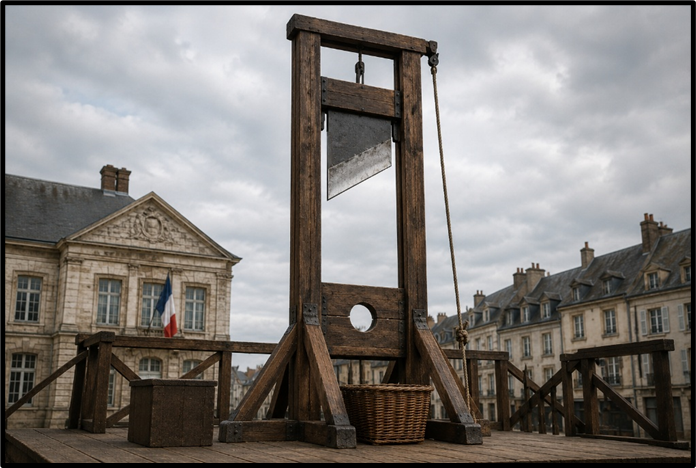
- The Republic: The monarchy was abolished. Louis XVI and Marie Antoinette were executed by the guillotine in 1793.
- The Terror: Under Maximilien Robespierre, the Revolution turned on itself. To “protect” the revolution, thousands were executed for being “enemies of the state.”
- Levée en Masse: This was the first instance of modern mass conscription, turning the entire nation into a war machine.
Phase IV: The Directory & Rise of Napoleon (1795–1799) – The Search for Order
After Robespierre’s execution (Thermidorian Reaction), a weak five-man executive called the Directory took over. It was plagued by corruption and instability. The French people, exhausted by chaos and bread lines, began looking for a “savior.” In 1799, a young general named Napoleon Bonaparte seized power in a coup, ending the revolution but spreading its ideals across Europe.
The French Revolution was a “paradoxical” event. It spoke of Liberty, yet it gave birth to the Guillotine. It spoke of Equality, yet it ended with an Emperor (Napoleon).
However, its impact is undeniable:
- Dismantling Feudalism: It ended the era of “privilege by birth.”
- Secularism: It challenged the political authority of the Church.
- Global Inspiration: From the independence movements in Latin America to the preamble of the Indian Constitution, the slogan “Liberté, Égalité, Fraternité” remains the gold standard for democracy.
In the words of many historians, the French Revolution didn’t just change France; it gave the modern world its political identity. It taught us that power belongs to the people, but it also warned us that when revolution loses its moral compass, it can consume its own children.
Do you think the “Reign of Terror” was a necessary evil to save the revolution from foreign enemies, or was it a betrayal of the very ideals of Liberty?
Continuing our journey through the streets of 18th-century France, let us now look at the “Aftermath” and the “Ascension.” In the classroom of history, we often ask: Was the Revolution a success? If you look at the immediate chaos, you might say “No.” But if you look at the DNA of the modern world, the answer is a resounding “Yes.”
The Outcomes: What Did the World Inherit?
The French Revolution was not just a French event; it was a global earthquake. Its tremors are felt even today in the Preamble of the Indian Constitution.
A. Political Transformation: The End of “Divine Right”
The most significant shift was the death of the idea that a King is God’s representative on earth.
- Popular Sovereignty: Power shifted from the “Palace” to the “People.” The concept that the government exists only by the consent of the governed became the new global standard.
- The Napoleonic Code: This was perhaps the most successful export of the Revolution. It replaced a patchwork of feudal laws with a single, clear, and logical legal system.
B. Social and Economic Rebirth
- The Death of Feudalism: Centuries-old chains were broken. The system where a peasant was tied to the land of a Lord ended.
- The Birth of the “Citizen”: People were no longer “subjects” (who have only duties); they became “citizens” (who have rights).
- Nationalism: For the first time, people didn’t feel loyal to a King, but to a “Patrie” (Fatherland). This “Nation-State” concept is the foundation of modern geopolitics.
C. The Role of Women: The Unsung Architects
We must acknowledge that while the legal codes were often regressive toward women, the Women’s March on Versailles proved that women were the backbone of the street revolution. They demanded bread and political presence, sowing the early seeds of the global feminist movement.
The Rise of Napoleon: “The Man of Destiny”
How did a revolution that started by hating monarchs end up crowning an Emperor? This is the Great Paradox of history.
The Power Vacuum
After the “Reign of Terror,” France was governed by the Directory. It was weak, corrupt, and inefficient. In political science, we say “Nature abhors a vacuum.” When the civilian government failed to provide bread and order, the people looked toward the only institution that still functioned: The Military.
From Corsica to the Crown (1769–1804)
Napoleon was an “outsider”—born in Corsica, not Paris. He rose through the ranks not because of his father’s name, but because of his merit.
- Military Genius: His victories in Italy and Egypt made him a “Rockstar” in the eyes of the French public.
- Coup of 18 Brumaire (1799): Napoleon realized the Directory was a sinking ship. He seized power in a coup and declared himself “First Consul.”
- The Coronation (1804): In a move of supreme confidence, he invited the Pope to his coronation but took the crown from the Pope’s hands and placed it on his own head. He was signaling that his power came from his own merit and the “will of the people,” not from religious sanction.
Napoleon’s Reforms: The “Civilian” Napoleon
If Napoleon were only a general, he would be a footnote. He is a giant because he was a Modernizer. He famously said, “My true glory is not to have won forty battles… but my Civil Code.”
| Reform Area | Key Action | Impact |
| Legal | Napoleonic Code | Guaranteed equality before the law and protected private property. |
| Administrative | Centralization | Prefects were appointed to run provinces, making the government efficient. |
| Education | The Lycées | Established state-run schools to create a class of skilled bureaucrats. |
| Social | Meritocracy | “Careers open to talent”—positions were based on ability, not birth. |
| Religious | The Concordat | He made peace with the Catholic Church but kept it under state control. |
Critical Analysis: Was Napoleon the “Son” or the “Soldier” of the Revolution?
This is a classic debate.
- As a “Son” of the Revolution: He preserved the core gains—the end of feudalism, legal equality, and meritocracy. He spread these ideas across Europe through his conquests.
- As a “Betrayer” of the Revolution: He ended political liberty, brought back a monarchy (himself), and censored the press.
Conclusion:
The French Revolution was a “Glorious Failure” that became a “Resounding Success.” It failed to provide immediate stability, but it succeeded in destroying the old world beyond repair. Napoleon was the bridge. He took the “chaos of the revolution” and turned it into the “order of the state.”
The Revolution taught us a chilling yet vital lesson: Liberty is easy to demand, but difficult to manage. When liberty turns into chaos, the masses usually trade their freedom for the security of a strongman.
Think about this: If Napoleon had never risen, would the ideals of the French Revolution have survived, or would the old European Kings have crushed the movement entirely?
One Comment