
Indian Space Exploration Missions
ISRO’s Interplanetary and Deep-Space Missions
Launching satellites in Earth orbit is one thing. But leaving Earth’s gravity entirely, travelling hundreds of millions of kilometres, and precisely entering another planet’s orbit — that is an entirely different level of engineering. India has accomplished this, and the story of how ISRO achieved these feats with frugal budgets is one of the most inspiring chapters in global science.
Chandrayaan-1 (2008) — India Discovers Water on the Moon
Chandrayaan-1 was India’s first lunar mission and its first mission beyond Earth orbit. It was India’s entry card into the exclusive club of nations exploring deep space.
But more than just a political achievement, Chandrayaan-1 made one of the most significant scientific discoveries of the 21st century: it confirmed the presence of water molecules on the Moon.
Mission Architecture
- Mission Type: Orbiter + Moon Impact Probe (MIP)
- Orbit: 100 km polar lunar orbit — giving global coverage of the Moon
- Launch Vehicle: PSLV-XL from Sriharikota (2008)
- Duration: Designed for 2 years; operated ~10 months before communication lost
- Payloads: 5 Indian + 6 international instruments (USA, UK, Germany, Sweden, Bulgaria)
Major Scientific Discoveries of Chandrayaan-1
| Discovery | Instrument Used | Scientific Significance |
| Water/Hydroxyl molecules on Moon | Moon Mineralogy Mapper (M³) — NASA instrument | First definitive evidence of water on the Moon — landmark discovery |
| Water ice deposits in polar craters | Mini-SAR (NASA) | Ice trapped in permanently shadowed regions — implications for future lunar colonies |
| Global mineralogical maps | HySI and M³ | Identified olivine, pyroxene, plagioclase — helps understand Moon’s formation |
| Lunar Magma Ocean hypothesis | M³ data | Strong evidence Moon was once completely molten |
| Volcanic activity evidence | TMC images | Helps reconstruct Moon’s geological and thermal evolution |
| Solar wind interaction | SARA instrument | ~20% of solar wind protons reflected as neutral hydrogen — disproving ‘Moon as perfect absorber’ |
| 🧠 Why Water on the Moon Matters: Water on the Moon is not just scientifically exciting — it is strategically vital. Water can be split into hydrogen (rocket fuel) and oxygen (life support) by electrolysis. This means future lunar bases could be self-sustaining, using local resources instead of shipping everything from Earth. This concept is called In-Situ Resource Utilisation (ISRU). |
Permanently Shadowed Regions (PSRs) — Why They Matter
The Moon’s axial tilt is only 1.5° (Earth’s is 23.5°). This means sunlight hits the Moon’s poles at an extremely shallow angle. Deep craters near the poles — like Shackleton Crater — have floors that NEVER see sunlight. Temperatures there can go below -230°C.
Water ice delivered by ancient comets and asteroids has been trapped in these ‘cold traps’ for billions of years. This is what Chandrayaan-1 confirmed — and what Chandrayaan-3 went to explore directly.
Chandrayaan-2 (2019) — A Partial Success, not a Failure
Chandrayaan-2 is perhaps the most misunderstood Indian space mission. Most people remember it only for the Vikram lander’s crash. But the truth is more nuanced — Chandrayaan-2 was a partial success.
Mission Architecture: Three Components
1. Orbiter — Successfully placed in 100 km polar lunar orbit. Carries the highest-resolution camera in any lunar mission (~0.25 m resolution). Still operational — exceeded its 1-year design life and has been delivering data for 6+ years
2. Vikram Lander (named after Dr. Vikram Sarabhai) — India’s first soft-landing attempt. During final descent, it deviated from planned trajectory and communication was lost. Made a hard landing — not the controlled soft landing planned
3. Pragyan Rover (solar-powered) — Could not be deployed due to lander failure
Scientific Findings of Chandrayaan-2 Orbiter
- Improved global mapping of lunar water/hydroxyl — confirmed water signatures at ALL latitudes, not just poles
- Subsurface polar ice — probed permanently shadowed craters, strengthening evidence for water-ice
- Detection of chromium — first such mapping, improves understanding of lunar crust formation
- Extremely high-resolution lunar images (~0.25 m) — best ever from a lunar orbiter
- Lunar exosphere variability — showed solar wind influence on the Moon’s thin atmosphere
| 🧠 Insight: Chandrayaan-2 is described as a ‘partial success’ because of what was achieved vs. attempted. The orbiter — which carries most of the scientific instruments — works perfectly. The lander crash was a setback, but ISRO learnt enormously from it. In fact, those lessons directly enabled Chandrayaan-3’s success. Failure that leads to learning is not really failure — it’s expensive education. |
Chandrayaan-3 (2023) — India Conquers the Moon’s South Pole
On 23 August 2023, India made history. The Vikram lander touched down softly near the lunar south pole, making India the FIRST country ever to land near the lunar south pole, and the FOURTH country to achieve a soft landing on the Moon. The entire nation watched — and celebrated — as ISRO redeemed itself with extraordinary precision.
Why the South Pole — And Why Nobody Had Landed There Before
Every previous Moon landing — American Apollo missions, Soviet Luna missions, China’s Chang’e missions — happened in the equatorial region. Even China’s Chang’e 4, which landed on the far side of the Moon, was near the 45° latitude. The south pole had never been explored from the surface. Why?
- Extreme darkness: Many areas near the south pole are Permanently Shadowed Regions (PSRs) — no sunlight ever reaches them. Without solar power, instruments cannot operate.
- Extreme cold: Temperatures can go below -230°C in PSRs — equipment fails in such conditions
- Rugged terrain: Large craters like Shackleton, Aitken create dangerous, uneven landing surfaces
- Navigation challenge: Shallow-angle sunlight makes terrain mapping and navigation harder
Mission Architecture — Lean and Focused
Unlike Chandrayaan-2 which had an orbiter, Chandrayaan-3 was deliberately lean — no orbiter (the Chandrayaan-2 orbiter was still functioning and provided relay support). Just three components:
1. Vikram Lander — Redesigned with lessons from Chandrayaan-2 failure — more failure-tolerant GNC, larger landing legs, multiple sensors for hazard detection
2. Pragyan Rover (6-wheeled) — Solar-powered robotic rover for in-situ surface experiments. Carries LIBS (Laser-Induced Breakdown Spectroscopy) and APXS instruments for elemental analysis
3. Propulsion Module — Carried the lander from Earth orbit to lunar orbit; then separated. Also carried SHAPE payload to study Earth from lunar orbit
Why Land at Lunar Dawn?
The lander and rover were not designed to survive lunar night (temperatures drop to -200°C). So ISRO timed the landing precisely at lunar dawn — giving the instruments maximum operational time (one full lunar day = 14 Earth days) before the freezing night set in.
Major Findings of Chandrayaan-3
| Instrument | Finding | Significance |
| LIBS (Pragyan Rover) | Confirmed sulphur near south pole; also detected Al, Ca, Fe, Cr, Ti, Mn, Si | First in-situ elemental analysis of Moon’s south polar regolith |
| ChaSTE (Lander) | Sharp temperature variation between surface (~50°C in sunlight) and subsurface (-10°C, 10 cm deep) | Critical for future lunar habitat and thermal management planning |
| RAMBHA (Lander) | Very low near-surface plasma density | Improves understanding of solar wind interaction at lunar surface |
| ILSA (Lander) | Detected natural lunar vibrations and rover-induced signals | Aids study of lunar crust stability — proto-seismology |
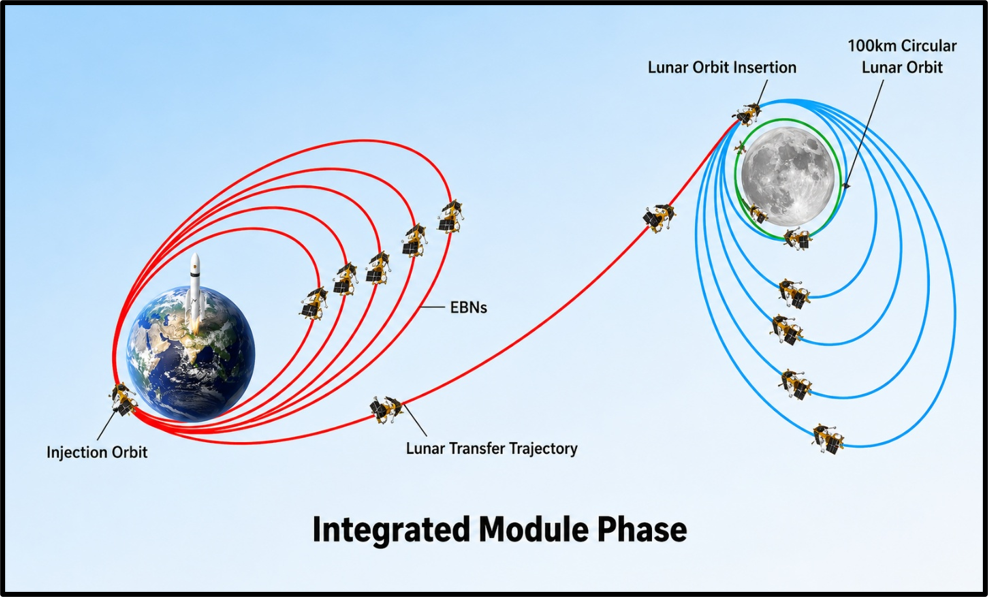
How Chandrayaan Missions Reached the Moon — Step by Step
| Step 1: Launch into Earth Parking Orbit The rocket placed the spacecraft into a low, elliptical Earth parking orbit. Rockets do NOT shoot directly at the Moon — they first establish an orbit, then gradually raise it. This saves fuel. |
| ▼ |
| Step 2: Earth-Bound Orbit Raising Manoeuvres Multiple engine burns at perigee (closest point to Earth) gradually raised the apogee (farthest point). The Oberth Effect: burning at perigee — where speed is highest — gives maximum energy gain. Like a hammer swing gaining energy at the lowest point of the arc. |
| ▼ |
| Step 3: Trans-Lunar Injection (TLI) A final long burn gave the spacecraft enough velocity to escape Earth’s gravity. The spacecraft exited Earth’s sphere of influence and entered the Moon’s gravitational domain. |
| ▼ |
| Step 4: Lunar Orbit Insertion (LOI) As the spacecraft approached the Moon, engines fired OPPOSITE to its direction of travel (retrograde burn). This reduced velocity, allowing lunar gravity to capture it into orbit. Without this burn, it would have flown past the Moon. |
| ▼ |
| Step 5: Circularisation to 100 km orbit Additional burns lowered and circularised the orbit to ~100 km altitude around the Moon. |
| ▼ |
| Step 6: Lander Separation and Powered Descent (Chandrayaan-2 & 3 only) The lander separated from the propulsion module and performed a precisely controlled descent — reducing velocity from ~1.6 km/s to nearly zero for touchdown. |
Comparison: All Three Chandrayaan Missions
| Feature | Chandrayaan-1 | Chandrayaan-2 | Chandrayaan-3 |
| Year | 2008 | 2019 | 2023 |
| Launch Vehicle | PSLV-XL | LVM3 (GSLV Mk-III) | LVM3 (GSLV Mk-III) |
| Components | Orbiter + Impact Probe (MIP) | Orbiter + Lander + Rover | Lander + Rover + Propulsion Module |
| Landing Attempt | No (impact probe crashed intentionally) | Yes — UNSUCCESSFUL (Vikram crashed) | Yes — SUCCESSFUL! |
| Target Region | Polar orbit (global mapping) | Lunar South Pole | Near Lunar South Pole |
| Key Finding | Water/hydroxyl molecules on Moon | Water at all latitudes; high-res imaging | Sulphur & elements at south pole; seismic data |
| Status | Completed (10 months operation) | Partial success (orbiter still operational) | Completed (~14 days surface ops) |
| Historic Achievement | First mission beyond Earth orbit | First soft-landing attempt | First near-south-pole soft landing in history |
Mars Orbiter Mission — Mangalyaan (2014)
Mangalyaan (Mars Orbiter Mission, or MOM) is arguably ISRO’s most celebrated achievement — not just for India, but for the entire world of space exploration. In 2013, India launched a spacecraft to Mars using PSLV (a medium-lift rocket not designed for interplanetary missions) and successfully entered Martian orbit on its VERY FIRST ATTEMPT. This had NEVER been done before.
Historic Achievements — Four Firsts
1. First Asian nation to reach Mars orbit
2. First country in the world to reach Mars on its maiden attempt — This is the one that made the world take notice
3. Fourth space agency to reach Mars orbit — After USA, USSR/Russia, and European Space Agency (ESA)
4. Most cost-effective Mars mission globally — ~₹450 crore (~$74 million) — less than many Hollywood movies
Key Technical Details
- Mission Type: Orbiter — primarily a technology demonstrator with scientific objectives
- Launch Vehicle: PSLV-C25 from Sriharikota (November 2013)
- Orbit: Highly elliptical Martian orbit after Mars Orbit Insertion
- Mission Duration: Designed for 6 months; operated for nearly 8 years (2014–2022) before battery depletion ended communication
- Payloads: 5 Indian scientific instruments — methane detection, surface imaging, atmospheric studies
How Mangalyaan Reached Mars
| Step 1: Launch into Earth Parking Orbit PSLV-C25 placed MOM into an elliptical Earth orbit. PSLV could not directly inject to Mars — not enough power for a direct shot across the solar system. |
| ▼ |
| Step 2: Earth-Bound Orbit Raising (6 manoeuvres) Multiple engine burns at perigee gradually stretched the orbit. ISRO used the Oberth Effect to efficiently gain energy with each burn. |
| ▼ |
| Step 3: Trans-Mars Injection (TMI) A final long burn on 1 December 2013 gave MOM enough velocity to escape Earth’s gravity and enter a heliocentric (Sun-centred) transfer orbit toward Mars. |
| ▼ |
| Step 4: Interplanetary Cruise (~680 million km) MOM travelled for ~300 days along an elliptical path around the Sun. Trajectory Correction Manoeuvres (TCMs) fine-tuned the path. Due to signal delays (up to 20+ minutes one-way), the spacecraft operated autonomously. |
| ▼ |
| Step 5: Mars Orbit Insertion (MOI) On 24 September 2014, MOM fired its main engine in retrograde (opposite to direction of travel) for 24 minutes. This slowed it down so Mars’s gravity could capture it into orbit. A moment of collective national breath-holding — and triumph! |
Scientific Findings of Mangalyaan
- Global imaging: High-resolution images of Martian surface, dust storms, and the Martian moon Phobos
- Methane investigation: Studied potential methane (biosignature gas) — no large-scale methane confirmed
- Atmospheric escape: Improved understanding of how Mars lost its atmosphere and water over billions of years
- Hydrogen escape (LAP instrument): Studied hydrogen loss — helping explain why Mars became arid
Shukrayaan-1 — India’s Venus Mission (Upcoming)
After the Moon and Mars, India sets its sights on Venus — the planet most similar to Earth in size and structure, yet utterly alien in every other way. Venus is often called ‘Earth’s evil twin’: same size, but a hellish world with temperatures of ~460°C, 96% CO2 atmosphere, sulfuric acid clouds, and atmospheric pressure 90 times that of Earth.
Why would anyone want to go there? Because understanding Venus helps us understand the worst-case scenario for Earth’s climate.
Mission Profile
| Parameter | Detail |
| Mission type | Orbiter (no lander or rover — Venus is too harsh for surface missions) |
| Launch vehicle | LVM3 |
| Target orbit | Highly elliptical orbit around Venus |
| Launch window | Late 2020s — Venus launch windows occur every ~19 months |
| Scientific focus | Venus atmosphere, surface, plasma environment, greenhouse effect, climate evolution |
Why Venus Matters
- Runaway greenhouse effect: Venus shows what happens when greenhouse warming spirals out of control. Surface: 460°C, hotter than Mercury despite being farther from the Sun. A warning for Earth’s climate.
- Atmospheric super-rotation: Venus’s atmosphere rotates 60x faster than the planet itself — a phenomenon not fully understood
- Comparative planetology: Earth, Venus, and Mars started similarly — why did each end up so differently? The answer shapes our understanding of planetary evolution
Aditya-L1 — Watching the Sun from Space
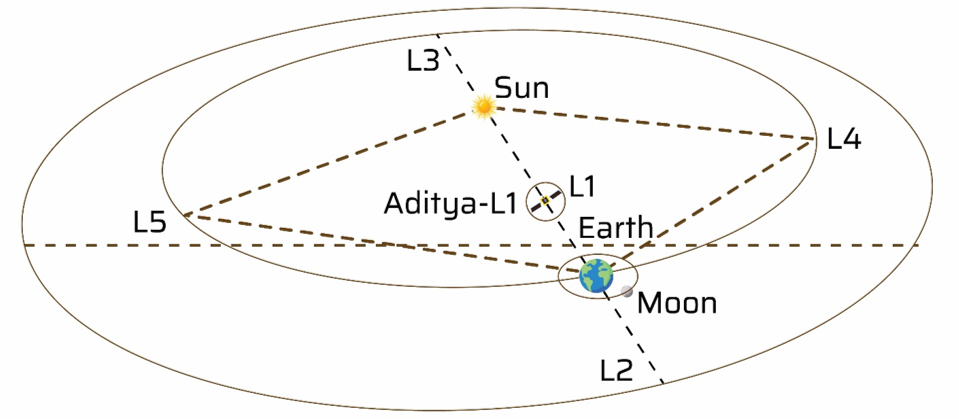
India’s Aditya-L1 mission (2023) is a solar observatory placed at a very special location in space — the Sun-Earth Lagrange Point L1, approximately 1.5 million km from Earth toward the Sun. From this vantage point, it can watch the Sun 24 hours a day, 365 days a year, without ever being blocked by Earth or the Moon.
What is a Lagrange Point?
Named after mathematician Joseph-Louis Lagrange, Lagrange Points are special locations in space where the gravitational forces of two large bodies (like the Sun and Earth) and the centrifugal force on a small spacecraft all balance perfectly.
A spacecraft placed here can orbit the Sun at the same angular rate as Earth — essentially ‘parking’ itself in a stable position relative to Earth.
The Sun-Earth system has 5 Lagrange points (L1 through L5). L1 lies between the Sun and Earth — the perfect spot for a solar observatory because it always faces the Sun. Several other solar observatories are at L1 — NASA’s SOHO, DSCOVR, and Wind missions.
Why a Halo Orbit at L1?
| Advantage | Why It Matters |
| Continuous, unobstructed Sun view | No eclipses — Sun is ALWAYS visible. Cannot observe solar flares from Earth orbit because Earth periodically blocks the view. |
| Early space weather warning | L1 is upstream in solar wind flow. Aditya-L1 detects Coronal Mass Ejections (CMEs) before they reach Earth — giving 30–60 minutes advance warning to protect satellites, GPS, and power grids. |
| Fuel efficiency | Maintaining halo orbit at L1 needs very little fuel for station-keeping vs. constantly manoeuvring in LEO to keep the Sun in view. |
| Thermal stability | No repeated heating-cooling cycles (no eclipses) — improves instrument longevity and reliability. |
Scientific Objectives of Aditya-L1
- Study the solar corona — the Sun’s outer atmosphere, millions of degrees hotter than the surface (the ‘coronal heating problem’ is one of solar physics’ great mysteries)
- Understand solar wind origin and acceleration
- Monitor Coronal Mass Ejections (CMEs) — massive bursts of plasma that can disrupt Earth’s technology
- Improve space weather prediction for protection of satellites, GPS, power grids, and communication systems
- Study photosphere, chromosphere, and corona simultaneously with 7 payloads (4 remote sensing + 3 in-situ)
| 💡 What is a Coronal Mass Ejection (CME)? A CME is a massive burst of magnetised plasma ejected from the Sun’s corona at speeds of 250–3000 km/s. When it reaches Earth (takes 1-3 days), it can cause geomagnetic storms that disrupt satellite communications, GPS accuracy, power grids, and even affect airline routes over polar regions. The famous 1989 Quebec blackout (9 million people lost power for 9 hours) was caused by a CME. Aditya-L1 provides early warning. |
Space Science & Astrophysics Missions
AstroSat (2015) — India’s Mini Hubble
AstroSat is India’s first dedicated multi-wavelength space observatory — often called ‘India’s mini Hubble’. Launched in 2015 by PSLV-C30, it operates in a 650 km near-equatorial LEO.
What makes AstroSat unique is its ability to observe the SAME astronomical object simultaneously in multiple wavelengths — from ultraviolet all the way to hard X-rays.
Why does this matter? Different physical processes emit different wavelengths. By observing all wavelengths at once, AstroSat gets a complete, multi-dimensional picture of cosmic phenomena — like seeing in all colours simultaneously while others can only see one colour at a time.
Major Payloads of AstroSat
| Instrument | Wavelength | Studies |
| UVIT (UV Imaging Telescope) | Ultraviolet | Hot stars, star-forming regions, stellar populations in galaxies |
| LAXPC (Large Area X-ray Proportional Counter) | Soft X-rays | X-ray emissions from neutron stars, black holes — timing variability |
| SXT (Soft X-ray Telescope) | Soft X-rays | Spectral studies of moderately energetic X-ray sources |
| CZTI (Cadmium Zinc Telluride Imager) | Hard X-rays + Gamma rays | Hard X-ray imaging; Gamma-Ray Bursts (GRBs) detection |
| SSM (Scanning Sky Monitor) | X-rays | Monitors variable X-ray sources across the sky |
XPoSat (2024) — India’s X-ray Eye on Extreme Universe
Launched in January 2024 by PSLV-C58, XPoSat (X-ray Polarimeter Satellite) is India’s first dedicated X-ray polarimetry mission — and only the SECOND in the world, after NASA’s IXPE (Imaging X-ray Polarimetry Explorer, 2021). It studies the polarisation of X-rays emitted by extreme cosmic objects like black holes, neutron stars, and pulsars.
Why polarisation? The polarisation angle and degree of X-rays tell us about the geometry and radiation mechanisms of high-energy objects — revealing the structure of accretion disks, magnetic fields, and plasma jets around compact objects in ways that conventional X-ray missions cannot.
- Orbit: ~650 km near-equatorial LEO — same orbital regime as AstroSat
- Key payloads: POLIX (Polarimeter Instrument in X-rays) and XSPECT (X-ray Spectroscopy and Timing)