
Social Divisions and Radicalisation leading to Extremism
Communal Conflict
India is a multi-religious, multi-ethnic and multi-cultural society, and its unity amid such diversity is its defining achievement. That unity, however, is periodically tested by communalism, and it is important at the outset to be precise about what the word means. Communalism is not the same as religious devotion.
It is the ideology that treats religious identity as the primary unit of society and politics, and that holds the interests of different religious communities to be fundamentally separate and even irreconcilable. A person may be deeply religious without being remotely communal; communalism begins where faith is turned into a political fault line.
Communal violence is the most visible and dangerous expression of this ideology. It threatens not only individual lives but the constitutional promise of a plural, secular republic, and it hands hostile external forces a ready instrument for destabilising the country from within.
This section examines the constitutional ideal that communalism attacks, the historical roots of the problem, the mechanics by which a riot is actually produced, and the institutional response.
Secularism in the Indian Constitutional Context
The Indian model of secularism is distinctive. Unlike the Western, and especially the American, model of a strict wall of separation between religion and the state, the Indian conception rests on equal respect for all religions, captured in the ideals of Sarva Dharma Sambhav and Sarva Dharma Sadbhav.
The state is not irreligious but even-handed; it keeps what scholars call a principled distance from every faith, intervening where necessary to guarantee equality and to reform harmful practices, rather than ignoring religion altogether.
This ideal is woven through the Constitution. The Preamble declares India a secular republic, the word secular having been made explicit by the Forty-second Amendment of 1976.
Articles 14, 15 and 16 guarantee equality and prohibit discrimination on grounds of religion.
Articles 25 to 28 protect freedom of conscience and the free profession, practice and propagation of religion, while Articles 29 and 30 safeguard the cultural and educational rights of minorities.
Crucially, in S.R. Bommai v. Union of India (1994), the Supreme Court held secularism to be part of the basic structure of the Constitution, placing it beyond the reach even of a constitutional amendment. Secularism, in India, is thus not a policy preference but a foundational commitment.
The Historical Trajectory — Colonial Roots to the Present
Communal conflict in its modern form is not an ancient inheritance but a substantially colonial construction. British policy actively encouraged the politicisation of religious identity as an instrument of divide and rule.
The Partition of Bengal in 1905 along communal lines, the formation of the Muslim League in 1906, the introduction of separate electorates through the Morley-Minto reforms of 1909, and the founding of the Hindu Mahasabha in 1915, together seeded the modern architecture of communal politics. The two-nation theory that grew from this soil culminated in Partition.
Partition in 1947 was the deepest wound. It displaced an estimated fourteen million people, and the accompanying violence killed, by scholarly estimates, anywhere from several hundred thousand to as many as two million. It bequeathed to the subcontinent a legacy of mutual suspicion that has never fully healed and that remains the emotional substrate of communal politics to this day.
Independent India has seen communal violence recur in episodic waves, often around specific triggers: the controversy over the Shah Bano case in 1986, the Ayodhya movement and the demolition of the Babri Masjid on 6 December 1992, the Mumbai riots of 1992-93 and the serial blasts that followed, the Godhra and post-Godhra Gujarat violence of 2002, and the Muzaffarnagar riots of 2013.
The broad pattern in recent years is that large-scale, prolonged riots have become less frequent, but violence has grown more localised, episodic and rapidly amplified by digital media, a shift that changes the nature of the challenge rather than removing it.
Factors Behind Communal Violence
Communal violence rarely has a single cause; it is produced by the convergence of several. A strong answer classifies them rather than listing them at random.
| Category | How it drives communal violence |
| Historical | The unhealed legacy of Partition and the two-nation theory sustains deep mutual mistrust |
| Political | Vote-bank calculations and deliberate polarisation make communal mobilisation electorally profitable |
| Socio-economic | Relative deprivation and under-representation of minorities, documented officially, breed grievance |
| Psychological | A reciprocal fear psychosis, each community perceiving threat from the other, primes both for conflict |
| Identity and cultural | Orthodoxy and conservatism on both sides harden separate identities against a shared citizenship |
| External | Hostile agencies and pan-religious extremist networks seek to inflame sentiment as proxy warfare |
| Demographic | Anxieties over migration and population change are exploited for short-term political ends |
| Informational | Rumour, fake news and hate propaganda, now travelling at digital speed, ignite and spread violence |
| Administrative | Biased, delayed or paralysed police and district action lets a local spark become a conflagration |
Onto these underlying factors, an immediate flashpoint is usually grafted. The most common are gender-related incidents framed in communal terms, including the contested allegation popularly labelled “love jihad”; disputes over land and places of worship, including construction, demolition and rival claims; and friction during religious processions and festivals, when the two communities’ public assertions of identity most directly collide.
The Anatomy of a Riot
One of the most important insights in this field is that major riots are rarely spontaneous eruptions of primordial hatred; they are frequently produced. The political scientist Paul Brass advanced the influential idea of the “institutionalised riot system”, a standing, if informal, network of “riot specialists”, rumour-mongers and political entrepreneurs that lies dormant between episodes and can be activated to convert a small local incident into large-scale violence when doing so serves a political purpose.
Understood this way, a riot unfolds in three phases: a preparation or rehearsal phase in which tensions are cultivated, an activation or enactment phase in which violence is triggered and directed, and an interpretation phase in which each side contests the meaning and assigns the blame.
Two mechanisms deserve special mention.
- The first is rumour, the classic spark, now vastly accelerated by social media, whose role as an accelerant of communal and mob violence is examined more fully in the study of media and information warfare.
- The second is political entrepreneurship: scholarship on the electoral logic of riots, notably by Steven Wilkinson, argues that communal violence is more likely where polarisation pays at the ballot box, and is more effectively prevented where the party in power depends on minority votes and therefore has an incentive to keep the peace.
Above all, the evidence points to the decisive role of the local administration. Riots persist and spread chiefly where the district administration and police are perceived as partisan, or fail to act in the crucial first hours. Prompt, visible and even-handed action by a determined District Magistrate and Superintendent of Police can arrest a riot at its inception; hesitation, bias or political interference allows it to metastasise. The single most reliable predictor of whether a communal incident becomes a communal catastrophe is therefore the conduct of the officials on the spot.
Commissions and Reports
Successive inquiries have examined communal violence and the condition of minorities, and citing them precisely lends authority to an answer.
| Commission / Committee | Subject | Key finding or recommendation |
| Srikrishna Commission (report 1998) | The Mumbai riots of 1992-93 | Indicted specific police personnel and political actors; documented administrative and police failure and bias |
| Liberhan Commission (set up 1992, reported 2009) | The demolition of the Babri Masjid | One of India’s longest-running inquiries; examined responsibility for the events of 6 December 1992 |
| Sachar Committee (2006) | Socio-economic and educational status of Muslims | Found Muslims, about 14% of the population, severely under-represented, holding only around 2.5% of posts in the bureaucracy |
| Ranganath Misra Commission (2007) | Religious and linguistic minorities | Recommended reservation for minorities, including 10% for Muslims, and Scheduled Caste status for Dalit Muslims and Christians |
A common thread runs through them. The Srikrishna and Liberhan inquiries expose administrative and police failure as central to how violence unfolds, while the Sachar and Ranganath Misra reports document the structural under-representation and relative deprivation of minorities that supplies the underlying grievance. It is a telling comment on the political difficulty of the subject that most of their major recommendations remain unimplemented.
The Communal Violence Bill Debate, Peace Committees and Accountability
The long-running effort to legislate specifically against communal violence illustrates both the ambition and the limits of a legal response.
The Communal Violence (Prevention, Control and Rehabilitation of Victims) Bill, 2005, and later the National Advisory Council’s draft Prevention of Communal and Targeted Violence (Access to Justice and Reparations) Bill, 2011, sought to impose a duty on public servants to prevent violence, to introduce a measure of command responsibility for officials who failed, and to guarantee reparations to victims.
The proposals proved deeply contentious and were never enacted, and the debate itself is instructive for an evenhanded answer. Supporters argued the legislation was needed to fix accountability and protect vulnerable groups. Critics raised two serious objections: first, that by making law and order, a state subject, the occasion for central intervention, the Bill threatened the federal structure; and second, that its design appeared to presume the majority community to be always the aggressor and the minority always the victim, which they held to be both unfair and unworkable. The Bill’s failure reflects the genuine difficulty of legislating in this area without either weakening federalism or appearing to take sides.
In the absence of a dedicated statute, the practical instruments of prevention remain administrative. District and neighbourhood peace committees, or mohalla committees, bringing together respected figures from all communities to build trust and defuse rumour, have a proven record where they are taken seriously.
And the deeper cure lies in administrative accountability and reform: fixed and protected tenures for key field officials, clear command responsibility, videography of disturbances and prompt action against provocateurs, a police-population ratio raised towards the internationally referenced norm of around 222 personnel per lakh, from which India still falls short, and greater representation of minorities in the police and other state institutions to build trust and dispel the perception of bias.
Caste, Ethnic and Mob Violence
Communal conflict is only one form that identity-based violence takes. Alongside religion, the fault lines of caste and ethnicity, and the increasingly common phenomenon of mob violence, each generate their own distinct public-order challenges.
What unites them is a common logic, the mobilisation of a group identity against an out-group, but each demands a different response, and treating them separately is essential to clear thinking about internal security.
Caste Conflict and Reservation Agitations
Caste violence has two rather different faces.
The first is atrocity against the historically oppressed, the continuing violence against Scheduled Castes and Scheduled Tribes that the Scheduled Castes and Scheduled Tribes (Prevention of Atrocities) Act, 1989 was enacted to punish. The dilution of that Act’s stringent provisions by a Supreme Court ruling in 2018, and Parliament’s swift restoration of them by amendment, underlined how sensitive and contested this terrain remains; incidents such as the violence around Bhima Koregaon in 2018 show how caste memory can rapidly become a public-order flashpoint.
The second face is the paradoxical rise of reservation agitations by relatively dominant agrarian castes. In a striking reversal, several land-owning communities that were never regarded as backward have mobilised, often disruptively, to demand inclusion in reservation categories, the Patidars in Gujarat, the Jats in Haryana, the Marathas in Maharashtra, the Gujjars in Rajasthan and the Kapus in Andhra Pradesh among them.
The roots lie in agrarian distress and the shrinking pool of secure public employment, which have converted reservation into a fiercely contested prize and produced a politics of competitive claim-making. These agitations frequently spill into serious disorder, road and rail blockades, arson and, in the Haryana Jat agitation of 2016, dozens of deaths, making them a genuine internal-security concern.
They also press against the judicially fixed ceiling of fifty per cent on total reservations, a tension the introduction of the ten per cent quota for the economically weaker sections, upheld by the Supreme Court in 2022, has only sharpened.
Ethnic Conflict — Manipur as a Case Study
Ethnic conflict arises where the primary identity in contention is neither religion nor caste but ethnicity, tribe and community, usually entangled with competition over land, resources and political recognition. The prolonged crisis in Manipur is the defining contemporary example and repays close study.
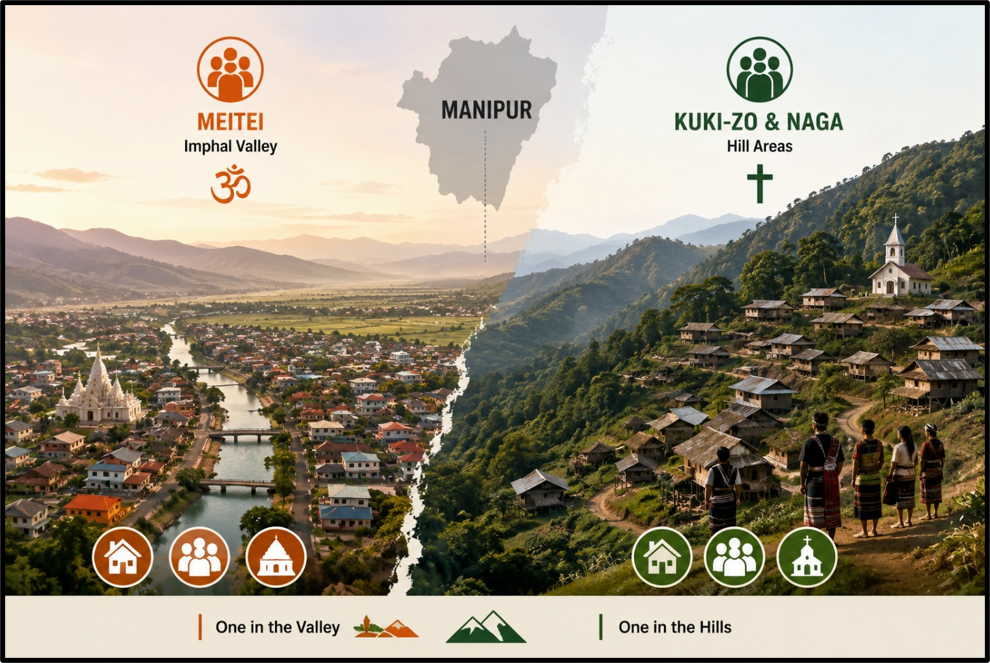
| Case Study — The Manipur Conflict (from 2023) The communities: Manipur is divided between the Meitei, who are mostly Hindu and concentrated in the Imphal valley, and the Kuki-Zo and Naga tribal groups, largely Christian, who inhabit the surrounding hills. A long-standing legal asymmetry lies beneath the conflict: as Scheduled Tribes, the hill communities can buy land in the hills, while the valley-dwelling Meitei, who are not Scheduled Tribes, cannot, leaving the Meitei feeling hemmed into a shrinking valley. The trigger: In 2023 a High Court order recommending that the state consider Scheduled Tribe status for the Meitei alarmed the hill tribes, who feared losing their land and reservation protections. A tribal solidarity march on 3 May 2023 erupted into ethnic violence between the two communities. The deeper drivers: competition over land and Scheduled Tribe status, contested forest-eviction drives, the politics of poppy cultivation and the narcotics economy, cross-border kinship ties between Kuki-Zo groups and Myanmar, and mutual demographic anxiety, all fused into a self-reinforcing spiral. The consequences: more than 250 people killed and over fifty thousand displaced into relief camps, near-total ethnic segregation enforced by buffer zones, and a collapse of trust in the neutrality of the state. President’s Rule was imposed in February 2025, and an elected government was restored only in February 2026, with the underlying disputes over status, land and separate administration still unresolved. The lesson: ethnic conflict is driven by identity fused with competition over land and resources, and it is gravely worsened when the state itself comes to be seen by one side as partisan. Its resolution requires impartial security, humanitarian relief, and a political settlement of the underlying land-and-status question, not force alone. The wider canvas of north-eastern ethnic conflict is developed in the study of insurgency in that region. |
Mob Violence and Lynching
Lynching is a form of violence in which a mob, under the pretext of administering justice without trial, kills a presumed offender, often after torture. It represents a direct assault on the rule of law, for it substitutes the passion of the crowd for the authority of the state, and its recent rise, driven by digitally circulated rumour, is among the more troubling internal-security trends of the era. Because this theme has been directly examined by the examiners, it merits a fully worked answer.
| Model Answer — Curbing the Rise of Mob Violence Understanding the phenomenon. Mob violence and lynching have risen sharply in recent years, taking three overlapping forms: cow-vigilante attacks, especially after restrictions on cattle trade; killings driven by child-lifting and kidnapping rumours circulated on messaging platforms; and violence arising from communal or moral policing. What they share is a crowd acting as self-appointed judge and executioner. Causes. The principal drivers are the viral spread of rumour and fake news on social media; a climate of communal and social polarisation that dehumanises the target; the impunity that follows weak investigation and low conviction; the normalisation of vigilantism where such acts are socially or politically condoned; and the absence, until recently, of a dedicated legal deterrent. Consequences. Lynching erodes the state’s monopoly on the legitimate use of force and the rule of law itself; it spreads fear and insecurity among minorities and the marginalised; it deepens communal polarisation; and it damages India’s standing as a constitutional democracy. Steps to curb it, on a preventive-remedial-punitive framework. Preventively: a designated nodal officer in every district with a special task force to identify vigilante networks and pre-empt gatherings, prohibitory orders in tense areas, and aggressive countering of rumour in partnership with digital platforms. Remedially: immediate registration of an FIR, a victim-compensation scheme, witness protection, and fast-track, time-bound trials. Punitively: firm application of the new criminal law that now makes lynching a distinct offence, and departmental action against officials who fail in their duty. Underpinning all three: police reform, sensitisation, and public education against rumour. |
The Tehseen Poonawalla Guidelines and the New Legal Response
The judicial cornerstone of the response is Tehseen S. Poonawalla v. Union of India (2018), in which the Supreme Court, describing mob vigilantism as impermissible, laid down a comprehensive and binding framework under three heads.
- Preventive measures: a senior nodal officer in every district and a special task force to gather intelligence on vigilante groups, patrolling of sensitive areas, and prohibitory action against those likely to incite violence.
- Remedial measures: prompt FIRs, a state victim-compensation scheme, protection of witnesses, and fast-track trials with time-bound completion.
- Punitive measures: departmental and disciplinary action against police and district officials who fail to prevent violence or investigate it properly, treated as an act of deliberate negligence.
The Court also urged Parliament to enact a special law against lynching, and the directions were made binding on all authorities under Article 141. The persistent weakness has been implementation: compliance across states has been patchy, and the Court has repeatedly had to seek status reports.
The most significant recent development answers the Court’s call for legislation. The Bharatiya Nyaya Sanhita, 2023, in force from 1 July 2024, for the first time makes mob lynching a distinct offence. Its provision on the point stipulates that where a group of five or more persons acting together commits murder on grounds such as race, caste, community, sex, place of birth, language or personal belief, every member shall be punishable with death or imprisonment for life, along with a fine.
Several states had earlier passed their own anti-lynching laws, and this central provision now supplies the dedicated deterrent whose absence had long been criticised. The remaining task is enforcement, and the containment of the social-media rumour that so often lights the spark, a challenge taken up in the treatment of media, social networks and information warfare.
| Current Status (as of July 2026) Manipur: The ethnic conflict that began on 3 May 2023 between the Meitei and Kuki-Zo communities has left more than 250 dead and over 50,000 displaced. President’s Rule, imposed in February 2025, was revoked in February 2026 with the restoration of an elected state government, but the underlying disputes over Scheduled Tribe status, land and demands for separate administration remain unresolved, and the communities remain largely segregated. Anti-lynching law: The Bharatiya Nyaya Sanhita, 2023 (in force 1 July 2024) now makes mob lynching a distinct offence punishable with death or life imprisonment, filling the legislative gap the Supreme Court had flagged in the Tehseen Poonawalla case. Communal Violence Bill: No dedicated central law against communal violence has been enacted; the earlier draft bills lapsed amid federalism and fairness objections. Reservation agitations: Demands by dominant agrarian castes continue, with the Maratha quota and similar measures caught in litigation against the fifty-per-cent ceiling, alongside the ten-per-cent economically-weaker-sections quota upheld in 2022. Policing: The police-population ratio remains below the internationally referenced norm of roughly 222 per lakh, and the representation of minorities in the police stays low, sustaining the trust deficit that both communal and mob violence exploit. |
| Answer-Writing Perspective On communal conflict, the distinguishing move is to treat riots as produced rather than spontaneous, invoking the institutionalised-riot-system idea and fixing responsibility on the local administration, while grounding secularism in S.R. Bommai and citing the four commissions precisely. On caste and ethnic violence, separate the two faces of caste conflict, atrocity and reservation agitation, and use Manipur as the model case of identity fused with land. On mob lynching, always structure the answer on the preventive-remedial-punitive framework of Tehseen Poonawalla, and show awareness of the new Bharatiya Nyaya Sanhita provision that finally criminalises it. Throughout, an evenhanded tone that acknowledges competing perspectives reads as maturity, not evasion. |
Radicalisation as a Social Process
Extremism does not spring into being fully formed. No one wakes up a terrorist. Between an ordinary life and a violent one lies a journey, and radicalisation is the name we give to that journey.
Understanding it as a process, gradual, incremental and above all social, rather than as a single event or the simple product of an ideology, is the key that unlocks prevention. If violence is the destination, radicalisation is the road, and a state that understands the road can block it long before the destination is reached.
This connects directly to the spectrum from radicalism to terrorism set out in the conceptual frame of this subject. There we distinguished the points on the spectrum; here we study the movement along it, how a person travels from grievance, through the acceptance of extreme ideas, to the willingness to kill.
Definition and Stages
Radicalisation is the process by which an individual or group comes to adopt increasingly extreme political, social or religious ideals that reject the existing order and, at the far end, come to accept or endorse violence as a legitimate means. Its most important feature is that it is rarely a solitary act of ideology. It happens through relationships, within families, friendship circles and small groups, which is why it is properly called a social process.
Two influential models illuminate how the journey unfolds, and naming them lends analytical weight to an answer.
| Model | Core idea | Insight for prevention |
| Moghaddam’s Staircase to Terrorism (2005) | Radicalisation is a narrowing staircase of six floors: a ground floor of perceived injustice and relative deprivation, rising through the search for options, the displacement of aggression onto an enemy, moral engagement with a terrorist worldview, rigid us-versus-them thinking and, finally, the act itself. Fewer people climb to each higher floor. | Intervene low on the staircase, by addressing perceived injustice and offering real options, before exits disappear |
| Sageman’s ‘bunch of guys’ / social-network theory | Radicalisation is bottom-up, driven by pre-existing bonds of friendship and kinship; small groups of friends radicalise one another through a search for belonging as much as belief | Target the social dynamics of belonging, not just the ideology; the peer group is the unit of radicalisation |
The two models are complementary.
- Moghaddam explains the psychological progression from grievance to violence;
- Sageman explains the social mechanism, the network of relationships, through which that progression actually occurs.
Both carry the same lesson: because most people who share a grievance never climb the staircase, ideology alone is never a sufficient explanation, and the decisive action lies in the social and personal factors that determine who takes the next step.
Drivers — Push, Pull and Personal
The internationally accepted framework for understanding why an individual radicalises separates the drivers into three interacting categories. A strong answer uses all three rather than collapsing everything into economics or into ideology.
- Push factors are the structural grievances that push a person away from the mainstream: poverty, unemployment, discrimination, marginalisation, injustice, humiliation and the absence of a legitimate political voice, the very development and governance deficits examined earlier in this chapter.
- Pull factors are the attractions the extremist movement offers: a sense of belonging, identity, purpose and significance, adventure and status, the promise of an ideology or utopia, revenge, and sometimes direct financial incentive. For a rootless young person, the group can supply everything ordinary life has withheld.
- Personal factors are the individual vulnerabilities: an identity crisis, a search for meaning or significance, personal trauma or grievance, and the moment of psychological receptivity that scholars call a “cognitive opening.”
The essential insight is that radicalisation lies in the interaction of the three, never in any one alone. The overwhelming majority of the poor, the unemployed and the aggrieved never radicalise. What distinguishes the few is the convergence of a structural grievance with the pull of a group that offers belonging and an individual psychology primed to accept it.
This is precisely why purely economic remedies, though necessary, are never by themselves sufficient, a point that echoes the qualified view of the development-extremism link established at the outset of this chapter.
Religious Radicalisation and the Neighbourhood Effect
India’s location matters. It sits in one of the most radicalism-saturated neighbourhoods on earth, and the examiners have asked directly how a diverse society should insulate itself from that environment. The theme deserves a fully worked answer.
| Model Answer — Radicalism in India’s Neighbourhood and How to Counter It The neighbourhood. India is ringed by sources of radical ideology: a state-sponsored jihadist infrastructure in Pakistan, the instability of Afghanistan with its Taliban and Islamic State Khorasan presence, extremist currents in Bangladesh, and the ambient reach of transnational movements such as Al-Qaeda in the Indian Subcontinent and the Islamic State. Radicalism spills across borders not only through infiltration and funding but, increasingly, through ideology, propaganda and digital indoctrination that need no visa. India’s exposure, and its resilience. A multi-religious, multi-ethnic society with unresolved identity anxieties is inevitably a target. Yet India’s record is, by global standards, one of remarkable resilience: its Muslim population has by and large resisted radicalisation, and the number who joined the Islamic State was strikingly small compared with many Western countries, a resilience rooted in India’s syncretic traditions, democratic outlets and community structures. The vulnerability is real but confined to a fringe, seen in isolated modules and self-radicalised individuals, and it must be acknowledged that radicalisation is not confined to any one community; majoritarian and other forms of extremism are an emerging concern in their own right. Strategies to counter the environment. The response must be multi-layered. Upstream, counter-radicalisation, credible counter-narratives, community and religious engagement, education, and the removal of the socio-economic and political grievances that supply the raw material. For those already drawn in, de-radicalisation and rehabilitation. Operationally, intelligence-led disruption of networks and financing, and the regulation of the online spaces where indoctrination now happens. Externally, regional and international cooperation, on intelligence, on terror financing through bodies such as the Financial Action Task Force, and through the United Nations framework. And, underpinning all of it, the deliberate protection of India’s pluralist, syncretic ethos, which is itself the country’s strongest defence. Conclusion. India cannot change its neighbourhood, but it can inoculate its society against it, by draining domestic grievances, policing networks intelligently, and above all by keeping faith with the constitutional pluralism that has so far made India far less fertile ground for radicalism than its surroundings. |
Online and Algorithmic Radicalisation
The internet has transformed the process. Radicalisation that once required physical proximity, a mentor, a mosque or madrasa, a cell, can now occur entirely online, producing the self-radicalised individual and the lone-wolf attacker who never meets a handler in person.
Encrypted platforms provide secure command and control; echo chambers and recommendation algorithms progressively feed users more extreme content, so that the technology itself nudges the vulnerable up the staircase; and virtual handlers recruit and direct from across the world. The digital dimension has thus compressed and accelerated a process that used to take years.
Because this belongs to a larger story, the mechanics of online propaganda, algorithmic amplification and the platform-regulation debate are examined in full in the treatment of media, social networks and information warfare; here it is enough to register that the road to radicalisation now runs largely through the screen.
De-radicalisation and Countering Violent Extremism
The policy response to radicalisation goes by the umbrella term Countering Violent Extremism (CVE), and it is important to distinguish its three strands.
- Counter-radicalisation is upstream prevention, stopping people from radicalising in the first place.
- De-radicalisation works with those already radicalised, seeking to change their beliefs.
- Disengagement is the more modest but often more realistic goal of ending violent behaviour, even where extreme beliefs persist.
India has no single national de-radicalisation policy, and its efforts have been led by states. The Maharashtra police pioneered a de-radicalisation programme that works with families, community elders and credible religious scholars to counsel young people flagged as being at risk, a deliberately “soft” approach that avoids criminalising the merely vulnerable.
Kerala, which saw the highest number of Islamic State recruits, has grappled with the challenge chiefly through community and family engagement and the monitoring of returnees. Around the world, three models are most often studied, and India has drawn on them.
| Model | Approach | Distinctive feature |
| Saudi Arabia | Religious re-education plus rehabilitation and long-term aftercare (the prevention–rehabilitation–aftercare approach) | Heavy emphasis on theological correction of misconceptions, with monitoring and support after release |
| Denmark (the Aarhus model) | A soft, welfare-based approach of mentoring, counselling and reintegration rather than punishment, including for returning foreign fighters | Treats the radicalised as recoverable citizens; involves parents and offers an ‘exit’ pathway |
| Singapore (Religious Rehabilitation Group) | Voluntary religious scholars counsel detainees to dismantle the extremist interpretation of doctrine | Community-led theological rehabilitation, closely paired with the state’s security apparatus |
The lessons for India are consistent: de-radicalisation works best when it is community-led and religiously credible, when it involves the family, when it provides aftercare and reintegration rather than stigma, and when the soft approach is intelligently paired with the hard edge of security. A calibrated national framework, respectful of India’s diversity and civil liberties, remains a gap worth filling.