Basics of Cell
🔬 What is a Cell?
Imagine you are building a house. What is the smallest unit you need? A brick. Remove one brick and the structure weakens. That is exactly what a cell is to a living organism — the most fundamental building block. This is why it’s called the “building block of life.”
But a cell is far more than just a structural unit. It is also a functional unit — meaning it can independently carry out all the essential life processes: nutrition, excretion, respiration, growth, reproduction, and response to stimuli. Think of it as a tiny self-sufficient city inside your body!
Two great scientists are credited with this discovery:
- Robert Hooke (1665) — first discovered cells and coined the term “cell” while observing cork under a microscope. The word came from the Latin cellula meaning “small room.”
- Anton Von Leeuwenhoek — the pioneer who first observed and described a live cell.
Let me now show you how cell structure is organized: –
🦠 Types of Organisms Based on Cells
Now here’s a beautiful insight — all living things are made of cells, but not all in the same quantity.
Unicellular organisms — the lone warriors 😊. A single cell does everything: eats, breathes, excretes, reproduces. Examples: Amoeba, Chlamydomonas, Paramecium, Bacteria.
Multicellular organisms — the cooperative societies 😊. Millions or billions of cells work in coordination. Examples: Fungi, Plants, Animals.
And here’s the most profound fact: even an organism with billions of cells begins its life as a single cell — the fertilised egg. That one cell divides and differentiates to eventually become you.
📜 Cell Theory — The Foundational Framework
Think of Cell Theory as the Constitution of Biology — it took multiple scientists and decades to draft!
The story goes like this:
- 1838 — German botanist Matthias Schleiden observed that all plants are made of cells.
- Around the same time — British zoologist Theodore Schwann found that animal cells have a plasma membrane, and noted that plant cells have a unique cell wall. Together, they proposed that plants and animals are made of cells.
- 1855 — Rudolf Virchow made the clinching addition: “Omnis cellula e cellula” — all new cells come from pre-existing cells. This was revolutionary because it demolished the idea of spontaneous generation in cellular biology.
The modern Cell Theory rests on two pillars:
- All living organisms are composed of cells and cell products.
- All cells arise from pre-existing cells.
📐 Shape and Size of Cells — Function over Form
A very common misconception to avoid: the shape and size of a cell is determined by its function, NOT by the size of the organism. An elephant’s nerve cell isn’t bigger than a mouse’s nerve cell just because the elephant is bigger.
Shape varies enormously:
- Disc-like — Red Blood Cells (for maximum surface area to carry oxygen)
- Polygonal, columnar, cuboid — epithelial cells
- Thread-like — nerve cells (neurons can stretch meters in large animals!)
- Irregular — amoeba (changes shape to move)
The cell membrane gives shape to both plant and animal cells. In plant and bacterial cells, an additional cell wall provides extra rigidity and structural support — like the difference between a balloon (only membrane) and a cardboard box (membrane + wall).
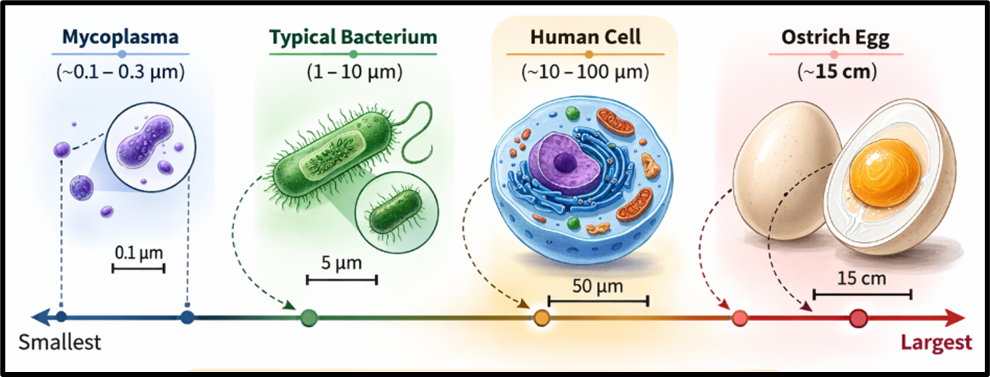
Size is equally varied:
- Most cells are microscopic — measured in micrometres (μm)
- Mycoplasma (a bacterium) — the smallest known cell
- Ostrich egg — the largest known isolated single cell (visible to the naked eye!)