Morphology of Flowering Plants
When we talk about flowering plants, scientifically called angiosperms, we are essentially studying their external structure (morphology).
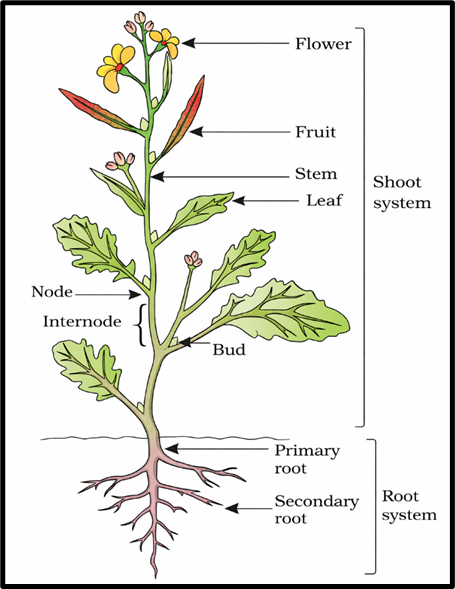
Despite the huge diversity—from tiny herbs to massive trees—all angiosperms share five basic organs:
- Root
- Stem
- Leaf
- Flower
- Fruit
Think of these as the fundamental building blocks of plant life.
🌱 The Root System
Functions of Roots
Roots are not just “underground parts”—they are highly active organs:
- Absorb water and minerals
- Provide anchorage
- Store food
- Produce growth hormones
Types of Root Systems
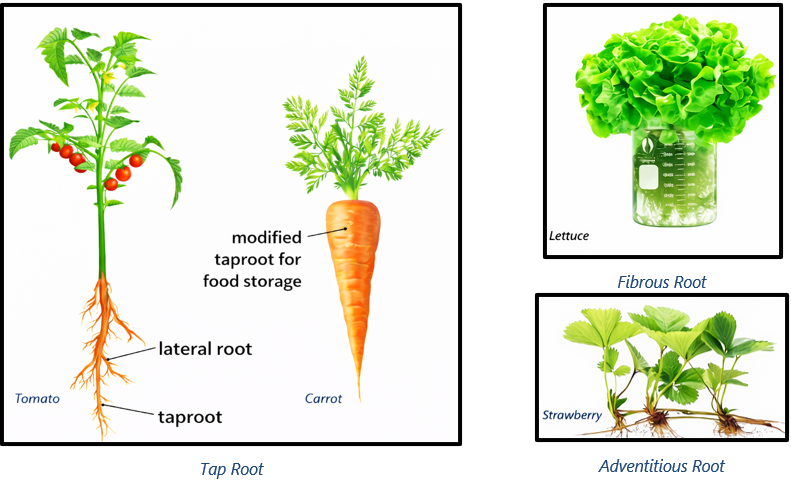
1. Tap Root System (Dicots)
- Develops from the radicle (embryonic root)
- Has a primary root → secondary → tertiary roots
- Example: Mustard, Tomato
👉 Concept: Deep penetration → strong anchorage
2. Fibrous Root System (Monocots)
- Primary root is short-lived
- Replaced by many thin roots at the base of stem
- Example: Wheat, lettuce
👉 Concept: Surface spread → prevents soil erosion
3. Adventitious Roots
- Arise from parts other than radicle
- Example: Banyan, grass, monstera, strawberry
👉 Concept: Functional adaptation beyond normal roots
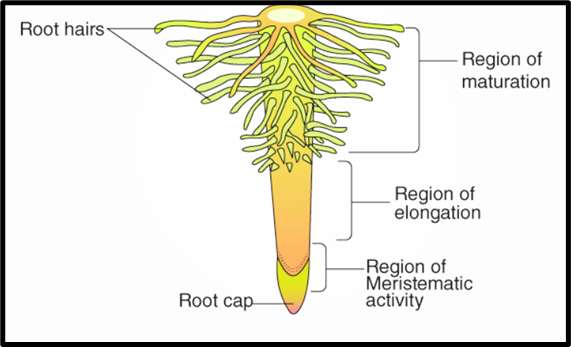
Regions of Root
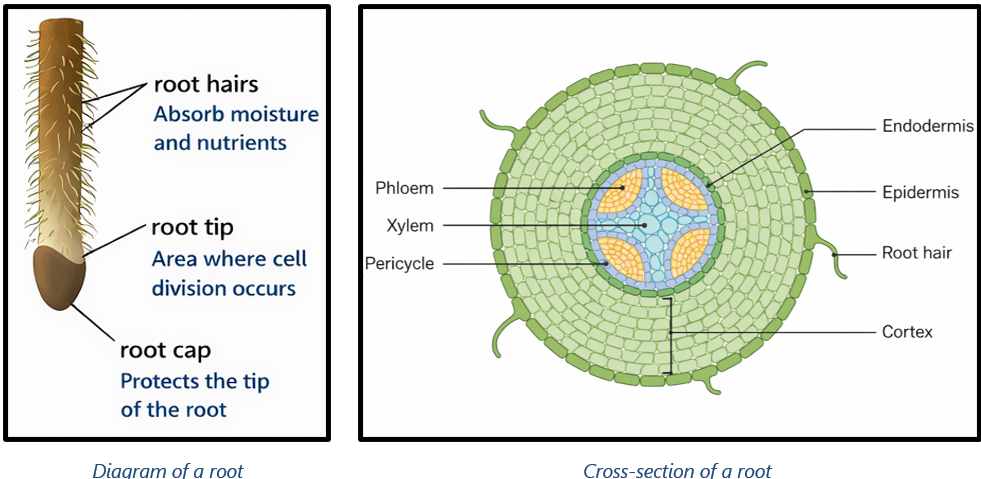
Imagine root as a growing machine with specialized zones:
| Region | Function |
| Root cap | Protection |
| Meristematic region | Cell division |
| Elongation zone | Growth in length |
| Maturation zone | Differentiation + root hairs |
👉 Root hairs are crucial because they increase absorption surface area.
Root Modifications
Roots can change their structure for survival advantages:
- Storage → carrot, turnip, sweet potato
- Support → banyan (prop roots), maize (stilt roots)
- Respiration → pneumatophores in swamp plants like Rhizophora
👉 This shows an important concept:
Structure changes according to function (Adaptation).
🌿 The Stem
The stem develops from the plumule and grows upwards.
Key roles:
- Supports leaves, flowers, fruits
- Conducts water and nutrients
- Produces buds
- Helps in vegetative propagation
Key Structural Terms
- Node → point where leaf arises
- Internode → space between two nodes
👉 This distinction is often asked in prelims.
Stem Modifications
Stems can be modified to perform special functions
| Types | Function | Example | Key Feature / Note |
| Underground Stems | Store food and help the plant survive harsh conditions | Potato | Stem grows below ground and accumulates nutrients |
| Thorns | Protection from herbivores | Bougainvillea | Stem modified into sharp spine |
| Propagation (Runners/Stolons) | Formation of new plants | Strawberry | Spreading underground stems give rise to new plants |
| Stem Tendrils | Climbing support | Pumpkin | Thin, coiled structures; axillary bud modified into tendril |
| Photosynthetic Stems | Perform photosynthesis in arid conditions | Euphorbia | Fleshy, cylindrical green stems carry out photosynthesis |
| Lateral Branches | Help in vegetative propagation (forming new plants) | Mint | Branches develop roots and grow into new plants |
🍃 The Leaf
Leaves are the food factories of the plant due to photosynthesis.
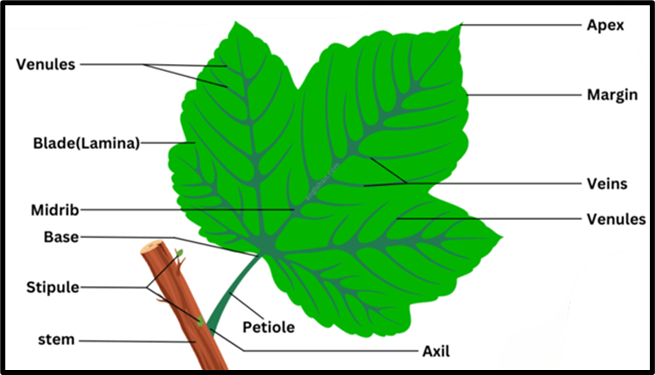
Parts of a Leaf
| Part | Function |
| Leaf base | Attaches leaf to stem |
| Petiole | Holds leaf for sunlight |
| Lamina | Main photosynthetic surface |
👉 The lamina contains veins and veinlets for transport and support
Venation (Pattern of Veins)
- Reticulate venation → network (dicots)
- Parallel venation → parallel lines (monocots)
👉 This is a classic monocot vs dicot differentiator.
Types of Leaves
1. Simple Leaf: Lamina not fully divided
2. Compound Leaf: Lamina divided into leaflets
Types of Compound Leaves:
- Pinnate → arranged along rachis (neem)
- Palmate → from one point (silk cotton)
👉 Key concept:
Leaflets do NOT have buds, but leaves do.
Phyllotaxy (Leaf Arrangement)
| Type | Pattern | Example |
| Alternate | One leaf per node | Mustard |
| Opposite | Two leaves per node | Guava |
| Whorled | More than two leaves | Alstonia |
👉 Helps in maximum sunlight exposure.
Leaf Modifications
Leaves also adapt:
- Tendrils → climbing (pea)
- Spines → protection (cactus)
- Storage → onion, garlic
- Photosynthesis via petiole → Australian acacia
- Insectivorous leaves → pitcher plant, Venus flytrap
🌸 The Flower — A Modified Shoot
The most important idea to start with:
👉 A flower is not a separate entity, it is actually a modified shoot.
- The shoot apical meristem transforms into a floral meristem
- Growth becomes compact
- Instead of leaves, it produces floral organs
👉 Conceptually:
Vegetative phase → Reproductive phase transition
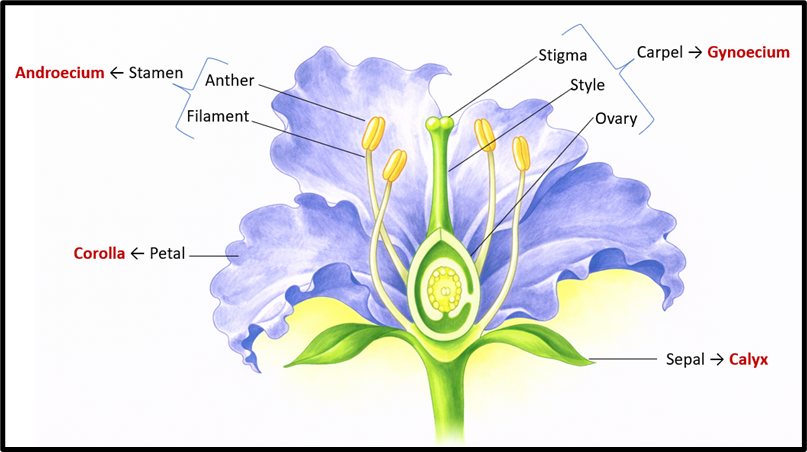
🌼 Structure of a Flower
All floral parts are arranged on a swollen base called:
👉 Thalamus (Receptacle)
Four Main Whorls
| Whorl | Nature | Function |
| Calyx | Accessory | Protection |
| Corolla | Accessory | Attraction |
| Androecium | Reproductive | Male part |
| Gynoecium | Reproductive | Female part |
👉 If calyx and corolla are not distinct → Perianth (e.g., lily)
🌿 Calyx (Sepals)
- Outermost whorl
- Usually green and leaf-like
- Protects the flower bud
Types:
- Gamosepalous → fused sepals
- Polysepalous → free sepals
🌺 Corolla (Petals)
- Brightly coloured → attract pollinators
- Shapes vary: tubular, bell-shaped, funnel-shaped
Types:
- Gamopetalous → fused petals
- Polypetalous → free petals
🔁 Aestivation (Arrangement in Bud)
Aestivation is the arrangement of sepals or petals in a flower bud in relation to each other.
| Type | Pattern | Example |
| Valvate | Edges touch, no overlap | Calotropis |
| Twisted | Overlapping in sequence | China rose |
| Imbricate | Irregular overlap | Cassia |
| Vexillary | Special papilionaceous pattern | Pea |
👉 Helps in taxonomic identification
♂️ Androecium (Male Reproductive Part)
Made of stamens.
Structure of Stamen
- Filament → stalk
- Anther → produces pollen
👉 Pollen grains = male gametophyte
Variations in Stamens
Based on attachment:
- Epipetalous → attached to petals (brinjal)
- Epiphyllous → attached to perianth (lily)
Based on fusion:
- Polyandrous → free
- Monadelphous → one bundle
- Diadelphous → two bundles
- Polyadelphous → many bundles
👉 These are very important for plant classification questions.
♀️ Gynoecium (Female Reproductive Part)
Made of carpels.
Structure of Carpel
| Part | Function |
| Stigma | Receives pollen |
| Style | Connects stigma to ovary |
| Ovary | Contains ovules |
👉 Ovules later become seeds
Types Based on Carpels
- Apocarpous → free carpels (lotus)
- Syncarpous → fused carpels (mustard)
Placentation (Arrangement of Ovules)
This tells us how ovules are arranged inside ovary.
| Type | Description | Example |
| Marginal | Along edge | Pea |
| Axile | Central axis | Tomato |
| Parietal | Inner wall | Mustard |
| Basal | Base | Sunflower |
| Free central | Central without septa | Marigold |
🌸 Classification of Flowers
Based on Reproductive Parts
- Bisexual → both androecium + gynoecium
- Unisexual → only one
Based on Symmetry
| Type | Meaning | Example |
| Actinomorphic | Radial symmetry | Mustard |
| Zygomorphic | Bilateral symmetry | Pea |
| Asymmetric | No symmetry | Canna |
Based on Number of Floral Parts
- Trimerous → multiples of 3 (monocots)
- Tetramerous → multiples of 4
- Pentamerous → multiples of 5
Based on Ovary Position
| Type | Ovary Position | Example |
| Hypogynous | Superior ovary | Mustard |
| Perigynous | Half inferior | Rose |
| Epigynous | Inferior ovary | Guava |
👉 Shortcut:
- Hypo = below → ovary above
- Epi = above → ovary below
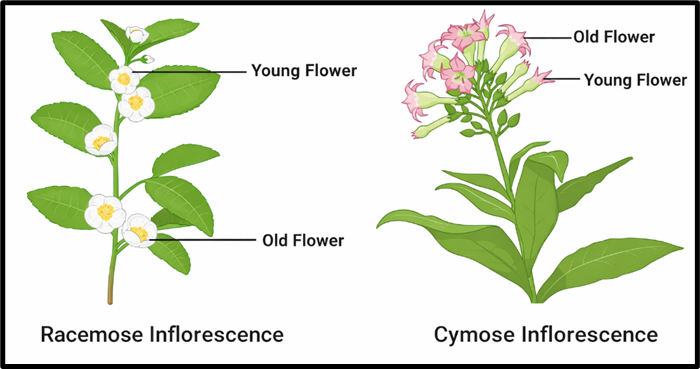
🌼 Inflorescence (Arrangement of Flowers on a stem)
Types:
1. Racemose
- Main axis keeps growing
- Flowers in acropetal order (old → base)
2. Cymose
- Main axis stops growing
- Flowers in basipetal order (old → top)
👉 This reflects growth pattern differences.
🍎 The Fruit
👉 A fruit is a mature ovary after fertilisation → Contains seeds + pericarp
Special case: Parthenocarpic fruit → develops without fertilisation (e.g., banana)
Structure of Fruit Wall (Pericarp)
| Layer | Function |
| Epicarp | Outer |
| Mesocarp | Middle (often edible) |
| Endocarp | Inner |
Example: Drupe
- Hard endocarp (stone fruit)
- Example: Mango, coconut
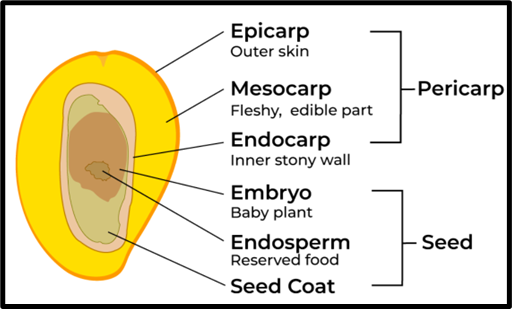
🌱 The Seed
👉 Seed = mature ovule after fertilisation
Parts of Seed
| Part | Function |
| Seed coat | Protection |
| Embryo | Future plant |
Embryo Components
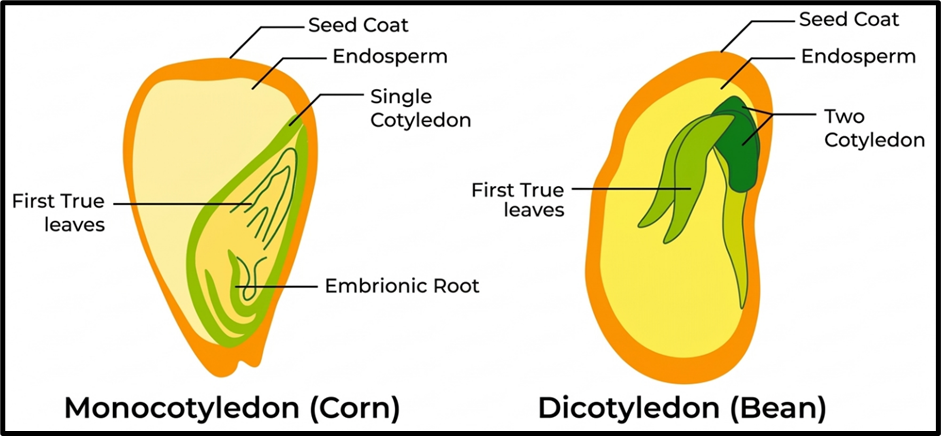
- Radicle → future root
- Embryonal axis → future shoot
- Cotyledons → food storage
Monocot vs Dicot Seed
| Feature | Monocotyledonous Seed | Dicotyledonous Seed |
| Number of Cotyledons | One | Two |
| Examples | Wheat, maize, rice, lily, grass | Bean, pea, gram, mango, sunflower |
| Seed Coat | May be distinct or fused with the fruit wall | Two distinct layers |
| Venation in Leaves | Parallel | Reticulate (net-like) |
| Flower Parts | Usually in multiples of three | Usually in multiples of four or five |
| Root System | Adventitious and fibrous | Taproot |
| Vascular Bundles | Scattered in the stem | Arranged in a ring |
| Pollen Structure | Single furrow or pore | Three furrows or pores |