
Respiration in Human Beings
Human Respiratory System
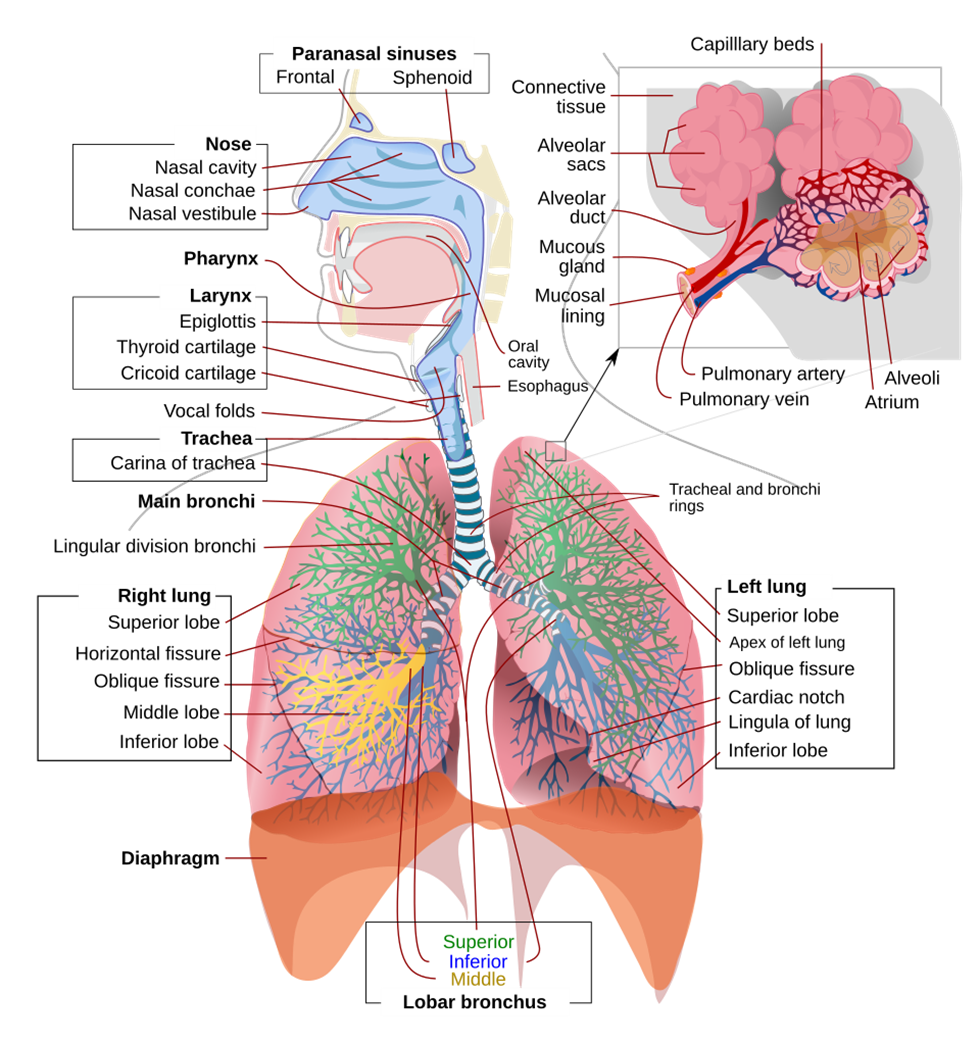
The human respiratory system is designed to ensure a continuous supply of oxygen (O₂) and removal of carbon dioxide (CO₂). It consists of a well-organised pathway that air follows:
(a) Entry and Filtration of Air
Breathing begins at the external nostrils, through which air enters the nasal chamber.
Here, the air is filtered (by hairs and mucus), warmed, moisturised.
This conditioning is crucial because delicate internal structures require clean and humid air.
(b) Common Passage: Pharynx
From the nasal chamber, air passes into the pharynx, which serves as a shared passage for both food and air. This dual function makes regulation essential.
(c) Larynx: The Sound Box
The pharynx opens into the larynx, a cartilaginous structure responsible for sound production.
A key structure here is the epiglottis, which acts like a flap:
- It closes during swallowing, preventing food from entering the airway.
- This ensures proper separation of respiratory and digestive pathways.
(d) Trachea and Branching System
Air then moves into the trachea (windpipe), which is supported by C-shaped cartilage rings to prevent collapse, extends downward into the chest.
The trachea divides into → Right and left bronchi, each entering a lung, which further branch into bronchioles.
(e) Alveoli: The Functional Units
The bronchioles terminate in tiny air sacs called alveoli, which are the actual sites of gas exchange.
Key features of alveoli:
- Extremely thin walls (one cell thick),
- Surrounded by a dense network of capillaries,
- Provide a large surface area for efficient diffusion.
This design ensures rapid exchange of gases between air and blood.
(f) Lungs and Protective Covering
The entire branching system—bronchi, bronchioles, and alveoli—forms the lungs.
- The lungs are covered by a double-layered membrane called pleura.
- The space between these layers contains pleural fluid, which:
- Reduces friction during breathing,
- Allows smooth expansion and contraction.
(g) Thoracic Cavity and Breathing Mechanics
The lungs are housed in the thoracic cavity, which is airtight, bounded by ribs, sternum, and diaphragm.
The diaphragm, a dome-shaped muscle, plays a crucial role in breathing:
- Contracts → increases thoracic volume → inhalation
- Relaxes → decreases volume → exhalation
Steps of Respiration: A Functional Flow
Respiration is not a single event but a sequence of coordinated processes:
Step 1: Pulmonary Ventilation (Breathing)
This involves:
- Inhalation → intake of oxygen-rich air,
- Exhalation → removal of carbon dioxide.
Step 2: Diffusion at Alveoli
At the alveolar level:
- Oxygen diffuses from alveoli → blood,
- Carbon dioxide diffuses from blood → alveoli.
This occurs due to concentration gradients.
Step 3: Transport of Gases in Blood
- Oxygen is transported mainly by haemoglobin in red blood cells.
- Carbon dioxide is transported in dissolved form, as bicarbonates, or bound to haemoglobin.
Step 4: Tissue-Level Gas Exchange
At body tissues:
- Oxygen diffuses from blood → cells,
- Carbon dioxide diffuses from cells → blood.
Step 5: Cellular Respiration
Finally, within cells:
- Oxygen is used in mitochondria to produce energy (ATP),
- Carbon dioxide is generated as a waste product.
Final Conceptual Insight
If you look at the entire system holistically, respiration can be understood as a multi-level integration:
- Organ level → lungs enable ventilation,
- Tissue level → alveoli enable diffusion,
- Circulatory level → blood transports gases,
- Cellular level → mitochondria generate energy.
Thus, respiration is not just breathing—it is a complete energy-sustaining mechanism of life.
Diversity in Respiratory Organs
After our discussion on humans, it is important to recognise a fundamental principle:
respiration is universal, but respiratory structures differ based on habitat and complexity.
- Simple organisms such as sponges, coelenterates, and flatworms do not possess specialised organs. They rely on diffusion across the body surface, as their cells are directly exposed to the environment.
- Earthworms and frogs exhibit cutaneous respiration, meaning gas exchange occurs through moist skin. In frogs, this is supplemented by lungs, especially on land.
- Insects have a highly efficient tracheal system, where air is directly delivered to tissues through a network of tubes (tracheae), bypassing the need for blood-mediated transport.
- Aquatic animals like fishes use gills (branchial respiration), which are specialised for extracting dissolved oxygen from water.
- Terrestrial vertebrates such as amphibians, reptiles, birds, and mammals rely primarily on lungs (pulmonary respiration).
This comparative view helps you appreciate that the human respiratory system is an advanced adaptation for efficient gas exchange in a terrestrial environment.
Mechanism of Breathing: The Physics Behind Respiration
Breathing is not an active “sucking in” of air; rather, it is governed by a simple physical principle:
air moves from a region of higher pressure to a region of lower pressure. This creates two alternating phases:
(a) Inspiration (Inhalation)
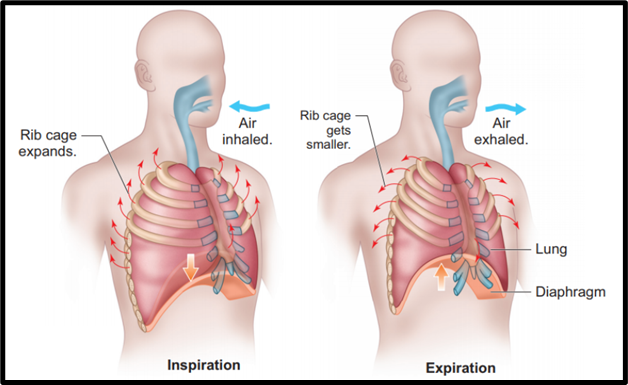
Inspiration occurs when the pressure inside the lungs becomes lower than atmospheric pressure.
This pressure change is achieved through muscular action:
- The diaphragm contracts and flattens, moving downward.
- The external intercostal muscles (between the ribs) contract, causing:
- Ribs to move upward and outward,
- Sternum to move forward.
As a result:
- The thoracic cavity expands,
- Lung volume increases,
- Internal lung pressure decreases below atmospheric pressure.
This pressure gradient allows air rich in oxygen (O₂) to flow into the lungs.
👉 Key idea: Inspiration is an active process involving muscle contraction.
(b) Expiration (Exhalation)
Expiration occurs when the pressure inside the lungs becomes higher than atmospheric pressure.
This happens mainly due to relaxation:
- The diaphragm relaxes and returns to its dome shape.
- The intercostal muscles relax, causing → Ribs to move downward and inward.
Consequently:
- The thoracic cavity volume decreases,
- Lung volume reduces,
- Internal pressure increases above atmospheric pressure.
This forces air rich in carbon dioxide (CO₂) out of the lungs.
👉 Key idea: Normal expiration is largely a passive process.
Breathing Rate: Measuring Ventilation Efficiency
The breathing rate refers to the number of complete breathing cycles per minute.
- One cycle = 1 inhalation + 1 exhalation
- In a healthy adult: 12–16 breaths per minute (at rest)
To quantify breathing more precisely, instruments like a spirometer are used.
They measure:
- Volume of air inhaled and exhaled,
- Lung capacities and efficiencies.
This becomes important in diagnosing respiratory disorders.
Exchange of Gases: The Core of Respiration
While breathing brings air into the lungs, the real purpose of respiration is gas exchange, which occurs primarily in the alveoli.
(a) Principle of Diffusion
Gas exchange is driven by:
- Concentration gradients, or more precisely,
- Partial pressure gradients
The partial pressure of a gas (like pO₂ or pCO₂) represents its individual contribution in a mixture of gases.
(b) Direction of Gas Movement
The movement of gases follows a predictable pattern:
- Oxygen (O₂):
- From alveoli (high pO₂) → blood (low pO₂)
- From blood → body tissues
- Carbon dioxide (CO₂):
- From tissues (high pCO₂) → blood
- From blood → alveoli (low pCO₂)
👉 This establishes a continuous two-way exchange system.
(c) Role of Solubility
An interesting physiological insight:
- CO₂ is 20–25 times more soluble in water than O₂.
This means:
- CO₂ diffuses more easily,
- Even a small pressure gradient is sufficient for its movement.
This is why removal of CO₂ is generally efficient under normal conditions.
(d) Diffusion Membrane: Structural Efficiency
The efficiency of gas exchange depends heavily on the respiratory (diffusion) membrane, which is extremely thin (less than 1 mm).
It consists of three layers:
- Alveolar epithelium (lining of alveoli)
- Capillary endothelium (lining of blood vessels)
- Basement membrane (thin layer between them)
Because of Minimal thickness, Large surface area, Rich blood supply, the diffusion of gases is rapid and highly efficient.
Transport of Gases: Role of Blood as a Carrier System
Once gases are exchanged at the alveoli, they must be transported efficiently to and from tissues. This responsibility is performed by blood.
Distribution Pattern
- Oxygen (O₂):
- ~97% transported by red blood cells (RBCs) via haemoglobin
- ~3% dissolved in plasma
- Carbon dioxide (CO₂):
- ~70% transported as bicarbonate (HCO₃⁻) in plasma
- ~20–25% carried by haemoglobin
- ~7% dissolved in plasma
This clearly shows that while oxygen relies mainly on haemoglobin, carbon dioxide uses multiple transport forms, with bicarbonate being dominant.
Transport of Oxygen: Haemoglobin Dynamics
At the centre of oxygen transport lies haemoglobin, an iron-containing respiratory pigment present in RBCs.
(a) Formation of Oxyhaemoglobin
- Haemoglobin binds with oxygen reversibly to form oxyhaemoglobin.
- Each haemoglobin molecule can bind up to four O₂ molecules.
(b) Factors Affecting Oxygen Binding
The binding and release of oxygen depend primarily on partial pressure of oxygen (pO₂), but also on:
- pCO₂ (carbon dioxide pressure)
- H⁺ concentration (pH)
- Temperature
(c) Loading and Unloading Mechanism
- In the lungs (alveoli):
- High pO₂, low pCO₂, low H⁺, lower temperature → Haemoglobin readily binds oxygen
- In the tissues:
- Low pO₂, high pCO₂, high H⁺, higher temperature → Haemoglobin releases oxygen
👉 This phenomenon ensures that oxygen is picked up where it is abundant and released where it is needed most.
Under normal conditions: 100 ml of oxygenated blood delivers ~5 ml of O₂ to tissues
Transport of Carbon Dioxide: A Multi-Form System
Carbon dioxide transport is slightly more complex.
(a) Binding with Haemoglobin
- About 20–25% of CO₂ binds with haemoglobin to form carbaminohaemoglobin.
- This binding depends mainly on pCO₂.
- In tissues:
- High pCO₂ → more CO₂ binds
- In lungs:
- Low pCO₂ → CO₂ is released
(b) Role of Carbonic Anhydrase (Key Enzyme)
Inside RBCs, an enzyme called carbonic anhydrase plays a crucial role.
In tissues:
- CO₂ + H₂O → H₂CO₃ (carbonic acid) → HCO₃⁻ + H⁺
- Thus, CO₂ is converted into bicarbonate, which is easily transported in blood
In lungs:
- The reaction reverses: HCO₃⁻ → CO₂ + H₂O
- CO₂ is released into alveoli for exhalation
(c) Quantitative Insight
- 100 ml of deoxygenated blood delivers ~4 ml of CO₂ to alveoli
Regulation of Respiration: Neural and Chemical Control
Breathing is not random—it is precisely regulated according to body needs.
(a) Neural Control
- The respiratory rhythm centre in the medulla oblongata controls basic breathing.
- The pneumotaxic centre in the pons:
- Regulates breathing pattern,
- Shortens inspiration,
- Helps adjust breathing rate.
(b) Chemical Regulation
A chemosensitive area near the medulla monitors → CO₂ levels, H⁺ concentration (pH).
If CO₂ increases:
- Signals are sent to increase breathing rate,
- Excess CO₂ is expelled.
Additionally, Receptors in the carotid artery and aortic arch detect changes and send feedback to the brain.
👉 Important insight: CO₂ (not O₂) is the primary regulator of breathing under normal conditions.
Disorders of the Respiratory System
Understanding disorders helps connect theory with real-life implications.
(a) Asthma
- Characterised by inflammation of bronchi and bronchioles
- Leads to Narrowed airways, Wheezing and breathing difficulty
(b) Emphysema
- A chronic disorder where:
- Alveolar walls are damaged,
- Surface area for gas exchange decreases
- Major cause: Cigarette smoking
(c) Occupational Respiratory Disorders
- Occur in industries like → Stone breaking, Mining, Grinding
- Caused by prolonged inhalation of dust → leads to:
- Lung inflammation,
- Fibrosis (thickening of lung tissue)
👉 Preventive measure: Use of protective masks
(d) Natural Protective Mechanism: Sneezing
- Air contains dust, pollen, and smoke.
- Nasal hairs trap most particles.
- Irritants trigger sneezing reflex, which helps expel them.
Final Conceptual Synthesis
If you integrate this entire discussion:
- Lungs perform gas exchange,
- Blood transports gases,
- Haemoglobin ensures efficient oxygen delivery,
- Enzymes like carbonic anhydrase facilitate CO₂ transport,
- Brain centres regulate breathing dynamically, and
- Protective and pathological mechanisms influence respiratory health.
Thus, respiration is not just a biological process—it is a finely regulated, multi-system coordination that sustains life continuously.