
Atomic Structure and Molecular Fundamentals
Let’s begin with a question that humans have asked for thousands of years: if you keep cutting a piece of matter into smaller and smaller pieces, where does it end?
The ancient Greek philosopher Democritus said — it must end somewhere. He called that final, indivisible particle the ‘atomos’ — meaning ‘uncuttable’. He was remarkably right in spirit, even if modern science tells a more nuanced story. That is where we begin.
Atoms
An atom is the smallest unit of matter that retains the identity and properties of an element.
Think of it this way — if you have a piece of gold and keep dividing it, the smallest piece that is still ‘gold’ in every chemical sense is a single gold atom. Divide it further and you no longer have gold — you have subatomic particles with no elemental identity.
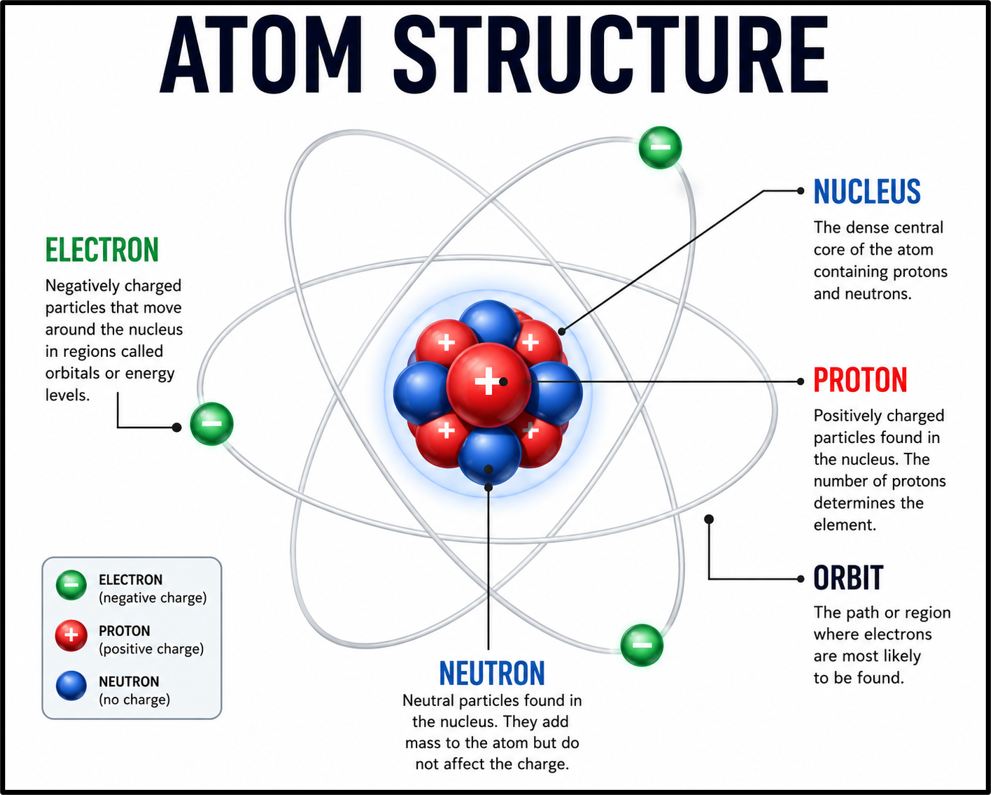
Every atom consists of three types of subatomic particles: protons, neutrons, and electrons.
These three particles are the ‘trinity’ of atomic architecture — and understanding them is the key to understanding all of chemistry.
The Structure of an Atom
The Nucleus: Protons and Neutrons
Picture a tiny, incredibly dense core sitting at the centre of an atom. This is the nucleus.
Ernest Rutherford discovered it in 1911 through his legendary Gold Foil Experiment, in which he fired alpha particles at a thin gold sheet and found that some bounced straight back — as if they had hit something very solid. That solid thing was the nucleus.
The nucleus is made up of particles called nucleons — a collective term for protons and neutrons. Most of the atom’s mass is concentrated here, even though the nucleus is unimaginably small compared to the overall atom.
- Protons are positively charged subatomic particles. The number of protons in the nucleus gives the atom its identity — change the proton count and you change the element entirely. Protons were discovered by Ernest Rutherford.
- Neutrons are electrically neutral subatomic particles. Discovered by James Chadwick, they sit alongside protons in the nucleus and provide nuclear stability by offsetting the repulsive forces between the positively charged protons.
💡 Both protons and neutrons have nearly identical masses, approximately 1 atomic mass unit (amu) each. This makes the nucleus the heavyweight of the atom.
Electrons
If protons and neutrons form the dense nucleus, electrons are the lightweight, energetic particles that orbit around it.
Discovered by J.J. Thomson, electrons are negatively charged and orbit the nucleus in specific regions called energy levels or shells. T
he farther an electron is from the nucleus, the higher its energy — much like how a satellite in a higher orbit has more potential energy.
- Electrons have negligible mass compared to protons and neutrons — about 1/1836th of a proton’s mass.
- They can jump between energy levels by absorbing or emitting specific amounts of energy, usually in the form of light (photons).
- In a neutral atom, the number of electrons exactly equals the number of protons, making the atom electrically neutral overall.
- Electrons exhibit both wave-like and particle-like properties — a mind-bending concept known as wave-particle duality, which is a cornerstone of quantum mechanics.
Key Characteristics of an Atom
Atomic Number (Z)
The atomic number (Z) is the number of protons present in the nucleus of an atom. This is the most fundamental identifier of an element — no two elements share the same atomic number.
Think of it as an element’s ‘Aadhaar number’. Atomic number also equals the number of electrons in a neutral atom, and it determines an element’s position in the Periodic Table.
| Element | Symbol | Atomic Number (Z) |
| Hydrogen | H | 1 |
| Helium | He | 2 |
| Carbon | C | 6 |
| Oxygen | O | 8 |
| Gold | Au | 79 |
Mass Number
The mass number is the total number of protons AND neutrons in the nucleus.
Since electrons have negligible mass, the mass number gives us a very good approximation of the atom’s mass. The formula is simple:
Mass Number = Atomic Number (protons) + Number of Neutrons.
| Element | Symbol | Atomic Number | Neutrons | Mass Number |
| Hydrogen | H | 1 | 0 | 1 |
| Helium | He | 2 | 2 | 4 |
| Carbon | C | 6 | 6 | 12 |
| Oxygen | O | 8 | 8 | 16 |
| Uranium-238 | U | 92 | 146 | 238 |
Atomic Mass vs. Atomic Weight
Atomic mass is the sum of the masses of protons, neutrons, and electrons in a single atom of a specific isotope. It is measured in atomic mass units (amu) or Daltons (Da).
One amu is defined as 1/12th the mass of a Carbon-12 atom.
Atomic weight (also called Relative Atomic Mass) is subtly different — it is the weighted average mass of ALL naturally occurring isotopes of that element, taking into account their relative abundance in nature.
For example, chlorine has two main isotopes: Chlorine-35 and Chlorine-37. Its atomic weight (~35.5) reflects the weighted average of these two, not a single value from either.
💡 Think of atomic weight like an average exam score for a class. Not every student scored exactly 35.5, but when you average them all out, that’s where the class stands.
Other Important Characteristics
- Size: Atoms are measured in picometers (10⁻¹² metres). The ‘atomic radius’ is the distance from the nucleus to the outermost electron shell.
- Neutrality: A neutral atom has equal numbers of protons (+) and electrons (−), resulting in no overall electric charge.
- Stability: An atom’s stability depends on its proton-to-neutron ratio. For lighter elements, a 1:1 ratio is stable. For heavier elements, more neutrons are needed to counteract proton-proton repulsion. Unstable atoms are radioactive.
- Indivisibility: In chemical reactions, atoms are neither created nor destroyed — they are rearranged. However, in nuclear reactions (fission/fusion), atoms can be split or fused.
- Chemical Behaviour: Determined primarily by valence electrons (electrons in the outermost shell). Atoms gain, lose, or share valence electrons to achieve a stable configuration.
Different Atomic Species
Here is where many students get confused — and understandably so. Nature is rich with variations of atoms that differ from each other in subtle but important ways. Let’s go through each one.
Isotopes — Same Element, Different Weights
Isotopes are atoms of the same element that have the same atomic number (same protons) but different mass numbers (different neutrons).
They are chemically identical because chemical behaviour depends on electrons, not neutrons. But physically, they can differ in mass, density, and radioactive behaviour.
- Hydrogen has three isotopes:
- Protium (¹H) — 1 proton, 0 neutrons;
- Deuterium (²H) — 1 proton, 1 neutron;
- Tritium (³H) — 1 proton, 2 neutrons.
- Carbon has three common isotopes: Carbon-12, Carbon-13, and Carbon-14.
- Carbon-14 is radioactive and used in carbon dating to determine the age of fossils!
- Stable Isotopes do not undergo radioactive decay. E.g., Protium, Deuterium, Carbon-12.
- Radioactive Isotopes are unstable and emit radiation over time.
- E.g., Iodine-131 (used in thyroid treatment), Cobalt-60 (cancer therapy), Uranium-235 (nuclear fuel).
Ions — When Atoms Gain or Lose Electrons
Ions are atoms or molecules that have gained or lost one or more electrons, giving them a net electrical charge.
This is like an atom that is no longer electrically neutral — it has either more electrons (negative) or fewer electrons (positive) than protons.
- Cations: Cations are positively charged ions, formed when an atom LOSES electrons. Metals typically form cations. Examples: Na⁺ (sodium ion), Ca²⁺ (calcium ion).
- Anions: Anions are negatively charged ions, formed when an atom GAINS electrons. Non-metals typically form anions. Examples: Cl⁻ (chloride), S²⁻ (sulfide).
Key properties of ions:
- Conductivity: Ions in solution or molten form conduct electricity — this is why ionic compounds are electrolytes.
- Solubility: Ions are highly soluble in water due to water’s polar nature surrounding and stabilising them.
- Stability: Ions are most stable when they achieve a noble gas electron configuration (full outer shell).
- High melting/boiling points: Strong electrostatic forces between oppositely charged ions in a crystal lattice.
- Applications: Electrolysis (metal refining, electroplating); biological ions (Na⁺, K⁺, Cl⁻) for nerve impulses; lithium-ion batteries.
Isobars — Same Mass, Different Elements
Isobars are atoms of different elements that have the same mass number but different atomic numbers. Same total nucleons, different identity.
Example: Argon-40 (18 protons, 22 neutrons) and Calcium-40 (20 protons, 20 neutrons) — both have mass number 40, but are completely different elements with different chemical properties.
Isotones — Same Neutrons, Different Elements
Isotones are atoms of different elements that have the same number of neutrons but different numbers of protons.
Example: Carbon-13 (6 protons, 7 neutrons) and Nitrogen-14 (7 protons, 7 neutrons) — both have 7 neutrons but are entirely different elements.
Allotropes — Same Element, Different Structures
Allotropes are different structural forms of the same element in the same physical state.
The atoms are the same, but the way they are arranged or bonded is different — and this leads to dramatically different physical and chemical properties.
Carbon is the best example of this: the same carbon atoms, arranged differently, give us both the hardest natural substance on Earth (diamond) and one of the softest (graphite)!
Allotropes of Carbon:
- Diamond: Hardest natural substance, transparent, high thermal conductivity, non-conductive of electricity. Used in jewellery and cutting tools.
- Graphite: Soft, slippery, excellent electrical conductor. Used in pencils, lubricants, electrodes.
- Graphene: A single layer of graphite; extremely strong, lightweight, brilliant electrical conductor. Used in advanced electronics and nanotechnology.
- Fullerenes (Buckyballs): Hollow, cage-like structures; chemically stable, conductive. Used in medicine, nanotechnology.
Allotropes of Oxygen:
- Dioxygen (O₂): Colourless, odourless — the oxygen we breathe. Highly reactive oxidising agent essential for life and combustion.
- Ozone (O₃): Pale blue gas with pungent odour, strong oxidising agent, absorbs UV radiation. Forms the protective ozone layer.
Allotropes of Phosphorus:
- White Phosphorus: Highly reactive, waxy, toxic, glows in the dark (phosphorescence). Used in military applications.
- Red Phosphorus: Stable, less reactive. Used in matchsticks, flame retardants, pesticides.
- Black Phosphorus: Good semiconductor. Used in electronics.
Allotropes of Sulfur:
- Rhombic Sulfur: Yellow crystals, stable at room temperature. Used in producing sulfuric acid and vulcanising rubber.
- Monoclinic Sulfur: Needle-like crystals, stable at higher temperatures.
- Plastic Sulfur: Amorphous, obtained by rapid cooling of molten sulfur.
Isomers — Same Formula, Different Arrangement
Isomers are molecules with the same molecular formula (same atoms, same numbers) but different arrangements of those atoms.
This difference in arrangement can cause significant differences in physical properties (boiling point, melting point) and even biological activity — the same atoms connected differently can mean the difference between a medicine and a poison!
Quick Comparison of All Atomic Species:
| Type | Protons | Neutrons | Electrons | Key Difference |
| Isotopes | Same | Different | Same | Different mass numbers |
| Ions | Same | Same | Different | Charge due to electron gain/loss |
| Isobars | Different | Different | Same | Same mass number, different elements |
| Isotones | Different | Same | Same | Same neutron count, different elements |
| Allotropes | Same | Same | Same | Different atomic arrangement/structure |
| Isomers | Same | Same | Same | Same formula, different atomic connectivity |
The Evolution of Atomic Models
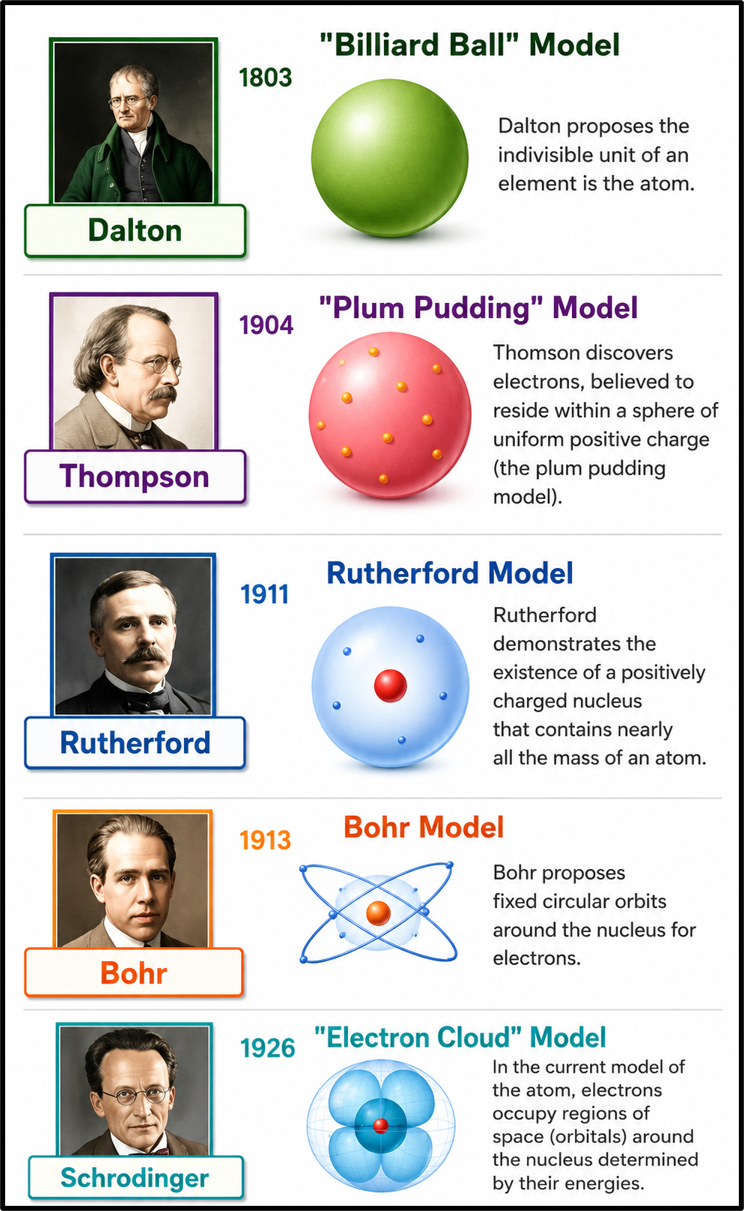
Science rarely gets things right the first time. Our understanding of the atom has evolved dramatically over two centuries, with each model building on — and correcting — the one before. This is a great story of scientific progress. Let’s trace it chronologically.
Dalton’s Model (1803) — The Billiard Ball Model
John Dalton proposed that matter is made up of tiny, indivisible, solid spheres — like billiard balls.
All atoms of an element are identical; chemical reactions just rearrange them; atoms are neither created nor destroyed.
Dalton gave chemistry its first truly scientific framework.
- Key contribution: Atoms are real, distinct particles with fixed masses for each element.
- Limitation: Could not explain subatomic particles (discovered later) or isotopes (atoms of same element with different masses).
Thomson’s Model (1897) — The Plum Pudding Model
J.J. Thomson discovered the electron in 1897 and proposed a new model: the atom as a positively charged ‘pudding’ with electrons (like raisins) embedded within it.
The atom was overall neutral — positive and negative charges balanced.
- Key contribution: First model to include electrons; accepted that atoms have internal structure.
- Limitation: Could not explain how electrons are arranged, nor account for atomic stability or scattering experiments.
Rutherford’s Model (1911) — The Nuclear Model
Ernest Rutherford’s Gold Foil Experiment was a turning point. When he fired alpha particles at a thin gold sheet, most passed through — but some bounced back sharply.
His conclusion: the atom is mostly empty space, with a tiny, dense, positively charged nucleus at the centre, surrounded by electrons orbiting at a distance — like planets around the Sun.
- Key contribution: Discovery of the nucleus; the ‘planetary’ orbital picture of the atom.
- Limitation: Could not explain why orbiting electrons don’t spiral into the nucleus (which classical physics predicted they should, losing energy as radiation). Also failed to explain atomic emission spectra.
Bohr’s Model (1913) — The Planetary/Quantised Model
Niels Bohr saved Rutherford’s model by adding a crucial restriction: electrons can only orbit in certain fixed, quantised energy levels. They don’t spiral in because they can only exist in these specific ‘allowed’ orbits.
When an electron jumps from a higher to a lower orbit, it emits a photon of specific energy — explaining why atoms emit light of specific colours (spectral lines).
- Key contribution: Quantised energy levels explain atomic spectra; correctly predicts hydrogen’s spectral lines.
- Limitation: Works well for hydrogen (one electron) but fails for complex atoms. Does not account for the wave-like nature of electrons.
Quantum Mechanical Model (1926) — The Modern Atomic Model
Developed by Erwin Schrödinger, Werner Heisenberg, and others, this is our current best model of the atom. It treats electrons as both particles AND waves (wave-particle duality).
Heisenberg’s Uncertainty Principle tells us we can never know both the exact position AND momentum of an electron simultaneously. Instead of fixed orbits, electrons exist in orbitals — regions of space where there is a high probability of finding an electron.
- Electrons occupy discrete energy levels but their positions are described probabilistically — not as fixed paths.
- This model successfully explains the spectra of ALL elements and predicts chemical bonding behaviour accurately.
Summary of Atomic Models:
| Model | Scientist | Year | Key Idea | Major Limitation |
| Billiard Ball | Dalton | 1803 | Atoms are indivisible solid spheres | No subatomic particles; no isotopes |
| Plum Pudding | Thomson | 1897 | Positive pudding with embedded electrons | No explanation of electron arrangement |
| Nuclear Model | Rutherford | 1911 | Dense positive nucleus; electrons orbit it | Why don’t electrons spiral into nucleus? |
| Planetary Model | Bohr | 1913 | Electrons in quantised energy orbits | Fails for multi-electron atoms |
| Quantum Mechanical | Schrödinger/Heisenberg | 1926 | Electrons as waves; probability orbitals | Complex, but most accurate |
Molecules
While atoms are the smallest units of elements, molecules are the smallest units of compounds that can exist independently while retaining the chemical properties of that compound.
A molecule is a group of two or more atoms chemically bonded together — they can be atoms of the same element (like O₂) or different elements (like H₂O).
Types of Molecules
- Homonuclear — Same element. E.g., O₂ (oxygen), N₂ (nitrogen).
- Heteronuclear — Different elements. E.g., H₂O (water), NH₃ (ammonia).
- Monatomic — Single atom. E.g., He, Ne (noble gases).
- Diatomic — Two atoms. E.g., O₂, H₂, HCl.
- Triatomic — Three atoms. E.g., O₃ (ozone), CO₂.
- Polyatomic — More than three atoms. E.g., CH₄ (methane), C₆H₁₂O₆ (glucose, 24 atoms).
Properties of Molecules
Polarity — The Hidden Charge Distribution
Polarity refers to the unequal distribution of electric charge within a molecule.
It is one of the most important molecular properties because it determines how molecules interact with each other and with other substances.
- Polar molecules have unequal electron sharing, creating a dipole moment — one end is partially positive (δ+) and the other partially negative (δ−). E.g., H₂O, NH₃, HCl.
- Non-polar molecules have equal electron sharing, no net charge separation, no dipole moment. E.g., CH₄, CO₂, O₂.
| Feature | Polar Molecules | Non-polar Molecules |
| Electron sharing | Unequal | Equal |
| Charge distribution | Uneven (δ+/δ−) | Even (no separation) |
| Dipole moment | Present | Absent |
| Intermolecular forces | Dipole-dipole, H-bonding | London dispersion forces |
| Boiling/Melting pts | Higher | Lower |
| Solubility | In polar solvents (water) | In non-polar solvents (oil, benzene) |
| Examples | H₂O, NH₃, HCl | CH₄, CO₂, O₂ |
Intermolecular Forces
Intermolecular forces are the attractive or repulsive forces between molecules.
Unlike the intramolecular bonds that hold atoms together within a molecule, intermolecular forces are generally weaker — but they determine crucial physical properties like boiling point, melting point, solubility, and state of matter.
- London Dispersion Forces (Van der Waals): Weakest intermolecular force. Caused by temporary dipoles due to electron movement.
- Present in ALL molecules — polar or non-polar.
- Stronger in larger molecules with more electrons.
- E.g., noble gases, O₂, CH₄.
- Dipole-Dipole: Occur between polar molecules.
- The positive end of one molecule attracts the negative end of another.
- Stronger than dispersion forces.
- E.g., HCl, acetone.
- Hydrogen Bonding — Hydrogen Bonding: Special, stronger form of dipole-dipole interaction.
- Occurs when hydrogen is bonded to a highly electronegative atom — nitrogen (N), oxygen (O), or fluorine (F). This is why water has a surprisingly high boiling point for its small molecule size!
- E.g., water, ammonia, hydrogen fluoride.
- Ion-Dipole: Between an ion and a polar molecule.
- Strongest of the intermolecular forces discussed here.
- Common in ionic compounds dissolved in polar solvents.
- E.g., NaCl dissolved in water.
💡 Van der Waals Force is a collective term encompassing both London dispersion forces and dipole-dipole interactions — essentially all weak intermolecular forces arising from temporary or permanent dipoles.