
Electricity, Magnetism and Electromagnetic Applications
Electricity
Everything from the phone in your pocket to the satellite orbiting Earth runs on electricity. Electricity is a form of energy resulting from the flow of electric charge. To understand electricity deeply, we need to understand the foundational concepts: electric charge, current, voltage, and resistance — and how they are all interconnected.
Core Concepts of Electricity
A) Electric Charge
At the subatomic level, matter is made of protons (positive charge) and electrons (negative charge).
Electric charge is the fundamental property of these particles that causes them to exert forces on each other when placed in an electric or magnetic field.
- Positive Charge: Carried by protons
- Negative Charge: Carried by electrons
- Unit: Coulomb (C) — the SI unit of electric charge
The Universal Rule of Charge Interaction:
| Like charges REPEL each other (+ repels +, − repels −) Unlike charges ATTRACT each other (+ attracts −) |
| Analogy: Think of political parties — same ideology (like charges) tends to push each other away in competition, while opposing parties sometimes attract to form coalitions (unlike charges attract). This is, of course, just an illustrative analogy! |
B) Electric Current
If electric charge is the ‘what’, then Electric Current is the ‘how much flows’. Current is defined as the rate of flow of electric charge through a conductor.
| Current (I) = Total Charge (Q) ÷ Time (t) SI Unit: Ampere (A), where 1 Ampere = 1 Coulomb per second |
Factors Affecting Electric Current:
- Potential Difference (Voltage): Acts as the driving force — higher voltage pushes more current.
- Resistance: Opposes the flow of current — higher resistance means less current for the same voltage.
- Material of Conductor: Determines how easily electrons can move (copper conducts better than iron).
Effects of Electric Current — How Current Manifests:
- Heating Effect: Current flowing through resistance produces heat (Joule’s Heating Effect). Used in electric heaters, toasters, geysers, and incandescent bulbs.
- Magnetic Effect: A current-carrying conductor generates a magnetic field around it. Used in electromagnets, electric motors, and generators.
- Chemical Effect: Current causes chemical reactions in electrolyte solutions — used in electrolysis, electroplating, and batteries.
C) Voltage (Potential Difference)
Think of voltage like water pressure in a pipe. Just as water flows from a high-pressure region to a low-pressure one, electric charges flow from a region of higher electric potential to lower electric potential. This difference in potential is called Voltage or Potential Difference.
| Voltage (V) = Work Done (W) ÷ Charge (Q) SI Unit: Volt (V), where 1 Volt = 1 Joule per Coulomb |
| Type of Voltage | Description |
| Direct Voltage (DC) | Voltage remains constant in magnitude and direction. Examples: batteries, solar cells, fuel cells. |
| Alternating Voltage (AC) | Voltage alternates direction periodically (in India, 50 Hz). Examples: household power supply, grid electricity. |
D) Resistance
If voltage is the push and current is the flow, Resistance is the opposition to that flow. It is like friction for electricity. The more resistance, the less current flows for a given voltage.
| Resistance (R) = Voltage (V) ÷ Current (I) SI Unit: Ohm (Ω), where 1 Ohm = 1 Volt / Ampere |
Factors Affecting Resistance:
- Material: Conductors (copper, silver) have low resistance; insulators (rubber, glass) have very high resistance.
- Length: Resistance is directly proportional to length. Longer wire = more resistance.
- Cross-Sectional Area: Resistance is inversely proportional to area. Thicker wire = less resistance. This is why high-power cables are thick.
- Temperature: For most conductors, resistance increases with temperature. For semiconductors, resistance decreases with temperature (very important for NTC thermistors and electronic devices).
- Nature of Material (Resistivity): Each material has an intrinsic property called Resistivity (ρ) that determines its resistance independent of shape or size.
E) Resistivity — The Material’s Fingerprint
While Resistance depends on the dimensions (length, area) of a conductor, Resistivity is an intrinsic property that depends only on the material and temperature — not on its shape or size. It is like a DNA fingerprint of the material.
| Resistivity (ρ) = Resistance × (Cross-sectional Area ÷ Length) SI Unit: Ohm-metre (Ω·m) |
| Material Category | Resistivity | Examples |
| Conductors | Very Low (10⁻⁸ Ω·m range) | Copper, Silver, Aluminium, Gold |
| Semiconductors | Intermediate | Silicon, Germanium |
| Insulators | Very High (10⁸ – 10¹⁶ Ω·m range) | Rubber, Glass, Plastic, Ceramic |
Resistivity vs. Resistance — The Key Distinction:
| Feature | Resistivity | Resistance |
| Nature | Intrinsic material property | Depends on material + dimensions |
| SI Unit | Ohm-metre (Ω·m) | Ohm (Ω) |
| Depends on Shape? | No | Yes |
| Temperature Effect | Increases in conductors; decreases in semiconductors | Also changes (follows resistivity) |
| Material Specific? | Yes — unique to each material | No — varies with wire dimensions |
F) Power and Energy in Electricity
When you pay your electricity bill, you are paying for electrical energy consumed.
Power is the rate at which electrical energy is transferred or converted into another form (heat, light, motion).
| Power (P) = Voltage (V) × Current (I) SI Unit: Watt (W), where 1 Watt = 1 Joule per second Note: 1 Horsepower (HP) ≈ 746 Watts (used for motors) Energy (E) = Power × Time SI Unit: Joule (J) Practical Unit: Kilowatt-hour (kWh) — what you pay in your electricity bill |
G) Coulomb’s Law of Electric Force
Just as Newton gave us the law of gravitational force between masses, Coulomb’s Law tells us the force between two electric charges. The law states that the electric force between two point charges is:
- Directly proportional to the product of the magnitudes of the two charges (q₁ × q₂).
- Inversely proportional to the square of the distance between them (1/r²).
| F = k × (q₁ × q₂) ÷ r² Where: F = Electric force between charges, k = Coulomb’s Constant = 9 × 10⁹ Nm²/C² q₁, q₂ = Magnitudes of the two charges, r = Distance between the charges |
Notice the structural similarity with Newton’s Law of Gravitation (F = Gm₁m₂/r²). Both are inverse square laws, but electric force is astronomically stronger than gravitational force for the same distance and charge/mass values.
H) Ohm’s Law
Ohm’s Law is the backbone of all circuit analysis. Named after German physicist Georg Ohm, it describes the elegant relationship between voltage, current, and resistance.
| Ohm’s Law: The current (I) through a conductor is DIRECTLY PROPORTIONAL to the voltage (V) across it, provided temperature and other physical conditions remain constant. Mathematically: V = I × R (Voltage = Current × Resistance) |
Limitation: Ohm’s Law applies only to Ohmic materials (materials with a linear V-I relationship) like most metals at constant temperature. It does NOT apply to semiconductors, diodes, transistors, and other non-linear devices — these are called Non-Ohmic materials.
I) Conductors, Insulators, and Semiconductors
Based on their ability to allow electric charge to flow, materials are classified into three broad categories. This classification is fundamental to all of electronics and electrical engineering.
| Property | Conductors | Insulators |
| Definition | Allow electrons to flow freely | Block or resist electron flow |
| Resistance | Very low resistance | Very high resistance |
| Electron behaviour | Valence electrons are loosely bound — free to move | Electrons are tightly bound to atoms |
| Examples | Copper, Silver, Aluminium, Graphite, Saltwater | Rubber, Plastic, Glass, Ceramic, Dry Air |
| Applications | Electrical wiring, circuit components, electrodes | Cable insulation, protective coverings, safety equipment |
Semiconductors — The Middle Ground:
Semiconductors have conductivity between conductors and insulators. What makes them extraordinary is that their conductivity can be controlled and modified by temperature, light, or by adding impurities (a process called doping). This controllability makes them the foundation of modern electronics — transistors, diodes, integrated circuits, and solar cells all depend on semiconductor behaviour.
- Examples: Silicon (Si), Germanium (Ge)
- Applications: Transistors, diodes, LEDs, solar cells, microprocessors, memory chips
| The distinction between conductors, insulators, and semiconductors is fundamental. Semiconductors are critical to India’s aspirations in electronics manufacturing (India Semiconductor Mission) — a recurring theme in Science & Technology questions. |
Types of Electricity
A) Static Electricity
When you drag your feet on a carpet and then touch a metal doorknob — zap! That tiny shock is Static Electricity in action.
Static electricity is the accumulation of electric charges on the surface of an object, typically due to friction. The charges are ‘static’ because they do not flow — they stay put until discharged.
How Static Electricity Builds Up — Three Mechanisms:
- Friction: When two materials are rubbed together, electrons transfer from one to the other. E.g., rubbing a balloon on hair — the balloon picks up negative charge from hair and sticks to walls.
- Contact: When a charged object touches a neutral one, charge is shared. E.g., peeling plastic wrap from a surface.
- Induction: A charged object nearby causes redistribution of charges on a neutral object without direct contact. E.g., a charged comb attracting small bits of paper.
Real-World Significance: Lightning is Nature’s most spectacular example of static electricity. Charge builds up in storm clouds (due to friction between ice crystals and water droplets), and when the potential difference becomes large enough, a massive discharge occurs — the lightning bolt.
B) Current Electricity
Unlike static electricity where charges sit still, Current Electricity involves the continuous, directed flow of electric charges through a conductor. This is the electricity that powers your home, your devices, and the national power grid.
| Type | Description |
| Direct Current (DC) | Electric charges flow in ONE fixed direction continuously. Produced by batteries, solar panels, fuel cells. Used in portable electronics, electric vehicles, and space applications. |
| Alternating Current (AC) | Electric charges periodically REVERSE direction. Frequency in India: 50 Hz (reverses 100 times per second). Produced by generators. Powers homes, industries, and the grid. Easier to transmit over long distances at high voltage. |
| India’s power grid operates on AC at 50 Hz and 230 V (domestic). The debate between AC vs DC transmission is gaining importance with HVDC (High Voltage Direct Current) transmission lines being used for long-distance bulk power transfer — relevant in infrastructure and energy questions. |
Magnetism
From navigating ships to powering generators, from MRI scanners to hard drives — Magnetism is woven into the fabric of modern technology. Magnetism is the force of attraction or repulsion that arises due to the motion of electric charges. This is a profound insight: electricity and magnetism are not separate phenomena — they are deeply interconnected, as unified by Maxwell’s equations.
A) Magnetic Poles
Every magnet has two regions of strongest magnetic force — the North Pole (N) and the South Pole (S).
An important physical fact: magnetic monopoles do not exist. You can never isolate a North or South pole alone — break a magnet in half, and you get two smaller magnets, each with both poles.
| Law of Magnetic Poles: • Like poles REPEL each other (N-N repel, S-S repel) • Unlike poles ATTRACT each other (N-S attract) Note: Earth’s Geographic North Pole is actually a Magnetic SOUTH Pole (that’s why the North pole of a compass needle points toward it — opposite poles attract)! |
B) Magnetic Field
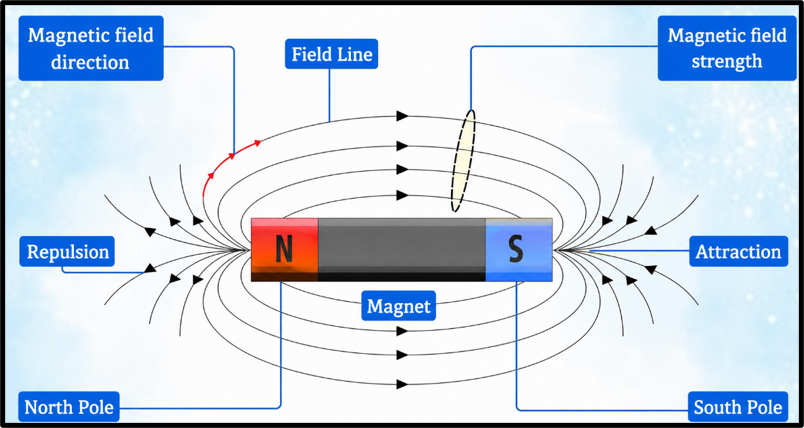
The Magnetic Field is the region around a magnet or current-carrying conductor where the force of magnetism is experienced. It is represented by Magnetic Field Lines that show the direction and intensity of the field.
Units: Tesla (T) in SI system; Gauss (G) in CGS system. Note: 1 Tesla = 10,000 Gauss
Properties of Magnetic Field Lines — Four Rules to Remember:
- Closed Loops: Magnetic field lines always form complete, closed loops — they exit from the North Pole, travel through the air to the South Pole, and return through the magnet internally.
- Density = Strength: Closer/denser lines indicate a stronger magnetic field. Near the poles, lines are densest.
- Direction:
- Outside the magnet: North Pole → South Pole.
- Inside the magnet: South Pole → North Pole.
- No Intersection: Field lines never cross each other because the magnetic field at any point has only one direction.
Key Laws of Magnetism:
- Coulomb’s Law for Magnetism: Magnetic force between poles is proportional to the product of their pole strengths and inversely proportional to the square of the distance between them.
- Gauss’s Law for Magnetism: Magnetic monopoles do not exist — magnetic field lines always form closed loops (total magnetic flux through any closed surface is zero).
- Faraday’s Law of Electromagnetic Induction: A changing magnetic field induces an electric current. This is the principle behind generators, transformers, and wireless charging.
Types of Magnetism
Not all materials respond to magnetic fields in the same way. The response of a material to an external magnetic field is called its magnetic behaviour, and it varies considerably across materials.
| Type | Behaviour | Examples |
| Diamagnetism | Weakly REPELLED by magnetic field; creates opposing field; negative susceptibility; does NOT retain magnetism | Copper, Gold, Silver, Bismuth, Water |
| Paramagnetism | Weakly ATTRACTED to magnetic field; positive but small susceptibility; does NOT retain magnetism | Aluminium, Platinum, Magnesium, Oxygen (gas) |
| Ferromagnetism | STRONGLY attracted; retains magnetism (permanent magnets); very high susceptibility; magnetic domains align | Iron, Nickel, Cobalt |
| Antiferromagnetism | Adjacent magnetic moments align OPPOSITELY — cancel out; no net magnetism; specific temperature (Néel temp.) | Manganese oxide, Hematite |
| Ferrimagnetism | Like antiferromagnetism but unequal opposing moments — net magnetisation remains; weaker than ferromagnetism | Magnetite, Ferrites |
| Superparamagnetism | Ferromagnetic nanoparticles showing paramagnetic behaviour; highly sensitive; no retained magnetism | Iron oxide nanoparticles (used in MRI, data storage) |
| Ferromagnetism — it underlies permanent magnets, electric motors, and generators. Superparamagnetism is emerging in nanotechnology and medical applications (targeted drug delivery, MRI contrast agents). |
Geomagnetism — Earth as a Giant Magnet
Perhaps the most remarkable application of magnetism in nature is the Earth’s own magnetic field.
Geomagnetism refers to the magnetic field associated with Earth, generated primarily by the movement of molten iron and nickel in the Earth’s outer core.
This motion creates electric currents through the Core Dynamo Effect, producing a global magnetic field that extends from deep inside Earth far out into space.
Key Features of Earth’s Magnetic Field:
- Magnetic Poles: Earth has two magnetic poles — the North Magnetic Pole and the South Magnetic Pole. These are NOT fixed; they drift over time due to the dynamics of Earth’s outer core. The North Magnetic Pole is currently located in the Arctic and is gradually shifting.
- Magnetic Axis: The line connecting the magnetic poles is tilted at approximately 11° from Earth’s rotational axis. This is why compass needles do not point to geographic north — they point to magnetic north.
- Magnetic Declination: The angle between geographic north and magnetic north at a given location. It varies from place to place and changes slowly over time. Important for navigation.
- Magnetic Inclination (Dip): The angle that a freely suspended magnetic needle makes with the horizontal at any point on Earth.
- At the magnetic poles, dip = 90° (needle points straight down).
- At the equator (magnetic equator), dip = 0° (needle is horizontal).
- Magnetic Intensity: Earth’s magnetic field strength varies — it is strongest near the magnetic poles and weakest near the magnetic equator.
Sources of Geomagnetism:
- Core Dynamo Effect (Primary Source): The convective motion of molten iron-nickel in the outer core generates electric currents, producing the main geomagnetic field.
- Crustal Magnetism: Magnetic minerals (like magnetite) in the Earth’s crust contribute to localised magnetic anomalies — used in geological surveys to find mineral deposits.
- Magnetosphere & Ionosphere: Electric currents in the ionosphere and magnetosphere also contribute to variations in the geomagnetic field, especially during solar activity (magnetic storms).
Uses of Earth’s Magnetic Field:
- Navigation: Magnetic compasses have guided sailors and explorers for centuries, aligning with Earth’s field to indicate north.
- Protection from Solar Radiation (Magnetosphere): Earth’s magnetic field deflects the solar wind (a stream of charged particles from the Sun) — forming a magnetosphere that shields life on Earth from harmful radiation. Without it, solar wind would strip away our atmosphere (as happened to Mars, which lost its magnetic field billions of years ago).
- Animal Navigation: Migratory birds (like pigeons and European robins), sea turtles, and even some bacteria use Earth’s magnetic field for navigation — a phenomenon called Magnetoreception.
- Geological Studies: Geomagnetic data helps scientists’ study plate tectonics, palaeomagnetism (past reversals of Earth’s magnetic field recorded in rocks), and the movement of continents.
| Geomagnetic field reversal (where North and South magnetic poles switch) has occurred many times in geological history. The last reversal was ~780,000 years ago. This is relevant to questions on Paleomagnetism and Earth Science. |