
Sound Waves and Acoustics
Introduction: What is Sound?
Think about the last time you heard a clap of thunder. That earth-shattering boom travels all the way from the clouds to your ears — but how? The answer lies in Sound Waves.
Sound is not just what we hear — it is energy in motion, a disturbance that travels through matter by making the particles of the medium push and pull against each other.
At its core, a sound wave is a mechanical longitudinal wave. Let us break this down.
It is mechanical because it requires a medium (solid, liquid, or gas) to travel — sound cannot travel through a vacuum.
It is longitudinal because the particles of the medium oscillate (vibrate) parallel to the direction of wave propagation — unlike light which is transverse.
Imagine shaking a slinky spring back and forth — the compressions and rarefactions moving along it is exactly how sound works.
| Analogy: Imagine a crowd doing ‘the wave’ in a stadium — each person only moves up and down, but the wave travels horizontally across the crowd. Sound behaves similarly: particles vibrate in place but the disturbance (energy) travels forward. |
Characteristics of Sound Waves
A) Speed of Sound
Here is a fundamental rule that you must remember: sound travels fastest in solids, slower in liquids, and slowest in gases. Why?
Because the closer the particles of the medium are to each other, the faster the sound energy can be passed along — just like a tightly packed crowd transmits a push faster than a sparse one.
The speed of sound is affected by the following key factors:
- Medium’s Elasticity: Higher elasticity means the medium can be compressed and restored quickly, so sound travels faster. Steel is highly elastic — hence sound travels at ~5,960 m/s in steel.
- Medium’s Density: Higher density (with constant elasticity) decreases speed, because denser particles are harder to move. Think of it as pushing through a crowd vs. walking freely.
- Temperature: Higher temperature → greater kinetic energy → particles vibrate faster → sound travels faster. This is why on a hot day, sound travels slightly faster than on a cold day.
- Humidity: Humid air is less dense than dry air (water vapour, H₂O, is lighter than N₂ and O₂ molecules it replaces), so sound travels faster in moist air. A common misconception is that humid air is ‘heavier’ — it is actually lighter!
- Pressure: At constant temperature, pressure alone does not affect the speed of sound in an ideal gas, because density changes proportionally with pressure.
Speed of Sound in Common Materials — A Quick Reference
| Medium | Speed of Sound |
| Air (at 20°C) | 343 m/s |
| Water (at 25°C) | 1,480 m/s |
| Wood (Hardwood) | 3,960 m/s |
| Glass | 5,200 m/s |
| Steel | 5,960 m/s |
| Remember: Solid > Liquid > Gas. Steel (~5,960 m/s) is the fastest among common solids; air at room temperature is ~343 m/s. |
B) Tone vs. Noise
You love music — but you hate traffic! Have you ever wondered what makes one sound pleasant and another jarring? The answer lies in whether the sound wave is periodic or random.
| Feature | TONE |
| Definition | A sound with a specific, well-defined frequency and a regular (periodic) wave pattern |
| Frequency | Single or harmonically related frequencies |
| Waveform | Periodic and consistent |
| Perception | Pleasant, melodious, harmonious |
| Examples | Piano notes, guitar strings, tuning fork |
| Feature | NOISE |
| Definition | A sound with multiple, non-harmonically related frequencies creating a random, irregular wave pattern |
| Frequency | Mix of unrelated frequencies |
| Waveform | Irregular and non-periodic |
| Perception | Harsh, discordant, disturbing |
| Examples | Traffic, machinery, construction, radio static |
| Analogy: A Tone is like a disciplined army marching in step — uniform, regular, and pleasing. Noise is like a crowd rushing out of a stadium after a match — chaotic and discordant. |
C) Pitch
When someone speaks in a high-pitched voice versus a deep, bass voice, what are they actually doing? They are changing the frequency of sound. Pitch is essentially our subjective perception of frequency.
- Pitch depends on Frequency: Higher frequency = Higher pitch. A whistle, bird’s chirp, or violin string vibrating rapidly produces high-pitched sound. Thunder, drumbeats, and bass guitar — with slower vibrations — produce low pitch.
- Pitch is independent of Amplitude: Whether you whisper or shout a particular note, the pitch (frequency) remains the same. Volume changes, not pitch.
- Human Hearing Range: The healthy human ear can hear frequencies between 20 Hz to 20,000 Hz (20 kHz). This is called the Audible Range. Anything outside this range is inaudible to us.
- Pitch is Subjective: The perception of pitch varies with age (older people may lose sensitivity to high frequencies), hearing loss, or individual differences.
D) Intensity and Loudness of Sound
Intensity of Sound
Sound Intensity is the amount of sound energy passing through a unit area per unit time, measured in Watts per square metre (W/m²). It is an objective, measurable physical quantity. The everyday unit we use is the Decibel (dB), which measures relative loudness on a logarithmic scale.
Key factors that determine sound intensity:
- Distance from Source: Intensity is inversely proportional to the square of the distance. So if you double your distance from a loudspeaker, the intensity drops to one-fourth. Move far from a construction site — the noise drops rapidly!
- Amplitude: Intensity is proportional to the square of the amplitude. Larger vibrations = greater energy = louder sound.
- Medium: The density and temperature of the medium affect how easily sound energy is transmitted.
Loudness
While intensity is objective, Loudness is subjective — it is how our ear and brain perceive sound intensity. Two people hearing the same sound may perceive different levels of loudness based on age, hearing ability, and sensitivity.
What affects how loud we perceive a sound?
- Intensity (Amplitude): Greater intensity → louder perception. This is the most direct relationship.
- Frequency: Human ears are most sensitive to frequencies between 1,000 Hz and 5,000 Hz. Sounds in this range seem louder than sounds of the same intensity at lower or higher frequencies. This is why a baby’s cry (high frequency) feels more irritating than a low rumble of similar intensity.
- Duration: Longer sounds tend to be perceived as louder than brief sounds of the same intensity.
- Individual Perception: Age-related hearing loss (presbycusis) makes high-frequency sounds harder to detect for older individuals.
The Decibel Scale — Sound Levels in Everyday Life
| Sound Level (dB) | Source / Reference |
| 0 dB | Threshold of human hearing |
| 10-20 dB | Breath, Rustling leaves (Faint) |
| 30-40 dB | Whisper, Refrigerator (Quiet) |
| 50-60 dB | Normal conversation, Rain (Moderate) |
| 70-80 dB | City traffic, Truck (Loud) |
| 85 dB+ | Threshold for potential hearing damage |
| 90-100 dB | Hair dryer, Helicopter (Very Loud) |
| 110-120 dB | Trombone, Police siren (Extremely Loud) |
| 130-140 dB | Jet engine, Fireworks (Threshold of Pain) |
| Remember: Any sound above 85 dB can lead to hearing damage, depending on duration and frequency of exposure. Noise pollution is a growing environmental concern — relevant for Environment & Ecology questions too. |
E) Mach Number
Have you ever seen a fighter jet on TV tearing through the sky and then heard the boom after it has already passed? That tells you the jet was moving faster than sound. The Mach Number is the scientific way to describe this.
| Mach Number = Speed of Object ÷ Speed of Sound in the Same Medium It is a dimensionless quantity — it has no units. |
Mach Number Ranges — Classification of Speeds
| Category | Mach Number & Significance |
| Subsonic | M < 1 — Slower than sound (commercial airplanes like Boeing 737) |
| Transonic | M ≈ 1 — Approaching the speed of sound |
| Supersonic | 1 < M < 5 — Faster than sound (fighter jets, Concorde) |
| Hypersonic | M > 5 — Extremely high speeds (ballistic missiles, space re-entry vehicles) |
| Sonic Boom: When an object travels faster than sound (M > 1), it creates a cone-shaped shock wave. When this wave passes an observer, they hear a sudden explosive ‘boom’. That is not the jet accelerating past the sound barrier — you simply heard the shock wave pass you! |
| Supersonic and Hypersonic speeds are frequently in news — India’s BrahMos missile is supersonic (~Mach 2.8). Agni missiles are hypersonic at terminal phase. These are important for Defence & Internal Security context. |
Classification of Sound Waves
Based on frequency, sound waves are divided into three categories. Think of it as a vast spectrum — just like the electromagnetic spectrum, but for sound. The human ear only catches a narrow window of this entire spectrum.
| Type | Frequency Range | Audible to Humans? |
| Infrasonic (Subsonic) Waves | Below 20 Hz (f < 20 Hz) | No |
| Audible Waves | 20 Hz to 20,000 Hz | Yes |
| Ultrasonic Waves | Above 20,000 Hz (f > 20 kHz) | No |
A) Infrasonic Waves (Subsonic Waves)
Infrasonic waves have frequencies below 20 Hz — so low that our ears simply cannot detect them. But that does not mean they do not exist or are not powerful. In fact, some of nature’s most violent events produce infrasonic waves.
Natural Sources:
- Earthquakes and volcanic eruptions
- Ocean waves and tsunamis
- Elephant, whale, and rhinoceros vocalisations (animals use infrasound to communicate over vast distances)
Artificial Sources:
- Large explosions, sonic booms from supersonic aircraft
- Heavy industrial machinery and engines
Applications of Infrasonic Waves:
- Earthquake Monitoring: Seismographs detect infrasonic waves to analyse seismic activity.
- Volcanic Eruption Prediction: Infrasonic sensors around volcanoes detect pre-eruption pressure changes.
- Tsunami Detection: Tsunamis generate powerful infrasonic waves — these can be detected to issue early warnings.
- Animal Communication: Elephants can communicate with each other over distances of several kilometres using infrasound.
- Industrial Monitoring: Used to monitor large machinery vibrations and structural health of buildings and bridges.
B) Audible Waves
The audible range — 20 Hz to 20,000 Hz — is the window of sound that the normal human ear can perceive. This is the range of human speech, music, animal calls, and almost all everyday sounds. Note that children can hear up to 20,000 Hz, but this upper limit decreases with age.
Natural sources include: human speech, musical instruments, bird calls, wind, and flowing water. Artificial sources include: loudspeakers, headphones, machine engines, alarms, and sirens.
C) Ultrasonic Waves
Ultrasonic waves have frequencies above 20,000 Hz. While inaudible to humans, these waves are extremely useful because of their short wavelengths (which enable high-resolution detection) and ability to travel long distances in certain media.
Natural Sources:
- Bats — use ultrasound for echolocation (navigation and hunting)
- Dolphins and whales — use ultrasound for communication and navigation
Artificial Sources:
- Ultrasonic transducers (convert electrical energy to ultrasonic waves)
- Piezoelectric crystals (certain crystals vibrate at ultrasonic frequencies when electricity is applied)
Applications of Ultrasonic Waves:
- Medical Imaging (Sonography/Ultrasonography): Ultrasound imaging is used to visualise internal organs, monitor foetal development during pregnancy, and detect tumours. Completely safe — no radiation!
- Physiotherapy: Ultrasonic waves penetrate deep into tissues and provide targeted heat treatment for muscle injuries.
- Non-Destructive Testing (NDT): Industries use ultrasound to detect internal cracks, defects, or corrosion in metal structures (bridges, pipelines, aircraft wings) — without damaging them.
- Ultrasonic Cleaning: High-frequency vibrations create microscopic bubbles that implode and dislodge dirt from delicate items like jewellery, surgical instruments, and electronics.
- Ultrasonic Welding: Used in the automotive and plastics industry to join materials using high-frequency ultrasonic vibrations instead of heat.
- Pest Control: Devices emitting ultrasonic waves repel rodents and insects without chemicals.
- Military — SONAR: Detection of submarines and underwater mines. Covered in detail below.
D) SONAR — Sound Navigation and Ranging
SONAR is an advanced application of ultrasonic waves used primarily in underwater navigation, detection, and mapping. It works by emitting ultrasonic pulses into water and analysing the returning echoes to determine the distance, shape, and position of underwater objects.
Why ultrasound? Because ultrasonic waves can penetrate water over long distances without being easily absorbed or scattered — unlike audible sound which disperses quickly.
| Type of SONAR | How it Works |
| Active SONAR | Emits its own sound pulses and listens for the echoes reflected from objects (submarines, seabed, fish shoals, mines) |
| Passive SONAR | Only listens — detects sounds emitted by other objects (e.g., engine noise of enemy submarines). Stealthier but less precise. |
| UPSC Angle: SONAR has both civilian uses (mapping the ocean floor, fishing, depth measurement) and strategic military uses (submarine warfare, mine detection). India’s naval modernisation involves advanced SONAR systems. |
E) Echolocation — Nature’s Own SONAR
Long before humans invented SONAR, bats had already mastered the concept. Echolocation (also called Biological SONAR) is a technique used by animals to navigate and hunt in complete darkness.
A bat emits a high-frequency ultrasonic pulse, and by analysing the time and character of the returning echo, it can precisely determine the location, size, and movement of an insect — even in total darkness. Dolphins and sperm whales similarly use echolocation for underwater navigation.
Behaviour of Sound Waves
Sound waves, like all waves, exhibit characteristic behaviours when they encounter boundaries, obstacles, or changes in medium. These behaviours — Reflection, Refraction, Diffraction, the Doppler Effect, and Interference — are fundamental to understanding how sound works in the real world.
A) Reflection of Sound
When sound waves strike a hard surface or a boundary between two media, they bounce back into the original medium. This is called Reflection of Sound, and it follows the same law as light: the Angle of Incidence equals the Angle of Reflection.
The nature of the surface determines how much sound is reflected:
- Hard & Smooth surfaces (concrete walls, cliffs, mountains): Reflect most of the sound energy, enhancing echo clarity.
- Soft & Rough surfaces (curtains, carpets, foam panels): Absorb or scatter sound, reducing reflection — used in recording studios.
Echo vs. Reverberation — A Critical Distinction:
| Feature | ECHO |
| Definition | A distinct repetition of the original sound after a significant time delay |
| Condition | Reflected sound reaches the listener after a delay of MORE than 0.1 seconds |
| Minimum Distance | At least 17 metres between source and reflective surface (at room temperature in air) |
| Clarity | The reflected sound is clearly distinguishable from the original |
| Example | Shouting in a valley or at a wall — you hear your voice repeat distinctly |
| Feature | REVERBERATION |
| Definition | Persistence of sound due to multiple rapid reflections in an enclosed space |
| Condition | Multiple reflections merge before the ear can distinguish them (delay < 0.1 sec) |
| Occurrence | Enclosed spaces — halls, rooms, cathedrals, auditoriums |
| Effect | Creates a ‘ringing’ effect — the sound seems to linger |
| Example | Singing in a bathroom, speaking in an empty hall, cathedral acoustics |
| Analogy: Echo is like receiving a letter (clear, separate message). Reverberation is like everyone in a room talking at the same time — the sounds blur and overlap. Architects carefully design concert halls to control reverberation for optimal acoustics. |
| Applications of Sound Reflection: Bats use it (echolocation), SONAR uses it underwater, and it is used in architectural acoustics design of concert halls and cinemas. |
B) Refraction of Sound
Just as light bends when it moves from air to water, sound waves bend (refract) when they pass from one medium to another, or even through the same medium when its properties (temperature, density, pressure) vary from region to region. This bending occurs because the speed of sound changes.
Key Rule: Sound bends towards the slower medium — similar to Snell’s Law for light. The frequency remains constant during refraction; only the wavelength changes in proportion to the speed.
Fascinating Real-World Examples of Sound Refraction:
- Day vs. Night Effect: During the day, air near the ground is warmer, so sound travels faster near the ground. The waves tend to bend upward — making distant sounds harder to hear. At night, the ground cools but upper air stays warmer (temperature inversion), causing sound to bend downward. This is why you can hear distant trains or ships more clearly at night!
- Underwater Refraction: In the ocean, temperature, pressure, and salinity all vary with depth, causing sound to refract and form ‘sound channels’ — used in underwater communication and SONAR.
- Temperature Gradient: Sound always bends toward the cooler (denser) region because it travels slower there.
C) Diffraction of Sound
Have you ever noticed that you can hear someone talking around a corner, even though you cannot see them? That is Diffraction at work. It is the bending and spreading of sound waves as they encounter obstacles or pass through small openings.
Two key principles to remember:
- Wavelength Dependence: Diffraction is most noticeable when the obstacle/opening size is comparable to the wavelength of sound. Longer wavelengths (lower frequency) diffract more than shorter wavelengths (higher frequency). This is why a low bass sound can be heard around a corner more easily than a high-pitched voice.
- Obstacles & Openings: Sound bends around walls, buildings, and barriers. It also spreads out when passing through doorways, windows, and narrow gaps — which is why you can hear conversations through a door even when it is closed.
| Analogy: Imagine water waves in a pond approaching a wall with a small gap. The waves pass through the gap and spread outward in all directions — not just straight ahead. Sound behaves identically. Diffraction is why concert sound reaches the back rows even when there are pillars in the way. |
D) Doppler Effect in Sound Waves
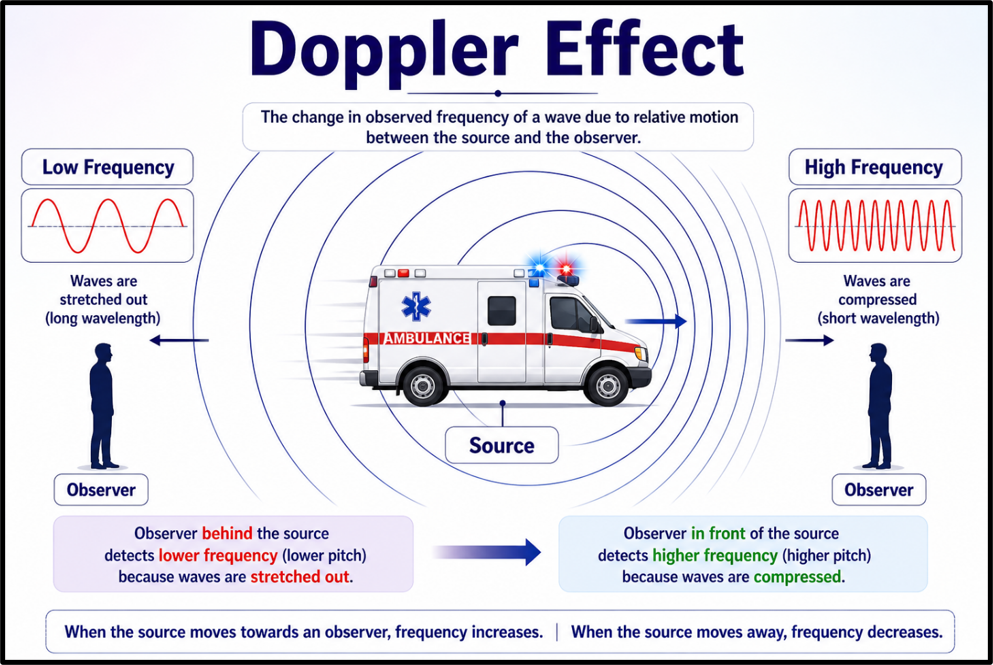
Picture an ambulance rushing past you. As it approaches, the siren sounds higher pitched; as it recedes, the siren sounds lower pitched. Yet the siren itself has not changed! This is the celebrated Doppler Effect — the apparent change in frequency of a wave due to relative motion between the source and the observer.
| When the source moves TOWARD the observer: Sound waves get compressed → wavelength decreases → frequency increases → HIGHER pitch. When the source moves AWAY from the observer: Sound waves get stretched → wavelength increases → frequency decreases → LOWER pitch. If there is NO relative motion: No change in observed frequency. |
Practical Applications of Doppler Effect:
- Traffic Radar Guns: Police use Doppler radar to measure the speed of vehicles.
- Medical (Doppler Ultrasonography): Measures blood flow velocity in vessels — detecting blockages and heart conditions.
- Astronomy: The ‘Red Shift’ of light from distant galaxies is the Doppler Effect for light — evidence that the universe is expanding.
- Weather Radar: Doppler radar measures wind speed and direction inside storms.
| The Doppler Effect is not limited to sound — it applies to all waves, including light (red shift in astronomy). Both the sound and light Doppler effects have appeared in UPSC context. |
E) Interference in Sound Waves
When two or more sound waves meet and overlap in the same medium, they combine to form a new resultant wave. This phenomenon is called Interference. Depending on how the waves align, interference can be either constructive or destructive.
| Type | Description |
| Constructive Interference | Two waves meet IN PHASE (crest meets crest, trough meets trough). Amplitudes add up → LOUDER sound (greater intensity). Example: Two speakers playing the same tone in sync produce a noticeably louder sound. |
| Destructive Interference | Two waves meet OUT OF PHASE (crest meets trough). Amplitudes cancel out → SOFTER or completely silent zone (reduced intensity). Example: Noise-cancelling headphones generate a sound wave exactly opposite to ambient noise, cancelling it out. |
| Analogy: Constructive Interference is like two people pushing a swing together — force adds up! Destructive Interference is like two people pushing from opposite sides — they cancel each other out. Noise-cancelling headphones use this exact principle. |
One Comment