
Sources of Ethical Guidance
(Laws, Rules, Regulations and Conscience)
Introduction: What Guides Our Ethical Choices?
Imagine you are a young IAS officer posted in a district. A contractor offers you a bribe to clear a file. What stops you — or should stop you — from accepting it?
Is it fear of the Anti-Corruption Bureau? Is it the service rules? Is it the Constitution you swore to uphold? Or is it something deeper — a quiet voice inside you that says, ‘This is wrong’?
That quiet voice has a name: conscience. And the external rules, laws, and regulations that govern your conduct also have a systematic philosophical basis. This section is essentially about the four pillars of ethical guidance:
| Laws • Rules • Regulations • Conscience These are the four sources that guide human ethical conduct, especially in public life. |
The section explores how thinkers from John Austin in the 19th century to St. Thomas Aquinas in the 13th century have thought about the relationship between law and morality. It also dives deep into conscience — what it is, where it comes from, and how it operates in public life.
| Source | Nature | Example in Public Life |
| Laws | External, state-enforced, territorial | Indian Penal Code, RTI Act |
| Rules / Regulations | External, organisational, broader in scope | Service conduct rules, departmental codes |
| Constitutional Values | Fundamental, supreme moral framework of state | Justice, Liberty, Equality, Fraternity |
| Conscience | Internal, personal, intuitive moral guide | Refusing a bribe despite no one watching |
Understanding Law: Ordinary Meaning to Deep Philosophy
The Ordinary Meaning of Law
When someone says ‘law’, most of us immediately think: Parliament passes a bill, the President signs it, and it becomes law. This is the ordinary, secular understanding — law as a creation of the legislature. Over time, jurisprudence emerged as the science of law, sharpening legal concepts to deal with property disputes and criminal offences in courts.
Law has many branches, and it is important not to confuse them:
| Type | What It Covers | Example |
| Substantive Law | Defines offences, rights, obligations | Bharatiya Nyaya Sanhita (formerly IPC)— defines theft, murder |
| Procedural Law | Specifies how courts must operate | Bharatiya Nagarik Suraksha Sanhita (formerly CrPC) |
| Evidence Law | What counts as valid proof in court | Bharatiya Sakshya Adhiniyam (BSA), 2023 |
| Constitutional Law | Supreme law of the land | Constitution of India |
| Think of it this way: Substantive law tells you what crime is; procedural law tells you how the trial must run; evidence law tells you what proof is admissible. The Constitution sits above all of them. |
The Constitution as the Fundamental Law
The Constitution of India is not just a legal document — it is a moral charter. It embodies the basic values and ethos of the nation. Two sections are especially important for ethical guidance in public life:
| Document | What It Contains |
| Preamble | Socialism, Secularism, Democracy; Justice (social, economic, political); Liberty; Equality; Fraternity; National Unity & Integrity |
| Directive Principles (DPSP) | Goals for governance: equitable wealth distribution, employment, education, living wage, protection of children, panchayati raj, prohibition, scientific agriculture, international peace, social welfare |
These are not mere aspirations. They are the moral compass that every civil servant must internalise. When Kelsen (discussed ahead) says the Constitution provides the ‘basic norm’, he essentially captures this idea — everything else must be consistent with it.
Theories of Law: Three Great Thinkers
1. John Austin — The Command Theory (Legal Positivism)
Austin’s approach is like a strict army general: law is an ORDER, backed by PUNISHMENT, issued by a SOVEREIGN. Period. No room for morality, religion, or emotions.
This is called Legal Positivism — law is valid if it was passed correctly, regardless of whether it is morally good or bad.
| Austin’s famous formula: Law = Command of the Sovereign + Sanction for disobedience. Nothing more, nothing less. |
| Feature | Austin’s Explanation |
| Law is… | A command from a sovereign (legislature, king, ruler) |
| Obedience comes from… | Habit of people to obey + fear of punishment |
| Sanction is… | Punishment threatened for disobedience |
| Sovereign is… | The person/body that others obey, who obeys no one else |
| Morality is… | Irrelevant to legal validity |
Criticisms of Austin
Austin’s theory, while neat and clear, collapses under several real-world scenarios:
- Customary law: English Common Law includes judge-made decisions without written statutes. Austin can only defend this awkwardly via ‘tacit consent’ of the sovereign.
- International law: There is no global sovereign to issue commands. If Austin is right, international law is not ‘law’ at all — which is plainly absurd.
- Primitive/tribal law: Unwritten, unlegislated tribal codes have governed societies for millennia. Austin’s theory simply dismisses them.
- Higher law: Constitutions and treaties ‘constrain’ ordinary legislation. Austin’s command theory cannot account for this hierarchy.
- The ‘gangster island’ problem (pointed out by Hart): If a mob takes over a remote island and issues commands backed by force, is that ‘law’? Austin’s theory would say yes.
2. H.L.A. Hart — Primary and Secondary Rules
Hart was also a positivist, but he improved significantly upon Austin. He recognised that Austin’s ‘habit + punishment’ formula was too crude. Hart’s contribution: a legal system requires two types of rules working together.
| Rule Type | What It Does | Example |
| Primary Rules | Impose obligations or grant powers directly on people | BNS sections creating criminal offences; Law of Succession giving you right to make a will |
| Secondary: Rule of Recognition | Identifies what counts as valid law | Acts of Parliament, judicial decisions are valid law |
| Secondary: Rules of Change | Specifies how laws can be made, amended, repealed | Bill goes through Lok Sabha, Rajya Sabha, gets President’s assent |
| Secondary: Rules of Adjudication | Enables courts to settle disputes and interpret law | Courts applying and interpreting the Arbitration Act |
Like Austin, Hart does not accept any necessary connection between law and morality. An unjust law can still be legally valid. However — and this is crucial — legal validity does not mean you are morally obligated to obey it. That remains a matter of personal conscience.
| UPSC Insight: Hart’s distinction between primary and secondary rules is similar to the textbook’s distinction between substantive and procedural law. Remember: ‘rule’ in Hart’s sense is used as a synonym for ‘law’. |
3. Lon Fuller — The Inner Morality of Law
Fuller takes a different turn. He argues that law itself is necessarily moral — not in the sense of being morally good in content, but in the sense of having procedural morality built into its very structure.
If a set of rules fails to meet certain procedural standards, it simply cannot guide behaviour — and therefore cannot count as ‘law’ at all.
Fuller’s Eight Principles of Legality (Rules must be):
| # | Principle | Why It Matters |
| 1 | General | Rules must apply broadly, not targeting specific individuals arbitrarily |
| 2 | Publicly promulgated | People must be able to know what rules exist |
| 3 | Prospective | Rules should not punish actions committed before the rule was made (no retrospective laws) |
| 4 | Clear/understandable | Vague rules cannot guide behaviour |
| 5 | Non-contradictory | Conflicting rules cannot both be obeyed |
| 6 | Within human capacity | Rules cannot demand the impossible |
| 7 | Stable | Frequent changes make it impossible to rely on rules |
| 8 | Consistently administered | What is written must be what is enforced |
Fuller’s key insight: Law promotes social order by respecting human autonomy — it gives people rules so they can plan their lives independently. This respect for autonomy is itself a moral value. So law has an ‘inner morality’ even when its content is not explicitly moral.
| One way to remember Fuller’s 8 principles: GPP-CNCSA — General, Promulgated, Prospective, Clear, Non-contradictory, Capacity-respecting, Stable, Administered consistently. |
Quick Comparison: Austin vs Hart vs Fuller
| Dimension | Austin | Hart | Fuller |
| What is law? | Command of sovereign | Primary + secondary rules | Rules meeting 8 procedural standards |
| Law & morality | Completely separate | No necessary connection | Law has inner procedural morality |
| Obedience basis | Habit + fear of sanction | Rule of recognition | Law’s capacity to guide behaviour |
| Positivist? | Yes | Yes (refined) | Partially — procedural moralist |
Rules and Regulations vs Laws
What Are Rules and Regulations?
In Ethics, the terms ‘rules’ and ‘regulations’ are used interchangeably — both mean the same thing. However, they differ from laws in important ways. Think of it as three concentric circles: the Constitution is the outermost (supreme), laws are the middle layer, and rules/regulations are the innermost layer implementing the laws.
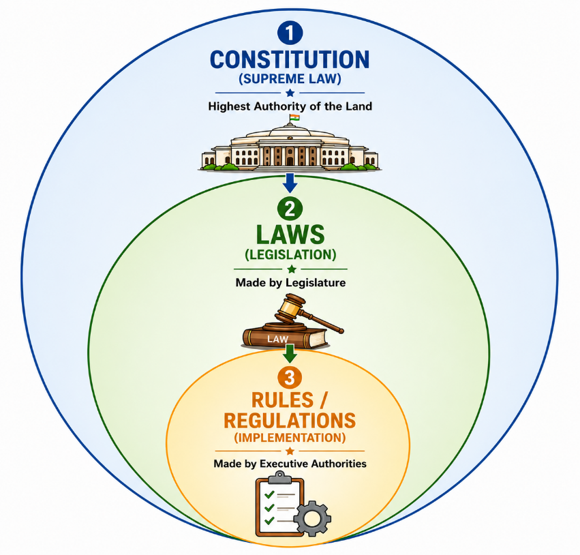
| Dimension | Laws | Rules / Regulations |
| Purpose | Seek to increase public good | Focus on individual/organisational good |
| Who makes them? | Only sovereign power — legislature (elected body) | Superiors, organisations, heads of family, private entities |
| Territorial scope | Apply within national territory (Indian law doesn’t apply to Indians in Sweden) | Apply wherever the person is (civil servant conduct rules apply even abroad) |
| Examples | BNS, RTI Act, Environment Protection Act | Government service conduct rules, monastic codes, company policies |
A practical illustration: If an IAS officer travels to the UK on official duty, Indian criminal law does not generally follow him there. But the Central Services (Conduct) Rules absolutely do — he cannot accept gifts from foreign hosts without government permission even in London. This captures the key difference neatly.
Hans Kelsen — The Pure Theory of Law
Kelsen was disturbed by the same ‘gangster island’ problem that troubled Hart. He tried to resolve it by building a theory where law is socially constructed and dynamic — it keeps changing as society changes. Unlike Austin, Kelsen doesn’t anchor law in natural morality.
Kelsen introduces the concept of the Grundnorm (basic norm), which he also calls the ‘logical constitution’. Think of it as the foundational rule that validates all other rules:
| Kelsen’s hierarchy: Grundnorm (basic norm / constitution) validates statutes, which validate regulations, which validate individual administrative orders. Every lower norm derives its validity from a higher norm. |
In practical terms, Kelsen’s Grundnorm is something like:
‘The Constitution shall be the supreme law, and all other laws shall be created in accordance with it.’
This basic norm is not itself justified by any higher norm — it is simply an accepted custom, the foundation on which the entire legal edifice rests.
Law in Ethics: The Wider Moral Meaning
Moral Law vs. Positive Law
So far we have discussed law in the positivist sense — law as made by humans, divorced from morality. But in Ethics, law has a much deeper meaning. Moral law is defined as
‘A general rule of right living — universal, unchanging, and having the sanction of God’s will.’
This is the tradition that St. Thomas Aquinas represents.
Aquinas was a 13th-century Roman Catholic theologian who used Aristotle’s deductive logic to apply reason in the service of faith. He believed that reason and revelation are not enemies but partners. His framework of law is one of the most influential in Western thought.
| Aquinas’s insight remains universally valid: even if you strip out the Christian theology, his core argument survives — laws derive their force not from the power of the king or legislature, but from reflecting moral principles that are dear to the human heart. |
Aquinas’s Four Types of Law
| Type of Law | Definition | Source / Discovery |
| Eternal Law | Laws governing the entire universe; God as ruler of the world; includes laws of nature | Known only through theology and philosophy |
| Divine Law | Standards for achieving eternal salvation; cannot be discovered by reason alone | Through divine revelation — Old Testament (Jews), New Testament (Christians) |
| Natural Law | Principles of eternal law governing rational beings with free will; ‘written in the hearts of men’ (St. Paul) | Through human reason and innate moral sense — accessible to all humans across civilizations |
| Human Law | Law made by humans for the common good; valid ONLY if consistent with natural law | Through legislation, custom, and judicial reasoning — but derived from natural law |
Natural Law — Three Levels of Principles
Aquinas doesn’t treat natural law as a single block. He divides it into three hierarchical levels, which explains why different people reach different moral conclusions even when they share the same basic values:
| Level | Principles | Knowability | Example |
| Primary | Do good, avoid evil; follow reason | Immediately clear to all; no ignorance excused | ‘Pursue good’ — all humans instinctively know this |
| Secondary | Derived from primary without great difficulty | Ordinary intelligence sufficient; vincible ignorance excused | Respect elders; be considerate to others |
| Tertiary | Derived from primary through complex reasoning | Difficult; invincible ignorance excused — no blame | Whether it is right to cheat a rich man to help the poor |
The distinction between vincible and invincible ignorance is crucial.
- Vincible ignorance = you could have known better with a little effort (no excuse).
- Invincible ignorance = it was genuinely beyond your capacity to know (no blame).
When Can Citizens Disobey the Law?
This is the most revolutionary aspect of Aquinas — and deeply relevant to UPSC’s ethics paper. He argues that human (civil) law is valid only to the extent it conforms to natural law. An unjust law, in St. Augustine’s famous phrase, ‘is no law at all’.
According to Aquinas, laws must satisfy ALL FOUR conditions to deserve obedience:
- Must conform to natural law — cannot prescribe what natural law prohibits, or prohibit what it prescribes
- Must be made by a lawful government with proper authority
- Must be reasonable and within the physical and mental capacity of citizens
- Must serve general social good — not individual benefit of the ruler
| If ANY one of these four conditions fails, citizens are not morally obligated to obey. This is the philosophical foundation of civil disobedience. Gandhi’s Salt Satyagraha (1930) is the classic Indian example — the Salt Law was legally valid but morally unjust, so it deserved defiance. |
| Condition Violated | Historical Example |
| Violates natural / moral law | Anti-Semitic laws in Nazi Germany — legally enacted, morally repugnant |
| Made by illegitimate authority | Laws imposed by foreign colonial rulers without democratic mandate |
| Demands impossible compliance | Wartime orders demanding soldiers commit atrocities |
| Serves individual not common good | Cronyist laws benefiting industrialist friends of a ruler |
Aquinas also makes another powerful observation: ‘Whatever law a man makes for another, he should keep himself.’ This is the ancient formulation of what we call rule of law today — no one, not even the sovereign, is above the law.
Constitutional Values: The Ethical Framework for Public Servants
Kelsen’s idea of the Grundnorm finds its practical expression in the Indian Constitution. For civil servants, the most ethically relevant values are found in the Preamble and the Directive Principles of State Policy (DPSP).
Values in the Preamble
| Constitutional Value | Meaning for a Public Servant |
| Socialism | Equitable distribution; not allowing policy to benefit only the elite |
| Secularism | Equal treatment to all religions; no discrimination in service delivery |
| Democracy | Accountability to elected representatives and ultimately to the people |
| Social, Economic & Political Justice | Ensuring policy and administration reach the last person |
| Liberty of thought & expression | Not suppressing legitimate voices; protecting free speech in administration |
| Equality of status & opportunity | Implementing reservation policies; fighting systemic discrimination |
| Fraternity & Human Dignity | Treating every citizen with respect regardless of caste, gender, religion |
| National Unity & Integrity | Actions must not divide society or compromise territorial integrity |
Key Directive Principles (DPSP) Relevant to Public Administration
- Equitable distribution of wealth; equal pay for equal work (men and women)
- Adequate means of livelihood for all citizens
- Provision of employment to all
- Free and compulsory education for children (now a Fundamental Right via Art. 21A)
- Living wage for workers
- Protection of children and youth from exploitation
- Organisation of village panchayats for self-governance
- Organisation of agriculture on modern and scientific lines
- Promotion of international peace and just relations between nations
- Social welfare measures
| UPSC Insight: These constitutional values are not just aspirational — they are legally binding on the State (Article 37: ‘fundamental in the governance of the country’). For a civil servant, they represent the minimum ethical floor. |
Conscience: The Internal Moral Guide
We have talked about laws, rules, and regulations — all external guides. Now we turn inward. Conscience is the internal moral compass. It is the faculty by which the mind passes judgement on the rightness or wrongness of a particular act.
Unlike moral laws (which are general), conscience is personal and specific.
Moral law says
‘Thou shalt not steal.’
Conscience says:
‘Should I take this pen from my colleague’s desk without asking?’
Conscience applies general moral principles to the particular decisions of individual life.
| Law is external; conscience is internal. Law tells you what society demands; conscience tells you what your deepest self demands. A mature moral agent needs both. |
How Different Thinkers Define Conscience
| Thinker | Definition / Conception |
| St. Paul | A God-given ability in all human beings to know and choose the good |
| Aquinas | Knowledge of human nature and primary moral precepts; a rational faculty |
| Joseph Butler | A God-given ability to reason morally; our ‘natural guide’ with ultimate authority over all other principles |
| John Henry Newman | ‘The voice of God’ planted in us before we could reason; an intuition, ‘the law of the mind’ |
| Sigmund Freud | The ‘superego’ — guilt arising from disobeying moral ideas internalised from authority figures (parents, society). Part of the subconscious, not God. |
| Jean Piaget | Conscience develops over time through stages; it is part of a healthy, maturing human mind |
Notice the great divide: St. Paul, Aquinas, Butler, and Newman all trace conscience to God. Freud and Piaget explain it entirely without God — as a psychological and developmental product. Both streams arrive at similar practical conclusions: we have an internal guide, and we should follow it — but they disagree completely on its origin.
Butler’s Theory of Conscience — The Most Important Account
Joseph Butler (18th century) is the most influential writer on conscience. His key ideas:
- Conscience is a reflective principle — it looks back on past actions, judges present ones, and evaluates future possibilities.
- It has universal authority over all other aspects of human nature.
- Human nature has a hierarchy: at the top is conscience; below it are self-love (desire for your own happiness) and benevolence (desire for others’ happiness). Conscience adjudicates between these two.
- Conscience operates independently of external consequences — it is not motivated by fear of punishment or hope of reward.
- Its guidance is not optional. As a God-given faculty, it has authority in all moral judgements.
The Human Nature Hierarchy (Butler)
| Level | Principle | Description |
| Top | CONSCIENCE | Supreme moral judge; governs all other principles |
| Middle | Self-love + Benevolence | Desire for own happiness + desire for others’ happiness. Conscience arbitrates between them. |
| Bottom | Passions & Instincts | Immediate desires, emotions, drives — governed by the higher principles |
Objections to Butler’s View
Butler’s theory, while compelling, has been criticised sharply:
- Sidgwick’s objection: Conscience is either reasonable on its own (in which case it is just another name for reason, not an independent faculty) or it is an ‘arbitrary authority’ (in which case why should we obey it?)
- Intuition is fallible: Conscience can be misinformed or wrong. History is full of people who followed their ‘conscience’ into atrocities. Without external, objective moral standards, Butler’s conscience risks becoming moral anarchy.
- Self-authenticating problem: Conscience certifies itself — it claims authority from within. This circularity makes it philosophically vulnerable.
| Rebuttal to the critics: Butler would say that since humans are naturally altruistic and benevolent, they will not use conscience to support genuinely immoral actions. The internal voice, properly cultivated, generally points toward good. |
The Empirical View: Conscience as Social Product
From Innate Faculty to Developed Capacity
Modern philosophy has largely abandoned the idea of conscience as a special God-given organ. Instead, empiricists view conscience simply as human intelligence applied to moral questions. When our intelligence deals with ‘the relations of persons and deeds’, we call it conscience. When it deals with the nature of things, we call it understanding.
Herbert Spencer’s hypothesis: While our basic moral sentiments may have some innate basis, they are primarily acquired through the collective experience of the human race, passed down through culture, language, and socialisation.
Three Stages in the Development of Conscience
Moral development is not a single event — it is a journey. John Dewey identified three stages through which conscience evolves:
| Stage | What Happens | Characteristics |
| 1. Customary / Conventional Conscience | Child absorbs the moral code of society through socialisation (family, school, religion, peers) | Moral convictions not from independent reasoning, but from social moulding. Moral maxims become habits of the mind. |
| 2. Loyal Conscience | Person identifies deeply with social moral forms and institutions; views their demands as their own will | Not just blind obedience — understands WHY the moral code matters. But still has not critically questioned it. |
| 3. Independent / Reflective Conscience | Person critically evaluates existing moral codes and may advocate reform | Great moral reformers operate here. Conscience goes beyond custom to question even ‘sacred’ institutions. |
John Dewey’s beautifully crafted description of the conventional conscience stage:
‘These demands and expectations naturally give rise to certain convictions in the individual as to what he should or should not do. Such convictions are not the outcome of independent reflection, but of the moulding influence of social institutions… until they leave in the mind a corresponding habit and attitude toward things to be done.’
| Think of it as three layers of moral maturity: first you obey (conventional); then you understand and own the code (loyal); finally you question and potentially reform it (reflective). Gandhi was in stage 3 when he challenged the British legal system. |
The ‘Right of Free Conscience’ (Hegel)
According to Hegel, the right of free conscience — the individual’s right to independently determine what is good — is the defining feature of modernity. Ancient societies imposed moral frameworks from outside. Modern societies respect the inner moral life of individuals.
BUT Hegel himself cautioned against its misuse. He observed:
‘The striving for a morality of one’s own is futile… to be moral is to live in accordance with the moral tradition of one’s country.’
| The right of free conscience does NOT mean ‘I can do whatever I think is right.’ It means: I engage critically with existing moral traditions rather than blindly following them. The new ideal I propose must emerge from existing institutions and customs — not from mere personal whim. (John Dewey) |
Moral Relativism and the Present Indian Context
What Is Moral Relativism?
Moral relativism is the view that there are no universal, objective moral standards. Morals are relative to: (a) a particular society, and (b) a particular historical period.
Since different cultures have different moral codes, and these change over time, who is to say any one code is ‘correct’?
This view arises naturally from the observation that morals vary across societies and time. Relativism is partially correct — morals do have a social function and must adapt as societies change. But the relativist makes a further, unjustified leap: because morals change, there are no moral standards at all.
| Position | Claim | Problem |
| Hard Relativism (Nietzsche) | ‘Nothing is true, all is allowed.’ No moral distinctions are valid. | Leads to moral anarchy; used to justify atrocities |
| Soft Relativism | Morals vary by culture and time; we should be tolerant of differences. | Does not mean abandoning all standards — some actions (e.g., genocide) are wrong across all cultures |
| Pragmatic Absolute (Urban) | Even if morals change, they function as absolutes during the period they prevail. | This is the balanced, functional view — moral standards are not eternal but are practically binding |
‘This philosophy of license, this idea that nothing is good or bad, but our own thinking makes it so, invariably appears in the first flush of realisation of historical relativity… Yet it is based on such obvious fallacies that it persists only in the minds of the most unthinking.’ — Wilbur Marshall Urban
The Present Indian Context: Conscience vs. Social Responsibility
The philosophical discussion comes alive in contemporary India. Individual conscience is crucial — but it has limits. The challenge is: when does conscience-driven dissent become irresponsible or anti-social?
| Legitimate Use of Conscience | Misuse / Perils |
| Refusing to sign a corrupt file despite pressure from superiors | Making ‘shocking’ statements on TV to attract attention under the guise of conscience |
| Whistleblowing on genuine corruption | Slogans that undermine national unity (e.g., anti-national rhetoric in the name of ‘azaadi’) |
| Gandhi’s civil disobedience against unjust colonial laws | Refusing to stand during national anthem as a ‘personal belief’, trivialising a serious issue |
| Pro-life groups opposing unjust legislation | Irresponsible dissent that overrides requirements of national security and social cohesion |
| The key test: Does your conscience-driven action emerge from serious moral reasoning rooted in the community’s shared values? Or is it merely a fashionable, attention-seeking deviation? Reflective conscience must be grounded — not capricious. |
Moral Change: The Role of Reflective Conscience
Morality at any given time is imperfect. This is why moral progress is possible. Conscience must neither blindly conform to existing morality (dead conformity) nor recklessly reject it on personal whim (capricious self-conceit). Reflective conscience must find the mean between these two extremes.
John Dewey captures this beautifully: ‘Reflective intelligence cross-questions the existing morality; and extracts from it the ideal which it pretends to embody… And thus the new ideal proposed by the individual is not a product of his private opinions, but is the outcome of the ideal embodied in existing customs, ideas and institutions.’
In other words: The truly moral reformer does not invent new values from thin air. He/she discovers the higher ideal already latent in society’s existing values, and holds society accountable to that ideal. Gandhi did not invent non-violence — he found it in Indian tradition and made it political.
Conscience in Public Administration
Until now, we have examined laws, rules, regulations, and conscience as guides to ethical decision-making. For a civil servant, all four operate simultaneously — and sometimes in tension with each other.
| Situation | Tension | Resolution |
| Superior orders you to clear an irregular file | Rule says: follow superiors. Conscience says: this is wrong. | Conscience takes priority. Service rules also protect you if you record your objection. |
| Law allows something morally questionable | Law says it is permitted. Conscience says it feels wrong. | Aquinas: human law must conform to natural law. An unjust law need not be followed (but civil disobedience must be principled). |
| Conflict between departmental rule and Constitutional value | Rule says X. Constitution says Y. | Constitutional value prevails (Kelsen’s Grundnorm principle — constitution is supreme). |
| Personal moral belief conflicts with public duty | Your conscience objects but law requires action. | Fuller’s framework: if the law meets all 8 procedural principles, it should generally be followed; use internal channels to change it. |
| The key takeaway for civil servants: Rules provide the framework, but moral judgment must fill the gaps. Public servants cannot act mechanically. They must identify situations with moral implications and think through alternatives — guided by conscience, grounded in constitutional values. |
Quick Reference Summary Table
| Concept | Key Idea | UPSC Relevance |
| Austin’s Command Theory | Law = Command + Sovereign + Sanction. No moral element. | Understand legal positivism; its limits (gangster island problem) |
| Hart’s Primary/Secondary Rules | Primary rules impose duties; secondary rules govern creation, recognition, and adjudication of primary rules. | Connect to substantive vs procedural law; rule of law |
| Fuller’s 8 Principles | Law must be general, promulgated, prospective, clear, consistent, possible, stable, administered consistently. | Why bad laws are not really ‘law’; transparency and accountability in governance |
| Kelsen’s Grundnorm | Constitutional basic norm validates all lower norms. | Constitution is supreme; all rules derive validity from it |
| Aquinas’s 4 Laws | Eternal > Divine > Natural > Human law hierarchy. | Foundation of civil disobedience; legitimacy of laws |
| 3 Levels of Natural Law | Primary (clear to all), Secondary (requires some thought), Tertiary (complex reasoning). | Why reasonable people disagree on moral questions |
| Constitutional Values | Preamble + DPSP = moral framework for public servants. | Direct application in ethics answers — cite specific values |
| Conscience (Butler) | Reflective, God-given; highest authority in human nature; governs self-love and benevolence. | Ethical dilemmas; whistleblowing; confronting superior pressure |
| 3 Stages of Conscience | Conventional → Loyal → Reflective | Moral growth; role of moral reformers; civil disobedience |
| Moral Relativism | Morals vary by society and time; BUT this does not mean no standards exist. | Dangerous doctrine for civil servants; constitional values are non-negotiable minimums |
Conclusion: Integrating External and Internal Guides
This section gives us a complete map of the sources of ethical guidance. On the external side, we have laws (from Austin’s commands to Aquinas’s natural law hierarchy), rules, regulations, and the supreme framework of constitutional values. On the internal side, we have conscience — intuitive or empirically developed, personal yet rooted in community.
The great insight of this section is that neither external law nor internal conscience alone is sufficient. Laws without conscience become tyranny — as Nazi Germany demonstrated.
Conscience without law becomes anarchy — as moral relativism warns us. The ideal civil servant operates at the intersection: following the law where it is just, exercising conscience where the law is silent or unjust, and always anchored in the constitutional values that represent India’s deepest collective moral commitments.
| Final Thought: Public servants cannot act mechanically in applying rules. They must identify situations with moral implications, think through possible alternatives, and exercise both legal knowledge and moral wisdom. That combination — legal competence + ethical conscience — is what GS-IV is ultimately testing. |