
Biotechnology in Agriculture
Why This Section Matters: India’s agriculture feeds 1.4 billion people. Biotechnology is rewriting the rules of farming — making crops pest-resistant, nutritionally richer, and climate-resilient. From Bt cotton fields of Vidarbha to tissue culture banana plantations in Maharashtra, from Golden Rice labs in Philippines to biofertiliser packets used by small farmers — this chapter connects science with India’s ground reality.
Tissue Culture and Micropropagation
Tissue culture is the art of growing plant cells, tissues, or organs in a nutrient-rich medium under sterile, controlled conditions. The wonder behind it all is a concept called totipotency — the ability of a SINGLE cell to develop into a complete, fully functional organism.
Think of it this way: every cell in a plant carries the full genetic blueprint — tissue culture ‘wakes up’ that blueprint in a controlled environment.
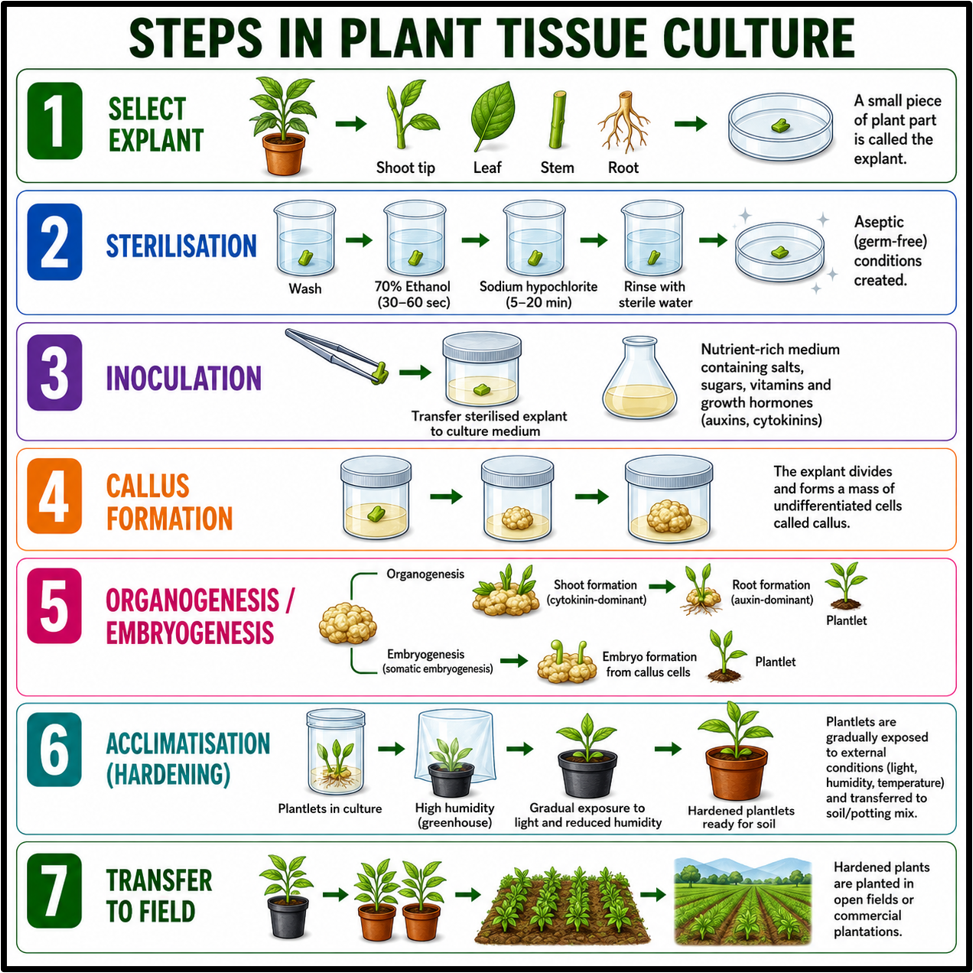
Steps in Plant Tissue Culture
Imagine setting up a perfect, miniature farm inside a glass bottle:
STEP 1: SELECT EXPLANT: Choose a healthy, disease-free plant part (shoot tip, leaf, root, stem) — this small piece is called the explant.
↓
STEP 2: STERILISATION: Wash and treat the explant with disinfectants (ethanol, sodium hypochlorite) to create aseptic (germ-free) conditions.
↓
STEP 3: INOCULATION: Transfer the sterilised explant to a nutrient-rich culture medium containing salts, sugars, vitamins, and growth hormones (auxins, cytokinins).
↓
STEP 4: CALLUS FORMATION: Under controlled conditions, the explant divides to form a mass of undifferentiated cells called a callus — the ‘raw dough’ of plant tissue culture.
↓
STEP 5: ORGANOGENESIS/EMBRYOGENESIS: Hormones trigger shoot formation (cytokinin-dominant) then root formation (auxin-dominant). Or, in some cases, embryos develop directly from callus cells (somatic embryogenesis).
↓
STEP 6: ACCLIMATISATION (HARDENING): Plantlets are gradually exposed to external conditions (light, humidity, temperature) — transferred from culture to soil/potting mix in a greenhouse.
↓
STEP 7: TRANSFER TO FIELD: Hardened plants planted in open fields or commercial plantations.
Types of Plant Tissue Culture
| Type | What It Is | Key Use |
| Callus Culture | Growth of unorganised, undifferentiated cells on nutrient medium | Genetic engineering, secondary metabolite production, regeneration |
| Organ Culture | In vitro culturing of plant organs (roots, shoots, leaves) | Studying organ development; regenerating whole plants |
| Embryo Culture | Isolating and growing embryos from seeds/crosses that wouldn’t develop naturally | Overcoming hybridisation barriers; saving weak embryos |
| Anther/Pollen Culture (Androgenesis) | Culturing anthers or pollen grains to produce haploid plants | Rapid crop breeding; creating homozygous lines faster |
| Protoplast Culture | Culturing plant cells with cell wall removed (protoplasts) | Somatic hybridisation, gene transfer between species |
| Suspension Culture | Growing free cells in liquid medium with constant shaking | Mass production of secondary metabolites (pharmaceuticals) |
| Meristem Culture | Culturing the shoot apical meristem (growing tip) | Producing virus-free plants; micropropagation |
| Somatic Embryogenesis | Embryos formed from somatic (non-reproductive) cells | Synthetic seed production; large-scale clonal propagation |
Applications of Plant Tissue Culture
Micropropagation
Micropropagation is the rapid production of large numbers of genetically identical, disease-free plants from a tiny piece of plant tissue.
Think banana plantations in Maharashtra — millions of identical, disease-free plants produced in months, not years! This is how India’s cut-flower and banana industry works at scale.
Key Applications — Summary Table
| Application | What It Does | Indian/Global Example |
| Micropropagation | Rapid, large-scale production of identical disease-free plants | Banana, potato, orchid, sugarcane propagation in India |
| Somatic Embryogenesis | Embryos from non-reproductive cells; genetically uniform plants | Oilseeds, sugarcane, forestry species |
| Germplasm Preservation (Cryopreservation) | Storage of plant genetic material in viable dormant state for long periods | Conservation of endangered plant species, maintaining seed banks |
| Disease Elimination (Meristem Culture) | Shoot apical meristem is virus-free — used to propagate pathogen-free plants | Potato virus-free seed programme in India |
| Transgenic Plant Regeneration | Essential for growing genetically engineered plants after gene insertion | Bt cotton, Golden Rice development |
| Hybrid Seed Production | Disease-free propagation of parental lines for hybrid seeds; year-round production | Commercial hybrid vegetable and cereal seed production |
| Secondary Metabolite Production | Controlled extraction of phytochemicals for pharmaceutical use | Taxol (anti-cancer), Artemisinin (anti-malarial), Vincristine |
| Forestry & Conservation | Large-scale propagation of forest trees, including rare/endangered species | Teak, sandalwood, bamboo propagation |
| Space Research | Growing plants in controlled environments for space missions | Understanding plant growth in microgravity for future space farming |
Secondary Metabolites vs Phytochemicals: Secondary metabolites are organic compounds produced by plants NOT directly involved in growth/development/reproduction — produced for stress response, defence, signalling, or attraction.
Phytochemicals are a subset of secondary metabolites found in plants that contribute to colour, flavour, and disease resistance and have health-promoting properties in humans.
Examples: Alkaloids (morphine, quinine, vincristine), Flavonoids (anthocyanins, quercetin), Terpenoids (menthol, artemisinin, taxol), Glycosides (digoxin, saponins), Phenolics (tannins, lignin).
Advantages and Disadvantages of Plant Tissue Culture
| Advantages | Disadvantages |
| Rapid Propagation: Large numbers in short period — ideal for high-demand crops. Clonal Propagation: Genetically identical plants preserve desirable traits. Genetic Engineering Platform: Controlled environment for introducing new traits. Conservation of Endangered Species: Rapid propagation and long-term in vitro storage. Faster Genetic Improvement: Accelerates plant breeding and hybrid variety development. Cost-Effective at Scale: For high-value crops like orchids, bananas — cheaper than traditional propagation. | High Initial Cost: Specialised lab, sterile environment, trained personnel — expensive for small operations. Contamination Risk: Minor lapses in sterility can destroy entire cultures. Somaclonal Variation: Genetic variations in tissue culture plants can create undesirable traits. Difficult Acclimatisation: In vitro plants may not adapt easily to natural conditions — high mortality during hardening. Genetic Uniformity Risk: Clonal crops are more susceptible to diseases affecting the entire population. Not for All Crops: Not economical for low-value staple crops; not applicable to all species. |
Genetically Modified (GM) Crops
GM crops are plants whose DNA has been altered using genetic engineering to introduce desirable traits such as high yield, pest resistance, herbicide tolerance, enhanced nutrition, or stress resistance.
Unlike traditional breeding which crosses related species, GM technology can pick a specific gene from ANY organism — a bacterium, an animal, or a distant plant — and insert it precisely into the crop’s genome.
The Key Distinction: Traditional breeding: Cross two rice varieties → hope the offspring has the desired traits (10–15 years). GM technology: Identify the exact gene responsible, insert it directly → done in 3–5 years with precision. That is the revolution.
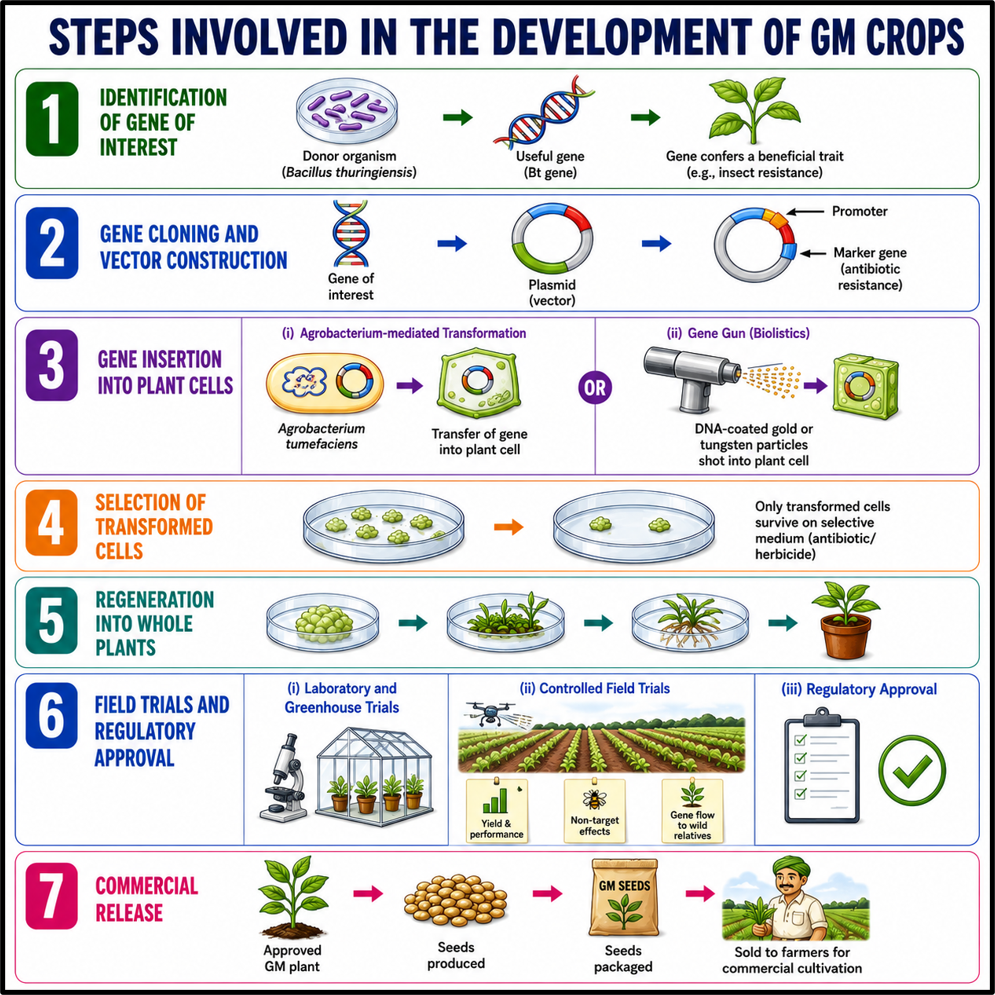
How GM Crops are Developed — Step by Step
STEP 1: IDENTIFY GENE: Isolate the useful gene (e.g., Bt gene for insect resistance from Bacillus thuringiensis) from the donor organism.
↓
STEP 2: CLONE & CONSTRUCT VECTOR: Clone the gene and insert it into a vector (plasmid/virus). Add promoters (to drive expression) and marker genes (to identify successful transformants).
↓
STEP 3: INSERT INTO PLANT CELLS: Two methods — (a) Agrobacterium-mediated Transformation: soil bacterium Agrobacterium tumefaciens used as a natural ‘gene taxi’ (mainly dicots; now also monocots). (b) Gene Gun/Biolistics: Gold/tungsten particles coated with DNA are shot into plant cells (monocots like corn, wheat, rice).
↓
STEP 4: SELECT TRANSFORMED CELLS: Only cells that successfully integrated the gene are selected using antibiotic or herbicide resistance markers.
↓
STEP 5: REGENERATE WHOLE PLANTS: Transformed cells grown into full plants using tissue culture techniques.
↓
STEP 6: FIELD TRIALS: Lab/greenhouse trials (gene stability, toxicity, allergenicity) → Confined field trials (crop yield, non-target effects, gene flow) → Regulatory approval (GEAC in India).
↓
STEP 7: COMMERCIAL RELEASE: Seeds produced, packaged, and sold to farmers.
Benefits of GM Crops
- Higher Crop Yields: Better pest/disease/abiotic stress resistance → higher productivity. E.g., Bt cotton gave India’s cotton a major yield boost.
- Reduced Pesticide Use: Bt crops produce their own insecticidal proteins → lower chemical use → less cost, less environmental pollution, healthier farm workers.
- Enhanced Nutrition (Biofortification): GM technology enables nutrient-rich crops. E.g., Golden Rice with Vitamin A.
- Climate Resilience: GM crops can be made drought-resistant, salinity-tolerant, temperature-tolerant — vital for climate-stressed Indian agriculture.
- Economic Benefits: Higher yields + lower input costs = better farm income. Bt cotton farmers in India reported significant profit gains.
- Reduced Post-Harvest Losses: GM traits can improve fruit ripening control (e.g., Flavr Savr tomato) and shelf life.
- Sustainable Agriculture: Herbicide-tolerant crops reduce tillage (soil conservation); lower pesticide use benefits soil microbes and biodiversity.
Concerns with GM Crops
- Biodiversity Loss: Gene flow from GM crops to wild relatives may reduce native species diversity and eliminate traditional crop varieties.
- Pest and Weed Resistance: Target pests may develop resistance over time (e.g., pink bollworms in Bt cotton). Herbicide-tolerant crops can create ‘superweeds’.
- Environmental Risks: Potential negative impacts on non-target organisms — beneficial insects, soil microbes, pollinators (bees, butterflies).
- Food Safety Concerns: Concerns about allergenicity, toxicity, and long-term health effects (still debated, no conclusive evidence).
- Corporate Control & Farmers’ Dependence: Patented GM seeds lead to farmer dependence on MNCs, raising seed sovereignty and cost concerns.
- Impact on Organic Farming: Cross-pollination can contaminate organic and non-GM crops, threatening organic certification.
- Trade & Export Issues: EU and many countries restrict GM foods — export of GM-contaminated products may be rejected.
Key Regulatory Bodies — FSSAI & ICAR
Food Safety and Standards Authority of India (FSSAI)
FSSAI is the statutory body for food safety and regulation in India, established under the Food Safety and Standards Act, 2006. Its mandate is food safety — NOT agriculture. Therefore, FSSAI does NOT regulate GM crop cultivation (that’s GEAC’s job). FSSAI’s role begins after a GM crop or its product enters the human food chain.
Critical Distinction:
Bt Cotton → non-food crop → GEAC approval only (FSSAI not involved).
GM Mustard Oil → food product → FSSAI approval required before it can be sold in the market.
FSSAI’s Specific Functions in GM Crops
- Approval of GM Foods: Under FSS (GM or Engineered Foods) Regulations, 2022 — no GM food can be manufactured, imported, or sold without FSSAI approval.
- Safety Evaluation: Conducts safety assessments of GM-derived foods (toxicity, allergenicity, nutritional value).
- Regulation of Imports: Regulates import of GM foods and ingredients (GM soybean oil, GM corn syrup) — customs clearance depends on FSSAI approval.
- Labelling: Mandates appropriate labelling of GM foods for consumer awareness and informed choice.
- Surveillance & Monitoring: Monitors GM foods in the Indian market for compliance with food safety standards.
Indian Council of Agricultural Research (ICAR)
ICAR is the apex body for agricultural research and education in India. Established in 1929 as Imperial Council of Agricultural Research, renamed after Independence. Registered as a society under Societies Registration Act, 1860.
Functions under the Department of Agricultural Research and Education (DARE), Ministry of Agriculture and Farmers’ Welfare.
ICAR is NOT a Regulator: ICAR does NOT approve GM crop field trials or cultivation. That role belongs to GEAC (for environmental release) and FSSAI (for food safety). ICAR is a scientific research and advisory body. Think of ICAR as the ‘scientist’ and GEAC as the ‘judge’.
ICAR’s Contributions in GM Crops
- R&D: Basic and applied research for GM varieties (pest resistance, disease resistance, nutritional enhancement, climate resilience). E.g., GM Mustard (DMH-11), Bt Brinjal, drought-tolerant rice.
- Field Trials & Agronomic Evaluation: Multi-location field trials to assess yield, quality, agronomic performance, and suitability for Indian conditions. Provides scientific data to GEAC and RCGM.
- Biosafety & Risk Assessment: Environmental risk assessments (gene flow, biodiversity impacts), food and feed safety studies for GEAC decision-making.
- Public-Sector GM Varieties: Supports development of public-sector GM varieties to reduce dependence on private seed companies. E.g., GM Mustard DMH-11 (Delhi University + ICAR collaboration).
- Policy Advisory Role: Provides scientific inputs to Ministry of Agriculture and GEAC on GM crop policy, agronomic suitability, and farmer acceptance.
GM Crops Approval Process in India
India has one of the most rigorous multi-tier regulatory processes for GM crops in the world. The legal framework rests on: (1) Environment Protection Act, 1986; and (2) Rules for Manufacture, Use/Import/Export and Storage of Hazardous Microorganisms/GM Organisms or Cells, 1989 (1989 Rules).
| Stage | What Happens | Who Oversees |
| 1. Laboratory R&D | GM trait developed in controlled lab conditions | IBSC monitors biosafety |
| 2. Application to RCGM | Lab data and biosafety protocols submitted to RCGM under DBT | RCGM reviews data |
| 3. Confined Field Trials (BRL I & II) | Multi-location trials in confined plots to assess gene stability, environmental impact, agronomic performance, toxicity, allergenicity | SBCC and DLC monitor |
| 4. Data Submission to GEAC | Comprehensive biosafety data submitted to GEAC under MoEFCC | GEAC reviews |
| 5. Large-Scale Field Trials | GEAC grants permission for open field trials after reviewing confined trial data | SBCC and DLC monitor |
| 6. Final Approval for Commercial Release | GEAC assesses long-term environmental, agronomic, and socio-economic impacts; recommends to MoEFCC; MoEFCC grants final approval | MoEFCC final authority |
| 7. Cultivation & Monitoring | State governments implement; SBCC/DLC monitor compliance; GEAC can mandate post-market monitoring | SBCC, DLC, GEAC |
| 8. Food/Feed Safety Approval (if applicable) | If intended for human consumption or animal feed → FSSAI approval required (food safety, nutritional equivalence, labelling) | FSSAI |
Bt Cotton — India’s Only Commercially Approved GM Crop
Bt cotton is a GM cotton variety engineered to produce a toxin (Cry protein) derived from the soil bacterium Bacillus thuringiensis (Bt). When the bollworm pest feeds on the plant, the Bt toxin disrupts its digestive system and kills it.
Developed by a joint venture between Monsanto (USA) and Mahyco (Maharashtra Hybrid Seed Company). Approved for commercial cultivation in India in 2002 — India’s first and only GM crop to be commercially released.
Historical Fact Worth Remembering
Bt bacterium was first discovered in 1901 by Japanese biologist Shigetane Ishiwatari (called it Bacillus sotto). In 1911, German scientist Ernst Berliner isolated it from a dead flour moth and named it Bacillus thuringiensis. The first commercial Bt cotton (Bollgard) was marketed in the US in 1996. India approved Bt cotton in 2002.
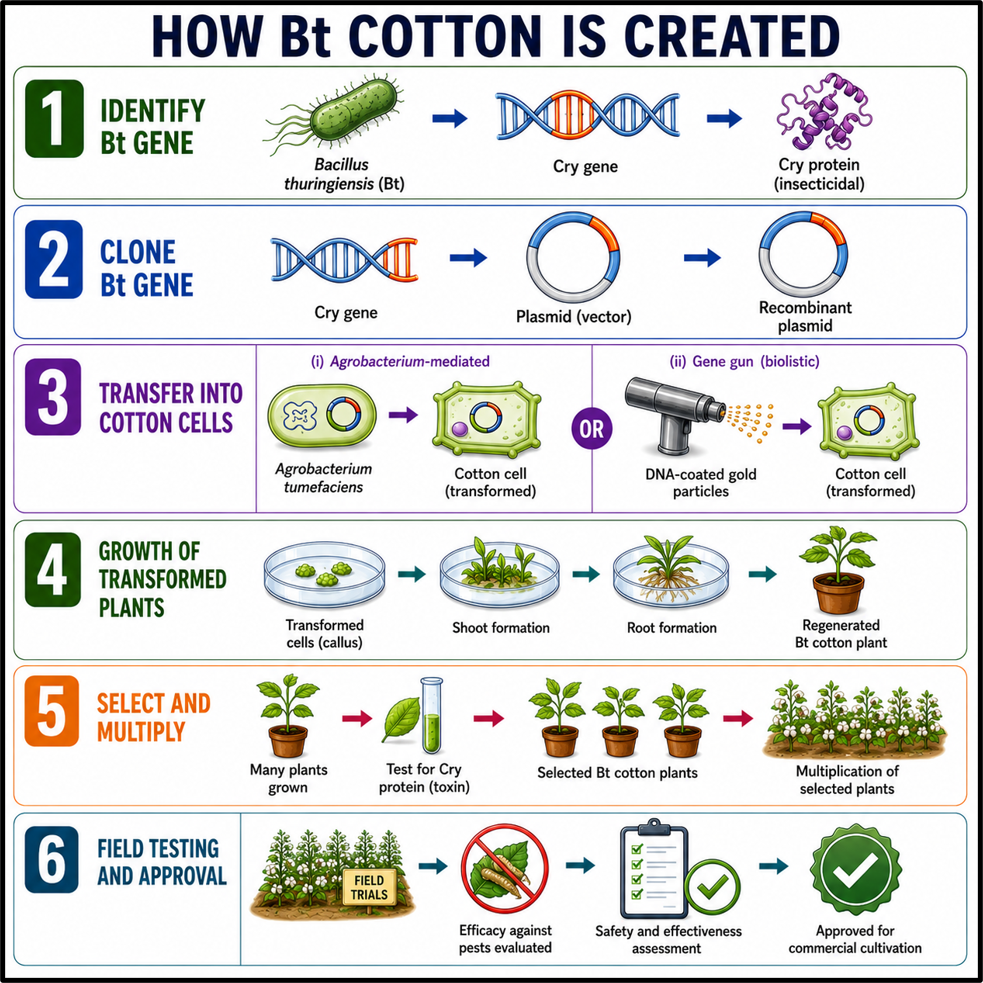
How Bt Cotton is Created — 6 Steps
- Identify the Bt Gene (Cry gene): Isolate the Cry gene (producing the insecticidal Cry protein) from Bacillus thuringiensis.
- Clone the Bt Gene: Copy the Cry gene and insert it into a circular plasmid (vector).
- Transfer into Cotton Cells: Recombinant plasmid inserted into cotton plant cells using Agrobacterium-mediated transformation or the Gene gun (biolistic) method.
- Grow Transformed Plants: Modified cells grown into full cotton plants in lab through tissue culture.
- Select and Multiply: Select cotton plants that successfully express the Bt gene and produce Cry toxin.
- Field Testing and Approval: Multi-year field trials to assess safety, effectiveness, and environmental impact before commercial approval.
Bollgard I vs Bollgard II — The Upgrade Story
| Feature | Bollgard I | Bollgard II |
| Bt Genes | One gene: Cry1Ac | Two genes: Cry1Ac + Cry2Ab |
| Resistance Spectrum | Protection against bollworm | Broader and stronger pest resistance |
| Year (US) | 1996 | Later generation |
| Resistance Risk | Higher (single gene) | Lower (two different modes of action) |
Bt Cotton in India — Achievements vs Concerns
| Achievements | Concerns |
| Bollworm Resistance: Significant reduction in bollworm-related yield losses. Higher Yields: India became world’s 2nd largest cotton producer after Bt adoption. Reduced Pesticide Use: Sharp decline in chemical insecticides — healthier farmers, cleaner environment. Higher Farmer Incomes: Higher yields + lower pesticide expenses = better net income. National Economy: Growth of India’s textile industry and export earnings. | Pest Resistance: Pink bollworm resurgence in Maharashtra, Gujarat — developing resistance to Bt toxin. Secondary Pests: Whiteflies, aphids, mealybugs increased — requiring additional pesticides. High Seed Costs: More expensive than conventional varieties; cannot reuse patented seeds. Seed Monopoly: Dependence on private companies (MNCs) threatens seed sovereignty. Farmer Debt Trap: High cultivation costs + crop failure in rainfed areas → increasing farmer distress. |
GM Crops NOT Approved for Commercial Cultivation
GM Mustard (DMH-11)
Full Form: DMH-11 = Dhara Mustard Hybrid-11. Developed by CGMCP (Centre for Genetic Manipulation of Crop Plants) at Delhi University, led by Prof. Deepak Pental.
India’s first GM food crop to receive regulatory approval (GEAC, 2022) — but commercial cultivation is ON HOLD due to a Supreme Court case.
The Science Behind DMH-11 — Barnase-Barstar Technology
The challenge: Mustard is a self-pollinating plant (fertilises itself). To create a hybrid with higher yield, you need cross-pollination between two DIFFERENT parent lines. DMH-11 solves this using a clever three-gene system (Barnase + Barstar + Bar):
| Gene | Source | Function in DMH-11 |
| Barnase gene | Bacillus amyloliquefaciens (bacterium) | Induces MALE STERILITY — blocks pollen development in the female parent plant |
| Barstar gene | Bacillus amyloliquefaciens (bacterium) | RESTORES FERTILITY in hybrids — neutralises Barnase so the hybrid seed is fertile |
| Bar gene | Bacterium | Confers HERBICIDE TOLERANCE (to glufosinate) — used as selection marker |
How DMH-11 Hybridisation Works
- Create Female Parent (Barnase Line): Barnase gene inserted → plant cannot produce pollen (male sterile) → acts as the female parent.
- Create Male Parent (Barstar Line): Barstar gene inserted → plant makes normal pollen (male fertile) → acts as the male parent.
- Hybridisation: Male (Barstar) plant pollinates female (Barnase) plant. In the resulting hybrid seed, Barstar neutralises Barnase → hybrid is fertile. Result: DMH-11 with better yield and vigour!
| Potential Benefits of DMH-11 | Concerns & Criticisms |
| Higher Yields: 25–30% more yield than traditional varieties. Reduces Edible Oil Imports: India imports >60% of edible oil. Higher mustard production from DMH-11 can reduce import bills and improve self-reliance. Efficient Land Use: Higher yield per hectare = less land needed. Public-Sector Innovation: Developed at Delhi University — reduces over-reliance on foreign seed technology. | Pollinator Risk: Mustard is pollinator-dependent — critics fear harm to bees, affecting honey production and biodiversity. Herbicide Risk (Bar Gene): Tolerance to glufosinate herbicide risks overuse, soil harm, harm to farm workers and non-target plants. Incomplete Biosafety Testing: Activists demand independent, peer-reviewed long-term biosafety data. India has not allowed any GM food crop for commercial cultivation (as of now). |
Bt Brinjal
Bt Brinjal is a GM brinjal containing the Cry1Ac gene from Bacillus thuringiensis, producing a toxin that protects it from the Fruit and Shoot Borer (FSB) — a pest causing up to 60% crop loss!
Developed by Mahyco in collaboration with Monsanto, supported by IARI. GEAC recommended commercial release in 2009. However, a moratorium was imposed in 2010 by MoEFCC following widespread public opposition.
| Potential Benefits | Concerns in India |
| 60% Pest Loss Reduced: Effectively targets and kills FSB, reducing crop damage. Higher Yields & Farmer Income: Healthier plants, lower pest loss, better marketable yield. Fewer Pesticides: Lower chemical pesticide use — better farmer health and environment. Public-Sector Research: Developed with IARI collaboration — encourages indigenous biotech. | Risk to Indigenous Varieties: India has 2,500+ native brinjal varieties. Genetic contamination fears. Health Risks: Insufficient long-term safety data; public concern over GM food. Cultural Sensitivity: Brinjal is a staple in Indian diets — emotional and cultural opposition. Seed Dependence: Farmers dependent on private firms for patented seeds. Bangladesh Case Study: Bangladesh adopted Bt Brinjal in 2013 — positive outcomes in yield, pest control, farmer profits. Used as evidence in favour of GM technology in South Asia. |
Biofortification
Biofortification is the process of increasing the nutritional value of crops while they are growing — using conventional breeding, genetic engineering, or agronomic practices — so that crops naturally contain higher levels of essential nutrients (iron, zinc, Vitamin A).
The goal is to combat ‘hidden hunger’ — widespread micronutrient deficiencies, especially in rural populations with limited access to diversified diets or processed foods.
India’s ‘Hidden Hunger’ Problem: India is home to the world’s largest number of malnourished people. Despite food security (enough calories), millions suffer from iron deficiency (anaemia), Vitamin A deficiency (blindness), and zinc deficiency (stunting). Biofortification addresses this by making the staple crops themselves more nutritious — without changing what people eat!
Three Methods of Biofortification
| Method | How It Works | Example | Limitation |
| Conventional Plant Breeding | Crossing high-nutrient varieties with high-yielding ones | Iron-rich pearl millet (Bajra) — developed by ICRISAT, ICAR | Takes time; limited by what’s available in the gene pool |
| Genetic Engineering (GM Crops) | Inserting specific genes to boost nutrient levels beyond what breeding can achieve | Golden Rice — produces Vitamin A (beta-carotene); gene from daffodil inserted into rice | Regulatory hurdles; GMO opposition |
| Agronomic Biofortification | Applying mineral-rich fertilisers or soil treatments to increase plant nutrient uptake | Zinc-enriched fertilisers in rice fields | Fast but effects don’t last across generations |
Examples of Biofortified Crops in India
| Crop | Nutrient Enhanced | Purpose | Developed By | Available in India? |
| Pearl Millet (Bajra) | Iron and Zinc | Combat anaemia, improve immunity | ICRISAT, ICAR | Yes |
| Rice | Zinc | Growth and immune function in children | ICAR, NARIC, HarvestPlus | Yes |
| Maize | Protein (Lysine & Tryptophan) | Improve protein quality in vegetarian diets | ICAR | Yes |
| Sweet Potato (Orange-fleshed) | Vitamin A (Beta-Carotene) | Prevent night blindness, Vitamin A deficiency | International Potato Centre (CIP), ICAR | Yes |
| Wheat | Iron and Zinc | Tackle hidden hunger and anaemia | ICAR | Yes |
| Golden Rice | Vitamin A (Beta-Carotene) | Prevent night blindness in children | IRRI, Philippines | NO (not approved) |
| Sorghum (Jowar) | Iron and Zinc | Address micronutrient deficiencies | ICRISAT, ICAR | Yes |
| Pigeon Pea (Arhar/Tur) | Protein | Improve protein intake in plant-based diets | ICAR | Yes |
| Mustard | Iron, Selenium | Improve thyroid and antioxidant health | ICAR | No (Under research) |
| Banana | Iron | Maternal health, reduce anaemia | DBT-funded | No (Under trials) |
Biofortification vs Food Fortification
| Aspect | Biofortification | Food Fortification |
| Definition | Enhancing nutrient content IN CROPS while growing (breeding/GMOs) | Adding nutrients to processed foods DURING MANUFACTURING |
| Method | Agronomic, conventional breeding, genetic engineering | Industrial processing (adding vitamins/minerals to flour, milk, salt) |
| Nutrient Source | Naturally increased in the crop itself | Externally added (synthetic or natural compounds) |
| Target Foods | Staple crops (rice, wheat, beans, sweet potatoes) | Processed foods (cereals, milk, salt, oils) |
| Timeframe | Long-term (years for crop development) | Immediate (once added to food) |
| Cost & Sustainability | High initial R&D but low recurring costs (seeds are self-sustaining) | Requires continuous manufacturing investment |
| Reach | Best for rural populations on subsistence farming | More effective in urban areas with processed food access |
| Examples | Golden Rice (Vitamin A), Iron-rich beans, Zinc-enriched wheat | Iodised salt, Vitamin D-fortified milk, Iron-fortified flour |
Benefits and Concerns of Biofortification
| Benefits | Concerns & Criticisms |
| Fights Hidden Hunger: Addresses iron, zinc, vitamin A deficiencies — reduces anaemia, stunting, poor immunity in rural populations. Cost-Effective & Sustainable: Once developed, seeds are self-sustaining — no repeated external interventions needed. Reaches Rural Poor: Improves nutrition without changing eating habits or increasing food costs. Supports POSHAN Abhiyan, AMB, SDG 2: Aligns with India’s national nutrition goals. Climate-Resilient: Many biofortified varieties are also drought and heat resistant. | Limited Nutrient Range: Most crops focus on 1–2 micronutrients, ignoring overall dietary diversity. Bioavailability Issues: Plant-based (non-heme) iron has <10% absorption vs 20–30% from meat. Yield-Nutrition Trade-Off: Some biofortified varieties have lower yields in early stages, discouraging farmers. GMO Opposition: GM-based biofortified crops (Golden Rice) face resistance over ethical and environmental concerns. Excessive Fortification Risk: Overconsumption can cause toxicity (e.g., Vitamin A overdose). Lack of Policy Push: Not yet mainstreamed in PDS or agricultural extension systems. |
Government Policies Supporting Biofortification
| Programme | Ministry | Goal | Biofortification Link |
| POSHAN Abhiyan (2018) / POSHAN 2.0 (2021) | Ministry of Women & Child Development (MoWCD) | Reduce stunting, undernutrition, low birth weight, anaemia | Promotes dietary diversity; converges with ICDS and Mid-Day Meal to include biofortified foods |
| Anaemia Mukt Bharat (AMB) | Ministry of Health & Family Welfare (sub-mission of POSHAN) | Target anaemia in children, adolescents, women | Promotes iron-rich biofortified crops (pearl millet, wheat, rice); food-based approach over supplements alone |
| National Food Security Mission (NFSM, 2007) | Ministry of Agriculture & Farmers’ Welfare | Increase grain productivity + nutritional quality | Supports production/distribution of biofortified seeds; frontline demonstrations (FLDs) for adoption |
| ICAR (AICRPs) | DARE, MoAFW | Agricultural research | Developed 75+ biofortified varieties; focus on iron, zinc, Vitamin A, protein in staples |
| HarvestPlus India Programme | CGIAR-led, with ICAR partnership | Develop and popularise biofortified crops | Works with ICAR, state agri universities, and private seed companies |
Biofertilisers
Biofertilisers are substances containing living microorganisms that enhance soil fertility by increasing the availability of essential nutrients to plants. They are the eco-friendly, sustainable alternative to chemical fertilisers. Think of them as ‘living fertilisers’ — organisms that work with the soil’s natural chemistry.
Types of Biofertilisers — Complete Reference Table
| Type | Mechanism | Microorganism Examples | Where Used |
| Nitrogen-Fixing (Symbiotic) | Form symbiotic associations with plant roots; fix atmospheric N₂ into ammonia in root nodules | Rhizobium (legumes — peas, beans, lentils) | Legume crops (pulse farming, soybean) |
| Nitrogen-Fixing (Free-living) | Free-living bacteria that fix atmospheric nitrogen in soil | Azotobacter (in soil), Azospirillum (with cereals/grasses) | Rice, wheat, maize, sugarcane |
| Phosphate-Solubilising | Convert insoluble soil phosphate to soluble forms via organic acids and enzymes | Bacillus spp., Pseudomonas spp. | All crops (phosphorus is universally required) |
| Mycorrhizal | Symbiotic fungi extending root surface area for phosphorus and water absorption | Arbuscular Mycorrhizal Fungi (AMF) | Used to rehabilitate degraded soils; excellent for drought-prone areas |
| Cyanobacterial (Blue-Green Algae) | Photosynthetic; fix atmospheric nitrogen; enrich soil nitrogen | Anabaena, Nostoc | Rice cultivation and wetland agriculture |
| Organic Matter Decomposers | Break down crop residues, plant waste, animal manure; release nutrients back into soil | Cellulolytic bacteria and fungi, composting microorganisms | Composting operations, organic farming |
Biopesticides
Biopesticides are biological agents derived from natural organisms (microorganisms, plants, or certain minerals) used to control pests, weeds, and plant diseases. They are a key component of sustainable agriculture and Integrated Pest Management (IPM). India’s NEEM — with its active ingredient Azadirachtin — is the world’s most famous natural biopesticide!
Types of Biopesticides
| Type | What It Is | How It Works | Examples |
| Microbial Pesticides | Contain microorganisms (bacteria, fungi, viruses, protozoa) | Microorganisms infect or kill specific pests | Bacillus thuringiensis (Bt) — toxins destroy insect larvae (caterpillars, beetles, mosquito larvae); Beauveria bassiana (fungus) |
| Botanical Pesticides | Derived from natural plant extracts | Active plant chemicals with insecticidal properties act on pests | Neem (Azadirachtin) — insect repellent and growth disruptor; Pyrethrin from Chrysanthemum flowers |
| Biochemical Pesticides | Naturally occurring substances | Control pests through non-toxic mechanisms (affect behaviour or growth) | Insect pheromones (mating disruption); plant growth regulators interfering with pest development |
| Plant-Incorporated Protectants (PIPs) | Pesticidal substances produced by GM plants | Transgene inserted into plant produces its own pesticide | Bt crops (Bt cotton, Bt corn) producing Cry proteins toxic to specific insect pests |
| Advantages of Biopesticides | Disadvantages of Biopesticides |
| Eco-friendly: Biodegradable, minimal environmental pollution. Target-Specific: Affect only specific pests — less harm to pollinators. Safer for Humans: Less toxic — safer for farmers, consumers, livestock. IPM Compatible: Can be combined with other pest control methods. Lower Resistance Risk: Pests less likely to develop resistance quickly. Organic Farming: Widely used in organic and sustainable agriculture. | Slower Action: Take longer to control pests than chemical pesticides. Limited Spectrum: Effective only against specific pests — may need multiple products. Short Shelf Life: Derived from living organisms — limited storage stability. Environment-Dependent: Effectiveness affected by temperature, humidity, sunlight. Frequent Application: May need more frequent application to maintain pest control. |
Biotechnology in Livestock
Biotechnology is transforming animal husbandry just as it is transforming crop science. From artificial insemination changing the genetics of an entire herd to transgenic animals producing medicines — the revolution is real. India’s dairy revolution (Operation Flood) was partly enabled by AI technology. Now gene editing and biopharming are opening up new frontiers.
Major Biotechnological Methods in Livestock
| Method | What It Is | Key Advantages |
| Artificial Insemination (AI) | Introducing semen from a selected superior male into the female’s reproductive tract without natural mating | Improves genetic quality of livestock; spreads superior male genetics across large populations; reduces spread of reproductive diseases |
| Embryo Transfer Technology (ETT) | Transferring fertilised embryos from a genetically superior female (donor) to surrogate mothers | Rapid multiplication of genetically superior livestock; improves breeding efficiency — one elite female can produce many offspring |
| In Vitro Fertilisation (IVF) | Fertilisation of eggs and sperm OUTSIDE the animal’s body; embryo implanted into a female | Improving breeding efficiency; preserving valuable genetic lines; useful for endangered animals |
| Cloning (SCNT) | Producing a genetically identical copy of an animal using Somatic Cell Nuclear Transfer | Preservation of valuable genetics; disease-resistant animal production; conservation of endangered species |
| Genetic Engineering (Transgenic Animals) | Modifying animal genes to improve desirable traits (growth rate, disease resistance, milk composition) | Development of disease-resistant breeds; biopharming (transgenic animals producing therapeutic proteins) |
What is Biopharming? Biopharming is the production of therapeutic proteins and vaccines using transgenic animals. For example, transgenic goats or cows engineered to produce human insulin or clotting factors in their milk. The animal becomes a ‘living bioreactor’. This is an emerging field with enormous pharmaceutical potential.
| Advantages of Biotech in Livestock | Disadvantages of Biotech in Livestock |
| Improved Productivity: Higher milk yield, meat production, egg production. Enhanced Genetic Quality: Rapid spread of desirable traits through AI, ETT, genetic engineering. Disease Resistance: Developing livestock breeds with improved disease resistance. Pharmaceutical Proteins: Transgenic animals can produce therapeutic proteins (biopharming). Conservation: Cloning and cryopreservation preserve important livestock genetic resources. | High Cost: Expensive equipment and specialised expertise. Ethical Concerns: Genetic modification and cloning raise animal welfare concerns. Genetic Uniformity Risk: Overuse of elite breeds reduces genetic diversity — vulnerability to disease. Technical Complexity: Requires skilled personnel and advanced lab infrastructure. Ecological Risks: Genetic manipulation may have unintended biological or environmental consequences. |