
Basic Concepts of Nuclear Energy
See, before we touch a single equation, let us agree on one thing: nuclear energy is not a difficult topic — it is only an unfamiliar one. And unfamiliarity is cured the same way everywhere — by going slow, by building one idea on top of another, and by refusing to memorise anything we have not first understood. So that is exactly how we will travel through this section.
Picture the atom for a moment. It is unimaginably small — millions would sit comfortably on the full stop at the end of this sentence. Yet inside its tiny core lies a force so concentrated that a single kilogram of it can light up a city.
The whole story of this chapter is the story of how humanity learned to coax that force out of the nucleus — sometimes for electricity and medicine, sometimes, tragically, for weapons. Keep that tension in mind throughout; it is the moral spine of the subject.
| ◆ Why this chapter matters for you For the UPSC examination, Science & Technology is rarely about heavy mathematics. The examiner wants to know whether you understand concepts and can connect them to current affairs — India’s three-stage programme, ITER, SMRs, treaties like NPT and CTBT. So, as we go, notice not just ‘what’ but ‘so what’. That habit is worth more than ten memorised facts. |
What Is Nuclear Energy?
Let us start with the simplest possible definition and then unpack it.
Nuclear energy is the energy released from the nucleus of an atom when it undergoes a nuclear reaction — such as fission (the splitting of a heavy nucleus) or fusion (the joining of light nuclei).
Indian law settles it: the Atomic Energy Act, 1962 [s. 2(a)] defines atomic energy as “energy released from atomic nuclei… including the fission and fusion processes”. The two are synonyms. “Atomic” is simply the older word, preserved in institutional names — Department of Atomic Energy, AERB — while physicists prefer “nuclear”.
The Basic Idea, Built from Scratch
Everything around you — your body, this page, the air in the room — is made of atoms. They are the basic building blocks of matter, and ordinary chemical processes cannot break them down further. Each atom carries three kinds of subatomic particles:
- Protons — positively charged, sitting in the nucleus.
- Neutrons — neutral (no charge), also in the nucleus.
- Electrons — negatively charged, orbiting the nucleus in a cloud.
Protons and neutrons together form the nucleus, which holds almost all of the atom’s mass and is bound together by the immensely strong strong nuclear force.
Here is the crucial sentence of the whole chapter: when the structure of the nucleus changes — through fission, fusion, or radioactive decay — a tiny part of its mass disappears and reappears as energy.
How can mass simply become energy? Because of the most famous equation in physics, Einstein’s mass–energy equivalence:
E = mc²
- E = energy released
- m = mass converted into energy
- c = speed of light = 3 × 10⁸ m/s
Look closely at that c². The speed of light is already a colossal number; squaring it gives something astronomically large. So even a vanishingly small loss of mass yields a gigantic amount of energy. That single fact is why nuclear fuel is millions of times more energy-dense than coal or petrol.
| ◆ The c² intuition Think of mass as money and c² as a fantastically high exchange rate. Even if you convert a fraction of a gram — a few ‘rupees’ of mass — the exchange rate is so enormous that you walk out with a fortune of energy. That is the magic hidden inside the nucleus. |
What Is a Nuclear Reaction?
A nuclear reaction occurs when the nucleus of an atom changes — by splitting, by combining, or by transforming — and in the process either releases or absorbs a large amount of energy. Note the contrast with a chemical reaction, which only rearranges electrons; here we are reaching deep into the nucleus itself, where the energies involved are millions of times greater.
Types of Nuclear Reactions
There is a small family of nuclear reactions, and we will meet each member in turn. Here is the whole cast at a glance 😊
| 1 Nuclear Fission — splitting a heavy nucleus |
▼
| 2 Nuclear Fusion — joining light nuclei |
▼
| 3 Radioactivity (Radioactive Decay) |
▼
| 4 Nuclear Transmutation — one element into another |
▼
| 5 Neutron Capture Reactions |
▼
| 6 Spallation Reaction |
Nuclear Fission — Splitting the Giant
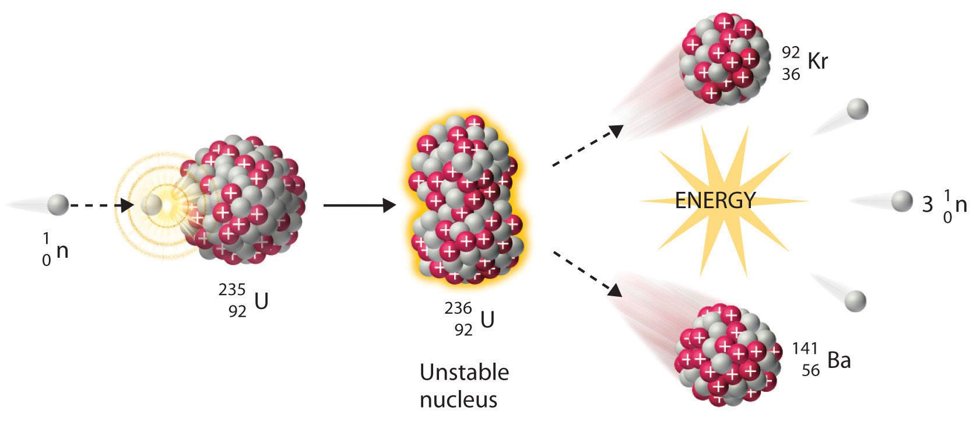
Imagine a heavy, overloaded nucleus — say Uranium-235 or Plutonium-239 — packed with so many protons and neutrons that it is barely holding itself together. Nuclear fission is the process in which such a heavy nucleus splits into two or more lighter nuclei, releasing a large amount of energy, free neutrons, and radiation.
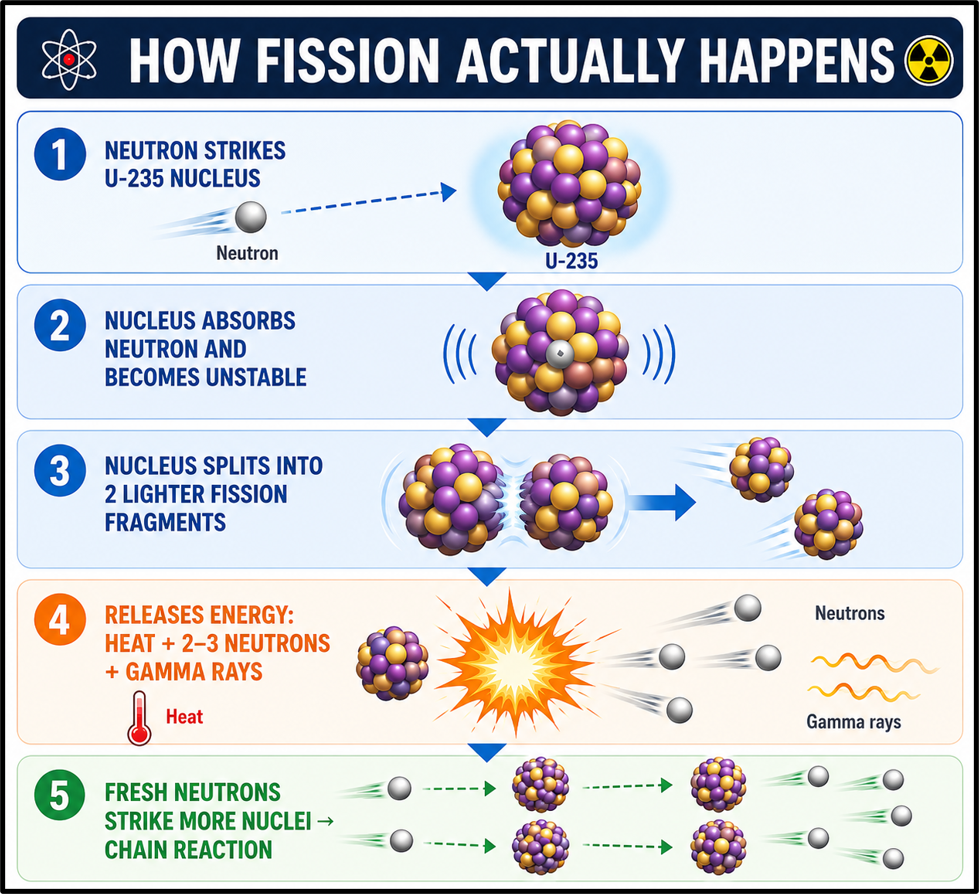
How Fission Actually Happens
A slow-moving neutron strikes the fissionable nucleus. The nucleus, already on the edge of stability, absorbs that neutron and becomes unstable. It wobbles, stretches, and finally breaks into two smaller nuclei (called fission fragments), throwing out energy (mostly as heat), 2–3 fresh neutrons, and gamma radiation.
| Neutron (usually slowed to thermal energy) strikes U-235 nucleus |
▼
| Nucleus absorbs neutron → becomes unstable |
▼
| Nucleus splits into 2 lighter ‘fission fragments’ |
▼
| Releases: HEAT + 2–3 neutrons + Gamma rays |
▼
| Fresh neutrons strike more nuclei → CHAIN REACTION |
Three Conditions Fission Demands
- Fissile nucleus: the material must be capable of undergoing fission when hit by neutrons — e.g., Uranium-235 (U-235), Plutonium-239 (Pu-239), Uranium-233 (U-233).
- Right neutron energy: slow (“thermal”) neutrons of roughly 0.025 eV are captured far more readily — U-235’s fission cross-section is around 500 times larger for thermal than for fast neutrons. Hence the moderator in most reactors. But fast neutrons cause fission too — that is exactly how FBRs and nuclear weapons work, with no moderator at all.
- Critical mass: there must be a minimum mass of fissile material present to sustain the reaction. Below this, too many neutrons escape from the surface and the reaction simply dies out.
| ◆ Critical mass, made obvious Think of a crowded room where everyone is throwing tennis balls. If the room is large but nearly empty, most balls hit the walls and fall — nothing sustains. Pack enough people (fissile nuclei) close together, and every ball thrown almost certainly hits someone, who throws more. That tipping point — where the throwing becomes self-sustaining — is the critical mass. |
The Chain Reaction — and Why Control Is Everything
The neutrons released by one fission can strike other fissile nuclei, triggering more fissions, whose neutrons trigger still more — a self-sustaining chain reaction. The entire difference between a power plant and a bomb lies in one word: control.
| Type of Chain Reaction | What Happens | Real Example |
| Controlled | Rate of fission is regulated using control rods that absorb excess neutrons. Energy is released steadily and safely. | Nuclear power plant (electricity) |
| Uncontrolled | No control over neutron release; reaction races ahead explosively, releasing massive energy instantly. | Atomic bomb |
Where Fission Is Put to Work
Fission is not merely a laboratory curiosity — it quietly powers hospitals, submarines and spacecraft. Let us survey its applications.
1. Electricity Generation (the headline use).
- In a nuclear power plant, controlled fission of U-235 or Pu-239 produces heat → heat boils water into steam → steam spins turbines → turbines generate electricity by electromagnetic induction.
- Most Indian plants use Pressurised Heavy Water Reactors (PHWRs) running on natural Uranium fuel with heavy water (D₂O) as both moderator and coolant.
- Indian plants to remember: Tarapur (Maharashtra — India’s first), Kakrapar (Gujarat), Kudankulam (Tamil Nadu), Rawatbhata (Rajasthan), Kaiga (Karnataka), Kalpakkam (Tamil Nadu).
2. Nuclear Propulsion.
- Compact fission reactors power submarines and naval ships, giving sustained high output without frequent refuelling — and, crucially, without needing atmospheric oxygen, which is ideal underwater. Example: INS Arihant, India’s first indigenously built nuclear-powered ballistic missile submarine.
3. Nuclear Weapons.
- An uncontrolled fission chain reaction is the basis of atomic bombs, using U-235 or Pu-239. The two used in 1945: “Little Boy” (U-235, Hiroshima) and “Fat Man” (Pu-239, Nagasaki).
4. Radioisotope Production.
- Medicine: Cobalt-60 (cancer radiotherapy; sterilising surgical tools), Iodine-131 (thyroid diagnosis), Technetium-99m (medical imaging).
- Agriculture: mutation breeding and food preservation.
- Industry: thickness gauging, weld testing, leak detection.
5. Research.
- Reactors act as powerful neutron sources for materials testing and nuclear physics — e.g., Dhruva Reactor (BARC, Trombay) and the decommissioned Cirus Reactor.
6. Desalination of Water.
- In dual-purpose plants, reactor heat both generates electricity and desalinates seawater — e.g., experimental units at Kudankulam and Kalpakkam.
7. Space Applications.
- Radioisotope Thermoelectric Generators (RTGs) supply electricity for deep-space probes where sunlight is too weak — e.g., Voyager 1 & 2, Cassini-Huygens, Curiosity Rover.
The Balance Sheet of Fission
No technology is all light or all shadow. Here is the honest ledger.
| ✓ Advantages | ✗ Disadvantages |
| High energy output — 1 kg of U-235, if fully fissioned ≈ 24 million kWh; millions of times denser than fossil fuels. | Radioactive waste — by-products stay hazardous for thousands of years; disposal is hard. |
| Reliable base-load power — steady supply, unaffected by weather (unlike solar/wind). | Accident risk — Chernobyl (1986) and Fukushima (2011) show the danger. |
| Low greenhouse emissions — no CO₂ during fission, helping fight climate change. | High cost — construction, safety systems and decommissioning are very expensive. |
| Long-term supply — years of operation from a small fuel quantity. | Proliferation risk — peaceful tech and fissile material can be diverted to weapons. |
| Medical & scientific gains — radioisotopes for therapy, farming, industry. | Limited fuel — uranium and plutonium are non-renewable and scarce. |
| Desalination & propulsion — waste heat powers fresh-water plants, ships and submarines. | Storage challenge — spent fuel needs secure geological repositories and public acceptance. |
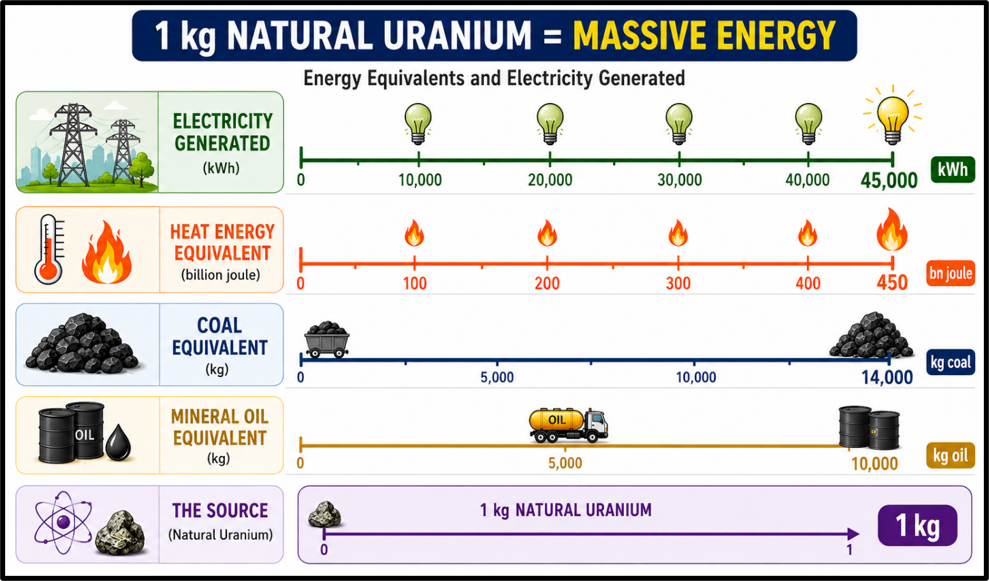
The following illustration shows how much coal, oil or natural uranium is required for a certain quantity of electricity. 1 kg natural uranium – following a corresponding enrichment and used for power generation in light water reactors – corresponds to nearly 10,000 kg of mineral oil or 14,000 kg of coal and enables the generation of 45,000 kWh of electricity.
Nuclear Fusion — Joining the Small
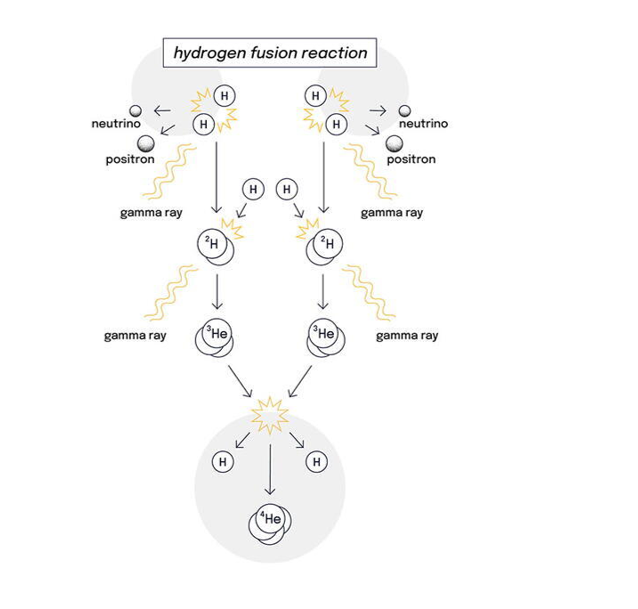
If fission is about breaking a giant apart, fusion is the opposite art: it is the process in which two or more light atomic nuclei (usually isotopes of hydrogen) combine to form a heavier nucleus, releasing an enormous amount of energy. This is the very reaction that lights the Sun.
Why does joining release energy? Because the mass of the resulting nucleus is slightly less than the total mass of the original nuclei. That missing mass — once again following E = mc² — is converted into energy.
How Fusion Happens
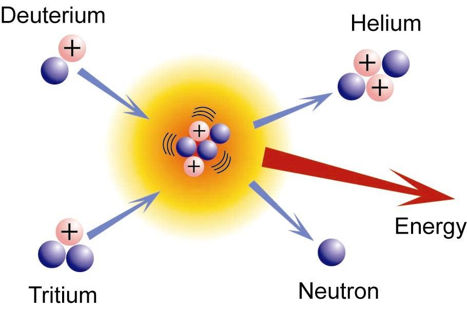
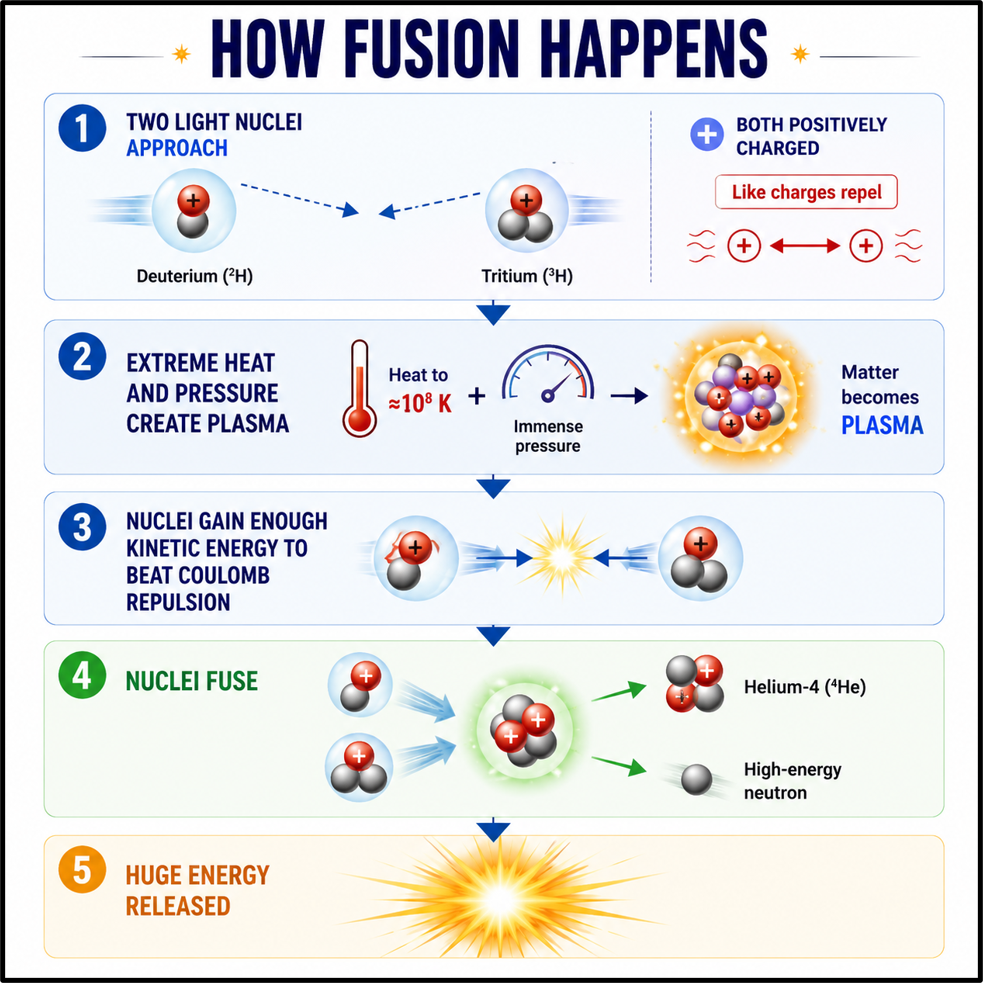
Take two light nuclei, typically deuterium (²H) and tritium (³H). Both carry positive charge, so as they approach they fiercely repel each other — this is the electrostatic (Coulomb) repulsion. To fuse, they must be hurled together hard enough to overcome that wall.
| Deuterium (²H) + Tritium (³H), both positively charged |
▼
| Heat to ≈10⁸ K + immense pressure → matter becomes PLASMA |
▼
| Nuclei gain enough kinetic energy to beat Coulomb repulsion |
▼
| Nuclei FUSE → Helium-4 (⁴He) + a high-energy neutron |
▼
| Huge energy released |
Five Conditions Fusion Demands
- Extremely high temperature — about 10⁸–10⁹ K (100–150 million °C). At such heat atoms become plasma, and nuclei move fast enough to collide.
- Very high pressure (density) — to force nuclei close and raise collision frequency.
- Sufficient confinement time — the plasma must be held under heat and pressure long enough. This is the Lawson Criterion: the product of plasma density and confinement time must exceed a minimum value for sustained fusion.
- Proper fuel composition — light nuclei with low Coulomb repulsion work best; Deuterium + Tritium is the most efficient pair.
- Plasma confinement method — no solid wall can survive such heat, so plasma is held without touching anything, by either:
- Magnetic confinement — strong magnetic fields hold the plasma (as in a tokamak).
- Inertial confinement — powerful lasers compress fuel pellets to extreme density.
| ◆ Why fusion is so hard to tame Two magnets pushed north-to-north resist you more and more as they near. Now imagine forcing them to actually touch — you would need tremendous effort. Fusion nuclei repel for the same reason, except the ‘effort’ required is the heat of a star. Recreating a star inside a steel chamber on Earth is precisely why a commercial fusion reactor still does not exist. |
Where Fusion Appears
1. The Sun and the stars (natural fusion). In the Sun’s core — about 15 million K under crushing gravitational pressure — hydrogen nuclei fuse into helium, releasing the heat and light that drive Earth’s climate, photosynthesis, and ultimately all life. Without solar fusion, Earth would be a dead rock.
2. The Hydrogen bomb (uncontrolled fusion). In a thermonuclear weapon, a fission bomb is detonated first to create the temperature and pressure needed to ignite the fusion of deuterium and tritium. Fusion bombs are far more powerful than fission bombs. India’s “Shakti 1998” series included a thermonuclear test.
3. Neutron source for research. Fusion releases high-energy neutrons used for testing materials’ radiation resistance and for breeding tritium.
4. Future possibilities. Clean limitless power generation, production of short-lived medical isotopes, and even fusion-powered deep-space propulsion.
The Balance Sheet of Fusion
| ✓ Advantages | ✗ Disadvantages |
| Enormous output — 3–4× more energy per unit mass than fission. | Extreme temperature — 10⁷–10⁸ K is technologically very hard to create and hold. |
| Clean — no greenhouse gases, no thermal pollution; supports net-zero goals. | Plasma confinement — holding stable plasma off the walls needs complex magnetic/laser systems. |
| Abundant fuel — deuterium from seawater, tritium bred from lithium; near-inexhaustible. | No commercial reactor yet — NIF has repeatedly achieved target energy gain since Dec 2022, but wall-plug breakeven and continuous operation remain unachieved |
| Inherently safe — no chain reaction; any disturbance stops it. No meltdown risk. | Very high cost — facilities are hugely expensive; commercial viability uncertain near-term. |
| Minimal waste — only short-lived isotopes; no deep-geological storage problem. | Tritium & neutrons — tritium is radioactive and rare; fast neutrons embrittle and activate reactor walls. |
Fission vs Fusion — Side by Side
Students confuse these two endlessly. Burn this small table into memory and you will never slip again.
| Feature | Nuclear Fission | Nuclear Fusion |
| Process | Heavy nucleus splits into lighter ones | Light nuclei join into a heavier one |
| Typical fuel | U-235, Pu-239 (heavy) | Deuterium, Tritium (light) |
| Conditions | Slow neutron, critical mass | ≈10⁸ K, very high pressure |
| Energy per unit mass | Very high | 3–4× higher than fission |
| Waste | Long-lived radioactive waste | Mainly short-lived isotopes |
| Control | Chain reaction (can run away) | Self-limiting; stops if disturbed |
| Status | Commercial & mature | Still experimental (ITER, NIF) |
| Found in | Power plants, atom bombs | The Sun & stars, H-bombs |
Radioactivity — Nature’s Slow Transformation
Some nuclei are simply born restless. Radioactivity is the spontaneous disintegration (decay) of unstable atomic nuclei into more stable ones, accompanied by the emission of radiation as alpha, beta, or gamma rays. Nobody pushes the nucleus; it transforms on its own, on its own schedule.
- Naturally — in elements such as uranium (U), radium (Ra), and thorium (Th).
- Artificially induced — when stable nuclei are bombarded with particles to make them radioactive.
The Three Emissions — Know Their Penetrating Power
| Type | Nature of Radiation | Penetrating Power | Example |
| Alpha (α) | Helium nucleus | Low — stopped by paper, skin, or a few cm of air | ²³⁸U → ²³⁴Th + α |
| Beta (β⁻) | High-speed electron | Moderate — stopped by thin aluminium / plastic | ¹⁴C → ¹⁴N + β⁻ |
| Gamma (γ) | High-energy EM waves (photons) | Very high — needs thick lead or concrete | ⁶⁰Co* → ⁶⁰Co + γ |
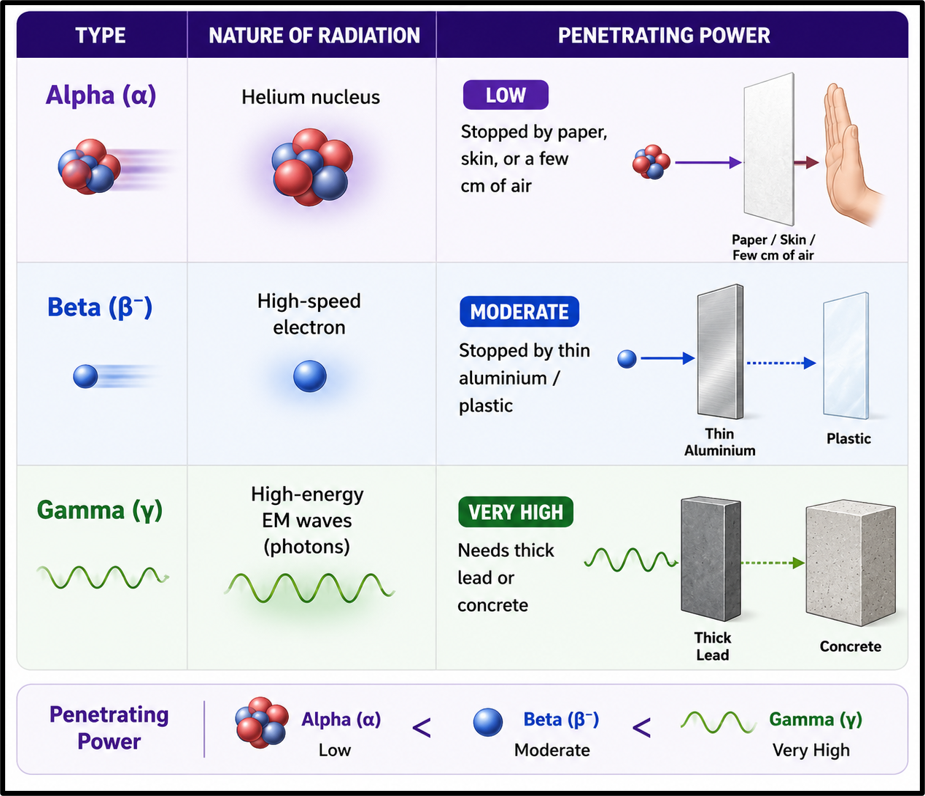
| ◆ Remember α, β, γ with a wall Alpha is a heavyweight boxer — powerful but slow; a sheet of paper blocks him. Beta is a quick middleweight; a thin metal sheet stops him. Gamma is a ghost — massless, charge-less, slipping through almost anything until a thick lead wall finally halts it. Penetrating power runs γ > β > α; ionising power runs the opposite way. |
A bit of history. Henri Becquerel (1896) discovered natural radioactivity while studying uranium salts. Marie and Pierre Curie took it further, discovering radium (Ra) and polonium (Po). The three shared the Nobel Prize in Physics (1903).
Two Equations Worth Knowing
Law of Radioactive Decay.
Decay is spontaneous and random for any single atom, yet for a large sample it follows a precise law:
N = N₀ e^(−λt)
- N₀ = initial number of radioactive atoms
- N = atoms remaining after time t
- λ = decay constant (probability of decay per unit time)
- t = time elapsed
Half-Life (T₁/₂).
The time required for half the atoms in a sample to decay. It links neatly to the decay constant:
T₁/₂ = 0.693 / λ
Why Do Nuclei Become Radioactive?
At heart, radioactivity is a quest for stability. A nucleus is unstable when the attractive strong nuclear force cannot balance the repulsive electrostatic force among protons. The triggers:
- Unfavourable neutron–proton ratio (N/Z) — stable nuclei keep an optimal balance; disturb it and the nucleus decays to restore it.
- Low binding energy per nucleon — weakly bound nuclei break more easily. Heavy elements like uranium, thorium, radium fall here.
- Large atomic number — beyond lead (Z = 82) the strong force can no longer hold so many protons; e.g., uranium (Z=92), thorium (Z=90), radium (Z=88) emit radiation to shrink.
- Excess nuclear energy (excited state) — some nuclei sit in a high-energy state and shed the extra as gamma radiation, e.g., Cobalt-60.
- Quantum instability — quantum mechanics lets nuclei ‘tunnel’ through an energy barrier and decay; this is why decay is random and unpredictable for a single atom.
Applications of Radioactivity
| Field | How Radioactivity Helps |
| Medicine | Cobalt-60 & Caesium-137 (radiotherapy); Tc-99m & I-131 (imaging); Sodium-24 (blood-flow tracing); Co-60 (sterilising instruments). |
| Agriculture | Gamma rays for mutation breeding & food irradiation; P-32 & N-15 study fertiliser uptake; Sterile Insect Technique controls pests. |
| Industry | Beta/gamma gauge thickness & density; Sodium-24 traces pipeline leaks; Iridium-192 / Co-60 industrial radiography finds cracks. |
| Scientific Research | Carbon-14 dating (ages up to ~50,000 years); P-32 & S-35 study metabolism and bonding. |
| Energy | RTGs use Pu-238 decay heat for deep-space missions (Voyager, Curiosity, New Horizons). |
| Earth & Environment | Tritium, Cl-36, Cs-137 trace groundwater flow, pollution and sedimentation. |
The Dark Side — Hazards of Radioactivity
The same rays that cure cancer can also cause it. Honesty demands we list the dangers as fully as the benefits.
- Cell & DNA damage — ionising radiation breaks chemical bonds in cells, mutating DNA, leading to cancers (leukaemia, thyroid, skin), tumours, genetic disorders, birth defects. Radon-222 is a leading cause of lung cancer after smoking.
- Radiation sickness — high exposure causes nausea, vomiting, fatigue, hair loss, bleeding — ‘Acute Radiation Syndrome (ARS)’.
- Organ damage — bone marrow, lungs and thyroid are vulnerable; Iodine-131 concentrates in the thyroid.
- Environmental contamination & bioaccumulation — Strontium-90 and Caesium-137 climb the food chain; some isotopes stay hazardous for centuries (Pu-239 half-life ≈ 24,000 years).
- Accidents & disasters — Chernobyl (then Ukrainian SSR, USSR, 1986, reactor explosion during a safety test) and Fukushima (Japan, 2011, tsunami-triggered meltdown).
- Waste, weapons, occupational & psychological harms — spent fuel stays dangerous for millennia; weapons cause instant and fallout radiation; workers face chronic low-dose exposure; survivors suffer stigma and trauma; ‘dirty bombs’ pose a terrorism threat.
Nuclear Transmutation — Turning One Element Into Another
The medieval alchemist’s dream — changing one element into another — is, it turns out, real physics. Nuclear transmutation is the conversion of one chemical element into another by changing the number of protons (the atomic number) in the nucleus.
- Natural transmutation — happens spontaneously through radioactive decay.
- Artificial (induced) transmutation — a stable nucleus is bombarded with neutrons, protons or alpha particles.
Applications: producing artificial radioisotopes; breeder reactors (U-238 → Pu-239, Th-232 → U-233); nuclear waste management (turning long-lived isotopes into short-lived/stable ones); and discovering new superheavy elements (114–118).
Neutron Capture Reactions
Here a target nucleus simply captures (absorbs) a neutron, becoming a heavier, often unstable isotope, which may then emit gamma radiation or undergo beta decay to reach stability. Quietly, this reaction shapes the cosmos and runs our reactors.
- Formation of heavy elements in stars — inside stars, neutron capture builds elements beyond iron, explaining the cosmic origin of gold, uranium and more.
- Production of radioisotopes — a workhorse method for making useful isotopes.
- Reactor operation — control rods of cadmium or boron absorb neutrons by capture to regulate the chain reaction.
- Nuclear waste transmutation — converts long-lived isotopes into short-lived or stable ones.
Spallation Reaction
In a spallation reaction, a heavy nucleus (lead, tungsten or uranium) is struck by high-energy particles (usually protons or neutrons) and shatters, ejecting several smaller fragments — neutrons, protons, light nuclei.
- Neutron sources — produces high-intensity neutron beams for research.
- Rare-isotope production — makes radioisotopes and exotic nuclei for medicine, industry, research.
- Accelerator-Driven Subcritical Reactors (ADSR) — spallation neutrons drive subcritical reactors that can produce clean energy, transmute long-lived waste, and reduce runaway-reaction risk.
- Nuclear astrophysics — explains the formation of light elements (lithium, beryllium, boron) when cosmic rays hit heavier atoms.
- Radiation shielding & space science — helps design shielding for satellites and spacecraft.
Nuclear Energy and Radioactive Materials
What Are Radioactive Materials?
Radioactive materials are substances whose nuclei are unstable and spontaneously emit α, β or γ radiation as they decay toward stability. When the proton–neutron balance is disturbed, the nucleus becomes radioactive; the act of regaining stability is radioactive decay.
| Natural Radioactive Materials | Artificial Radioactive Materials |
| Present in Earth’s crust and even the human body — in rocks, soil, air, water. | Made in nuclear reactors or particle accelerators. |
| Examples: Uranium, Thorium, Radium, Potassium-40. | Examples: Cobalt-60, Technetium-99m, Iodine-131, Plutonium-239. |
Key properties: spontaneous decay; a unique, constant half-life; transformation into other elements; emission of penetrating α/β/γ rays; and a decay rate unaffected by temperature, pressure or chemical state.
Clearing a Common Misconception
Many students believe “all nuclear energy comes from radioactive materials.” This is subtly wrong, and examiners enjoy testing it. The truth, stated crisply:
| ◆ The one-line rule to remember NOT all nuclear energy comes from radioactive materials. Fusion and certain particle-induced reactions involve stable nuclei. The confusion arises only because today’s commercial reactors happen to use radioactive fuels like U-235 and Pu-239. |
| Type of Nuclear Energy | Involves Radioactive Material? | Dependence Level |
| Radioactive Decay | Yes | Complete |
| Nuclear Fission | Yes | Complete |
| Nuclear Fusion | Partly | Partial |
| Particle Bombardment (Transmutation, Neutron Capture, Spallation) | Usually, stable targets | Minimal to Partial |
Nuclear Power Plants and Reactors
A nuclear power plant is an industrial facility that turns nuclear energy into electricity, usually through controlled fission inside a nuclear reactor. The reactor is the heart of the plant — the device in which a controlled, self-sustaining fission reaction releases heat. That heat boils water into steam, the steam spins turbines, and the turbines drive generators.
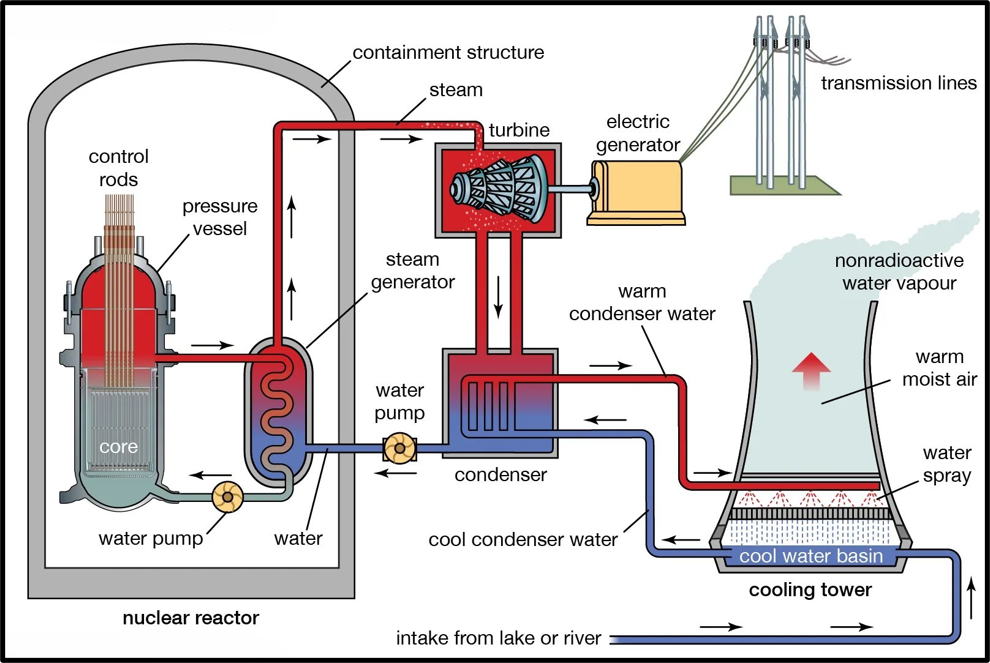
The Main Components — A Reactor’s Anatomy
Think of these eight parts as organs, each with one clear job.
| Component | Its Job | Examples |
| Fuel | Provides fissile material that undergoes fission | U-235, Pu-239, U-233 |
| Moderator | Slows fast neutrons to thermal speeds (raises fission probability) | Heavy water (D₂O), Graphite, Light water (H₂O) |
| Control Rods | Absorb excess neutrons to regulate or stop the chain reaction | Cadmium, Boron, Hafnium |
| Coolant | Removes heat from the core, carries it to the steam generator | Light/Heavy water, CO₂, Liquid Sodium, Helium |
| Reactor Core | Central region holding fuel, moderator & control rods — the ‘heart’ | Where fission occurs |
| Pressure Vessel | Encloses core & coolant; holds high pressure, prevents leakage | Thick steel alloy |
| Shielding | Blocks radiation; protects people & environment | Concrete, lead |
| Steam Generator / Turbine | Converts heat → steam → mechanical → electrical energy | Turbine-generator set |
How a Reactor Works — Step by Step
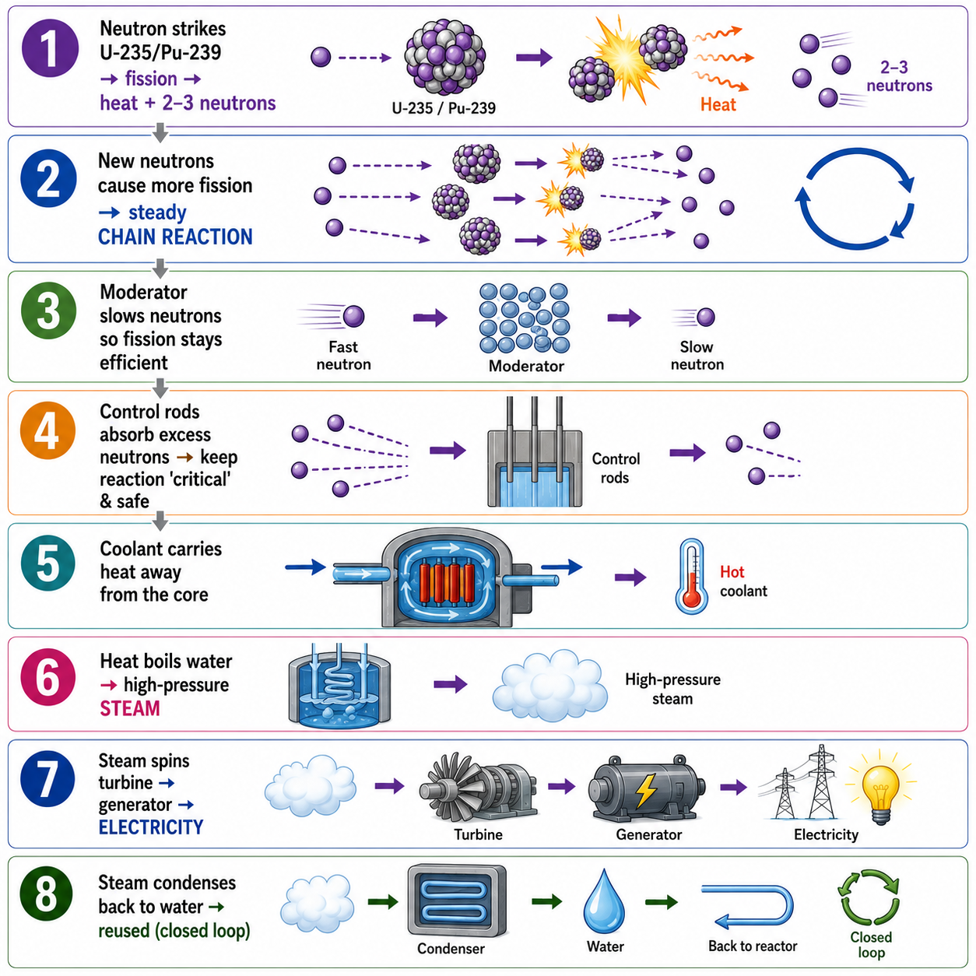
Follow the energy as it flows from a single neutron all the way to the bulb in your home.
| 1 Neutron strikes U-235/Pu-239 → fission → heat + 2–3 neutrons |
▼
| 2 New neutrons cause more fission → steady CHAIN REACTION |
▼
| 3 Moderator slows neutrons so fission stays efficient (thermal reactors only — FBRs have no moderator) |
▼
| 4 Control rods absorb excess neutrons → keep reaction ‘critical’ & safe |
▼
| 5 Coolant carries heat away from the core |
▼
| 6 Heat boils water → high-pressure STEAM |
▼
| 7 Steam spins turbine → generator → ELECTRICITY |
▼
| 8 Steam condenses back to water → reused (closed loop) |
Types of Nuclear Reactors
Reactors come in several designs. We will study the four most important ones — PWR, BWR, PHWR and FBR — plus the advanced designs (AHWR, SMR, Fusion). Pay special attention to PHWR and FBR; they are the backbone of India’s Three-Stage Nuclear Programme.
Pressurised Water Reactor (PWR)
A PWR is a thermal reactor that uses ordinary light water (H₂O) as both coolant and moderator, with low-enriched uranium (~3–5% U-235) as fuel.
Its signature trick: the primary water is kept at very high pressure (~150 atm) so it does not boil even at 315–325°C. In India, Kudankulam (Russian VVER design) is a PWR variant.
Working — two separate water loops:
- Fission heats the core.
- Pressurised light water in the primary loop carries heat out.
- In the steam generator it passes heat to a secondary loop of non-radioactive water.
- That water boils to steam and drives the turbine.
- Control rods regulate the reaction.
| ✓ Advantages of PWR | ✗ Disadvantages of PWR |
| High thermal efficiency from high pressure & temperature. | Needs enriched uranium — extra cost & technology. |
| Compact design; smaller reactor for the same power. | High-pressure operation needs costly pressure vessels. |
| Enhanced safety — radioactive primary loop is sealed off from steam/turbine. | Corrosion & leakage risk from hot high-pressure water. |
| Proven technology — ~70% of world reactors; mature & reliable. | Moderate efficiency (~32–34%); waste generation. |
| Good load-following; ideal for marine use (INS Arihant). | Coolant dependency — loss of coolant risks meltdown; hydrogen-explosion risk on overheating. |
| ★ Uranium Enrichment — a quick but vital aside Uranium enrichment raises the proportion of fissile U-235 in natural uranium. Natural uranium is only ~0.7% U-235 (the rest mostly U-238). Enrichment levels: commercial light-water reactors ~3–5%; research/some naval reactors up to 20%; weapons-grade ~90%. Process: uranium is turned into gas (UF₆) and separated by tiny mass differences, most commonly using gas centrifuges (historically, gaseous diffusion). Enrichment is the gateway that decides whether uranium fuels a reactor or a bomb — which is why it sits at the centre of global non-proliferation politics. |
Boiling Water Reactor (BWR)
A BWR also uses light water (H₂O) as coolant and moderator and low-enriched uranium (~3–5%) as fuel — but with one bold simplification: the water is allowed to boil right inside the core, and that steam directly drives the turbine. This makes it a single-loop system. In India, Tarapur Atomic Power Station Units 1 & 2 (US-supplied) used BWRs.
Working: fission heats the core → water acts as both moderator and coolant → water boils in the vessel → steam goes straight to the turbine → condenses → returns. Control rods regulate the rate.
| ✓ Advantages of BWR | ✗ Disadvantages of BWR |
| Simpler design — single loop, no separate steam generator; cheaper to build. | Radioactive steam — steam touches the core, so turbine & piping become slightly radioactive. |
| Higher heat-transfer efficiency (steam made directly in core). | Lower power density because boiling reduces coolant density. |
| Lower pressure (~70 atm), about half a PWR — less stress, better safety. | Slightly lower thermal efficiency than advanced PWRs. |
| Better neutron economy; faster load response. | Reactivity instability from steam ‘voids’; needs careful control. |
| Proven, mature technology (Japan, USA, Sweden). | Shorter component life; corrosion from steam + radiation. |
Pressurised Heavy Water Reactor (PHWR) — India’s Workhorse
Now we reach the reactor closest to India’s heart. A PHWR runs on natural uranium (just ~0.7% U-235 — no enrichment needed!) and uses heavy water (D₂O) as both moderator and coolant. Heavy water is brilliant because it slows neutrons efficiently while absorbing very few of them — so fission can be sustained even with un-enriched uranium. The PHWR forms the First Stage of India’s Three-Stage Nuclear Programme.
- Examples: Rajasthan Atomic Power Station — RAPS (India’s first PHWR, Canadian collaboration), Kakrapar, Kaiga, Narora; the original design is the Canadian CANDU reactor.
Working — two loops:
- U-235 in natural uranium fissions, releasing heat & neutrons.
- Pressurised heavy water acts as moderator + coolant and carries heat to a steam generator.
- Light water in the secondary loop becomes steam and drives the turbine.
- Control rods maintain a steady chain reaction.
| ✓ Advantages of PHWR | ✗ Disadvantages of PHWR |
| Uses natural uranium — no costly enrichment. | High heavy-water cost to produce & maintain. |
| Excellent neutron economy (D₂O absorbs few neutrons). | Lower efficiency (~30%) than PWRs. |
| On-load refuelling — refuel while running; higher availability. | Tritium production from neutron + deuterium; must be managed. |
| Indigenous & self-reliant; lower pressure (~100 atm). | Larger core (natural U is less energy-dense). |
| Negative reactivity coefficient — auto-slows if it overheats. | Long-lived waste; disposal needed. |
| Flexible fuel (thorium, MOX) — ideal for India’s thorium-rich strategy. | Limited global adoption (mainly India & Canada). |
Fast Breeder Reactor (FBR) — The Fuel-Maker
Here is something almost magical. An FBR uses fast (unmoderated) neutrons and breeds more fissile fuel than it consumes — hence the word ‘breeder’. It burns Mixed Oxide (MOX) fuel of Pu-239 and U-238, uses liquid sodium coolant, and wraps the core in a breeding blanket of fertile U-238 or Th-232. The FBR is the Second Stage of India’s Three-Stage Programme.
- Examples: Fast Breeder Test Reactor (operational) and Prototype Fast Breeder Reactor (attained first criticality in April 2026) at Kalpakkam, Tamil Nadu; BN-600 (Russia).
Working — the breeding trick:
- Pu-239 & U-238 fission gives fast neutrons + heat.
- Fast neutrons (no moderator) are absorbed by fertile isotopes in the blanket, converting them into new fissile fuel — U-238 → Pu-239 and Th-232 → U-233.
- Two sodium loops carry heat to the steam generator (the secondary loop isolates radioactive sodium from the turbine).
| ◆ Why ‘breeder’ is such a big deal for India An ordinary reactor is like a stove that only burns fuel. A breeder is a magical stove that, while cooking, also creates MORE firewood than it burns — converting otherwise useless U-238 and abundant Th-232 into usable fuel. For a country with modest uranium but the world’s largest thorium reserves, this is the bridge to energy independence. |
| ✓ Advantages of FBR | ✗ Disadvantages of FBR |
| Breeds more fuel — extends nuclear resources for centuries. | Complex & costly fuel handling and sodium loops. |
| High fuel efficiency (uses 60–70% of fuel energy vs <1% in thermal reactors). | Sodium hazard — reacts violently with air & water. |
| Reduces waste — consumes long-lived actinides. | High build & maintenance cost; specialised materials. |
| High thermal efficiency (~40%) at up to 550°C. | Difficult MOX fuel handling — highly radioactive & toxic. |
| High power density from a small core. | Limited experience — few countries; long road to commercial scale. |
Advanced & Emerging Reactors
Advanced Heavy Water Reactor (AHWR) — India’s Third Stage
The AHWR is a next-generation reactor designed around Th-232 and U-233 (with some Pu-239), using heavy water as moderator and boiling light water as coolant (single-loop, like a BWR).
Developed by BARC, Mumbai, it represents the final, Third Stage of India’s programme — the stage where India’s vast thorium reserves finally take centre stage. It breeds U-233 from Th-232 within the same reactor, and uses passive safety systems (natural-circulation cooling, gravity-fed water, self-shutdown) that need no external power.
- Strengths: energy independence (India holds ~25% of world thorium), self-sustaining thorium cycle, passive safety, low waste, indigenous design.
- Limits: still under development; complex fuel cycle; U-233 emits strong gamma (needs remote handling); slow breeding; limited global experience; ~30–33% efficiency.
Small Modular Reactors (SMRs)
An SMR generates up to 300 MWe per unit — about one-third of a conventional reactor. The key idea is modularity: built in factories, transported, and assembled on site, using proven light-water technology with advanced passive safety. Examples: NuScale (USA), Akademik Lomonosov (Russia), Linglong One (China), Rolls-Royce SMR (UK); BARC and NPCIL are exploring Indian designs.
- Strengths: compact & scalable, lower capital cost, shorter build (3–5 yrs vs 8–10), passive safety, decentralised deployment for remote regions, load-following, long refuelling cycles, less cooling water, versatile (heat, desalination, hydrogen), strong IAEA backing.
- Limits: little operational experience, higher cost per kWh initially, HALEU fuel-supply needs, waste handling, proliferation/security concerns, decommissioning complexity, long payback.
Fusion Reactor (Experimental)
The ultimate prize: a reactor that fuses deuterium and tritium into helium, mimicking the Sun to deliver clean, virtually limitless energy. The flagship is ITER (International Thermonuclear Experimental Reactor) in France — with India, USA, Russia, EU, Japan, South Korea and China as partners — currently under construction. Its goal is an energy gain of Q = 10: 500 MW of fusion power from 50 MW of input heating.
- Strengths: abundant fuel, clean & sustainable, inherently safe (self-limiting), extreme energy density (1 g ≈ 8 tonnes of oil), no enrichment needed.
- Limits: needs >100 million °C, hard plasma confinement, very high cost & complexity, tritium handling, neutron-induced material degradation, decades from commercial use.
Classifying Reactors
Examiners may be asking ‘which reactor uses which moderator/coolant/fuel’. These compact tables make revision painless.
By Neutron Energy
| Type | Description | Examples |
| Thermal Reactors | Use slow (thermal) neutrons; need a moderator | PHWR, PWR, BWR, CANDU, Magnox |
| Fast Breeder Reactors | Use fast neutrons (no moderator); breed fuel | FBTR (Kalpakkam), BN-600 (Russia) |
By Moderator
| Moderator | Reactor Type | Examples |
| Light Water (H₂O) | Pressurised Water Reactor (PWR) | USA, France, Kudankulam |
| Light Water (H₂O) | Boiling Water Reactor (BWR) | Tarapur, Japan |
| Heavy Water (D₂O) | Pressurised Heavy Water Reactor (PHWR) | Rajasthan, Kakrapar, Kaiga |
| Graphite | Gas-Cooled Reactor (GCR) | Magnox (UK) |
| Light Water Graphite Reactor | RBMK (USSR) | |
| None | Fast Breeder Reactor (FBR) | Kalpakkam (India) |
By Coolant
| Coolant | Reactor Type | Examples |
| Light Water (H₂O) | PWR, BWR | Kudankulam & Tarapur |
| Heavy Water (D₂O) | PHWR | Kakrapar & Rajasthan |
| Liquid Sodium | Fast Breeder Reactor | FBTR (Kalpakkam) |
| Carbon Dioxide (CO₂) | Gas-Cooled Reactor | Magnox (UK) |
| Helium Gas | High-Temperature Gas-Cooled Reactor (HTGR) | Germany, Japan |
| Molten Salt | Molten Salt Reactor (MSR) | Under development (USA, China) |
By Fuel Type
| Fuel Used | Reactor Type | Examples |
| Natural Uranium | PHWR, Magnox | Rajasthan, Kakrapar |
| Enriched Uranium | PWR, BWR | Kudankulam, Tarapur |
| Mixed Oxide (U-Pu) | FBR, MOX Reactors | FBTR (Kalpakkam) |
| Thorium-Based | AHWR (under development) | India’s future reactor (BARC) |
By Purpose & By Generation
| Purpose | Reactor Type | Function / Example |
| Power Reactor | PHWR, PWR, BWR | Electricity (Kudankulam, Kaiga) |
| Research Reactor | Apsara, Dhruva | Neutron research, isotopes |
| Breeder Reactor | FBTR, PFBR | Breeds U-233, Pu-239 |
| Prototype Reactor | AHWR | Testing thorium technology |
| Submarine Reactor | Compact PWR | INS Arihant |
| Production (Military) | Plutonium Production Reactor | CIRUS (retired), Hanford (USA) |
| Generation | Period | Key Features / Examples |
| Gen I | 1950s–60s | Early experimental designs (Shippingport, USA) |
| Gen II | 1970s–90s | Commercial plants (PHWR, PWR, BWR) |
| Gen III / III+ | 2000s–present | Improved safety & efficiency (EPR, AP1000, Kudankulam) |
| Gen IV | Future | Sustainable, breeder & thorium-based (AHWR, MSR, SMR) |
India’s Three-Stage Nuclear Programme — The Big Picture
Designed by Dr. Homi Bhabha, this is perhaps the single most exam-relevant theme in the chapter. Its logic flows directly from India’s resources: modest uranium, but the world’s largest thorium reserves.
| STAGE 1 PHWR — burns natural uranium (U-235), produces Pu-239 |
▼
| STAGE 2 FBR — uses Pu-239 + U-238/Th-232; breeds more fuel (U-233) |
▼
| STAGE 3 AHWR — Thorium (Th-232 → U-233) cycle for limitless energy |
The Nuclear Bomb — Power Turned to Destruction
We now turn to the chapter’s darkest application. A nuclear bomb (atomic or thermonuclear weapon) is an explosive device whose enormous destructive power comes from fission, fusion, or a combination of both. Per unit mass it releases energy far beyond any chemical explosive, producing intense blast, heat, and ionising radiation — and often long-term radioactive contamination. Understand these designs, but never lose sight of the human cost behind them.
Types of Nuclear Bombs (by Design)
Fission (Atomic) Bombs
Also called the A-bomb, these release energy through rapid, uncontrolled fission of U-235 or Pu-239. They have a relatively simpler design, yields in the kiloton range, and produce radioactive fallout. They are responsible for the first and only wartime use of nuclear weapons (1945). Two subtypes:
- Gun-type (historical) — two subcritical masses of U-235 are fired together to form a supercritical mass. E.g., “Little Boy” (Hiroshima, 1945).
- Implosion-type — conventional explosives compress a subcritical Pu-239 core symmetrically inward to supercriticality. E.g., “Fat Man” (Nagasaki, 1945).
Boosted Fission Weapons
A small quantity of fusion fuel (deuterium–tritium gas) is injected into the fission core. During detonation, fusion produces extra high-energy neutrons that boost the efficiency and yield of the fission reaction. The result: higher yield from the same fissile material, enabling compact warheads — yet the output remains fission-dominated, producing fallout.
Thermonuclear / Hydrogen / Fusion Weapons
The most powerful design. A two-stage weapon: a fission primary (A-bomb) creates the extreme temperature and pressure needed to ignite a fusion secondary (H-bomb).
- Extremely high energy density — compact warheads with very large yields (hundreds of kilotons to several megatons).
- Adjustable yield and a central strategic role — deployed on ICBMs, SLBMs and strategic bombers.
- Significant fallout risk from fissionable layers; the Tsar Bomba (USSR, 1961) remains the largest nuclear test ever.
Pure Fusion Weapons (Theoretical)
A hypothetical device releasing energy solely from fusion, with no fission trigger. Status: purely theoretical — no publicly verified, deployable pure-fusion weapon is known to exist.
Enhanced-Radiation Weapons (Neutron Bombs)
A low-yield weapon engineered to maximise prompt neutron radiation while minimising blast and heat. It is a modified boosted-fission/small thermonuclear device.
- Low yield (1–10 kt) but intense fast-neutron radiation — lethal to living organisms over a wide radius while sparing infrastructure.
- Short-term radiation; designed for tactical battlefield use (against tanks, troops) rather than city destruction.
- Developed by the US, USSR, France and China, but never widely deployed — mostly withdrawn due to political backlash.
Bombs by Purpose, Yield & Generation
By Purpose (Operational Role)
| Category | Intended Role | Range / Yield | Delivery |
| Strategic | Long-range deterrence vs cities, infrastructure, command centres | Hundreds of kt to megatons | ICBMs, SLBMs, bombers |
| Tactical | Localised battlefield use vs troops, armour, installations | Tons to a few kt | Artillery, short-range missiles, bombs |
| Radiological (Dirty Bomb) | Contamination, not blast; disperses radioactive material | Not a true nuclear blast | Conventional explosives |
| Anti-Satellite / EMP | High-altitude burst to create EMP or damage space assets | Low to moderate | High-altitude / orbital vehicle |
By Yield / Effect
| Category | Typical Yield | Effect | Examples |
| Low-Yield | <10 kt | Tactical, localised | Neutron bomb, small fission devices |
| Medium-Yield | 10–100 kt | Tactical to limited strategic | Hiroshima/Nagasaki range |
| High-Yield | >100 kt to megatons | Strategic, massive destruction | Thermonuclear; Tsar Bomba |
By Generation
| Generation | Type / Era | Key Advancement |
| 1st (1940s–50s) | Simple fission bombs (U-Pu) | Basic chain-reaction control |
| 2nd (1950s–60s) | Thermonuclear weapons | Fusion stage for higher yield |
| 3rd (1970s–80s) | Boosted fission, neutron bombs | Yield control, compactness, tactical roles |
| 4th (Experimental) | Pure fusion / advanced radiological | Theoretical miniaturisation, low-fallout |
A Timeline — The History of Nuclear Weapons
Finally, let us place these ideas on the river of history. A timeline is the easiest way to retain dates, and the easiest way for the examiner to test you. Read it as a story of discovery curdling into rivalry, and rivalry slowly being fenced in by treaties.
Scientific Foundations (1890s–1930s)
| Year | Milestone |
| 1896 | Henri Becquerel discovers natural radioactivity; the Curies study polonium & radium |
| 1919 | Ernest Rutherford achieves the first artificial nuclear reaction (transmutation) |
| 1932 | James Chadwick discovers the neutron — the key to chain reactions |
| 1938 | Otto Hahn & Fritz Strassmann discover nuclear fission; Lise Meitner & Otto Frisch explain it |
World War II & the Manhattan Project (1939–1945)
- Manhattan Project (1942–45): secret US-led programme (with UK & Canada), led by Gen. Leslie Groves (engineering) and J. Robert Oppenheimer (science), built the first nuclear weapons.
- Trinity Test (July 1945): first-ever nuclear explosion, a Pu implosion device (~20 kt) in the New Mexico desert — the atomic age begins.
- Hiroshima & Nagasaki (Aug 1945): “Little Boy” (U gun-type, ~15 kt) on 6 Aug; “Fat Man” (Pu implosion, ~21 kt) on 9 Aug — leading to Japan’s surrender and the end of WWII.
Early Cold War & Arms Race (1945–1960s)
| Year | Event |
| 1945 | US monopoly on nuclear weapons begins |
| 1949 | USSR tests its first atomic bomb (“First Lightning”) — arms race begins |
| 1952 | UK’s first atomic test; USA’s Ivy Mike — first full-scale thermonuclear (fusion) weapon |
| 1954–58 | France and China begin nuclear weapons programmes |
| 1957 | IAEA established to promote peaceful uses and oversee safeguards |
Height of the Arms Race (1960s–1980s)
| Year | Event |
| 1960 | France tests an atomic bomb |
| 1961 | USSR detonates Tsar Bomba (~50 Mt) — largest explosion ever |
| 1963 | Partial Test Ban Treaty (PTBT) — bans tests in atmosphere, space & underwater |
| 1964 | China tests its first atomic bomb |
| 1968 | Nuclear Non-Proliferation Treaty (NPT) signed (in force 1970) |
| 1974 | India’s “Smiling Buddha” (peaceful) test at Pokhran — 6th nation to test |
| 1974–75 | Nuclear Suppliers Group (NSG) formed in reaction to India’s test |
| 1986 | Chernobyl disaster reinforces global nuclear-safety awareness |
| 1987 | INF Treaty (US–USSR) removes a whole class of missiles |
Post-Cold War Era (1990s–2000s)
| Year | Event |
| 1991 | START I — US & USSR/Russia agree large warhead reductions |
| 1996 | Comprehensive Nuclear-Test-Ban Treaty (CTBT) adopted (not yet in force) |
| 1998 | India’s Pokhran-II (Operation Shakti, 5 tests) → nuclear-weapon state; Pakistan’s Chagai tests follow |
| 2003 | North Korea withdraws from NPT; conducts tests from 2006 |
| 2009–10 | New START (US–Russia) caps deployed strategic warheads (~1,550 each). It EXPIRED on 5 February 2026 and has not been replaced as of July 2026. |
| 2017 | Treaty on the Prohibition of Nuclear Weapons (TPNW) — in force 2021 (nuclear powers not joined) |
Tying It All Together
Let us step back and see the whole forest, now that we have walked among the trees. Everything in this chapter springs from a single seed — E = mc² — the idea that a sliver of mass can become a flood of energy.
From that seed grow two great branches: fission, which splits heavy nuclei and powers today’s reactors and bombs, and fusion, which joins light nuclei, lights the Sun, and remains humanity’s unfinished dream of clean limitless power.
Around these we met the quieter reactions — radioactivity, transmutation, neutron capture, spallation — each unstable nucleus simply seeking peace. We saw how engineers tamed fission inside reactors (PWR, BWR, PHWR, FBR, AHWR, SMR), and how India built a thoughtful Three-Stage Programme to convert its thorium wealth into lasting energy security.
And we confronted the same physics turned into weapons, and the long chain of treaties — NPT, CTBT, NSG, New START, TPNW — by which the world tries to keep that power in check.
| ◆ The one thought to carry away The nucleus is morally neutral — it neither blesses nor curses. The same fission that destroyed Hiroshima also lights Kudankulam and cures cancer patients with Cobalt-60. Technology only magnifies human choice. For an aspirant who will one day help shape policy, that is the real lesson hiding inside the physics. |