
Nuclear Energy in India
Introduction
Think about this for a moment: India is a nation of 1.4 billion people with an insatiable appetite for energy. Coal is polluting our skies, oil is burning holes in our import bill, and solar and wind, though renewable, are intermittent — they stop when the sun sets and the wind stills.
So what is India’s long-term answer for clean, reliable, 24×7 base-load power? The answer, conceived by Dr. Homi Jehangir Bhabha in the 1950s, is Nuclear Energy.
But India’s nuclear story is not just about generating electricity. It is the story of scientific vision, strategic autonomy, technological self-reliance, and a three-stage master plan designed to give India energy independence for centuries. Not years. Not decades. Centuries. That is the scale of thinking that Bhabha brought to independent India.
| The Big Picture — Why This Section Matters for UPSC Nuclear energy currently supplies only ~3% of India’s electricity, yet this 3% carries the weight of a 70-year-old programme spanning three stages, multiple institutions, several landmark laws, and global agreements. The UPSC examiner tests not just facts, but your ability to understand WHY India took the path it did — the resource constraints, the strategic compulsions, and the geopolitical dimensions. This section, once mastered, gives you the analytical depth to answer any question on this topic. |
Historical Background of Nuclear Energy in India
The story begins in 1945 — barely two years before Independence — when the visionary Dr. Homi Jehangir Bhabha established the Tata Institute of Fundamental Research (TIFR) in Mumbai. Think of TIFR as the seed from which the entire nuclear tree grew.
Within three years, the government gave it the legal and institutional framework it needed. The Atomic Energy Act of 1948 became the first legal foundation, and the Atomic Energy Commission (AEC), with Bhabha as its first chairman, became the apex policy body — a body that reported directly to the Prime Minister.
Even at that stage, nuclear energy was being treated not as a minor ministry matter, but as a matter of national strategy.
The chronology that follows is not just a list of dates — each milestone is a chapter in India’s quest for technological sovereignty. Memorise the key milestones and understand their significance, not just the year.
Chronology of India’s Atomic Energy Development
| Year | Milestone | Significance (Why It Matters) |
| 1945 | TIFR established by Dr. Homi J. Bhabha, Mumbai | Cradle of India’s atomic research; foundation of all future nuclear science |
| 1948 | Atomic Energy Act, 1948 enacted | India’s first nuclear legislation — gave legal basis to the programme |
| 1948 | Atomic Energy Commission (AEC) set up; Bhabha as 1st Chairman | Highest nuclear policy body; reported directly to PM — signals strategic importance |
| 1954 | Department of Atomic Energy (DAE) created under PMO | Brought nuclear programme under direct PM oversight — strategic centralisation |
| 1954 | Atomic Energy Establishment, Trombay (AEET) established | Later renamed BARC in 1967; became India’s principal R&D hub |
| 1956 | APSARA reactor commissioned at Trombay | Asia’s first research reactor; built with British assistance |
| 1958 | India’s Three-Stage Nuclear Programme formally adopted | Bhabha’s 1954 vision formalised — India’s roadmap to energy independence via thorium |
| 1969 | Tarapur Atomic Power Station commissioned | India’s first commercial nuclear plant; BWRs supplied by USA under ‘Atoms for Peace’ |
| 1971 | IGCAR established at Kalpakkam | Primary R&D centre for Fast Breeder Reactor technology (Stage II) |
| 1973 | Rajasthan Atomic Power Station (RAPS) | Canada-assisted PHWR; later indigenised — India’s first step to indigenous mastery |
| 1974 | Pokhran-I (Smiling Buddha) — India’s first peaceful nuclear explosion | Led to NSG formation and international sanctions; pushed India toward self-reliance |
| 1985 | Dhruva commissioned at BARC, Trombay | India’s largest research reactor; major source of radioisotopes |
| 1998 | Pokhran-II (Operation Shakti) | Declared India a de facto nuclear weapons state with credible capability |
| 2003 | India’s Nuclear Doctrine adopted | Based on ‘No First Use’ + ‘Credible Minimum Deterrence’ |
| 2008 | Indo-US Civil Nuclear Agreement (123 Agreement) signed | Ended nuclear isolation; allowed civil nuclear trade with USA and NSG countries |
| 2008 | NSG Waiver granted to India | First-ever country-specific waiver; enabled civilian nuclear trade globally |
| Pokhran I vs. II Pokhran-I (1974): Code name ‘Smiling Buddha’. India called it a ‘peaceful nuclear explosion.’ It triggered the formation of the Nuclear Suppliers Group (NSG) and led to severe technology sanctions — which paradoxically forced India to develop its own PHWR technology (blessing in disguise!). Pokhran-II (1998): Code name ‘Operation Shakti.’ India openly declared itself a nuclear weapons state. Pakistan responded within weeks with its own tests (Chagai-I). |
Significance of Nuclear Energy for India
Why does nuclear energy matter so much for India? Think of it as a three-dimensional problem.
- First, India has a massive and growing energy demand.
- Second, India imports roughly 85% of its crude oil — a serious drain on foreign exchange.
- Third, India has committed to Net-Zero carbon emissions by 2070.
Nuclear energy uniquely addresses all three simultaneously: it is abundant, low-carbon, and domestically producible once the three-stage programme matures.
- Energy Security: Nuclear plants provide 24/7 base-load power — the kind of round-the-clock supply that India’s industrial sector needs and that neither solar nor wind can provide reliably.
- Reducing Fossil Fuel Import Bill: India imports ~85% of crude oil and ~50% of natural gas. Each rupee devaluation inflates the import bill. Nuclear reduces this structural vulnerability.
- Net-Zero 2070 Commitment: India needs 5,630 GW of solar capacity by 2070. Nuclear provides 17% of India’s non-fossil firm power (i.e., power available when needed) — though it is only 3% of total generation. This firmness is critical.
- Thorium — India’s Strategic Ace: India holds 25-30% of the world’s thorium reserves, mainly in monazite sands in Kerala, Tamil Nadu, and Andhra Pradesh. The three-stage programme is specifically designed to convert this thorium into usable fuel via Uranium-233. This is India’s long-term energy trump card.
- Technological Self-Reliance (Atmanirbhar Bharat): India has indigenised PHWR-220, PHWR-540, and PHWR-700 designs. The upcoming AHWR (Advanced Heavy Water Reactor) will use thorium. India is one of the few nations mastering the complete nuclear fuel cycle — from mining to reprocessing.
- Grid Stability: Indian nuclear plants operate at 85-90% capacity factor — far higher than solar (20-25%) or wind (25-35%). This high reliability is essential for grid stability as intermittent renewables expand.
- Reducing Coal Dependence: Coal contributes ~70% of India’s power. Reducing this without nuclear risks energy shortages. Nuclear provides the low-carbon, always-on alternative.
- Radioisotopes for Medicine, Agriculture & Space: India supplies radioisotopes (like Cobalt-60, Iodine-131) to 40+ countries. These enable cancer treatment, food preservation, and space applications — making India a global leader.
- Closed Fuel Cycle — Waste Reduction: India reprocesses spent fuel to recover Plutonium and Uranium, reducing waste and extending fuel supply. This closed cycle is a model of resource efficiency.
- Geopolitical Standing: Civil nuclear cooperation agreements with 14+ countries (Russia, France, USA, Japan, Australia, Canada, Kazakhstan) demonstrate India’s recognised status as a responsible nuclear power.
- Supports Atmanirbhar Bharat: Development of BARC, IGCAR, and NPCIL as world-class institutions has created advanced capabilities in metallurgy, cryogenics, materials science, and robotics — strengthening India’s scientific ecosystem broadly.
Challenges and Issues for Nuclear Energy in India
Every strength has a shadow. India’s nuclear programme, for all its brilliance, faces serious structural challenges. The UPSC examiner expects you not merely to list these challenges, but to understand why they exist and what their implications are. Let us examine them honestly.
- Limited Domestic Uranium: India has only ~1-2% of global uranium reserves — mostly low-grade — in Jharkhand, Meghalaya, and Andhra Pradesh. This forces reliance on IAEA-safeguarded imports and historically constrained reactor operations.
- Delayed Fast Breeder Reactor (FBR) Programme: While the Prototype Fast Breeder Reactor (PFBR) at Kalpakkam finally achieved criticality in 2026, over a decade of severe delays has heavily bottlenecked the critical Stage I-to-Stage II transition. Consequently, commercial scaling and India’s ultimate goal of thorium utilisation remain pushed far into the future.
- High Construction Cost & Time Overruns: Indigenous 700 MW PHWRs cost Rs. 17,000-20,000 crore per site; imported PWRs cost even more. Gestation periods of 7-10+ years make nuclear less cost-competitive against rapidly deployable solar and wind.
- Public Opposition & Local Protests: Projects at Kudankulam (Tamil Nadu), Jaitapur (Maharashtra), and Kovvada (Andhra Pradesh) have seen large protests over safety, displacement, and ecological concerns — significantly escalating costs and timelines.
- NSG Membership Denial: India is still NOT a member of the Nuclear Suppliers Group (NSG). This limits access to certain advanced reactor components, enrichment technologies, and fuel-cycle machinery — creating uncertainty for large foreign-assisted projects.
- Limited Manufacturing Capacity: Only a few Indian companies (L&T, BHEL) can produce heavy nuclear-grade components. Supply constraints slow the rollout of indigenous 700 MW PHWRs and future Small Modular Reactors (SMRs).
- Waste Management Infrastructure: India reprocesses spent fuel at Tarapur, Kalpakkam, and BARC (Trombay) — but capacity is limited. High-level radioactive waste vitrification and long-term storage need significant scaling up.
- Underperformance vs. Strategic Potential: Nuclear contributes only ~3% of India’s electricity, far below its strategic potential. The government targets tripling capacity to 22,480 MW by 2031-32 , and — under the Nuclear Energy Mission announced in Budget 2025-26 (₹20,000 crore) — 100 GW by 2047, with at least five indigenously designed SMRs operational by 2033. Both targets require commissioning far faster than the current pace.
- Natural Disaster Vulnerability: Sites like Kalpakkam and Kudankulam are in coastal zones vulnerable to cyclones and tsunamis (the 2004 tsunami affected MAPS briefly). Enhanced safety measures increase cost and design complexity.
Nuclear Reactors of India
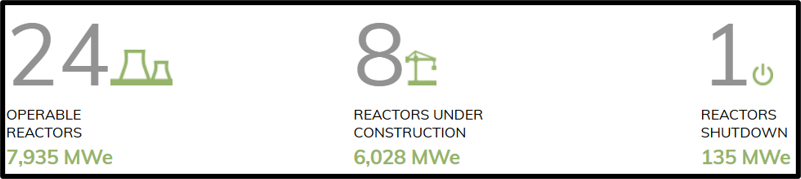
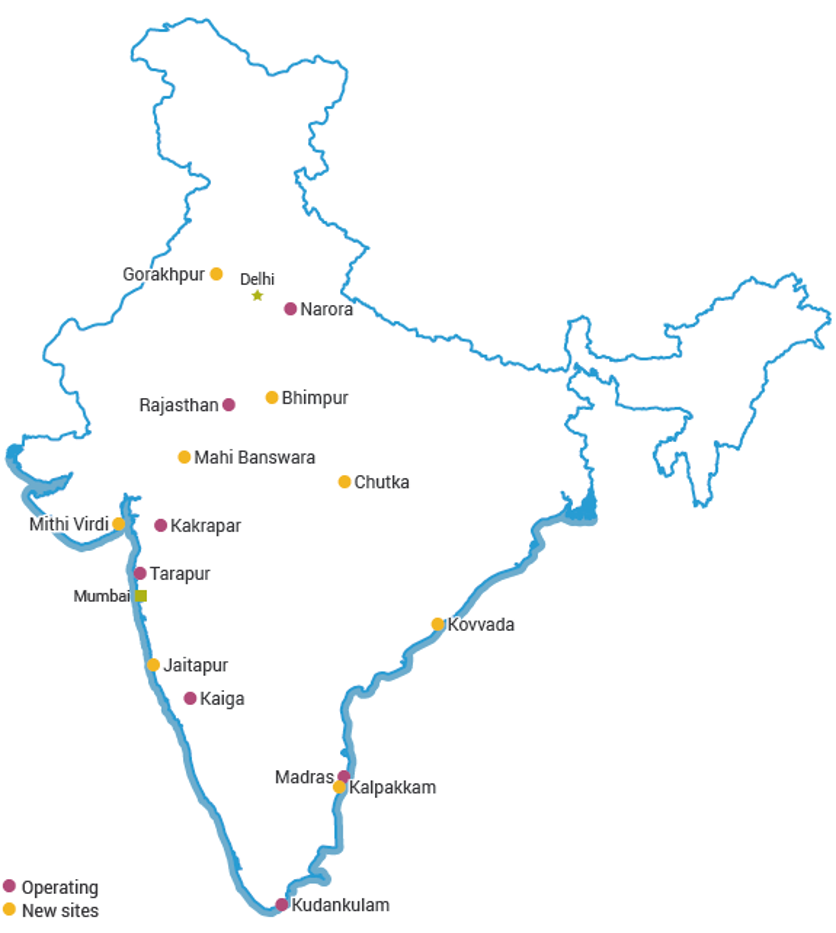
As of July 2026, India operates 24 nuclear reactors at 7 sites, totalling ~7,935 MWe of installed capacity. These reactors are of three main types — and understanding the differences between them is essential.
Types of Nuclear Reactors in India
| Reactor Type | Fuel | Moderator / Coolant | Key Feature for India |
| Pressurised Heavy Water Reactor (PHWR) | Natural Uranium (U-238 + trace U-235) | Heavy Water (D2O) — both moderator & coolant | Does NOT need enriched uranium — perfect for India’s limited, low-grade uranium |
| Boiling Water Reactor (BWR) | Enriched Uranium | Light Water (H2O) — both moderator & coolant | India’s FIRST commercial reactor type; US-supplied under ‘Atoms for Peace’ |
| Pressurised Water Reactor (PWR) | Enriched Uranium | Light Water — coolant (under HIGH pressure) + moderator | India’s LARGEST reactors (VVER-1000); Russia-supplied at Kudankulam |
Pressurised Heavy Water Reactors (PHWRs) — India’s Backbone
PHWRs are India’s nuclear workhorse. They account for ~80% of India’s nuclear capacity. The reason India chose PHWRs is elegant in its logic: India has very limited uranium reserves, and its uranium is mostly low-grade.
Conventional reactors (like BWRs and PWRs) need enriched uranium — a technology India lacked and was denied after Pokhran-I. But PHWRs run on natural uranium without any enrichment. This made PHWRs India’s only viable option during the technology-denial years after 1974.
- Backbone of Commercial Nuclear Power: World’s largest PHWR fleet — India has indigenised designs at 220 MW, 540 MW, and 700 MW capacities.
- Essential for Stage II: PHWR spent fuel provides Pu-239 (Plutonium-239), which is the fuel for Stage II Fast Breeder Reactors. PHWRs are the ‘factory’ that produces Stage II fuel.
- Kaiga Generating Station (Karnataka): World-leading capacity factor of >90% — a testament to operational excellence.
Boiling Water Reactors (BWRs)
India operates only two BWR units — both at Tarapur, Maharashtra. These were India’s very first commercial nuclear power units, supplied by the USA under the ‘Atoms for Peace’ programme in 1969. They use enriched uranium and contribute only ~4% of India’s nuclear capacity today. Their significance is largely historical — they laid the foundation for India’s civilian nuclear programme.
Pressurised Water Reactors (PWRs)
India’s newest and largest reactors are the VVER-1000 type PWRs (Water-Water Energetic Reactor) at Kudankulam, Tamil Nadu — built with Russian collaboration.
Kudankulam is currently India’s largest nuclear power station (2000 MW operational; 4 more units under construction, adding another 4000 MW). PWRs operate at very high pressures to prevent the coolant from boiling within the reactor core.
Major Nuclear Power Stations of India
| Power Station | State | Type | Units | Capacity | Notable Fact |
| Tarapur (TAPS 1-2) | Maharashtra | BWR | 2 | 320 MW | India’s FIRST commercial nuclear plant (1969); US-supplied |
| Rajasthan (RAPS) | Rajasthan | PHWR | 6 | 1180 MW | Oldest PHWR site; started with Canadian CANDU technology |
| Madras/Kalpakkam (MAPS) | Tamil Nadu | PHWR | 2 | 440 MW | India’s FIRST fully indigenously built PHWR |
| Narora (NAPS) | Uttar Pradesh | PHWR | 2 | 440 MW | High operational reliability; early indigenous design |
| Kakrapar (KAPS) | Gujarat | PHWR | 4 | 1840 MW | India’s FIRST 700 MW PHWRs (advanced design) |
| Kaiga (KGS) | Karnataka | PHWR | 4 | 880 MW | World-leading capacity factor (>90%) |
| Tarapur (Units 3 & 4) | Maharashtra | PHWR | 2 | 1080 MW | India’s FIRST 540 MW PHWRs |
| Kudankulam (KKNPP 1-2) | Tamil Nadu | PWR (VVER-1000) | 2 | 2000 MW | India’s LARGEST nuclear power station; Russia-assisted |
| Kudankulam Units 3-6 | Tamil Nadu | PWR | 4 | 4000 MW | Under construction |
| RAPS 7 & 8 | Rajasthan | PHWR | 2 | 1400 MW | Under construction |
| Gorakhpur GHAVP 1 & 2 | Haryana | PHWR | 2 | 1400 MW | Under construction |
Advanced & Special Reactors
| Reactor | Location | Capacity | Type | Status | Key Significance |
| PFBR | Kalpakkam, TN | 500 MW | Fast Breeder | Critical | Core of Stage II; breeds Pu-239 |
| FBR-600 Series | Multiple sites | 600 MW each | Fast Breeder | Planned | Expansion of India’s breeder fleet |
| AHWR | TBD | 300 MW | Thorium-based | Conceptual prototype | Core of Stage III — India’s flagship thorium reactor |
| KAMINI | Kalpakkam, TN | 30 kW | U-233 Reactor | Operational | World’s ONLY operating U-233-fuelled reactor |
| Dhruva | BARC, Trombay | 100 MW | Research | Operational | India’s main research + radioisotope production reactor |
| Apsara-U | BARC, Trombay | Low | Research | Operational | Upgraded version of Asia’s first research reactor |
Major Proposed Foreign-Assisted Projects
| Project | State | Reactor Type | Capacity | Foreign Partner | Status |
| Jaitapur NPP | Maharashtra | EPR (PWR) | 9,900 MW | France | Planned to be world’s LARGEST nuclear plant |
| Kovvada NPP | Andhra Pradesh | AP1000 (PWR) | TBD | USA | Proposed; finalisation pending |
| Kudankulam Expansion | Tamil Nadu | VVER-1000 | TBD | Russia | Long-term proposed |
India’s Three-Stage Nuclear Power Programme
This is the HEART of India’s nuclear strategy — Bhabha’s masterpiece. Before explaining the stages, let us understand the problem it was designed to solve.
India has a paradox: It has very little uranium (only 1-2% of world reserves), but enormous amounts of thorium (25-30% of world reserves). Normal reactors run on uranium. So how do you build a nuclear energy programme when you lack the primary fuel?
You cannot use thorium directly either — thorium (Th-232) is a fertile material, not a fissile one. It cannot sustain a chain reaction by itself. To use thorium, you must first convert it into Uranium-233 (U-233) inside a reactor. That is exactly what the three-stage programme does — in three elegant steps.
| Key Distinction — Fissile vs. Fertile FISSILE materials (U-235, Pu-239, U-233): Can sustain a nuclear chain reaction on their own. They are ‘ready to use’ as reactor fuel. FERTILE materials (U-238, Th-232): Cannot sustain a chain reaction but can be CONVERTED into fissile materials inside a reactor. Think of them as raw ore that must be processed. India’s challenge: Abundant fertile Th-232, scarce fissile material. The three-stage programme is essentially a conversion factory — converting fertile materials into fissile fuel, stage by stage. |
The Three Stages
| STAGE I PHWRs (Foundation) Reactor: PHWR Fuel: Natural Uranium (U-238 + U-235) Output: Electricity + Pu-239 (in spent fuel) Purpose: Generate power; produce Pu-239 as fuel for Stage II | => | STAGE II Fast Breeder Reactors Reactor: FBR (sodium-cooled) Fuel: MOX fuel (Pu-239 + U-238) Output: Electricity + More Pu-239 + U-233 Purpose: Convert U-238 -> Pu-239 and Th-232 -> U-233; breed more fuel than consumed | => | STAGE III Thorium Reactors (Sustainability) Reactor: AHWR Fuel: Th-232 + U-233 (or Pu-239) Output: Electricity + U-233 Purpose: Use abundant thorium; achieve long-term self-reliant nuclear energy |
Stage I — Pressurised Heavy Water Reactors (PHWRs) [MATURE]
In Stage I, India uses PHWRs fuelled by natural uranium (U-238 with a small fraction of fissile U-235). These reactors generate electricity — but more importantly, they also produce Plutonium-239 (Pu-239) in their spent fuel. This Pu-239 is the key product of Stage I, because it becomes the fuel for Stage II.
- Reactor: PHWR
- Fuel: Natural Uranium (U-238 + trace U-235)
- Output: Electricity + Pu-239 (in spent fuel)
- Examples: Rajasthan, Kaiga, Kakrapar, Narora, Madras (Kalpakkam) PHWRs
- Status: MATURE — 18+ PHWRs operational; 700 MW PHWRs under expansion
Stage II — Fast Breeder Reactors (FBRs) [Operational-First Criticality April 2026]
Stage II is where the magic of ‘breeding’ happens. Fast Breeder Reactors use Mixed Oxide Fuel (MOX) — a combination of Pu-239 (from Stage I spent fuel) and U-238. The FBR does something remarkable: it produces MORE fissile material than it consumes. This is possible because fast neutrons convert surrounding U-238 into more Pu-239, and Th-232 into U-233 (the fuel for Stage III). The PFBR at Kalpakkam (500 MW) is India’s Stage II pioneer.
- Reactor: Fast Breeder Reactor (sodium-cooled; no moderator needed — fast neutrons do the job)
- Fuel: MOX fuel (Pu-239 + U-238)
- Output: Electricity + more Pu-239 + U-233 (fuel for Stage III)
- Example: PFBR (Prototype Fast Breeder Reactor), Kalpakkam — operated by BHAVINI
- Status: attained its first criticality on 6th April 2026
Stage III — Thorium-Based Reactors (Advanced HWR) [FUTURE]
Stage III is India’s endgame — the ultimate goal of the entire programme. Here, the Advanced Heavy Water Reactor (AHWR) uses thorium (Th-232) along with U-233 (produced in Stage II) as fuel. The AHWR produces electricity and more U-233, creating a self-sustaining thorium fuel cycle. Since India has enough thorium to last for centuries, Stage III represents true energy independence.
- Reactor: AHWR (Advanced Heavy Water Reactor) — heavy water moderator, boiling light water coolant
- Fuel: Th-232 + U-233 (or Pu-239)
- Output: Electricity + U-233 (continuous cycle)
- Status: AHWR design completed at BARC; awaiting policy decision and industrial rollout
Why India Uses This Three-Stage Approach
| Reason | Explanation |
| Limited Uranium, Abundant Thorium | India has only 1-2% of world uranium, but 25-30% of world thorium. Conventional reactors waste this strategic asset. The three-stage programme is designed to unlock it. |
| PHWRs Suited to India’s Low-Grade Uranium | PHWRs use natural uranium (no enrichment needed), enabling India to generate nuclear power even with limited, low-grade uranium reserves. |
| Need to Multiply Fissile Material | India has vast U-238 (fertile) but scarce fissile material. FBRs ‘breed’ more Pu-239 from U-238 — solving the fissile scarcity problem. |
| Thorium Cannot Be Used Directly | Th-232 is fertile, not fissile. It must be converted to U-233 inside a Stage II FBR before Stage III can use it. |
| Long-Term Energy Security | India’s thorium reserves can power the country for centuries. The three-stage cycle ensures fuel self-sufficiency for the long term. |
| Post-Pokhran-I Technology Denial | After 1974, NSG sanctions cut off enrichment, reprocessing, and uranium imports. India had no choice but to develop an indigenous, closed-cycle programme. |
| Closed Fuel Cycle — Waste Reduction | Reprocessing spent fuel recovers Pu and U, reducing waste and extending fuel supply — critical for a resource-scarce nation. |
Current Status Summary
| Stage | Technology | Status |
| Stage I | PHWRs | MATURE — 18+ PHWRs operational; 700 MW PHWRs under expansion |
| Stage II | PFBR (Fast Breeder Reactor) | PFBR at Kalpakkam attained first criticality 6 April 2026; commercial power projected Sept 2026; FBR-600 series planned |
| Stage III | AHWR (Thorium Reactor) | AHWR design completed; awaiting policy decision & industrial rollout |
Legal Framework for Nuclear Energy in India
Laws are the backbone of any nuclear programme. For a technology as powerful — and potentially dangerous — as nuclear energy, robust legal architecture is not optional, it is essential.
India’s nuclear legal framework has evolved over seven decades, with the 2025 SHANTI Act representing the most comprehensive restructuring in history.
Atomic Energy Act, 1948 (Repealed)
India’s first nuclear law. It established the Atomic Energy Commission (AEC) and laid the initial legal foundation. It was later replaced by the more comprehensive Atomic Energy Act, 1962.
Atomic Energy Act, 1962 — The Primary Law
The Atomic Energy Act, 1962 is India’s primary legislation for nuclear energy. It replaced the 1948 Act and gave the central government complete monopoly control over all nuclear activities.
- Exclusive Central Authority: States and private entities have NO independent authority in nuclear matters.
- Prescribed Substances: Controls uranium, thorium, beryllium, lithium, heavy water (D2O), nuclear-grade graphite, zirconium alloys, Pu-239, U-233. Government can declare any mineral a ‘prescribed substance.’
- Institutional Framework: The Act provided the legal basis for central control of atomic energy, under which DAE and its constituent units operate
- Safety & Security: Empowers AERB to license plants; strict provisions for secrecy, anti-trafficking, and sabotage prevention.
- Import-Export Controls: Regulates nuclear trade; essential for IAEA safeguards compliance.
Civil Liability for Nuclear Damage Act (CLND), 2010
Enacted after the 2008 Indo-US Civil Nuclear Agreement to facilitate international reactor imports, the CLND Act provides the legal framework for compensation following a nuclear accident. India joined the Convention on Supplementary Compensation (CSC) in 2016.
- No-Fault Liability: Victims do NOT need to prove negligence. Operator is automatically liable.
- Operator-Only Liability (in principle): Only the operator (NPCIL) can be directly sued — not suppliers or manufacturers.
- Operator’s Financial Limit: Rs. 1,500 crore (operator’s maximum). Government covers anything beyond this.
- Section 17 — Right of Recourse (Controversial!): Operator CAN seek compensation from a supplier if: (a) contract allows it, (b) damage caused by defective equipment/sub-standard services, or (c) intentional act. This supplier liability clause is UNIQUE — most international conventions do not allow it. Inspired by lessons from the Bhopal Gas tragedy (1984). This clause deterred foreign suppliers.
- Liability Period: Claims within 10 years generally; 20 years for personal injury.
NSRA Bill, 2012 (Lapsed)
Introduced to establish an independent, statutory nuclear safety regulator to replace AERB. The problem: AERB reports to AEC, which is part of DAE — the same body that promotes nuclear power.
This is a conflict of interest. The bill was also driven by post-Fukushima (2011) concerns about independent oversight. The bill lapsed with the dissolution of the 15th Lok Sabha and has NOT been reintroduced. AERB therefore remained non-statutory until the SHANTI Act, 2025 conferred statutory status on it — see the SHANTI Act and AERB sections below.
WMD and Delivery Systems Act, 2005
India’s comprehensive law to prevent unlawful WMD activities, enacted to align with UN Security Council Resolution 1540 (2004) on non-proliferation. Covers nuclear, chemical, and biological weapons.
- Prohibits: Manufacture, transfer, export/import of WMDs without authorisation; assistance to non-state actors.
- Controls: Export/transit of nuclear materials, dual-use technologies, delivery systems (ballistic missiles, UAVs).
- Criminal Penalties: Up to life imprisonment; heavy fines; corporate liability; extra-territorial jurisdiction.
- 2022 Amendment: Strengthened FATF compliance — prohibits WMD financing; government can freeze/seize assets of proliferators; mandatory compliance for banks, NGOs, and financial institutions.
SHANTI Act, 2025 — A Landmark Reform
The SHANTI Act, 2025 (Sustainable Harnessing and Advancement of Nuclear Energy for Transforming India) is a watershed moment.
It replaces BOTH the Atomic Energy Act, 1962 AND the CLND Act, 2010 with a single comprehensive law.
The most significant change? It ends the public sector monopoly on nuclear energy — opening the sector to private and foreign investment.
| Feature of SHANTI Act | What It Does | Significance |
| Unified Legal Framework | Replaces Atomic Energy Act 1962 + CLND 2010 with one law | Reduces legal fragmentation; simplifies governance |
| Private Participation | Allows private & foreign entities to own/operate nuclear plants | ENDS the public sector monopoly; attracts investment for rapid capacity addition |
| Revised Supplier Liability | Removes Section 17(b) of CLND — supplier liability for defective equipment | Resolves the key deterrent for US/French reactor suppliers; enables Jaitapur & Kovvada projects |
| Graded Liability Caps | Replaces fixed Rs. 1,500 crore cap with liability limits based on plant capacity | Aligns with global nuclear liability practices (CSC norms) |
| SMR Promotion | Encourages Small Modular Reactors (SMRs) and advanced reactor systems | SMRs are the future — smaller, cheaper, faster to deploy; opens new markets |
| State Retains Strategic Control | Government keeps control over nuclear materials, spent fuel, and strategic activities | Balances liberalisation with national security imperatives |
| Concern: The Removal of Supplier Liability — A Double-Edged Sword Supporters argue: Removing Section 17(b) was essential to unlock stalled foreign projects (Jaitapur with France; Kovvada with USA). The supplier liability clause had made India a nuclear no-go zone for international suppliers. Critics argue: The Bhopal Gas Tragedy (1984) taught India that supplier accountability cannot be waived. Removing this clause may weaken accountability if defective equipment causes a nuclear accident. The debate reflects a genuine tension between attracting investment and ensuring accountability — a classic governance dilemma. |
Major Institutions for Nuclear Energy in India
Understanding India’s nuclear institutional architecture is crucial. Here is a bird’s-eye view first, followed by detailed profiles.
| Institution | Est. | Reports To | Primary Role |
| DAE | 1954 | Prime Minister directly | Policy, planning, and implementation of entire nuclear programme |
| AEC | 1948 | DAE / PM | Highest policy body; sanctions major projects; guides R&D |
| AERB | 1983 | DAE (via AEC) | Safety regulator — licenses, inspects, and enforces nuclear safety |
| BARC | 1954 | DAE | Principal R&D hub — reactor design, fuel cycle, radioisotopes, training |
| NPCIL | 1987 | DAE | Builds and operates ALL commercial nuclear power plants (except FBRs) |
| BHAVINI | 2003 | DAE | Builds and operates Fast Breeder Reactors (Stage II) |
| IGCAR | 1971 | DAE | R&D for Fast Breeder technology; Stage II support centre |
DAE — Department of Atomic Energy
The DAE is the nucleus of India’s nuclear governance — established in 1954 by Presidential Order, it functions directly under the Prime Minister. This is significant: the PM personally oversees nuclear policy, underlining its strategic importance. The Secretary of DAE also serves as Chairman of AEC — ensuring policy and implementation remain integrated.
- Overall policy, planning, and implementation of the nuclear programme
- Nuclear R&D, fuel cycle activities, waste management
- International nuclear cooperation and IAEA safeguards compliance
- Oversees BARC, NPCIL, BHAVINI, IGCAR, TIFR, and all DAE institutions
AEC — Atomic Energy Commission
The AEC is the highest governing body for nuclear policy. Established in 1948, reconstituted in 1958. Think of it as the ‘board of directors’ for India’s nuclear programme. It sanctions new plants, guides R&D priorities, manages international partnerships, and advises the PM on nuclear security.
AERB — Atomic Energy Regulatory Board
AERB is India’s nuclear safety cop. Established in 1983, it licenses and regulates all nuclear facilities, ensures radiation safety, investigates accidents, and enforces safety codes.
For decades it carried a structural weakness: AERB was created by an executive order, not an Act of Parliament, and functioned as a subordinate office under the DAE — the same body that promotes nuclear power. This was a conflict of interest, and fixing it was the aim of the lapsed NSRA Bill, 2012.
The SHANTI Act, 2025 finally resolved this. It granted AERB statutory status, making it an independent regulator accountable to Parliament — with a chairperson chosen by an independent committee, fixed tenure, financial autonomy, and quasi-judicial powers to impose penalties, and to suspend or cancel licences.
BARC — Bhabha Atomic Research Centre
BARC is India’s nuclear brain — established in 1954 as AEET, renamed BARC in 1967. Located at Trombay, Mumbai, it is where India designs its reactors, develops fuel cycles, produces radioisotopes, trains nuclear scientists (BARC Training School), and operates key research reactors (Dhruva, Apsara-U, KAMINI).
| BARC’s Research Reactors at a Glance APSARA (1956): Asia’s first research reactor. Built with British help. Upgraded as APSARA-U. Dhruva (1985): India’s largest research reactor (100 MW). Primary source of radioisotopes for medical and industrial use. KAMINI (Kalpakkam): World’s ONLY operating reactor fuelled by Uranium-233. A landmark achievement. CIRUS: Operated 1960-2010; historically important for India’s early nuclear science. Purnima Series: Thorium-based experimental reactors (now shut down). |
NPCIL — Nuclear Power Corporation of India Limited
NPCIL is the executive arm of India’s civilian nuclear power programme — established in 1987 under the Companies Act. It is the sole operator of all commercial nuclear plants in India (except FBRs, operated by BHAVINI). NPCIL built and operates all PHWRs, BWRs, and the Russian-supplied PWRs at Kudankulam.
BHAVINI — Bharatiya Nabhikiya Vidyut Nigam Limited
BHAVINI (incorporated 2003, headquartered Kalpakkam) is Stage II’s custodian — it builds and operates Fast Breeder Reactors. Its flagship project is the 500 MW PFBR at Kalpakkam, which attained first criticality on 6 April 2026.. Plans include the FBR-600 series to create India’s first commercial fast breeder park.
IGCAR — Indira Gandhi Centre for Atomic Research
Founded in 1971 as Reactor Research Centre (RRC), renamed IGCAR in 1985. Located at Kalpakkam, it is the primary R&D centre for Fast Breeder Reactor technology — the intellectual engine behind Stage II. IGCAR also conducts research in advanced materials, metallurgy, and fuel cycle development.