
Networks
If ICT is the concept, then networks are the veins through which the digital blood flows. A network is simply two or more devices connected together to share resources, exchange data, and enable communication. But when we study it for UPSC, we must understand the taxonomy — how networks are classified.
Types of Networks
A. Based on Geographical Area
Think of it like administrative divisions — just as we have village, block, district, state, country — networks too have their own geographical hierarchy:
| Network Type | Coverage Area | Examples |
| PAN — Personal Area Network | 1–10 metres (around a person) | Bluetooth pairing, smartwatch-to-phone connection, AirDrop, personal hotspot |
| LAN — Local Area Network | Within a room, building, or campus (10m–1km) | Home Wi-Fi, office Ethernet, school computer labs |
| CAN — Campus Area Network | Within a campus or institution | University networks, hospital campuses, corporate office parks |
| MAN — Metropolitan Area Network | City or large metropolitan region (<10 km) | City-wide broadband/Wi-Fi, municipal networks, metro fibre networks |
| WAN — Wide Area Network | Countries or continents (100–1000+ km) | Banking networks, multinational company networks, the Internet (largest WAN) |
Based on Ownership / Access Control
- Private Network: Exclusive network owned by an organisation or individual. Used for confidential communication. E.g., corporate intranet, enterprise networks, private cloud networks.
- Public Network: Open to general users, operated by service providers. E.g., public Internet, ISP networks, public Wi-Fi hotspots, telecom networks.
- Hybrid Network: Combination of private and public components — balances security and cost efficiency. E.g., Government networks with classified + public zones; Banks using internal network + external payment networks.
C. Based on Functional Purpos
- SAN — Storage Area Network: High-speed dedicated network connecting servers to storage devices. Used in data centres and cloud platforms. Think of it as a super-fast highway only for data storage.
- VPN — Virtual Private Network: Secure private network created over a public infrastructure using encryption. Used for secure remote access and privacy. VPN is legal in India, but 2022 regulations require VPN providers to log user data (IPs, contact info, activity) for five years.
- WLAN — Wireless Local Area Network: A LAN that uses wireless technology (Wi-Fi) instead of cables. Your home Wi-Fi is a WLAN!
- VAN — Value Added Network: Private network offering extra services like secure data exchange and Electronic Data Interchange (EDI). Used for B2B communication in supply chains.
- IoT Networks: Networks connecting sensors, smart devices, and machines for automation, monitoring, and smart services. E.g., smart homes, smart meters, smart cities.
- Mobile/Cellular Networks: Wireless networks divided into geographical ‘cells’ using base stations. The story of 2G to 5G — India’s mobile revolution — is built on this.
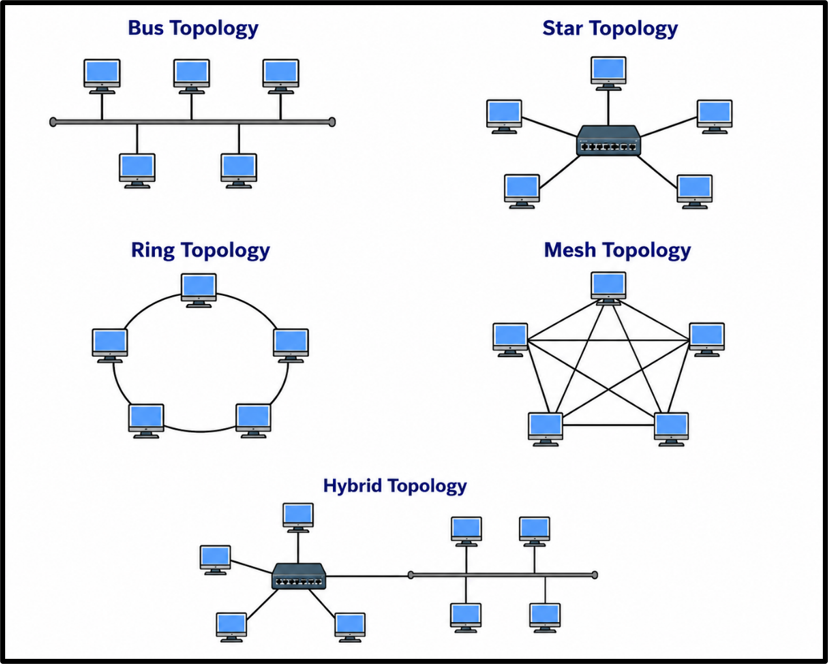
D. Based on Network Topology (Physical Arrangement)
How are devices physically or logically arranged? Topology tells us the shape of the network:
| Topology | Structure | Advantage | Disadvantage |
| Bus | All devices share one common line | Simple and inexpensive | Data collisions; hard to troubleshoot |
| Star | All devices connect to a central hub/switch | Easy to manage; one failure doesn’t affect others | Hub failure = entire network down |
| Ring | Devices connected in a loop; data flows one way | Predictable performance | One device failure can affect all |
| Mesh | Every device connects to every other device | Highly reliable and redundant | Very expensive and complex |
| Hybrid | Combination of multiple topologies (e.g., Star + Bus) | Flexible and scalable | Complex design and management |
Master Reference Table — All Network Types
| Type | Full Form | Coverage | Primary Use | Example |
| PAN | Personal Area Network | 1–10 m | Personal device connectivity | Bluetooth, smartwatch |
| LAN | Local Area Network | Room/building | Home/office network | Home Wi-Fi, office network |
| CAN | Campus Area Network | Campus | Multi-building connectivity | University campus |
| MAN | Metropolitan Area Network | City level | City-wide internet | Municipal Wi-Fi |
| WAN | Wide Area Network | Country/globe | Long-distance communication | Banking networks, Internet |
| SAN | Storage Area Network | Data centre | Server-storage connectivity | Cloud storage infra |
| VPN | Virtual Private Network | Virtual (over Internet) | Secure remote access | Corporate remote work |
| WLAN | Wireless Local Area Network | Same as LAN (wireless) | Wireless connectivity | Wi-Fi at home/office |
| VAN | Value Added Network | Private (business) | Secure B2B data exchange | EDI networks |
| Cellular | Mobile Network (2G–5G) | Regional/National | Mobile voice and data | 4G/5G networks |