
Mobile/Cellular Networks and Their Evolution (1G to 5G)
The mobile phone revolution is perhaps the most dramatic transformation India has seen in the last 30 years. In 1991, when India was opening its economy, barely anyone had a mobile phone. Today, India has over 1.1 billion mobile subscribers and is the world’s largest consumer of mobile data. This story is told through the evolution of cellular networks.
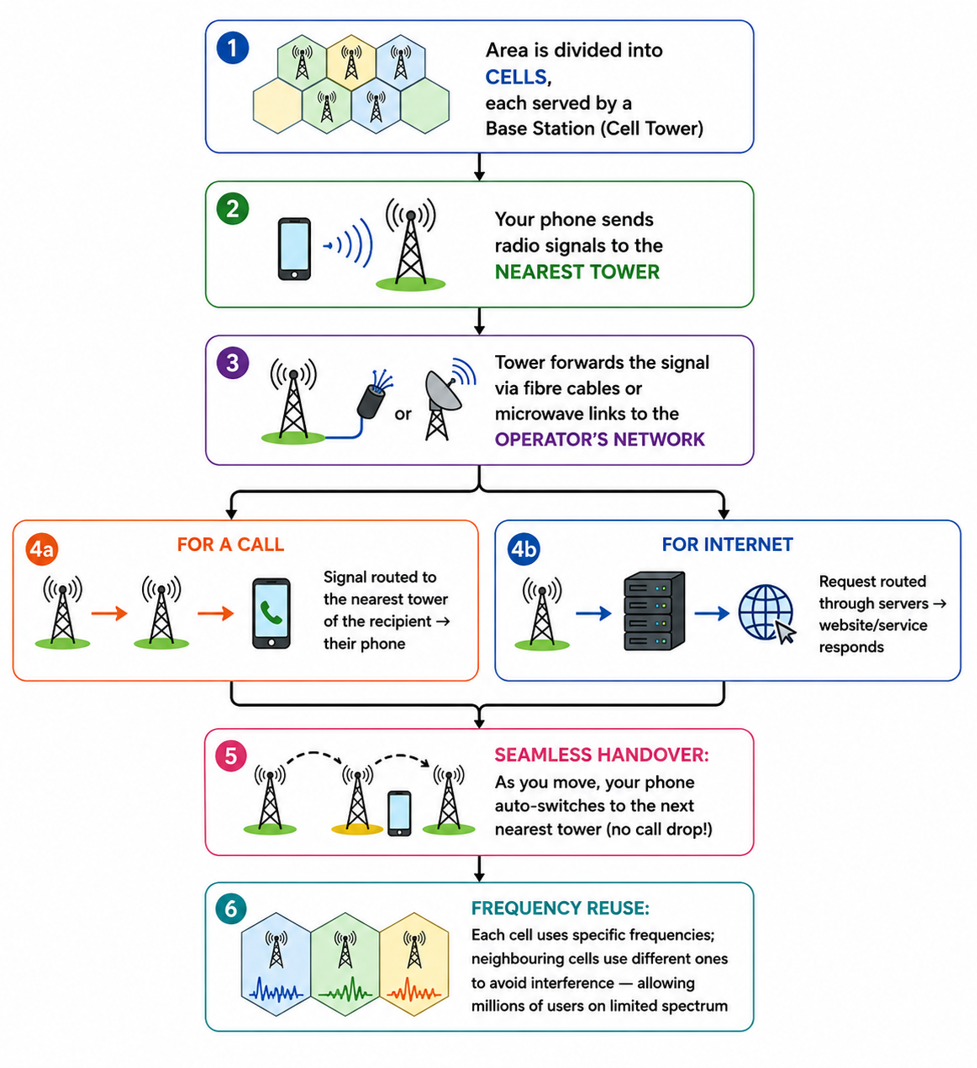
| How a Cellular Network Works — Step by Step |
| FLOWCHART: Your Phone Call/Internet Request 1. Area is divided into CELLS, each served by a Base Station (Cell Tower) 2. Your phone sends radio signals to the NEAREST TOWER 3. Tower forwards the signal via fibre cables or microwave links to the OPERATOR’S NETWORK 4a. For a CALL: Signal routed to the nearest tower of the recipient → their phone 4b. For INTERNET: Request routed through servers → website/service responds 5. SEAMLESS HANDOVER: As you move, your phone auto-switches to the next nearest tower (no call drop!) 6. FREQUENCY REUSE: Each cell uses specific frequencies; neighbouring cells use different ones to avoid interference — allowing millions of users on limited spectrum |
1G — First Generation (1980s): The Analog Era
If you have seen old Bollywood movies where the hero carries a brick-sized phone — that was 1G. The First Generation was purely analog, meaning voice was transmitted as continuous waveforms — not digitally encoded. India, interestingly, did not widely deploy 1G; we entered directly into the 2G world in 1995.
- Analog Technology (FM): Used FM (Frequency Modulation) radio signals — not digitally encoded, hence prone to noise, distortion, and easy interception.
- Voice Only: No SMS, no data transfer, no internet. Just voice calls.
- Speed: 2.4 Kbps: Extremely low — sufficient only for analog voice transmission.
- Poor Security: No encryption — anyone with the right equipment could intercept your calls. Privacy was near-zero.
2G — Second Generation (1990s): India’s Mobile Beginning
The year 1995 is pivotal for India — it is the year 2G (GSM) arrived, and mobile telephony began for real. The shift from analog to digital was transformative. Suddenly, calls were clearer, you could send texts, and most importantly, phone companies could serve more users on the same frequency.
- Digital Technology — GSM & CDMA: Voice signals converted to digital format. GSM (Global System for Mobile Communications) became the dominant standard. CDMA was also used in some countries.
- SMS and MMS: Short Message Service and Multimedia Messaging Service — transformed how people communicate. ‘I will SMS you’ became part of the language!
- Basic Mobile Data — GPRS & EDGE: GPRS offered 56–114 kbps; EDGE improved to ~384 kbps. Basic web browsing and emails became possible on mobile.
- Better Security: Digital encryption prevented easy call interception. User identity was protected. Background noise reduced.
- SIM Cards Introduced: Subscriber Identity Module (SIM) enabled user identity portability — you could change phones but keep your number.
| Why 2G was TRANSFORMATIVE for India: It popularized mobile phones through lower costs and mass adoption. It enabled text messaging as a dominant mode. It introduced mobile data. It supported caller ID, roaming, and prepaid plans — making mobiles accessible to the masses. |
3G — Third Generation (2000s): The Smartphone Revolution Begins
3G was the generation that turned your mobile phone into a computer in your pocket. Speeds jumped from kilobits to megabits per second. Suddenly, you could video call your family abroad, stream music, access social media, and navigate using GPS.
- High-Speed Mobile Internet: WCDMA offered ~384 kbps; HSPA gave 1–14 Mbps; HSPA+ reached up to 40–60 Mbps. The internet was now truly on mobile.
- Multimedia Capabilities: Two-way video calls, mobile TV, real-time streaming, app-based services, GPS integration — all became possible.
- Birth of Smartphones & App Stores: 3G enabled Android and Apple App Stores. Social media on mobile — Facebook, Twitter — began their journey. Email-on-the-go became a reality.
- Better Security & Spectrum Efficiency: Improved encryption and authentication. Better spectrum utilisation meant more users could be served.
- Global Roaming Support: Unified international standards in 3G allowed easier inter-country roaming.
| 17.4.5 IP (Internet Protocol) and IP Address — Concept Clarity |
| IP (Internet Protocol): A set of rules governing how data is sent, routed, and received over the Internet. It breaks data into PACKETS and routes them to their destinations. IP Address: A unique numerical identifier assigned to every device on a network — like a postal address for your device. Without it, data would not know where to go. Example: Just as every house has an address (12, MG Road, Delhi), every device has an IP address (e.g., 192.168.1.1). The IP ensures your email goes to the right inbox, not your neighbour’s! |
4G — Fourth Generation (2010s): India’s Digital Revolution
If there is one generation that truly changed India, it is 4G. The year 2016 — when Reliance Jio entered with nearly free 4G — is a watershed moment. India went from being a country of feature phones to a country of smartphones almost overnight. India became the world’s biggest consumer of mobile data.
Key Technical Characteristics of 4G
- All-IP Network Architecture (LTE): 4G uses LTE (Long-Term Evolution) — fully IP-based. Voice calls (VoLTE), video, and data are all transmitted via IP packets. This is why 4G voice quality (VoLTE) is so much better than 3G.
- Speed: 10–100 Mbps (up to 1 Gbps with LTE-A): Enabled seamless HD video streaming, cloud services, and high-speed downloads. LTE-Advanced can theoretically exceed 1 Gbps.
- Low Latency: 30–50 ms: Latency is the delay in data transmission. 4G’s low latency made real-time navigation, smooth gaming, and stable video calls possible.
- VoLTE — Voice over LTE: Voice calls transmitted as data packets over the LTE network — resulting in HD voice quality and faster call setup.
- Spectrum Efficiency: OFDMA (Orthogonal Frequency Division Multiple Access) and MIMO (Multiple Input Multiple Output) technologies allowed 4G to serve more users simultaneously.
Significance of 4G in India — A Comprehensive Analysis
| Domain | Impact of 4G |
| Democratisation of Internet | Affordable data (Jio’s entry, 2016) enabled mass internet penetration in Tier-2, Tier-3 cities and rural India. Reduction of the digital divide. |
| Foundation of Digital India | Enabled Aadhaar-based services, DigiLocker, e-Hospital, e-Governance portals, Direct Benefit Transfer (DBT). |
| Digital Payments Revolution | UPI and mobile banking became practical. India today LEADS the world in real-time digital payments. |
| App Ecosystem & Startups | E-commerce (Flipkart, Amazon India), food delivery (Swiggy, Zomato), mobility (Ola, Uber), fintech (PhonePe, Paytm), EdTech platforms — all flourished. |
| Education | Online classes, DIKSHA platform (national digital learning, launched 2017), SWAYAM (MOOC platform) — NEP 2020 vision enabled. |
| Healthcare | eSanjeevani teleconsultation, CoWIN portal, Ayushman Bharat Digital Mission for digital health records. |
| Agriculture | Real-time weather updates, mandi prices via apps like AgriMarket and Kisan Suvidha, digital agri-advisories. |
| Governance | Real-time monitoring, GIS mapping, FASTag tolling, Aadhaar e-KYC, online grievance redressal. |
| Employment | Gig economy (Swiggy, Zomato delivery), content creation economy (YouTube, Instagram), CSC-based IT services in rural India. |
| Foundation for 5G | 4G ecosystem created IoT adoption, smart city infrastructure, cloud usage, and AI-driven app development — paving the way for 5G. |
| DIKSHA: Digital Infrastructure for Knowledge Sharing — launched by Ministry of Education in 2017. Provides multilingual, curriculum-aligned e-learning content for school students and teachers. Central to Samagra Shiksha and Digital India. Plays key role in implementing NEP 2020. SWAYAM: National MOOC platform — provides FREE, high-quality online courses for school, college, and lifelong learners. As per UGC regulations, students can earn up to 40% of course credits through SWAYAM and transfer them to their university degree. |
5G — Fifth Generation (2020s): The Future is Here
If 4G gave us Netflix and Paytm, then 5G will give us autonomous cars, remote surgery, and smart cities. 5G represents not just faster internet, but a fundamentally new architecture of connectivity. India officially launched 5G in October 2022 by PM Modi. Operators like Airtel and Jio began rolling out 5G services in major cities.
Key Characteristics of 5G
- New Radio (NR) Standards: 5G New Radio (NR) is the global standard for 5G wireless communication, developed by 3GPP (3rd Generation Partnership Project). It defines new frequency bands and advanced technologies.
- Ultra-High Data Speeds: 1–10 Gbps: 10 to 100 times faster than 4G. Enables 4K/8K streaming, instant app downloads, real-time cloud gaming, and high-capacity video conferencing.
- Extremely Low Latency: ~1 millisecond: This is the game-changer! 1ms latency makes remote robotic surgery, autonomous vehicles, smart factories, and AR/VR experiences possible. 4G had 30–50ms latency.
- mMTC — massive Machine-Type Communication: Allows up to 1 MILLION devices per square kilometre to be connected simultaneously. Designed for IoT — smart cities, sensors everywhere, Industry 4.0.
- Network Slicing: 5G technology allows a single physical network to be divided into MULTIPLE virtual networks (slices), each customised for different applications. E.g., one slice for hospitals (ultra-reliable, low-latency); another for entertainment (high-bandwidth).
| Network Slicing — An Analogy: Imagine a 10-lane highway (5G network). Network slicing is like dedicating 3 lanes exclusively for ambulances (hospital/emergency communications), 4 lanes for regular traffic (consumer internet), and 3 lanes for freight trucks (industrial IoT). Same road, different priorities. |
Comprehensive Comparison: 1G to 5G
| Feature | 1G (1980s) | 2G (1990s) | 3G (2000s) | 4G (2010s) | 5G (2020s) |
| Technology | Analog | Digital (GSM/CDMA) | WCDMA, HSPA | All-IP (LTE) | 5G NR, Cloud-native |
| Primary Service | Voice only | Voice + SMS/MMS | Mobile internet + video calls | High-speed broadband | Ultra-fast intelligent connectivity |
| Data Speed | 2.4 Kbps | 56–384 Kbps | Up to 42 Mbps (HSPA+) | 10–100 Mbps (up to 1 Gbps LTE-A) | 1–10 Gbps |
| Latency | Very high | High | Moderate | 30–50 ms | ~1 ms (ultra-low) |
| Security | None (no encryption) | Strong encryption | Stronger authentication | End-to-end IP security | Advanced encryption + network slicing isolation |
| Architecture | Circuit-switched | Circuit-switched | Packet + circuit | All-IP packet-switched | Cloud-native, virtualised, edge computing |
| Device Type | Brick phones (analog) | Digital mobile phones | Early smartphones | Smartphones + broadband apps | Smart devices, IoT, autonomous systems |
| Key Use Cases | Basic voice calls | SMS, calling, simple apps | Video calling, early apps | OTT, UPI, social media, cloud | Autonomous cars, smart cities, robotics, telemedicine |
| India Context | Not deployed | Launched 1995 (widespread 2000s) | Moderate growth | Massive expansion after Jio 2016 | Commercial launch October 2022 |