
India and Neighbourhood Policy
Introduction
No dimension of India’s foreign policy is as consequential—or as difficult—as its relationship with its immediate neighbours. India sits at the geographical and civilizational core of South Asia, sharing land or maritime boundaries with Pakistan, China, Nepal, Bhutan, Bangladesh, Myanmar, Sri Lanka, the Maldives and Afghanistan.
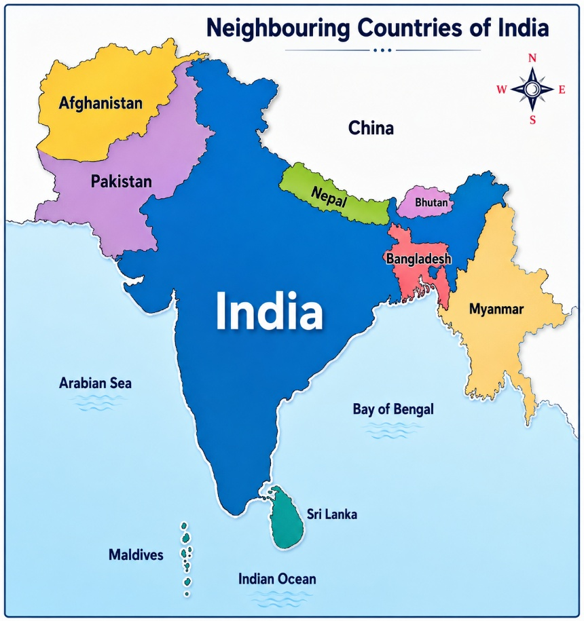
Its size, population, economy and central location mean that no regional arrangement can function without India, yet that very dominance breeds anxiety among smaller states. This is the central paradox that every phase of India’s neighbourhood policy has tried to manage.
A stable, prosperous and friendly periphery is not a matter of goodwill alone; it is a precondition for India’s own rise. Domestic growth, energy security, connectivity to Southeast and Central Asia, and India’s ambition to be a leading global power all run through the neighbourhood. Conversely, an unstable periphery invites external intervention, cross-border terrorism, refugee flows and strategic encirclement. The neighbourhood is therefore both India’s greatest opportunity and its most persistent vulnerability.
| Core Idea The guiding philosophy is captured in the phrase ‘Vistaarvaad Nahi, Vikasvaad’—not expansionism, but development for all. India seeks influence through shared prosperity rather than domination. |
The Structural Drivers: Geography, Security and Strategic Location
To understand India’s neighbourhood behaviour, one must begin with geography, because geography shapes India’s security conception. India’s security thinking has never been merely national; it has always been geopolitical and regional. A power of India’s size, placed at the heart of the subcontinent, reasons that any threat will emerge first from within the region before it comes from outside it.
The logic of a weak or unstable neighbour
India’s deepest fear is not a strong neighbour but a weak or unstable one. A fragile neighbour may invite a more powerful external state to intervene, thereby dragging great-power rivalry into what India regards as its own sphere of influence. This is why India has consistently favoured a stable Pakistan—but not one so strong that it becomes a threat.
China’s investments in the Gwadar port and the China–Pakistan Economic Corridor (CPEC) work in the opposite direction, deliberately strengthening Pakistan’s economy to keep India in check.
The ‘Indian Monroe Doctrine’
From Nehru onward, India held that South Asia is its exclusive sphere of influence, where India alone should be the intervening power and from which outside colonial or great powers should stay away. Scholars have likened this to the Monroe Doctrine by which the United States asserted primacy over the Western Hemisphere in the 19th century.
Yet India inherited this ambition without the resources or governance experience that the British had used to provide security to smaller states—creating a gap between aspiration and capacity that has dogged the policy ever since. India, like the USA in Latin America, thus faces a ‘Gringo problem’: its very attempt to lead breeds resentment.
The colonial inheritance
The subcontinent was first unified under the British, who built a double line of defence based on the policy of reverse slopes—keeping China and Russia out of the subcontinent by subordinating individual buffer states along the reverse Himalayan slopes.
The Partition of 1947 reversed this arrangement and opened the region to foreign intervention. Even after territorial loss, India emerged as the pre-eminent regional power, inheriting both the geography and the strategic dilemmas of the Raj.
| Determinants of the Neighbourhood-First Approach (Exam Keywords) Strategic location advantage — central position in South Asia and the western Indian Ocean gives India natural influence. Regional diplomacy & discourse — energizing platforms such as SAARC and BIMSTEC. Economic cooperation — energy, motor-vehicle and grid-connectivity groupings such as BBIN. Bilateral issue resolution — a preference for settling disputes through mutual agreement. Connectivity & cooperation — MOUs and infrastructure that stitch the region together. Military & defence cooperation — joint exercises such as Surya Kiran (Nepal) and Sampriti (Bangladesh). Disaster management & humanitarian aid — first-responder role, e.g. Operation Brahma after the 2025 Myanmar earthquake. Capacity building & training — ITEC scholarships; thousands of Afghan and other nationals trained in India each year. |
Historical Evolution of the Neighbourhood Policy
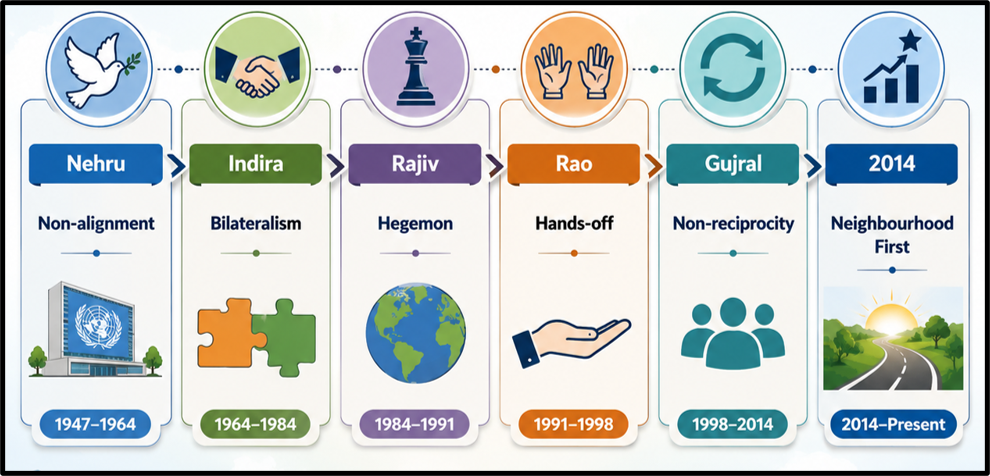
India’s approach to its neighbours has never been static. It evolved through distinct doctrinal phases, swinging between interventionism and restraint, before settling into the developmental logic of today. The chain below captures the journey.
| Phase / Leader | Core Idea | Explanation & Significance |
| Nehru (1950s–60s) | Non-alignment; Monroe Doctrine impulse | Global non-alignment kept India above Cold War blocs, so the neighbourhood received less focused attention—though Nehru insisted colonial powers stay out of South Asia. |
| Indira Gandhi | Bilateralism + selective intervention | Insisted regional issues be resolved bilaterally, excluding external powers. Willing to use force when security was threatened—the 1971 liberation of Bangladesh being the clearest case. Neighbours began to read India as interventionist. |
| Rajiv Gandhi | Regional hegemon (perceived) | Interventions in the Maldives and Sri Lanka in the 1980s cemented the image of India as a regional hegemon—but one that, critics argued, gave neighbours few economic or security benefits in return. |
| P. V. Narasimha Rao | Hands-off approach | A deliberate retreat from intervention: India would not interfere in neighbours’ internal functioning. It created no new tensions but also solved no old ones. |
| I. K. Gujral | Non-reciprocity & generosity | The first formal doctrine for the neighbourhood (1996). India would give without demanding equivalent returns from smaller neighbours, building goodwill and denying space to anti-India sentiment. |
| UPA (Manmohan Singh) | Political dialogue via SAARC | Sought deeper integration through SAARC and, in practice, followed most of the Gujral logic without publicly naming it. |
| Modi (2014– ) | ‘Neighbourhood First’ | Elevated the neighbourhood to the top of foreign-policy priority, linking India’s development to South Asia’s and shifting from reaction to shaping regional events. |
The Gujral Doctrine — A Closer Look
Because it is the intellectual foundation of everything that followed, the Gujral Doctrine deserves separate treatment. Formulated in 1996, it rested on the insight that India’s overwhelming size meant it could afford to be generous without insisting on reciprocity. By giving smaller neighbours what they needed without demanding equal returns, India would earn trust and remove the grievances on which anti-India sentiment feeds.
| The Five Principles of the Gujral Doctrine With Nepal, Bhutan, Bangladesh, the Maldives and Sri Lanka, India would not ask for reciprocity but give what it could in good faith (non-reciprocity). No South Asian country would allow its territory to be used against the interest of another. No country would interfere in the internal affairs of another (non-interference). All would respect one another’s territorial integrity and sovereignty. All would settle disputes through peaceful bilateral negotiation. |
The doctrine had limits. Gujral’s tenure was too short to reshape a sceptical foreign bureaucracy, and—despite its rhetoric of openness—it remained reluctant to genuinely liberalise regional trade. Even so, neighbours appreciated the spirit of generosity, and its logic quietly survives inside the Neighbourhood First policy today.
The SAARC Interlude and the Trade Problem
When the BJP came to power in 1998, its energies were consumed by the fallout of Pokhran-II and by Pakistan’s state-sponsored terrorism—the deepening ISI presence in Nepal and Bangladesh, and the IC-814 hijacking. The Vajpayee government nonetheless envisioned a South Asian Union, upgrading SAARC into a free-trade and even political union on European lines.
The vision failed: India insisted on a security guarantee as a condition for economic cooperation, Pakistan never opened up on trade, and post-Partition borders had already shrunk regional commerce to a trickle. Because trade surpluses ran in India’s favour, smaller neighbours stayed reluctant to open further.
The Neighbourhood First Policy (2014 onwards)
Announced in 2014, the Neighbourhood First policy was designed to rectify the accumulated shortcomings of the past—the interventionism, the trade timidity, the gap between ambition and delivery. Its symbolic launch was the invitation to all SAARC heads of state to the 2014 swearing-in ceremony.
Its essence is simple: India will shape events in its neighbourhood rather than merely react to them, linking its own development to that of South Asia through connectivity, commerce and shared prosperity.
The Four Pillars
| # | Pillar |
| 1 | Give diplomatic and political priority to the neighbourhood. |
| 2 | Provide active support for the development of neighbouring countries. |
| 3 | Build greater connectivity and integration across the region. |
| 4 | Promote India-led regionalism in a form with which neighbours are comfortable. |
Significance — Why India Pursues It
The policy is not charity; it serves a layered set of national interests. These are worth memorising as a ready-made answer to ‘why does India follow Neighbourhood First?’:
- A stable neighbourhood is the foundation for India’s own uninterrupted domestic growth.
- It advances India’s global ambitions, laying the ground for India to emerge as a Net Security Provider in the Indian Ocean.
- It lets India deploy economic diplomacy—lines of credit, grants, connectivity—that neighbours find difficult to resist.
- Economic integration can create a conducive climate for resolving political disputes, which in turn stabilises the whole region.
- By enduring primacy in its own periphery, India earns credibility as a global power.
- It counters the rising Chinese footprint (BRI, Indian Ocean presence) while expanding India’s own influence through commercial diplomacy.
Areas of Cooperation — The Policy in Action
The policy is delivered across several dimensions. The table below maps each area to a concrete instrument or example.
| Dimension | Instruments & Illustrations |
| Political & diplomatic | High-level visits and outreach; the first foreign visit under the policy was to Bhutan; landmark visits to Nepal, Bangladesh and Sri Lanka; the Land Boundary Agreement with Bangladesh (2015) settling a long-pending dispute. |
| Economic / development | Lines of credit and grants via the Ministry of External Affairs and EXIM Bank; ITEC scholarships; soft loans to neighbours; the ‘India Development Initiative’ (2003); High-Impact Community Development and Quick-Impact Projects. |
| Connectivity | BBIN Motor Vehicle Agreement; Kaladan Multimodal Transit Transport Project; Sagarmala; the Greater Male Connectivity Project in the Maldives—turning borders into connectors rather than walls. |
| Strategic / defence | Defence-cooperation pacts (e.g., with Bangladesh, 2017); joint exercises Surya Kiran (Nepal) and Sampriti (Bangladesh); building defence-production capacity under Make in India. |
| Maritime security | The SAGAR vision—‘Security and Growth for All in the Region’—under which India acts as Net Security Provider in the Indian Ocean; complemented by Project Mausam and the Act East policy. |
| Humanitarian / disaster | First-responder role: Operation Brahma (Myanmar earthquake, 2025); Operations Sanjeevani and Neer for emergency medical and water aid; the SAARC COVID-19 Emergency Fund and vaccine supply during the pandemic. |
| Technology / space | The South Asia Satellite (GSAT-9), launched on 5 May 2017, offering neighbours dedicated capacity for tele-medicine, tele-education and disaster management. |
| Cultural / people-to-people | Project Mausam (2014) reconnecting India’s ancient maritime and civilizational links with Indian Ocean Rim nations; pilgrimage and tourism ties; the shared civilizational heritage of the subcontinent. |
| Project Mausam — A Ready Sub-Answer (PYQ 2015) Launched by the Ministry of Culture in 2014 to reconnect India’s ancient maritime links with Indian Ocean Rim (IOR) nations.Though primarily cultural, it carries a clear strategic dimension: it strengthens shared heritage (recalling Chola naval influence), builds goodwill with Sri Lanka, the Maldives, Mauritius, Indonesia, Oman and Iran, and complements Act East and SAGAR (e.g., the Sabang port project with Indonesia).It projects soft power via UNESCO heritage recognition and boosts cultural tourism (e.g., the Lothal Maritime Heritage Complex). |
Development Diplomacy and Aid — The Deeper Logic
Since the 1950s India has extended technical assistance and human-resource training to neighbours such as Nepal, Sri Lanka and Bhutan, using ITEC scholarships and lines of credit as instruments of development diplomacy.
After the 2003 India Development Initiative, lines of credit are routed through the EXIM Bank via interest subsidies. This aid draws on the ancient Indian value of daan (charity), but it is also strategic: it builds political and economic goodwill and, some argue, underwrites regional leadership. Total soft-loan commitments to neighbours have run to the order of USD 15 billion.
Issues and Challenges
For all its ambition, the Neighbourhood First policy operates against strong headwinds. The challenges fall into structural, political, economic and security categories—and they interlink, each feeding the next.
The Structural Constraints on Indian Diplomacy
- Inadequate resources limit how much India can actually commit and deliver.
- A delivery deficit: even when projects are announced, India often fails to invest proportional diplomatic capital, so projects are delayed—the 13-year lag on the Chabahar port in Iran being the classic example.
- A strategic diffidence that insists on ‘going solo’ rather than co-developing projects with partners such as Japan.
- A thin foreign-bureaucratic manpower base, inadequate to grasp the political, historical and social dynamics of each neighbour.
The ‘Big Brother’ Perception and Distasteful Diplomacy
The single most corrosive challenge is the perception of India as an overbearing ‘Big Brother’. Neighbours have repeatedly alleged Indian interference: Nepal’s grievances over the alleged 2015 blockade and criticism of its constitution and the Madhesi issue; sensitivities in Sri Lanka and the Maldives over India’s reactions to their domestic politics.
The lesson India has had to absorb is that if a neighbour turns to China for investment, it has the sovereign right to do so—India’s answer must be patient diplomacy and better infrastructure, not coercion or regime change. A parliamentary standing committee has also flagged a worrying decline in India’s aid to neighbours.
Boundary and Territorial Disputes
India identifies historically as a civilizational state rather than a strictly territorial one, which—combined with colonial-era arbitrary borders, difficult terrain and domestic politics—makes boundary settlement hard. India has successfully resolved land boundaries only with Bangladesh and Sri Lanka, resorting to war with Pakistan and China elsewhere.
| Neighbour | Disputed Areas / Flashpoints |
| Pakistan | Kashmir—rooted in the 1947 Partition; the core, unresolved territorial dispute. |
| China | Ladakh, Arunachal Pradesh, Aksai Chin; the Doklam standoff (2017) and the Galwan Valley clash (2020) were serious military confrontations. |
| Nepal | Kalapani–Lipulekh; the 2020 map controversy sharply weakened mutual trust. |
| Sri Lanka | Katchatheevu island. |
Why do these disputes persist? A historical legacy of arbitrary colonial borders; domestic nationalist politics that make compromise costly; a trust and communication deficit; and geopolitical rivalries (notably the China–Pakistan axis) that harden positions.
River-Water Disputes
With the UNEP warning that nearly half the world may face severe water stress by 2030, rivers will increasingly define India’s riparian relations. India is both a lower riparian (to China) and an upper riparian (to Pakistan and Bangladesh), which complicates every negotiation.
| River System | The Dispute |
| India–Pakistan (Indus) | Governed by the Indus Waters Treaty (1960); friction over the Kishanganga and Baglihar projects. India placed the treaty in abeyance following the April 2025 Pahalgam attack. |
| India–Bangladesh (Ganga, Teesta) | The Ganga Waters Treaty (1996) settled the Ganga; the Teesta dispute remains unresolved, largely due to opposition from West Bengal. |
| India–Nepal (Mahakali, Koshi) | Disputes over implementation of the Mahakali Treaty (1996) and the Kosi Agreement (1954); concerns over flooding from embankments and dam operations. |
| India–China (Brahmaputra) | China’s upstream dams on the Yarlung Tsangpo/Brahmaputra raise fears of water diversion; construction of a massive hydropower project began in 2025, deepening downstream anxieties in India and Bangladesh. |
Trade Barriers and Poor Regional Integration
South Asia is among the least economically integrated regions in the world. India’s trade with its neighbours is a mere 1.7%–3.8% of its global trade.
The causes are well known: the legacy of import-substitution economics; bilateral conflicts (trade suspended after Kargil 1999 and Pulwama 2019); weak regional institutions (SAARC, SAPTA, SAFTA hobbled by India–Pakistan friction); poor connectivity; a lack of political will (Pakistan never granting India MFN status); and economic non-complementarity (India and Bangladesh, for instance, both compete as garment exporters rather than trading partners).
The Rising Chinese Footprint
Overshadowing every other challenge is the expanding presence of China in India’s periphery. Through the Belt and Road Initiative, China has embedded itself in Pakistan, Sri Lanka, the Maldives, Nepal and Bangladesh, raising fears of debt-trap diplomacy—most vividly the 99-year lease of Sri Lanka’s Hambantota port. CPEC diverts trade and investment from India and complicates India’s diplomacy at the UN (e.g., on Masood Azhar). China’s naval reach and its base in Djibouti extend its power projection into the Indian Ocean, directly contesting India’s sphere of influence.
Cross-Border Terrorism
India ranked 14th in the Global Terrorism Index (GTI) 2025. The central source is state-sponsored terrorism from Pakistan, through proxies such as Jaish-e-Mohammed and Lashkar-e-Taiba.
The April 2025 Pahalgam attack, in which 26 civilians were killed, was the most recent grave escalation and triggered India’s suspension of the Indus Waters Treaty. Terrorism also strangles trade—India revoked Pakistan’s MFN status after the 2019 Pulwama attack.
Way Forward
The prescription follows directly from the diagnosis. India needs to move from a policy of announcements to one of delivery, and from the instinct of a ‘Big Brother’ to that of a generous, patient regional leader.
Diplomatic and political
- Deepen high-level engagement and sustained dialogue, addressing each neighbour’s specific concerns.
- Evolve a grand strategy for the neighbourhood and a genuinely multilateral approach—co-developing projects (Chabahar with Japan, connectivity via the Quad and minilaterals) instead of going solo.
- Expand people-to-people and cultural ties—easier visas, pilgrimage tourism, cultural exchange.
Economic and connectivity
- Revive the Gujral logic of non-reciprocity and revitalise SAARC while leaning on functional groupings like BBIN and BIMSTEC.
- Complete flagship projects on time (hydropower in Nepal and Bhutan, the Kaladan project) to rebuild credibility.
- Boost trade by removing non-tariff barriers, strengthening FTAs, and building cross-border infrastructure and Integrated Check-Posts.
Security and disputes
- Strengthen intelligence-sharing and counter-terrorism cooperation (e.g., through the SCO’s RATS mechanism).
- Pursue confidence-building measures—joint patrols, Track-II diplomacy, legal and arbitral mechanisms—to defuse boundary and water disputes.
- Reduce nuclear risk with Pakistan through crisis-management and communication channels.
| The Interlinkage to Remember (Analytical Clincher) The dimensions are not separate—they form a virtuous chain: economic integration → political trust → regional stability → India’s global rise. Modi’s wager is that if economic interdependence is built first, it will create the conducive climate in which even the hardest political disputes can be negotiated. The obstacle is that Pakistan remains ‘the slowest camel in the caravan’, insisting political disputes be settled before economics—which is why India increasingly seeks to bypass Pakistan through Afghanistan, Iran and the BBIN sub-region. |
The Role of Border States
A distinctive feature of the modern policy is the reimagining of India’s border states as engines rather than edges. Under Neighbourhood First and Act East, the development of border regions—especially the North-Eastern states, envisaged as the hub of the BBIN Motor Vehicle Agreement—is a high priority.
The PM has spoken of a future South Asian Customs Union (SACU). The underlying mental shift is profound: borders are now seen as connectors, not walls—conduits for the movement of goods, people, ideas, culture and technology rather than mere lines of defence.
Conclusion
India’s neighbourhood policy is, at its heart, a search for the right balance between diplomacy, development and security. History has taught India that interventionism breeds resentment and that hands-off neglect solves nothing; the Neighbourhood First approach, drawing on the generosity of the Gujral Doctrine, tries to chart a middle path built on shared prosperity.
Its success is not guaranteed—border disputes, water tensions, trade barriers, cross-border terrorism and the long shadow of China continue to test regional harmony. But the direction is clear.
Going forward, sustained engagement, mutual trust and inclusive regionalism will decide whether South Asia becomes an integrated zone of prosperity or remains the world’s least connected region. For India, mastering the neighbourhood is the essential first step toward becoming a credible global power.
One Comment