
UPSC CURRENT AFFAIRS — 27 OCTOBER 2026
1. Sentencing Should Not Be a Lottery
(POLITY AND GOVERNANCE) (IE) Observing in Sunita Devi v. State of Bihar (2024) that “sentencing shall not be a mere lottery”, the Supreme Court asked the Union to examine a national sentencing policy, possibly through a Sentencing Commission. The Centre has reportedly asked the Law Commission of India to study the idea.
How Sentences Are Decided Today
Under the Bharatiya Nyaya Sanhita (BNS), 2023 and the Bharatiya Nagarik Suraksha Sanhita (BNSS), 2023, judges enjoy wide discretion within statutory limits. There is no binding grid to weigh aggravating and mitigating facts.
| Punishment | Position |
| Death penalty | Only in the “rarest of rare” cases |
| Life imprisonment | Usually the convict’s natural life, unless remitted |
| Imprisonment | Rigorous or simple |
| Community service | Non-custodial option for minor offences (Section 4, BNS) |
| Forfeiture and fine | Confiscation of crime-linked assets; monetary penalty |
After conviction, BNSS Section 258(2) requires a separate hearing on sentence, where age, background, prior record and reform prospects can be argued.
What Is Wrong?
- Equality and fairness: two judges can give very different sentences for the same crime, straining Articles 14 and 21 (Right to Equality).
- No checklist: nothing legally defines serious aggravation (weapon, extreme cruelty) or genuine mitigation (age, poverty, remorse).
- Appellate burden: High Courts and the Supreme Court spend time correcting quantum case by case.
- Alternatives ignored: probation and non-custodial options are underused; in Soman v. State of Kerala (2012) the Court called sentencing among the weakest parts of criminal justice.
- Irrelevant factors: studies of sexual-offence cases note reliance on a survivor’s supposed chastity or later marriage.
Way Forward
Assess seriousness ➜ Fix a starting point ➜ Adjust for aggravating and mitigating factors ➜ Give written reasons
- Statutory Sentencing Council, as the Malimath Committee (2003) urged, modelled on the UK Sentencing Council.
- Presumptive, not mandatory guidelines: judges may depart, but must record reasons, so judicial independence survives.
- National sentencing database built on the National Judicial Data Grid to track disparities.
- Victim-centric tools: victim-impact statements and pre-sentence reports.
- Federal fit: criminal law is in the Concurrent List (Entry 1) but prisons are a State subject (Entry 4), so guidelines must allow for varying prison capacity.
📖 Read More: Right to Equality • Evaluation of Fundamental Rights • Judicial Review • State Police and Police Reforms
2. Special Executive Magistrates: Bonds, Not Trials
(POLITY AND GOVERNANCE) (TH) A Special Executive Magistrate (SEM) court in Delhi granted bail to Cockroach Janta Party activists on surety bonds and refused the Delhi Police’s plea for a three-day custody extension. The order has put the limited, preventive role of SEMs in focus.
Who Is an SEM?
An executive officer appointed by the State (or, in Union Territories, the Centre) for a fixed term, area or purpose to perform preventive law-and-order functions. In commissionerate systems such as Delhi, police officers of ACP rank and above are often designated SEMs. Section 15 of the BNSS governs such appointments.
Because Article 50 separates the judiciary from the executive, an SEM sits in the executive wing and does not try offences.
Powers Under the BNSS
| Power | Provision | What it means |
| Peace bond | Section 126 | Require a person likely to breach the peace to furnish a bond, with or without sureties, for up to one year |
| Preventive inquiry | Section 135 | Test police inputs before enforcing a bond |
| Prohibitory orders | Section 163 | Urgent orders against nuisance or apprehended danger, such as banning assemblies |
| Custody on default | Sections 135(3), 141 | Remand if a person cannot furnish sureties or breaks a bond |
Limits
- An SEM cannot take cognizance of offences, frame charges, hold trials or convict.
- Orders are quasi-judicial and open to revision by Sessions Courts and to writs under Articles 226 and 227 (judicial review).
- Preventive detention through bond default must meet fairness standards under Article 21.
The episode shows the check that surety-based bail places on routine police requests for custody. See State Police and Police Reforms.
📖 Read More: Judicial Review • State Police and Police Reforms • Evaluation of Fundamental Rights
3. VB-G RAM G: Rural Job Guarantee Reboots
(POLITY AND GOVERNANCE) (PIB) The Viksit Bharat–Guarantee for Rozgar and Ajeevika Mission (Gramin) (VB-G RAM G) Act, 2025, which replaced MGNREGA on 1 July 2026, has generated 31.69 crore person-days of work for over 2.81 crore workers, with 61.65% women, as of 24 September 2026.
Key Features
| Feature | VB-G RAM G Act |
| Guarantee | 125 days of wage work a year per eligible rural household (earlier 100) |
| Timeliness | Work within 15 days of application, failing which unemployment allowance |
| Wages | DBT, generally within a fortnight of muster-roll closure; compensation for delay |
| Distance | Work preferably within 5 km; extra 10% wage beyond 5 km within the block |
| Cost sharing | 90:10 for North-Eastern and Himalayan States; 60:40 for other States/UTs with legislatures; 100% Centre for UTs without |
| Peak season | States notify sowing and harvest periods when works pause, protecting farm labour |
| Accountability | Face authentication, e-KYC, geo-tagging, e-Measurement Books, Janata Boards at worksites |
Works cluster in four themes: water security, core rural infrastructure, livelihood infrastructure and extreme-weather mitigation.
Viksit Gram Panchayat Plans (VGPPs)
Asset mapping ➜ Gap assessment ➜ Plan by Gram Panchayat ➜ Gram Sabha approval ➜ Block–District–State roll-up
- Prepared by Gram Panchayats and approved by Gram Sabhas, so planning is bottom-up.
- GIS tools such as Yuktdhara and PM Gati Shakti guide asset planning.
- A single plan converges Central, State and local schemes; 318 permissible works are listed.
Challenges
- Prompt work and on-time wages decide credibility.
- Gram Panchayat capacity to prepare quality plans varies widely.
- Face authentication and e-KYC can exclude poor, remote or elderly workers if not backed by fallbacks (inclusive growth).
📖 Read More: MGNREGA • Panchayati Raj and Decentralisation • Inclusive Growth
4. 11 Crore Farmer IDs, Five Months Early
(POLITY AND GOVERNANCE) (PIB) The Agriculture Ministry created 11 crore Farmer IDs under the Digital Agriculture Mission on 23 October 2026, five months ahead of the 31 March 2027 deadline. Over 6 crore farmers already receive services through the ID.
What Is a Farmer ID?
A unique digital identity that links a farmer’s details to digitised land records in the Farmer Registry, part of AgriStack. It speeds up access to schemes such as PM-KISAN and agri services.
Digital Agriculture Mission
- Approved by the Union Cabinet on 2 September 2024; outlay ₹2,817 crore, of which the central share is ₹1,940 crore.
- Aim: digital public infrastructure for data-driven, farmer-centric governance (e-governance, Digital India).
| Component | Function |
| AgriStack | Farmer Registry, Geo-referenced Village Maps and Crop Sown Registry, maintained by States/UTs |
| Krishi DSS | Satellite, weather, soil, reservoir and groundwater data for crop mapping, yield estimates and drought/flood monitoring |
| Soil Profile Mapping | Village-level soil maps for land use and crop planning |
The next test is data quality: accurate land records and tenant-farmer inclusion decide whether the ID reaches those who need it (agriculture).
📖 Read More: PM-KISAN • E-Governance • Agriculture and Allied Sectors • Farmer Producer Organisations
5. RELIEF: Insurance Cover for Exporters in Rough Seas
(ECONOMICS) (PIB) The Commerce Department has extended Component II of RELIEF (Resilience & Logistics Intervention for Export Facilitation) to 31 March 2027. It shields Indian exporters from West Asia shipping disruption through enhanced credit-risk cover.
Background
Launched on 19 March 2026 under the Export Promotion Mission, RELIEF offsets surging freight surcharges, trade-lane diversions and war-risk costs across the Red Sea, the Persian Gulf and wider West Asian routes. It is implemented through the Export Credit Guarantee Corporation (ECGC) digital portal.
Component II at a Glance
| Feature | Detail |
| Risk cover | 95% credit-risk cover on shipments to designated Gulf and West Asian destinations |
| Eligible policies | Standalone and Whole Turnover Policies taken on or after 16 March 2026 |
| Premium | Held at pre-disruption levels; the Centre absorbs the extra risk cost |
| Cargo | FCL, LCL and reefer containers; bulk energy/crude and re-imported cargo excluded |
| Claims | Handled digitally on the ECGC portal |
Why It Matters
- Stops farm and engineering exports from being priced out of West Asian markets.
- Credit-guarantee backing encourages banks to lend to MSME exporters without steep risk premiums (Foreign Trade Policy).
- Shows how trade policy now includes logistics resilience, not just tariffs (trade agreements).
📖 Read More: Foreign Trade Policy 2023 • Types of Trade Agreements
6. RBI’s Bhubaneswar Data Centre: Digital Sovereignty
(ECONOMICS) (PIB) The Prime Minister inaugurated the Reserve Bank of India’s new Data Centre and Cybersecurity Training Institute in Bhubaneswar, a ₹169-crore project meant to harden the country’s core payment infrastructure.
Key Features
- Four data centres certified to Uptime Institute Tier IV, the highest resilience tier.
- Critical load: NEFT, RTGS and the e-Kuber platform for government banking.
- Digital sovereignty: runs independently of third-party cloud providers, keeping control of critical financial systems with the RBI.
- Geographic resilience: far from the RBI’s three existing data centres in Maharashtra and in a different seismic zone.
- Training institute: builds skills in AI, big data analytics, quantum computing and blockchain for financial-sector institutions.
Why It Matters
Separate site ➜ Own infrastructure ➜ Tier IV uptime ➜ Resilient payments
Disasters or cyber events at one site should not freeze payments nationwide. Self-owned infrastructure also reduces exposure to vendor and supply-chain weaknesses of the kind seen in the Kudankulam data leak. See Digital Payment Infrastructure and India’s Cyber Security Framework.
📖 Read More: Digital Payment Infrastructure of India • Banking Sector Reforms • India’s Cyber Security Framework
7. India Hosts the Global Legal Metrology Meet
(INTERNATIONAL RELATIONS) (PIB) India is hosting the 61st meeting of the International Committee of Legal Metrology (CIML) in New Delhi, the first time it has hosted this apex gathering of the International Organization of Legal Metrology (OIML).
What Is Legal Metrology?
The regulation of weights, measures and measuring instruments so that trade, healthcare, safety and environmental monitoring rest on reliable measurement. Differing national rules create technical trade barriers and force repeat testing.
OIML and the CIML
- The OIML is an intergovernmental body created in 1955 to harmonise legal metrology; its secretariat is the International Bureau of Legal Metrology in Paris.
- The CIML is its principal decision-making committee, with a senior legal-metrology official from each member state.
- India joined in 1956 and is an issuing authority under the OIML Certification System (OIML-CS).
Functions of the CIML
| Function | Effect |
| Oversight | Guides OIML policy and strategy; meets yearly between four-yearly conferences |
| Technical Recommendations | Adopts OIML R standards for instruments and testing |
| Certification | Supervises OIML-CS so one test report is accepted across countries |
| Digital metrology | Machine-readable standards, EV-charging measurement, AI-based verification |
| Capacity building | Supports developing economies through CEEMS |
Harmonised standards advance the objectives of the WTO’s Technical Barriers to Trade Agreement, cut compliance cost and protect consumers (trade agreements).
📖 Read More: Types of Trade Agreements • Foreign Trade Policy 2023
8. Kudankulam Data Leak: Security Beyond the Fence
(INTERNAL SECURITY) (TH) A reported ransomware attack on data-centre provider Yotta exposed nearly 19,000 files (14.3 GB) linked to the Kudankulam Nuclear Power Plant, showing how contractors and cloud vendors can become the weak link in critical infrastructure.
What Reportedly Happened
- Files dated 2016–2025, including engineering drawings, inspection reports and contracts, were held by a vendor, not the plant.
- The attackers used double extortion: steal data first, then threaten a leak. A group called World Leaks is named in reports.
- In 2019, Dtrack malware linked to North Korea’s Lazarus Group was found on Kudankulam’s administrative IT network.
Vendor compromised ➜ Data exfiltrated ➜ Ransom demand ➜ Dark-web leak
India’s Framework
| Body | Role |
| NCIIPC | Nodal agency for Critical Information Infrastructure under Section 70A, IT Act, 2000 |
| CERT-In | National incident-response agency under Section 70B; 2022 directions require reporting within six hours |
| Sectoral CSIRTs | Domain teams such as CSIRT-Power (2024) and CSIRT-Fin (2022) |
| Cyber Crisis Management Plan | Continuity and recovery framework for government and strategic entities |
The Gaps
- Attackers go after contractors and cloud providers, not air-gapped reactors.
- The Digital Personal Data Protection Act covers personal data, leaving technical blueprints without a clear security mandate once they leave the operator.
- CERT-In reportedly logged over 29.44 lakh incidents in 2025, up about 85% from 2023.
Way Forward
- Security follows the data: bind every vendor and cloud host to NCIIPC-grade baselines.
- Zero-trust architecture, strict data minimisation, and deletion when contracts end.
- Red-team drills across vendors, not paper compliance.
- A single framework linking CERT-In, NCIIPC and sector regulators to audit third-party risk.
📖 Read More: Global and Emerging Cyber Security Challenges • India’s Cyber Security Framework • Nuclear Energy in India
9. AI Neolabs: Research First, Revenue Later
(SCIENCE AND TECHNOLOGY) (BS) A growing number of researchers are leaving big technology firms to found AI Neolabs, independent laboratories focused on advanced and safe artificial intelligence rather than quick products.
What Are They?
Research-first AI labs set up by leading scientists, prioritising long-term breakthroughs and alignment — making powerful systems follow human goals, values and safety limits (AI alignment).
| Feature | Detail |
| Funding | About 29 neolabs raised $23 billion within two years |
| Commercial focus | Fewer than 35% have launched products |
| Examples | Safe Superintelligence Inc. (Ilya Sutskever); Thinking Machines Lab (Mira Murati) |
Significance
- Pushes AI safety and controllability research.
- Enables high-risk science that commercial timelines discourage.
- Sharpens the case for safety standards, transparency and international cooperation (AI governance).
Concerns
- Huge private capital concentrates control over frontier AI in few hands.
- Without disclosure norms, public oversight of safety claims is weak.
- India needs its own research capacity so it is not only a consumer of foreign AI (Artificial Intelligence).
📖 Read More: Artificial Intelligence • Governance and Artificial Intelligence
10. Immersive Tech and India’s AVGC-XR Push
(SCIENCE AND TECHNOLOGY) (PIB) India is promoting immersive technologies — AI-driven extended reality (XR) and digital twins — for education, healthcare, urban planning and the creative economy under its AVGC-XR (Animation, Visual Effects, Gaming, Comics and XR) framework.
The Technologies
| Technology | What it does |
| Virtual Reality (VR) | Fully computer-generated environment |
| Augmented Reality (AR) | Overlays digital objects on the real world |
| Mixed Reality (MR) | Digital and physical objects interact |
| Digital twin | Live virtual copy of a system for simulation and prediction |
| Haptics | Touch sensations through vibration or pressure |
India’s immersive market was about USD 1.26 billion in 2023 and is projected at USD 7.82 billion by 2030, a 29.8% CAGR.
Applications
- Education: IIT Madras is building AR/VR learning for rural secondary schools.
- Heritage: the JATAN software has digitised collections of eight national museums and two ASI museums.
- Urban planning: DoT’s Sangam: Digital Twin and the Varanasi 3D spatial project; a National Digital Twin for major cities is targeted for 2035.
- Mobility: a Mobility Digital Twin at India Mobile Congress 2025 modelled Delhi traffic and Ayodhya tourist flows.
Government Initiatives
- AVGC Promotion Task Force (MIB, April 2022).
- Indian Institute of Creative Technologies (Mumbai, 2025), a centre of excellence working with global tech firms.
- AVGC Content Creator Labs in 15,000 secondary schools and 500 colleges under Union Budget 2026-27.
- GENESIS (MeitY, 2022) for about 1,600 start-ups, and WaveX media-tech accelerator.
- ESTIC 2026, a CSIR conclave at Bharat Mandapam, 27–29 October.
States are competing through policies: Karnataka, Maharashtra, Tamil Nadu, Kerala, Madhya Pradesh and Rajasthan have AVGC-XR policies, while Uttar Pradesh is building an AVGC-XR park at Jewar. Skills and affordable devices decide how inclusive the gains are (Digital India).
📖 Read More: Digital India Programme • Artificial Intelligence
11. E100: India Opens the Road to Pure-Ethanol Cars
(SCIENCE AND TECHNOLOGY) (IE) The Road Transport Ministry amended the Central Motor Vehicles Rules, 1989 to allow testing, certification and sale of flex-fuel vehicles that run on blends up to E100, nearly pure ethanol.
Key Terms
- E100: almost 100% bio-ethanol from sugarcane juice, molasses, maize or damaged grain, with small denaturing and anti-corrosion additives.
- Flex-fuel vehicle: an engine with sensors that adjust ignition and fuel flow for petrol, E100 or any blend such as E20 or E85.
How the Vehicles Cope With Ethanol
| Feature | Reason |
| Ethanol-resistant fuel lines and seals | Ethanol absorbs moisture and corrodes ordinary parts |
| Smart control unit | Adjusts air-fuel ratio and timing to the blend |
| High octane (about 100–105 RON) | Allows higher compression and less knocking |
| Larger injectors and pumps | Ethanol has roughly 30% less energy, so more fuel flows |
| Cold-start aids | Ethanol vaporises poorly in cold weather |
Benefits and Challenges
- Benefits: lower crude imports, a market for farm produce, rural jobs and lower tailpipe carbon (biofuels).
- Mileage: lower energy density cuts fuel economy, so savings depend on pricing and taxes.
- Water: sugarcane and paddy-based ethanol add pressure on groundwater and compete with food crops (sugar industry).
- Compatibility: existing E10/E20 vehicles cannot safely use E100 without modification.
A broader clean-fuel mix, including renewable energy, remains essential.
📖 Read More: Biofuels • Sugar Industry • Sugarcane • Measures to Boost Renewable Energy
12. IUCN Warns: Nearly All Reefs at Risk of Collapse
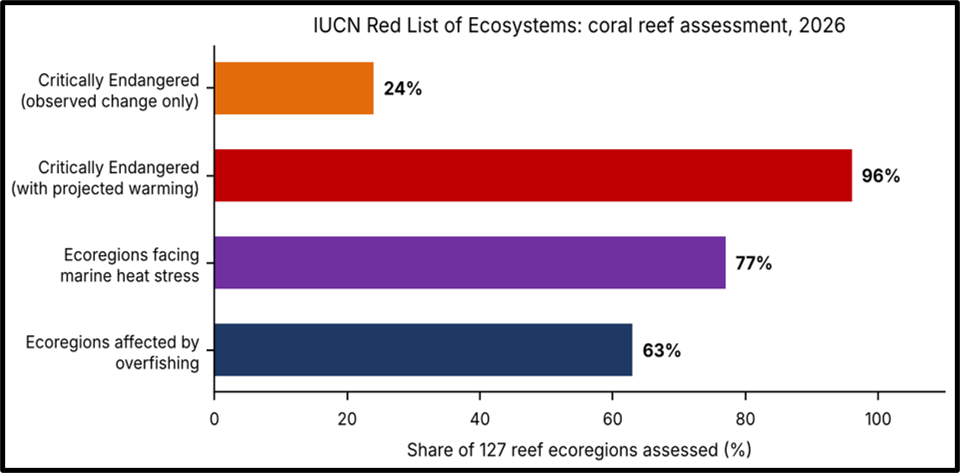
(ENVIRONMENT) (DTE) The IUCN released its first global assessment of coral reefs under the Red List of Ecosystems at the UN Biodiversity Conference (COP17) in Yerevan, Armenia. It finds that 96% of reef ecoregions face a critical risk of collapse by 2075.
What the Assessment Found
- 122 of 127 reef ecoregions are classed Critically Endangered; the Western Galápagos is classed as collapsed.
- Only 24% are Critically Endangered on observed change; the figure reaches 96% once projected warming is included.
- Marine heat stress threatens 77% of ecoregions and overfishing 63%.
Why Reefs Matter
- Cover under 0.2% of the ocean floor but support over 25% of marine species.
- Corals host zooxanthellae algae that supply up to 90% of their energy; heat makes them expel the algae, causing bleaching.
- Act as natural breakwaters, absorbing up to 97% of wave energy (marine resources).
- Sustain fisheries, tourism and a source of medicines.
Threats
- Marine heatwaves driven by global warming.
- Overfishing of grazers such as parrotfish, letting algae smother corals.
- Land-based pollution and sediment, as around Palk Bay and the Andamans (marine pollution).
- Disease and outbreaks, such as crown-of-thorns starfish.
Responses
- Global: the Kunming–Montreal Global Biodiversity Framework with 30×30 targets; the Global Coral Reef Monitoring Network and ICRI (climate diplomacy).
- India: corals are protected under the Wild Life (Protection) Act, 1972 and in marine protected areas of the Gulf of Mannar, Gulf of Kutch and the islands.
- Technology: Biorock, coral micro-fragmentation and larval seeding; cryobanking of heat-tolerant strains.
- Local action buys time, but deep emission cuts under updated NDCs decide survival beyond 2075.
📖 Read More: Introduction to Marine Resources • Impact of Global Warming • Measures to Curb Marine Pollution • National Initiatives for Biodiversity Conservation
13. Cyclone Arnab: Red Alert for Andhra and Odisha
(GEOGRAPHY) (HT) The India Meteorological Department issued a Red Alert for Andhra Pradesh and Odisha as cyclonic storm Arnab intensified into a Very Severe Cyclonic Storm (VSCS) over the west-central Bay of Bengal.
IMD Intensity Scale
| Category | Wind speed (knots) |
| Depression | 17–27 |
| Deep depression | 28–33 |
| Cyclonic storm | 34–47 |
| Severe cyclonic storm | 48–63 |
| Very severe cyclonic storm (VSCS) | 64–89 (about 118–166 kmph) |
| Extremely severe cyclonic storm | 90–119 |
| Super cyclonic storm | 120 and above |
Arnab formed as a low-pressure area over the south-east Bay of Bengal, then strengthened step by step before moving west-north-westward.
Conditions for Cyclogenesis
Warm sea above 26.5°C ➜ Moist air rises ➜ Coriolis spin ➜ Low wind shear ➜ Upper-level outflow deepens the low
- Warm water supplies latent heat; the Coriolis force (beyond about 5° latitude) gives the spin.
- Low vertical wind shear keeps the storm column intact; upper-level divergence lowers central pressure. See Cyclones.
How the Name Was Chosen
Names come from a pre-agreed list of the WMO/ESCAP Panel on Tropical Cyclones, whose 13 members include India, Bangladesh and Pakistan. Bangladesh contributed “Arnab”, meaning ocean or vast sea in Bengali.
Why It Matters
- October–November is a second cyclone peak; the Andhra–Odisha coast is highly exposed (environmental impacts).
- Inland remnants can combine with western disturbances to cause unseasonal rain and crop losses in the north.
- Success is measured in lives saved: early warnings, evacuation, state disaster authorities and the NDRF (NDMA).
📖 Read More: Cyclones: A Natural Hazard • Environmental Impacts of Tropical Cyclones • NDMA
14. Maharashtra Adds Kolamarka and Expands Tansa Sanctuary
(ENVIRONMENT) (TH) Maharashtra’s State Board for Wildlife, chaired by the Chief Minister, approved declaring Kolamarka Conservation Reserve a wildlife sanctuary and expanding the Tansa Wildlife Sanctuary.
Wildlife Sanctuary: Legal Position
A sanctuary under the Wildlife (Protection) Act, 1972 conserves wild animals and plants; regulated grazing and some traditional uses may continue with the Chief Wildlife Warden’s permission. See Wildlife Sanctuaries in India.
| Step | Provision | What happens |
| Notice of intent | Section 18 | State notifies the area proposed as a sanctuary |
| Inquiry into rights | Section 19 | Collector investigates private and community rights |
| Settlement of claims | Sections 21–25 | Collector admits, acquires or extinguishes rights |
| Final notification | Section 26A | State declares the area a sanctuary |
| Boundary change | Section 26A(3) | Only on National Board for Wildlife recommendation |
Kolamarka
- In Sironcha taluka of Gadchiroli district, near Chhattisgarh’s Indravati Tiger Reserve.
- Protects the endangered wild water buffalo, including one of central India’s few genetically pure populations.
- Links forests across Maharashtra, Chhattisgarh and Telangana as a wildlife corridor.
- Dry deciduous forest, bamboo and river grasslands on the Pranhita and Indravati basins.
Tansa
- In Thane and Palghar districts, in the Western Ghats foothills; roughly 320 km² under the existing sanctuary.
- Protects the catchments of Tansa, Vaitarna and Modak Sagar, which supply water to the Mumbai region.
- Proposed addition of 588.767 hectares across six villages to create an inviolate core.
- Home to leopards, sloth bears and the endangered forest owlet, with over 250 bird species.
The dual benefit — biodiversity and water security — makes such upgrades a good model; local rights settlement under forest governance will determine success.
📖 Read More: Wildlife Sanctuaries in India • National Parks in India • Conservation of Major Indian Wildlife Species • Forest Governance and Legal Frameworks