
Early Indian Miniature Paintings
(8th to 15th Century CE)
Pala Miniature (Eastern India)
Historical Context
- Developed under the Pala dynasty of Bengal (8th–12th century CE).
- The earliest surviving Indian miniatures belong to this school.
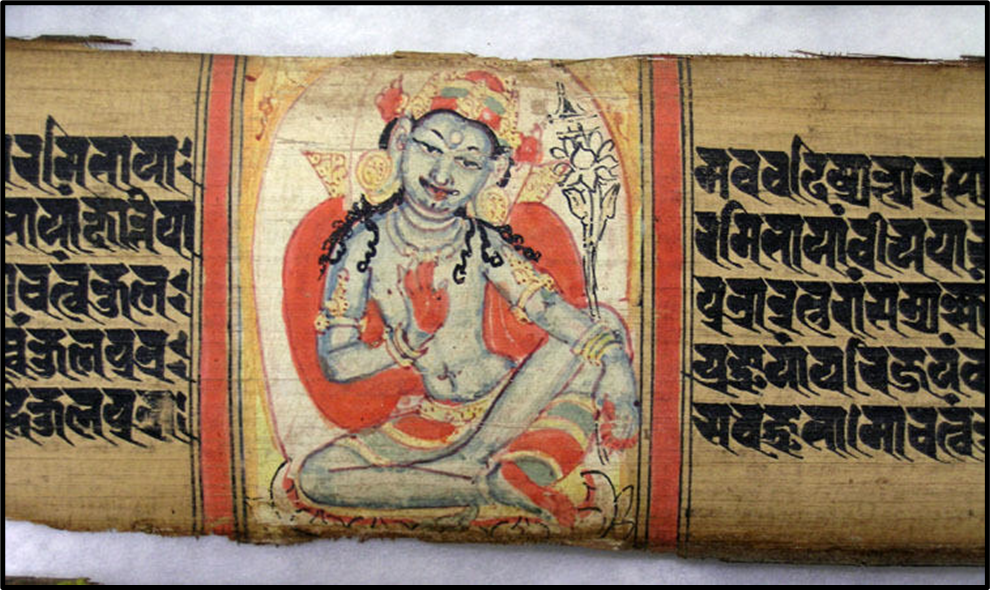
- Best-known examples occur in Buddhist manuscripts such as the Astasahasrika Prajnaparamita, dated to the reign of Mahipala (10th century CE).
Earlier miniatures on wood and cloth existed but are completely lost.

Themes and Subjects
- Entirely Buddhist in nature
- Focus on → Bodhisattvas, Buddhist deities, Philosophical concepts personified (e.g., Prajnaparamita as wisdom)
Artistic Characteristics
- Restricted colour palette — mainly red and white
- Curvilinear lines, closely resembling the murals of Ajanta
- Strict adherence to iconographic and proportional rules, derived from mural traditions
- Overall effect: subdued, spiritual, contemplative
Decline
- The Pala miniature tradition disappeared by the late 13th century
- Cause: Destruction of Buddhist monasteries during Islamic invasions, which eliminated the institutional base that sustained this art.
Jain Miniature (Western Indian School)
Origins and Patronage
- Emerged in Gujarat around the 10th century CE
- Also called → Apabhramsa School, Western Indian School of Art
- Flourished between 10th and 15th centuries
- Strongly patronised by the Chalukya dynasty (Solankis) with capital at Patan.
A major patron was Kumarapala (12th century), who commissioned and distributed hundreds of illustrated Jain manuscripts to propagate Jainism.
Themes and Texts
- Entirely Jain religious literature
- Most frequently illustrated text:
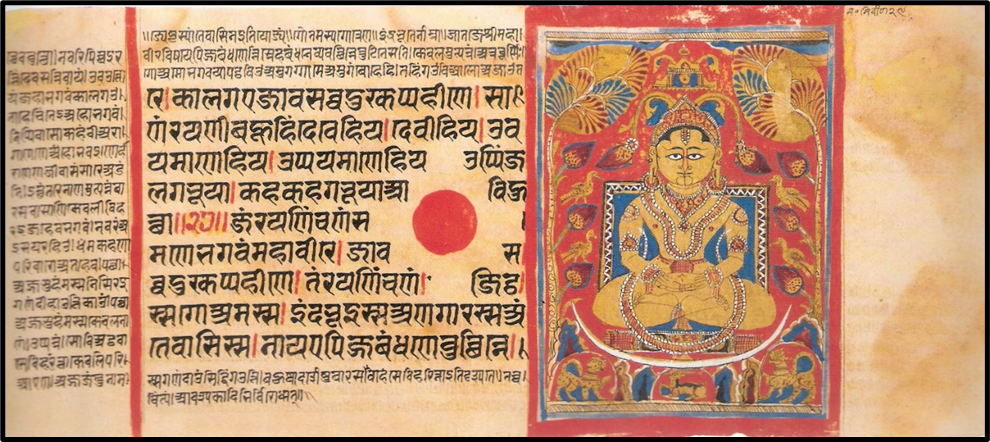
- Kalpa Sutra
- Describes the lives of Tirthankaras
- Traditionally attributed to Bhadrabahu
- Kalpa Sutra
Artistic Characteristics
- Bold, flat colours (red, blue, yellow)
- Strong, vigorous outlines
- Exaggerated facial features, especially:
- Long, pointed noses
- Protruding eyes
- The far eye shown projecting beyond the face so both eyes are visible in profile (a unique Jain stylistic marker)
Medium and Evolution
- Early works painted on palm leaves, called “Punthis”
- Paper introduced in the 14th century, allowing larger compositions
- By the later period:
- Jain miniature tradition spread to Rajasthan and Malwa
- It evolved into Rajput painting
- Later merged with Persian stylistic elements after the establishment of Islamic rule
Use of Gold and Persian Influence
- A major innovation in 15th-century Jain painting was applied gold
- Famous example:
- Illustrated Kalpa Sutra manuscript from Jaunpur (1465 CE)
→ effective use of gold and also of blue sourced from lapis lazuli
- Illustrated Kalpa Sutra manuscript from Jaunpur (1465 CE)
- This indicates direct exposure to Persian aesthetics via Sultanate connections.
Hindu (Early Rajput) Miniature Painting
Emergence and Background
By the 15th century, a distinct Hindu miniature tradition emerged, often called the Early Rajput Style.
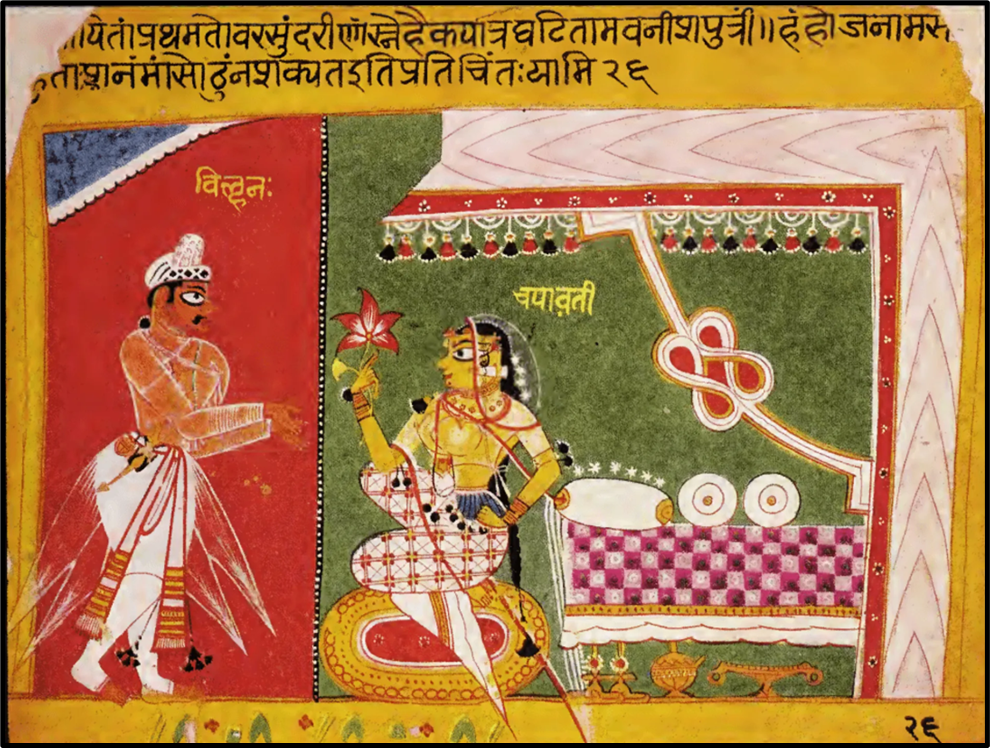
This style did not arise in isolation—it clearly inherited features from the Jain miniature tradition → Flat backgrounds, Bold outlines, Strong narrative emphasis
At the same time, it gradually moved towards greater emotional expression and sensuous themes.
Literary Inspirations
Two major texts shaped this style:
- Bhagavata Purana
- Stories of Krishna
- Emphasis on bhakti (devotion), love, and divine play
- Chaurapancasika
- Written by Bilhana (11th century)
- Literally means “Fifty verses of a thief”
- Here, “thief” refers metaphorically to a stealer of the heart
Chaurapancasika Style
- Vibrant, intense colours
- Transparent drapery, enhancing sensuality
- Angular drawing style, unlike the softer curves of Buddhist art
Symbolism and Emotional Coding
Every object in these paintings is emotionally loaded:
- Fire → intense passion
- Bed → erotic undertone
- Plants, furniture, garments → metaphors for love and longing
This marks a major shift:
👉 Paintings no longer just illustrate stories; they express emotions.
Idealised Human Forms
- Men: Broad chest, narrow waist
- Women: Rounded breasts, slender waist, wide hips
These figures reflect the aesthetic ideals of early Rajput courts rather than realism.
For chapter-wise Art and Culture Notes for UPSC Prelims and Mains, refer to the complete Art and Culture notes page.