
Indo-Persian and Mughal Miniature Paintings
(16th – 18th Century)
Muslim Miniature Painting (Pre-Mughal Phase)
Establishment of the Tradition
With the establishment of Islamic rule in India, illustrated manuscripts of Persian texts began to be produced.
- Muslim rulers set up kitabkhanas (royal book workshops)
- Artists and artisans were employed within palace complexes
- Painting became a court-sponsored activity
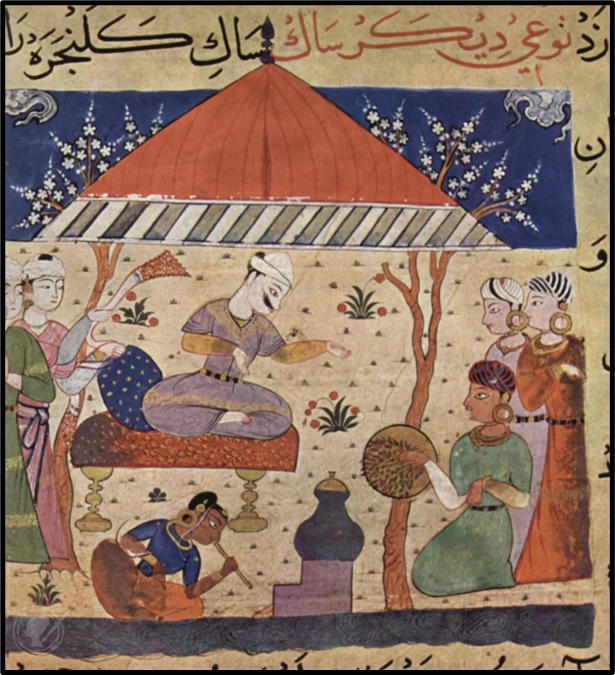
Notable Work: Nimatnama
One of the most famous early examples is → Nimatnama-i-Nasiruddin-Shahi commmissioned by Ghiyath Shah → Produced at Mandu (late 15th century)
Why is Nimatnama important?
- It is a cookbook, not a religious text → early sign of secular themes
- Illustrations show:
- Jain influence (bold colours)
- Hindu elements (figures, motifs)
- Persian stylistic features (composition, costumes)
👉 This manuscript acts as a bridge between indigenous styles and Mughal painting.
Mughal Miniature Painting
Origin and Growth
Mughal miniature painting began in the 16th century, under Mughal patronage.
- Mughal emperors wanted visual documentation of → Court life, Battles, Hunting expeditions, Administrative achievements
To achieve this, they employed → Indian (Hindu) artists, Muslim artists, Iranian masters
This collaboration produced a radically new court art.
Fusion of Artistic Traditions
Mughal painting is a synthesis of → Persian fine detailing, Indian colour richness, Islamic calligraphic and ornamental traditions
Later, with the arrival of European visitors (especially Italians), Mughal artists absorbed → Linear perspective, Shading, Naturalistic modelling
Main Features of Mughal Miniatures
- Miniature format on paper
- Used for → Book illustrations, Albums called muraqqa
- Practised between 16th–19th centuries
- Court art → meant for elite, private viewing
- Highly refined and polished
Themes → Court scenes, Battles and hunts, Wildlife, Portraits, Historical events, Mythological themes (less dominant)
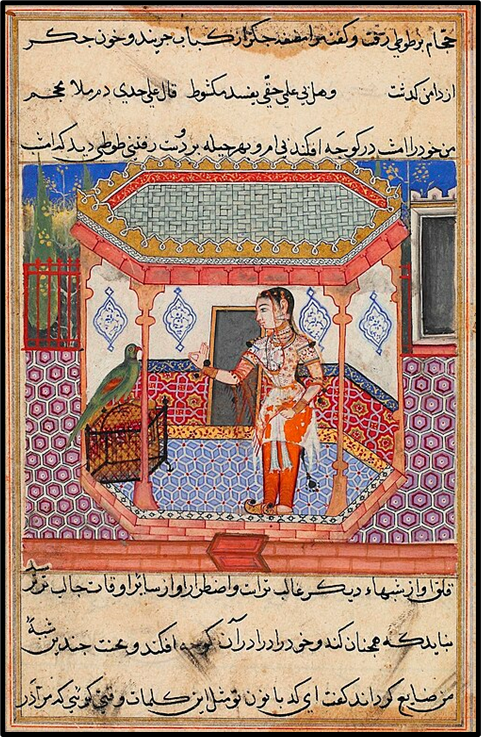
Tutinama – The Girl and the Parrot
One of the earliest Mughal illustrated manuscripts → Tutinama
Shows Early Mughal realism
- Fine observation of human emotions
- Naturalistic animals and vegetation
Realism and Naturalism
Unlike earlier Indian styles:
- Faces show individual expression
- Clothes have folds and texture
- Animals and landscapes are carefully observed
Portraiture
Mughal artists excelled in lifelike portraits:
- Emperors and nobles shown in profile
- Detailed costumes and backgrounds
- Used as historical records
Other Key Characteristics
- Women appear minimally and gradually disappear as themes become male-centric
- Almost secular in nature (unlike Jain, Hindu, Buddhist traditions)
- Team-based production → One artist for sketching, Another for colouring, Another for borders and calligraphy
- Extensive use of → Decorative borders, Calligraphy, Arabesque floral patterns
Indian vs Mughal Miniatures: Conceptual Comparison
| Indigenous Indian Styles | Mughal Style |
| Flat perspective | Near three-dimensional realism |
| Bold lines, vivid colours | Subtle tones and finesse |
| Mythology and devotion | Court life, portraits, history |
| Bhakti and romantic themes | Secular and imperial themes |
| Popular and regional | Elite and court-centric |
Indian miniature painting reflects emotional and devotional life, whereas Mughal miniature painting reflects political power, documentation, and realism.
Major Contributors to Mughal Miniature Painting
Babur (1526–1530)
Babur, the founder of the Mughal Empire, had personal interest in painting.
- In his autobiography Tuzuk-i-Babari, he mentions famous Persian painters → Behzad, Shah Muzaffar
👉 However, Babur did not patronise painting institutionally.
So, no significant Mughal painting tradition developed during his reign.
Babur = interest without institution.
Humayun (1530–1556)
- Humayun laid the actual foundation of Mughal miniature painting.
- During exile in Iran, he absorbed Safavid Persian art traditions.
Key Contributions
- Invited two Persian master painters → Mir Sayyid Ali, Khwaja Abdus Samad
- Established Nigaar Khana (royal painting workshop) within the library.
- Commissioned the illustrated manuscript:
- Dastan-e-Amir-Hamza (Hamzanama)
→ Could not be completed during his reign.
- Dastan-e-Amir-Hamza (Hamzanama)
- Another notable work:
- Princes of the House of Timur (1545–50), painted by Safavid artists.
UPSC Insight:
Humayun = Persian roots + institutional framework.
Akbar (1556–1605)
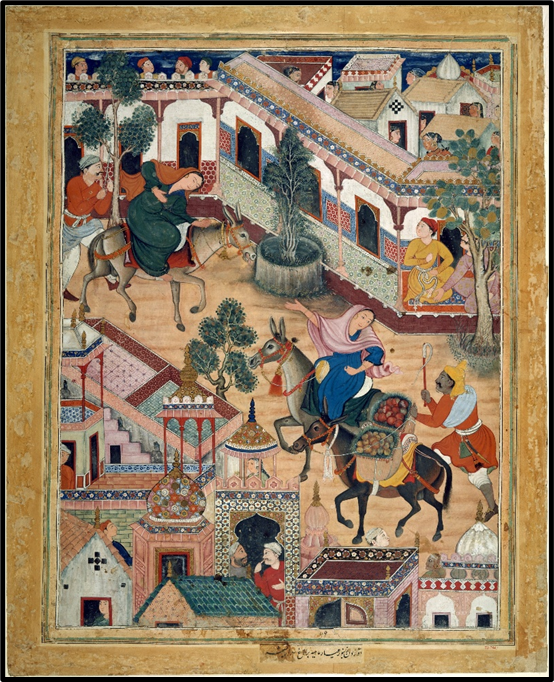
- Akbar transformed painting into a state-sponsored art.
- According to Abul Fazal (in Ain-i-Akbari), Akbar employed 100+ painters.
Artists at Akbar’s Court
Master painters included → Mir Sayyid Ali, Abdus Samad (Shirin Qalam – “Sweet Pen”), Daswanth, Basawan, Govardhan, Miskin
Govardhan and Miskin were especially famous for court scenes.
Institutional Setup
- Artists worked in Tasveer Khana at Fatehpur Sikri
- Supervised by Mir Sayyid Ali and Abdus Samad
Major Illustrated Manuscripts
- Hamzanama → completed (≈1400 miniatures)
- Tutinama
- Razmnama
- Ramayana
- Baburnama
- Akbarnama
- Tarikh-i-Khandan-i-Timuriyah
- Anwar-e-Suhaili (Persian Panchatantra)
European Influence
- Example: ‘Madonna and Child’ (1580) by Manohar
- European Renaissance composition
- Indian jewellery and accessories
UPSC Insight:
Akbar = mass production + synthesis of Indian, Persian & European styles.
Jahangir (1605–1627)
- Jahangir was a connoisseur and painter himself.
- Painting reached its highest artistic refinement during his reign.1
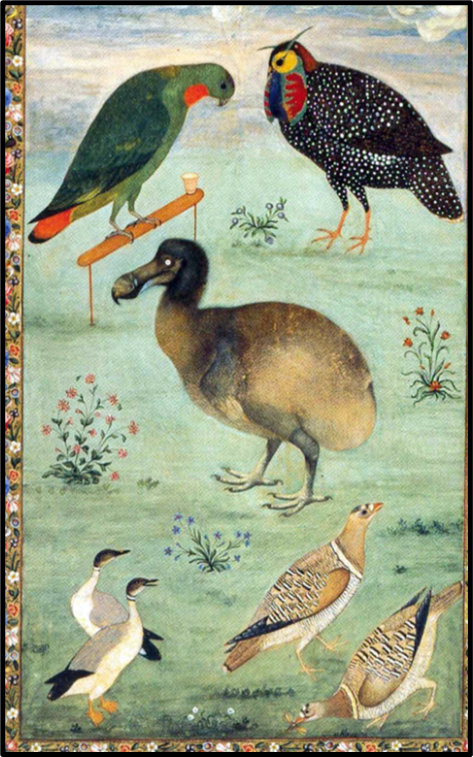
Artistic Focus → Portraits; Court personalities; Birds, animals, flowers; Albums (not books)
Notable Artists
- Aqa Riza
- Abul Hasan → Nadir-ul-Saman (“Wonder of the Age”)
- Ustad Mansur → Nadir-ul-Asr (“Unparalleled of the Age”)
- Bishan Das, Manohar, Govardhan
Key Characteristics
- Extreme naturalism & scientific accuracy
- Brilliant colours (peacock blue, deep red)
- Three-dimensional effects
- Lavishly decorated hashiya (margins) with gold flora and fauna
- Shift from:
- War narratives → aristocratic elegance
- Books → albums
European Impact
- Christian themes
- Use of perspective and realism
UPSC Insight:
Jahangir = quality over quantity + nature realism.
Shah Jahan (1628–1658)
- Shah Jahan prioritised architecture, but painting continued.
- Style became → More stylised, More idealised, Less naturalistic
Artists → Muhammad Fakirullah, Mir Hashim, Govardhan, Bichitra
Masterpiece → Padshahnama: Represents the technical zenith of Indian miniature painting
Dara Shikoh
- Dara Shikoh patronised painting like Akbar.
- Prepared an album of 40 paintings
- Today preserved in the British Museum
Aurangzeb (1658–1707)
- Aurangzeb opposed painting on religious grounds.
- Royal patronage stopped.
- Artists migrated to → Deccan courts, Rajput states
UPSC Insight:
Aurangzeb = dispersal → regional schools flourish.
Later Mughals & Final Decline
- Brief revival under Muhammad Shah Rangeela (1719–1748)
- By late 18th century:
- Mughal painting fragmented into:
- Post-Mughal
- Provincial Mughal
- Sub-Mughal styles
- Mughal painting fragmented into:
- Eventually merged with Company School of Art
Famous Mughal Paintings
- ‘Noah’s Ark’ → Miskin
- ‘Krishna Lifts Mount Govardhan’ → Miskin
- ‘Falcon Perched on a Bird Rest’ → Ustad Mansur
- ‘Jahangir’s Dream’ → Abul Hasan
- ‘Jahangir enthroned on an Hourglass’ → Bichitra
- ‘Dara Shikoh with Sages in a Garden’ → Bichitra
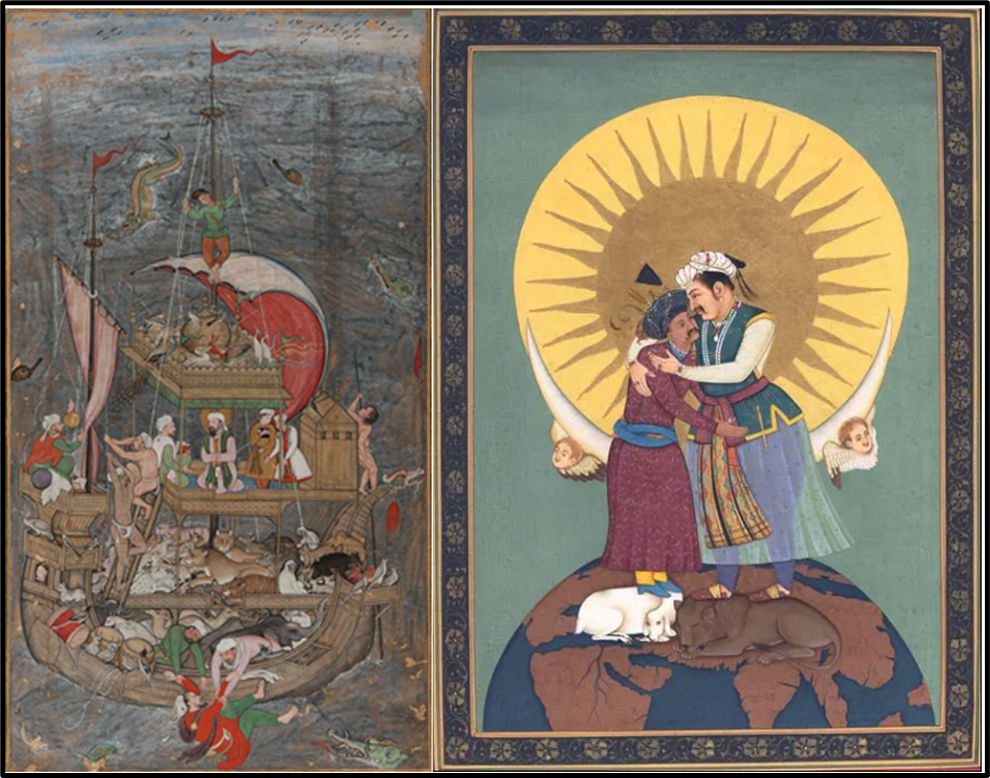
Summary of Mughal Miniature Paintings
- Babur – Though personally interested in painting and aware of Persian masters, he left no significant artistic legacy in India.
- Humayun – The true founder of Mughal painting in India, who institutionalised Persian artistic traditions by inviting master painters and setting up the royal atelier.
- Akbar – The real architect of the Mughal School, under whom miniature painting flourished through large-scale workshops, manuscript illustration, and stylistic synthesis.
- Jahangir – The golden age patron of Mughal painting, renowned for naturalism, refined portraiture, scientific accuracy, and exquisite album paintings.
- Shah Jahan – A period of visual grandeur marked by idealised portraits, rich colours, and heightened formal elegance rather than realism.
- Dara Shikoh – A liberal and intellectually inclined patron who continued Akbar’s artistic spirit through personal albums and painterly encouragement.
- Aurangzeb – A conservative ruler whose opposition to painting led to the decline of Mughal patronage and dispersal of artists to regional courts.
- Later Mughal Rulers – Oversaw a brief revival followed by decline, giving rise to provincial, post-Mughal styles and eventual absorption into Company School painting.
One-Line UPSC Memory Hook
Humayun laid the foundation, Akbar institutionalised, Jahangir perfected, Shah Jahan stylised, Aurangzeb dismantled.
- UPSC Prelims 1996 ↩︎
For chapter-wise Art and Culture Notes for UPSC Prelims and Mains, refer to the complete Art and Culture notes page.