
Deccan Sultanate
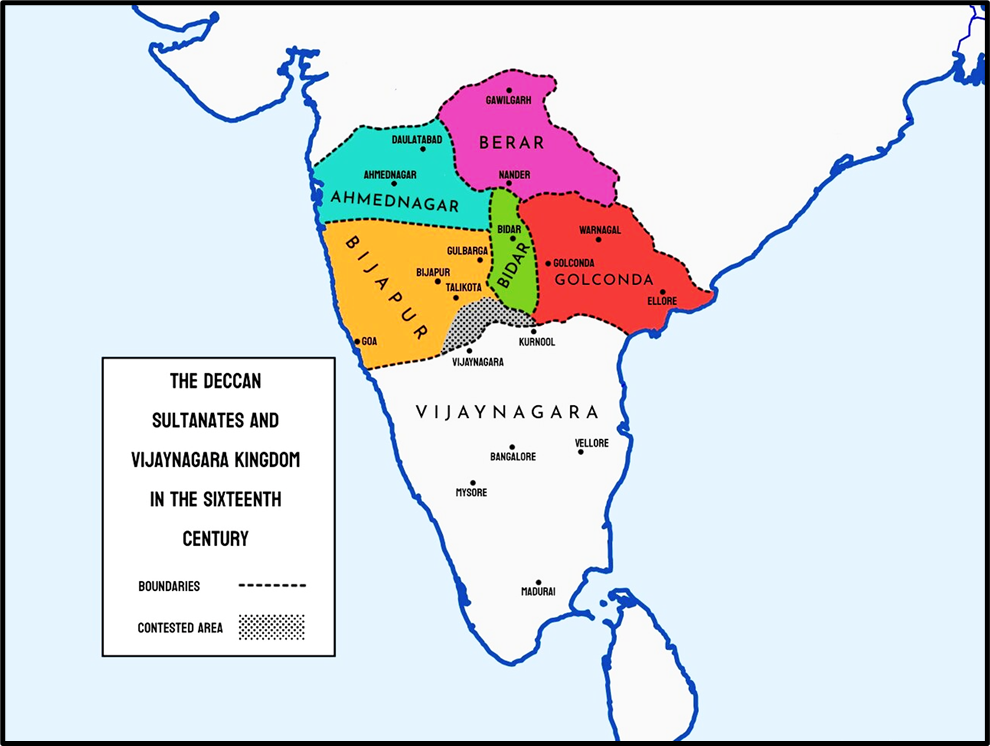
The Deccan Sultanates were five independent Muslim kingdoms that emerged from the fragmentation of the Bahmani Sultanate — itself the first independent Islamic kingdom of the Deccan, founded in 1347 CE.
As Bahmani power declined through the late 15th century, weakened by the factional rivalry between Deccani nobles (local Muslims) and Afaqis (foreign immigrants), provincial governors began asserting autonomy. The execution of the brilliant prime minister Mahmud Gawan in 1481 CE — a victim of court conspiracies — proved the decisive blow, after which central authority collapsed irreversibly.
By 1490 CE, three sultanates had already declared independence, and by 1526 CE all five had fully broken away: the Imad Shahi of Berar, the Nizam Shahi of Ahmadnagar, the Adil Shahi of Bijapur, the Qutb Shahi of Golconda, and the Barid Shahi of Bidar.
Though frequently rivals, these five states shared a common Bahmani political and cultural inheritance, continued using Bahmani coins to legitimize their rule, and occasionally united — most famously at the Battle of Talikota (1565 CE) — to decisively defeat the Vijayanagara Empire to their south.
Their individual histories reflect a remarkable diversity of origins, languages, and cultural traditions, yet together they defined the Deccan as one of the most dynamic and cosmopolitan regions of medieval India before their successive absorption into the Mughal Empire between 1574 and 1687 CE.
🏰 Nizam Shahi Dynasty (Ahmadnagar) — 1490–1633 CE
🌱 Foundation and Origins
The Ahmadnagar Sultanate was established by Malik Ahmad Nizam Shah I in 1490. He was the son of Malik Hasan Bahri and was originally part of the Kulkarnis of Pathri in Marathwada. After serving as governor of Beed and other districts, Malik Ahmad declared independence from the Bahmani Sultanate.
👑 Notable Rulers
🔵 Burhan Nizam Shah I (1509–1553 CE) — The Shi’a Reformer
After Ahmad’s death in 1510, he was succeeded by his son Burhan, a lad of seven years at that time. Burhan, the first of the Nizam Shahis to assume the title of Nizam Shah, ruled for forty-three years.
A major religious shift occurred under Burhan: Burhan Nizam Shah I became ruler, converting to Nizari Isma’ili Shi’a Islam. This made Ahmadnagar one of the few Deccan Sultanates with a Shi’a identity, distinguishing it from the Sunni-majority Bahmani tradition.
Shifting Alliances: Burhan Shah allied with the Hindu state of Vijayanagar — an unusual move that highlights the pragmatic, non-ideological nature of Deccan politics where religion took a back seat to strategic interests.
🔴 Husain Nizam Shah I (1553–1565 CE) — The Battle of Talikota
Burhan’s son Husain reversed his father’s Vijayanagara alliance and became the pivotal figure in the most significant battle in Deccan history.
Hussain Nizam Shah I was the Sultan of Ahmadnagar from 1554 until his death in 1565. He was the leading figure of the coalition of the Deccan Sultanates during the Battle of Talikota. Notably, Hussain Nizam Shah was responsible for taking prisoner and beheading Rama Raya of Vijayanagara after the Battle of Talikota.
Dynastic Diplomacy:
- Husain Nizam Shah married his daughter Chand Bibi to Ali Adil Shah I of Bijapur and gave the fort of Sholapur as dowry.
- Ali Adil Shah I married his sister to Murtaza, son of Husain Nizam Shah. His another daughter was married to Ibrahim Qutb Shah.
This web of marriages cemented the anti-Vijayanagara alliance.
🟢 Murtaza Nizam Shah I (1565–1588 CE) — Territorial Zenith
After the death of Hussain in 1565, his minor son Murtaza Nizam Shah I ascended the throne. During his minority, his mother Khanzada Humayun ruled as a regent for several years. Murtaza Shah annexed Berar in 1574, bringing the sultanate to its territorial zenith.
The annexation of Berar absorbed the weakest Deccan Sultanate and made Ahmadnagar the largest of the five Deccan states at its peak.
⚔️ Chand Bibi and the Mughal Assault (1595–1600 CE)
After a period of internal succession crises, the Mughal threat materialized under Akbar.
Confusion reigned supreme in the Ahmadnagar kingdom as there were four claimants to the throne. While one of them was supported by Chand Bibi, daughter of Husain Nizam Shah and widow of Ali Adil Shah of Bijapur, Miyan Manjhu threw his weight with another. Miyan Manjhu asked for help from Mughal emperor Akbar’s son Prince Murad who responded by besieging the Ahmadnagar fort. Chand Bibi fought gallantly but in the end in 1596 she was forced to enter into an agreement with the Mughals, ceding Berar to the Mughal empire.
An attack by the Mughals from the north was gallantly resisted by Chand Bibi, queen dowager of Bijapur, but Berar was ceded (1596) and Ahmadnagar fell after the queen’s death (1600).
🌟 Malik Ambar — The Last Defender (1600–1626 CE)
The most remarkable chapter of Nizam Shahi history belongs not to a sultan but to a prime minister of African origin.
Background: Originally a slave from modern-day Ethiopia, he was sold from place to place by many slave merchants, one of whom renamed him Ambar and converted him to Islam. He was eventually brought to India, where he was bought by his last owner, the Peshwa of the Ahmadnagar Sultanate. Ambar rose through the ranks at Ahmadnagar, where he created a mercenary force numbering greater than 50,000 men.
Political Role: After the fall of Ahmadnagar in 1600, Malik Ambar emerged as a central figure in the resistance movement. Rallying the remaining Nizam Shahi nobles and local Deccan forces, he declared Murtaza Nizam Shah II, a minor heir, as ruler, and assumed the office of Prime Minister (Peshwa) and Regent.
Military Genius: He is also regarded as a pioneer in guerrilla warfare in the region. He is credited with carrying out a revenue settlement of much of the Deccan, which formed the basis for subsequent settlements.
Revenue Reforms: Malik Ambar’s introduction of the revenue system was based on Raja Todarmal’s introduction of the revenue system in Northern India. He spent years properly determining the average yield of lands before classifying lands as good or bad based on their fertility. He did away with revenue farming. The revenue was first set at two-fifths of the actual output in kind, but later the growers were given the option of paying in cash.
Jahangir’s Nemesis: Jahangir’s memoirs (Tuzuk-i-Jahangiri) contain scathing remarks about him, calling him “a black-faced slave” but grudgingly acknowledging his prowess. The emperor even sent his son Prince Khurram (later Shah Jahan) to lead campaigns against him, though none achieved decisive victory.
Urban Legacy: Malik Ambar changed the capital of the Ahmadnagar Sultanate from Paranda to Junnar and founded a new city, Khadki, which was later on renamed to Aurangabad by Aurangzeb in the 1650s.
Malik Ambar is significant for THREE reasons: (1) pioneering guerrilla warfare adopted later by Marathas and Shivaji; (2) systematic land revenue reforms; (3) founding of Aurangabad (Khadki).
⚰️ Fall of the Nizam Shahi Dynasty (1633 CE)
After the death of Malik Ambar, his son Fath Khan surrendered to the Mughals in 1633 and handed over the young Nizam Shahi ruler Hussain Shah, who was sent as a prisoner to the fort of Gwalior. In a last stand, Shahaji, with the assistance of Bijapur, placed an infant scion of the Nizam Shahi dynasty, Murtaza, on the throne but acted as regent. In 1636, Aurangzeb, the Mughal viceroy of Deccan, finally annexed the sultanate to the Mughal empire, after defeating Shahaji.
🎨 Cultural Legacy of Nizam Shahi
The earliest extant school of painting in the Deccan sultanates is from Ahmadnagar. Several palaces, such as the Farah Bakhsh Bagh, the Hasht Bihisht Bagh, Lakkad Mahal were built, as were tombs, mosques and other buildings. The city of Ahmadnagar, founded by the Nizam Shahs, was described as being comparable to Cairo and Baghdad, within a few years of its construction.
Unlike the other Deccan sultanates, Ahmadnagar embraced Marathi cultural and administrative traditions, integrating local chieftains (Marathas) into governance and military structures. Its rulers patronized Marathi language and literature alongside Persian, fostering a unique syncretic identity that influenced later Maratha statecraft.
Maratha Connection: Both Shivaji’s maternal and paternal grandparents were nobles in the Ahmadnagar court, and early Maratha architecture is indistinguishable from the architecture elsewhere in the Nizam Shahi domains.
📋 Nizam Shahi — Rulers Summary Table
| Ruler | Reign | Key Event |
| Malik Ahmad Nizam Shah I | 1490–1510 | Founded dynasty; built Ahmadnagar city (1494) |
| Burhan Nizam Shah I | 1510–1553 | Adopted Shi’a Islam; allied with Vijayanagara |
| Husain Nizam Shah I | 1553–1565 | Led Battle of Talikota; beheaded Rama Raya |
| Murtaza Nizam Shah I | 1565–1588 | Annexed Berar; territorial zenith |
| Chand Bibi (Regent) | 1595–1600 | Resisted Mughals; ceded Berar (1596); died 1600 |
| Malik Ambar (Prime Minister) | 1600–1626 | Guerrilla warfare; revenue reforms; founded Aurangabad |
| Hussain Shah (last ruler) | 1630–1633 | Imprisoned by Mughals; dynasty ended |
🏰 Imad Shahi Dynasty (Berar) — 1490–1574 CE
🌱 Foundation
The Berar Sultanate was established in 1490 following the disintegration of the Bahmani Sultanate by Fathullah Imad-ul-Mulk. It was annexed by the Ahmadnagar Sultanate in 1574 following an invasion.
Origins of the Founder: Fathullah Imad-ul-Mulk was originally a Hindu captive from Vijayanagara, brought up as a Deccani Muslim and rose to command the army of Berar under the Bahmani Sultanate. He was born a Kanarese Hindu of the Brahmin caste, but was captured as a boy by Bahmani forces. Through the influence of Mahmud Gawan, he achieved the rank of officer in command of the forces (Sarlaskar) of Berar and received the title Imad-ul-Mulk.
Shortly after Malik Ahmad Nizam Shah I declared independence for the Ahmadnagar Sultanate in 1490, Fathullah Imad-ul-Mulk declared himself Sultan of Berar. He set up his capital in Achalpur and proceeded to annex Mahur to his new kingdom. He also fortified Gavilgad and Narnala.
📌 Note: Like the Nizam Shahi founder, Fathullah was also a Hindu-convert of Brahmin origin — showing the distinctly indigenous Deccani character of these sultanates.
👑 Notable Rulers
| Ruler | Reign | Key Events |
| Fathullah Imad-ul-Mulk | 1490–1504 | Founded dynasty; fortified Gavilgad & Narnala |
| Aladdin Imad Shah | 1504–1529 | Resisted Ahmadnagar with Gujarat’s support |
| Darya Imad Shah | 1529–1562 | Sought Bijapur alliance against Ahmadnagar |
| Burhan Imad Shah | 1562–1574 | Minor ruler; deposed by regent Tufail Khan |
The next ruler, Darya, ascended the throne in 1530 and tried to align with Bijapur to prevent aggression from Ahmadnagar, but was unsuccessful. Early in his reign, the minor Burhan Imad Shah, who succeeded his father in 1562, was deposed by his minister and regent Tufail Khan, who assumed rule of the Sultanate.
⚰️ Fall (1574 CE)
This gave a pretext for the intervention of Murtaza Nizam Shah of Ahmadnagar, who invaded Berar, imprisoned and put to death Tufail Khan, his son Shams-ul-Mulk, and the former-king Burhan, and proceeded to annex Berar into his own dominions of the Ahmadnagar Sultanate in 1574.
📌 Key Point: Berar is the first of the five Deccan Sultanates to be absorbed — by Ahmadnagar (not Mughals). This makes it the shortest-lived of the five (only 84 years).
⚔️ Adil Shahi Dynasty (Bijapur) — 1490–1686 CE
🌱 Foundation
Bijapur had been a taraf (province) of the Bahmani Kingdom prior to its independence in 1490. After emigrating to the Bahmani Sultanate, Yusuf Adil Shah rose through the ranks to be appointed governor of the province of Bijapur. In 1490, he created a de facto independent Bijapur state.
Origins of Yusuf Adil Shah: The Bijapur Sultanate by a foreigner who may have been a Georgian slave purchased by Mahmud Gawan. His exact origins remain disputed — Firishta claimed he was a son of Ottoman Sultan Murad II, but modern historians dispute this.
Yusuf was a man of culture and invited poets and artisans from Persia, Turkey and Rome to his court. He was also an accomplished musician and scholar with deep religious tolerance that was reflected in art and architecture.
👑 Notable Rulers
🔵 Yusuf Adil Shah (1490–1510) — Founder
- He proclaimed Shia Islam as the official religion of his territorial holdings in 1503, following the lead of Shah Ismail of the Safavid dynasty.
- A Portuguese Empire colonial expedition led by Afonso de Albuquerque exerted pressure on the major Adil Shahi port of Goa, conquering it in 1510; Yusuf retook the settlement two months later, but the Portuguese again conquered it in November of that year.
- Yusuf died in 1510, between these two clashes with the Portuguese.
🟢 Ibrahim Adil Shah I (1534–1557)
- He established Sunni Islam as the state religion and made anti-Westerner changes, replacing many Westerners with Deccanis.
- Ibrahim also invaded the Vijayanagara Empire; he pillaged a number of cities and besieged the capital, Vijayanagara, but did not seize any territory in the long term.
🔴 Ali Adil Shah I (1558–1580) — Battle of Talikota
- Ali Adil Shah restored Shi’a Islam and forged the critical anti-Vijayanagara alliance. He participated in the Battle of Talikota (1565), where the four Deccan Sultanates united and destroyed the Vijayanagara Empire, with Bijapur seizing the rich Raichur Doab afterwards.
🌟 Ibrahim Adil Shah II (1579–1626) — The Golden Age
- Ibrahim Adil Shah II’s reign (1579–1626) was the Adil Shahi dynasty’s greatest period, during which he extended its frontier to Mysore.
- He reverted to the Sunni form of Islam but remained tolerant of other religions, including Christianity. He was a skillful administrator and a generous patron of the arts.
Cultural Significance: Ibrahim Adil Shah II was an accomplished musician and poet, earning the title of “Jagadguru Badshah.” The dynasty’s policies of religious tolerance and cultural patronage enriched Bijapur’s heritage, making it a melting pot of traditions.1
🏛️ Muhammad Adil Shah (1627–1656) — Gol Gumbaz
The Gol Gumbaz is the most celebrated architectural contribution of the Adil Shahi dynasty. Commissioned by Muhammad Adil Shah as his mausoleum, Gol Gumbaz was completed in 1656. The dome of Gol Gumbaz, measuring 44 meters in diameter, is the second-largest dome in the world, unsupported by pillars.
⚰️ Fall (1686 CE)
From the late 16th century, the greatest threat to Bijapur’s security was the expansion of the Mughal Empire into the Deccan. Agreements and treaties imposed Mughal suzerainty on the Adil Shahs, by stages, until Bijapur’s formal recognition of Mughal authority in 1636. The influence of their Mughal overlords and continual strife with the Marathas sapped the state of prosperity until the Mughal conquest of Bijapur in 1686.
💎 Qutb Shahi Dynasty (Golconda) — 1518–1687 CE
🌱 Foundation
The founder was Quli Qutb Shah, a Turkish governor of the Bahmani eastern region, which largely coincided with the preceding Hindu state of Warangal. Qutb Shah declared his independence in 1518 and moved his capital to Golconda.
Origins: The dynasty’s founder, Sultan Quli Khawas Khan Hamdani, was born in Hamadan, Iran. He belonged to the Qara Qoyunlu, a Turkmen Muslim tribe. He migrated to Delhi with some relatives and friends, later travelled south to Deccan and served the Bahmani sultan.
The Golconda Sultanate was the last of the five to declare independence (1518) and also the last to fall (1687) — surviving the longest among all five Deccan Sultanates.
👑 Notable Rulers
🔵 Sultan Quli Qutb Shah (1518–1543) — Founder
- Sultan Quli Qutb Shah was a contemporary of Krishnadevaraya and extended his rule by capturing forts at Warangal, Kondapalli, Eluru, and Rajamundry.
- He was later assassinated in 1543 by his own son Jamsheed while offering prayers — a pattern of parricide that marked the early dynasty.
🌟 Muhammad Quli Qutb Shah (1580–1612) — Founder of Hyderabad
- Muhammad Quli Qutb Shah was the fifth sultan of the Sultanate of Golconda and founder of the city of Hyderabad.
- He built its architectural centrepiece, the Charminar.
- He was an able administrator and his reign is considered one of the high points of the Qutb Shahi dynasty.
The construction of Hyderabad was initiated in 1591, on the southern bank of the River Musi. The city was modelled to relieve overcrowding in Golconda and became one of the great cities of medieval India.
Cultural Legacy: Muhammad Quli Qutb Shah wrote poems in Dakhini Urdu, Persian and Telugu. In the early 17th century, the Telugu language was elevated to the status of the Persian language — as they adopted Telugu, the Qutb Shahis started seeing their polity as the Telugu-speaking state, with their elites considering the rulers as “Telugu Sultans.”
💰 Economic Significance
The kingdom was noted for its gold and diamonds. Its government was a Muslim military aristocracy; Persian influence was strong, and the sultans belonged to the Shīʿīte sect of Islam. Relations of the dynasty with the Hindu Telugus were generally good.
Golconda was the only known source of diamonds in the world until the 18th century — including the famous Koh-i-Noor and Hope Diamond.
⚰️ Fall (1687 CE)
The last sultan, Abul Hasan Tana Shah, had an inclusive administration, appointing Hindu ministers like Madanna and Akkanna to the highest administrative positions. This provoked Aurangzeb, who used it as a pretext for invasion. After a grueling siege, Golconda fell in 1687. Abul Hasan was captured and imprisoned in Daulatabad fort, ending the dynasty.
🏛️ Barid Shahi Dynasty (Bidar) — 1492–1619 CE
🌱 Foundation
The Sultanate was founded by Qasim Barid I, who was Georgian enslaved by Turks. He joined the service of Bahmani ruler Mahmud Shah Bahmani as a sar-naubat (commander), and later became a mir-jumla (governor) of the Bahmani Sultanate. In 1492, he became de facto ruler of Bahmani, although Sultan Mahmud Shah Bahmani remained as the nominal ruler.
The Barid Shahi dynasty is unique in that it began not as an outright rebellion but as a gradual takeover from within — the Bahmani sultans became mere figureheads while the Barids wielded real power.
Real power was by then in the hands of Amir Qasim Barid, and his grandson Ali Barid assumed the royal title in 1542.
📌 Note: Bidar was the original Bahmani capital — making the Barid Shahi the most direct successor state geographically.
👑 Notable Rulers
| Ruler | Reign | Key Events |
| Qasim Barid I | 1492–1504 | De facto ruler; nominal Bahmani sultans retained |
| Amir Barid I | 1504–1542 | Consolidated power; king-maker role |
| Ali Barid Shah I | 1542–1580 | First to use royal title “Shah”; Battle of Talikota |
| Amir Barid III | 1609–1619 | Last ruler; defeated by Bijapur |
Amir Barid was succeeded by his son Ali Barid, who was the first to assume the title of shah. Ali Barid participated in the Battle of Talikota and was fond of poetry and calligraphy.
Cultural Legacy: The tomb of Ali Barid Shah (1577) is the most notable monument in Bidar. An important class of metalwork known as Bidriware originated in Bidar. This metalwork consists of a black metal, usually a zinc alloy, inlaid with intricate designs in silver, brass, and sometimes copper.
⚰️ Fall (1619 CE)
In 1619, he (Amir Barid III) was defeated by Ibrahim Adil Shah II of the Sultanate of Bijapur, who annexed the territory of Bidar. Amir Barid III and his sons were brought to Bijapur and kept under surveillance.
- UPSC Prelims 2000 ↩︎
This article forms part of the broader Ancient and Medieval History syllabus for UPSC preparation.
One Comment