
Causes of World War I
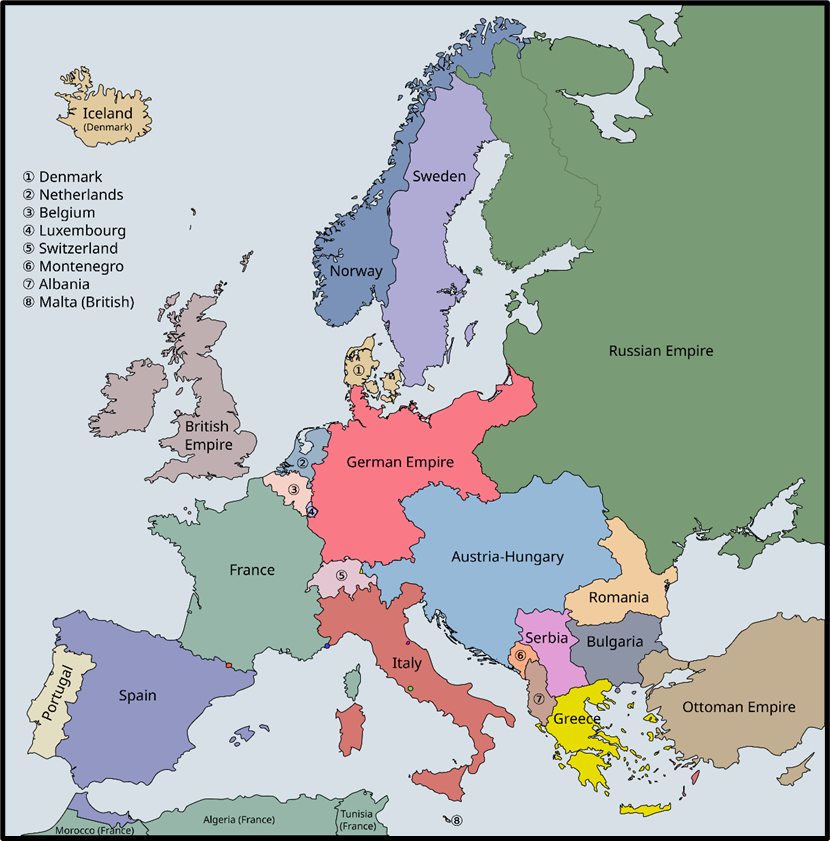
The question of responsibility for the outbreak of the First World War has remained one of the most debated issues in modern history. Even today, historians do not agree on a single cause or a single guilty nation. Instead, what emerges is a complex web of decisions, fears, ambitions, and miscalculations.
Let us approach this systematically—first by understanding the immediate trigger, and then by analysing the deeper structural causes and historiographical debates.
The Immediate Trigger vs. the Larger War
At the most basic level, there is a clear starting point: the conflict between Austria–Hungary and Serbia.
The assassination at Sarajevo did not automatically mean a world war. It triggered a regional conflict, but the real question is: why did this regional conflict escalate into a global war?
Austria–Hungary saw Serbian nationalism—especially the idea of a unified Yugoslav state—as an existential threat to the multi-ethnic Habsburg Empire. Therefore, the war against Serbia was conceived as a preventive war, aimed at crushing nationalism before it destroyed the empire.
Interestingly, Austria likely hoped for a localized war, similar to earlier Balkan conflicts. This tells us something important: the escalation was not inevitable at the beginning—it was produced by subsequent decisions.
The Problem of Escalation: Why Did It Become a World War?
The Alliance System: ‘Armed Camps’ or Flexible Arrangements?
One of the most common explanations is the role of alliances—Europe divided into two opposing blocs:
- Triple Entente (France, Russia, Britain)
- Triple Alliance (Germany, Austria–Hungary, Italy)
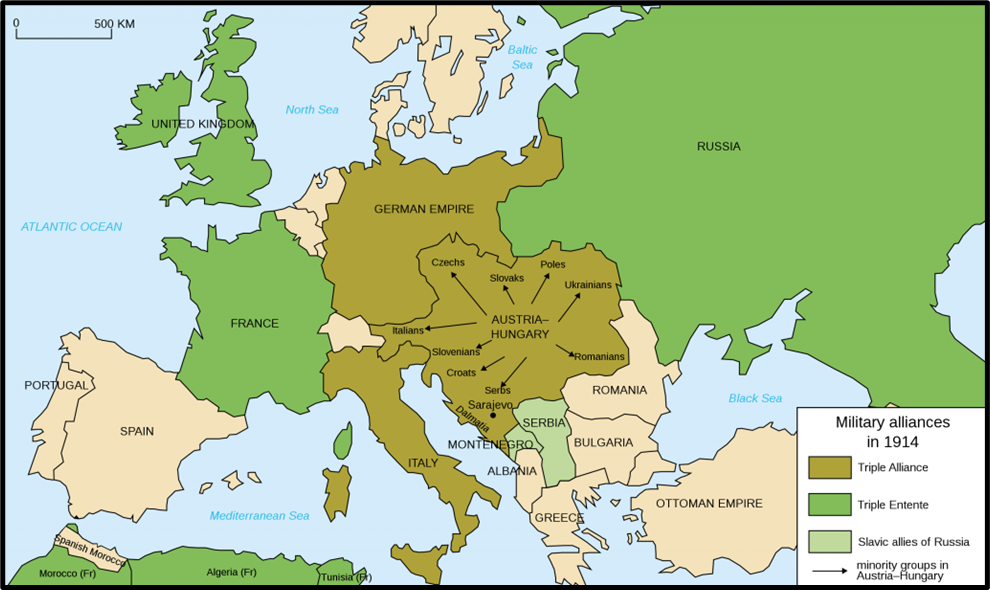
The American historian George Kennan argued that once the Franco-Russian alliance of 1894 was formed, Europe’s fate was sealed.
However, this explanation is not entirely convincing.
If we examine historical evidence, alliances were not rigid commitments. During earlier crises—like the Moroccan Crises (1906, 1911) or Bosnian Crisis (1908)—alliances did not automatically lead to war. Even Italy, a member of the Triple Alliance, later fought against Germany.
Thus, the alliance system created conditions of tension and suspicion, but did not make war inevitable. It acted more like a multiplier, not a direct cause.
Colonial Rivalries: A Weak Explanation
Another argument points to imperial competition in Africa and Asia.
At first glance, this seems logical—Germany was dissatisfied with its colonial possessions compared to Britain and France. However, most colonial disputes had been resolved diplomatically, not through war.
In fact, just before the war in July 1914, Anglo-German relations were relatively stable, even cooperative in some colonial negotiations.
So, colonial rivalry alone cannot explain the war. However, it had an indirect effect—it intensified naval competition.
Naval Rivalry: Britain vs Germany
Here we see a more tangible source of tension.
Influenced by Alfred Thayer Mahan, Germany believed that sea power was essential for global dominance. This led to a massive naval expansion under Admiral Tirpitz.
The British response was the revolutionary Dreadnought battleship (1906), which reset naval competition. Suddenly, Germany could compete on equal technological footing.
This created deep suspicion in Britain—many believed that Germany’s naval expansion implied future war intentions.
However, by 1913–14, this rivalry had lost intensity. Britain maintained a clear advantage, and even Winston Churchill noted that Germany could not catch up.
Thus, naval rivalry contributed to long-term distrust, but was not the immediate cause of war.
Economic Rivalry: A Marxist Interpretation
Marxist historians argue that capitalist competition—especially between Germany and Britain—drove the world toward war.
Germany was rapidly industrializing and challenging British economic dominance. However, this argument has a key flaw:
Germany was already on the path to economic supremacy. As one industrialist noted, a few more years of peace would secure dominance.
Therefore, from a rational economic perspective, war was not in Germany’s interest.
This suggests that economic rivalry alone cannot explain the war—it must be combined with political and strategic anxieties.
Russia’s Role: Protector of Slavs and Strategic Anxiety
Russia’s support for Serbia was a decisive factor in escalation.
Russia had multiple motivations:
- Pan-Slavism: Leadership of Slavic peoples
- Strategic concerns: Fear of losing access to the Dardanelles
- Prestige: Avoid humiliation after earlier setbacks
- Domestic politics: Possible diversion from internal unrest
Russia’s decision to mobilize first triggered a chain reaction—Germany responded with its own mobilization, making war unavoidable.
However, Russian leaders were aware of the risks. Minister Durnovo even warned that war could lead to revolution and collapse of the Tsarist regime—a prediction that proved accurate in 1917.
Thus, Russia acted both out of strategic necessity and emotional-national pressure, making escalation more likely.
Germany’s Role: The ‘Blank Cheque’ and Historical Debate
Perhaps the most controversial issue is Germany’s role.
Germany gave Austria unconditional support—often called the ‘blank cheque’. This emboldened Austria to act aggressively against Serbia.
But why did Germany take this risk? This has produced major historiographical debates.
1. The Fischer Thesis: Germany as the Main Aggressor
The German historian Fritz Fischer argued that Germany deliberately planned war to achieve:
- Global dominance
- Economic supremacy
- Suppression of domestic political challenges (like the rise of the SPD)
SPD: Social Democratic Party of Germany
He used evidence such as the 1912 ‘War Council’, where military leaders suggested that war was inevitable.
According to Fischer, war was not accidental—it was deliberate expansionism.
This view gained support, especially in Marxist and East German historiography, because it linked war to capitalism and imperialism.
2. The ‘Preventive War’ Argument
Another group of historians emphasizes fear and timing.
Germany felt increasingly encircled by:
- British naval superiority
- Rapid Russian military expansion (supported by French loans)
German leaders believed that waiting would make their enemies stronger. Therefore, war was seen as a preventive necessity—a war for survival.
General Moltke reportedly believed war must occur before Russia became too powerful.
This interpretation shifts Germany’s role from aggressor to anxious power reacting to strategic pressure.
3. The Miscalculation Theory
A third interpretation is more nuanced.
It suggests that German leaders, including Wilhelm II and Chancellor Bethmann-Hollweg, did not want a full-scale war.
Instead, they believed that strong support for Austria would intimidate Russia into backing down.
This was a catastrophic miscalculation.
Instead of deterring war, it triggered a chain reaction of mobilizations and declarations, leading to a global conflict.
Mobilization Plans: When Strategy Became Destiny
The Logic of Military Planning
By the early 20th century, European powers had developed highly sophisticated mobilization plans, designed for rapid deployment of troops using railways.
The most famous among these was the Schlieffen Plan, formulated by Count von Schlieffen (1905–06). Its core assumption was brutally simple:
- Defeat France quickly in the west
- Then shift forces to fight Russia in the east
This required speed, precision, and absolute adherence to timetable.
The Problem of Inflexibility
Historians like Gerhard Ritter and A. J. P. Taylor argue that these plans were dangerously rigid.
Once mobilization began, it triggered an unstoppable chain reaction:
- Railway schedules had to be followed exactly
- Troops could not be easily redirected
- Diplomatic negotiations became almost impossible
In essence, mobilization itself became equivalent to a declaration of war.
This is a crucial analytical point:
Technology (railways) and military planning reduced political flexibility, making war more likely even when leaders hesitated.
Belgium and the Expansion of War
The Schlieffen Plan required Germany to attack France through Belgium, violating its neutrality.
This single act had massive consequences:
- It brought Britain into the war
- It transformed a continental conflict into a global war
Interestingly, Germany had no direct quarrel with France at that moment—but the logic of the plan forced expansion beyond the original conflict.
Even when Wilhelm II attempted a last-minute modification (partial mobilization), the military leadership—especially Moltke—refused, arguing that plans could not be altered.
This suggests something profound: Control shifted from politicians to generals.
Was the Schlieffen Plan Overstated?
Modern historian Terence Zuber challenges this traditional narrative.
He argues that:
- There was no single rigid “Schlieffen Plan”
- Multiple alternative strategies existed
- The post-war German narrative exaggerated its rigidity to explain defeat
This introduces a historiographical debate:
- Traditional view: Military rigidity caused war
- Revisionist view: This rigidity has been overstated
War as a ‘Tragedy of Miscalculation’
The Turner Interpretation
Historian L. C. F. Turner presents a powerful alternative: The war was not inevitable—it was a tragedy of miscalculation. Let us unpack this idea.
Layered Miscalculations Across Europe
Each major power made critical errors:
- Austria–Hungary underestimated Russia’s willingness to intervene
- Germany overestimated the deterrent effect of its support (‘blank cheque’)
- Russia and Germany assumed mobilization would not necessarily lead to war
- Military leaders (e.g., Moltke) believed in quick victory through rigid plans
These were not irrational decisions individually. But collectively, they produced a self-reinforcing crisis spiral.
Bethmann-Hollweg’s famous remark— “Oh, if I only knew!”—captures this confusion perfectly.
Analytical Insight
This interpretation is extremely important:
The First World War was not simply planned—it was also stumbled into.
This challenges deterministic explanations and highlights the role of human error, misjudgment, and overconfidence.
The Continuing Debate: Who Was Ultimately Responsible?
Even after analysing all causes, historians remain divided. Let us examine the major positions.
1. The Fischer Thesis Revisited: Germany as the Primary Culprit
Many historians still support Fritz Fischer.
Later works like those edited by Richard Hamilton and Holger H. Herwig conclude that:
- Germany knowingly risked a major war
- It acted out of fear of declining power
- It gambled on a decisive victory
This was not necessarily a war for domination—but a war for survival before it was too late.
2. War Was Possible, Not Inevitable
A more recent perspective emerges from historians like Holger Afflerbach and David Stevenson.
Their argument:
- War was not inevitable
- But given the conditions of 1914, it was highly possible
This is a nuanced middle ground—rejecting both inevitability and pure accident.
3. Austria–Hungary’s Independent Role
Historian Samuel Williamson shifts focus to Vienna.
He argues:
- Austria did not plan war before Sarajevo
- The assassination created the decisive moment
- Austria acted independently, not merely under German pressure
This restores agency to Austria–Hungary, often overshadowed in traditional narratives.
4. Leadership and Personality: The Role of Wilhelm II
Historian John Rohl emphasizes individual responsibility.
He argues that:
- Wilhelm II was reckless and inconsistent
- His leadership style contributed significantly to escalation
This approach highlights the role of personality in history, not just structures.
5. Russia’s Role Reconsidered
Historian William Mulligan offers a counterbalance.
He argues that Russia also bears significant responsibility:
- After defeat in the Russo-Japanese War (1905), Russia sought to regain prestige
- Shifted focus to the Balkans
- Promised support to Serbia
- Undertook massive military expansion
These actions alarmed Germany and contributed to the decision for preventive war. Thus, Russia was not merely reactive—it was an active participant in escalation.
Final Synthesis: A Shared Responsibility
After examining all perspectives, a balanced conclusion emerges: The First World War cannot be attributed to a single cause or country.
Instead:
- Austria–Hungary triggered the crisis
- Germany escalated it through unconditional support
- Russia intensified it through mobilization
- France and Britain contributed through alliance commitments
- Military systems and miscalculations made de-escalation nearly impossible
Thus, responsibility is collective but unequal.
Conceptual Takeaway
The outbreak of the First World War was the result of an interaction between structural tensions (alliances, nationalism, militarism), immediate triggers (Sarajevo), systemic constraints (mobilization plans), and human failures (miscalculation and misjudgment).
This makes the war a classic case of unintended consequences in international relations.