
Frontal Zones
We know that fronts don’t form everywhere — they are created only where two contrasting air masses converge along a line. On a global scale, this happens mainly in two pressure belts: Equatorial Low-Pressure Belt and Subpolar Low-Pressure Belt.
From these regions, geographers have identified five major frontal zones (and some also count the Intertropical Front as a sixth). Let’s look at them one by one.
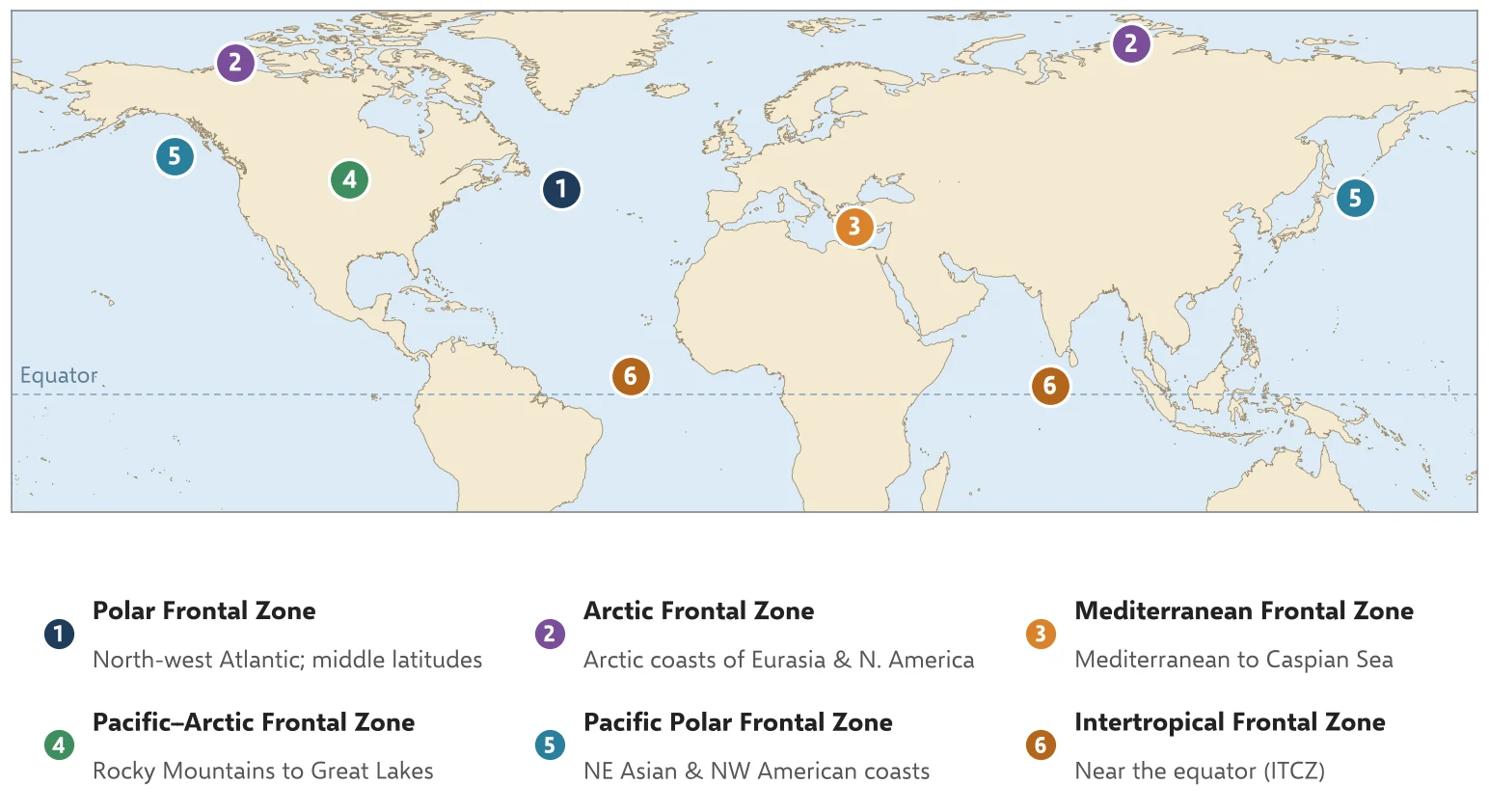
(1) Polar Frontal Zone
- Also called the Atlantic Polar Front, because it is most active in the north-west Atlantic Ocean.
- Formed by the convergence of:
- Polar Continental Air Mass → cold and dense.
- Tropical Maritime Air Mass → warm and moist.
- Location: Middle latitudes of both hemispheres.
- Seasonality: most active in winter → because temperature contrast is highest; weakens in summer → contrast reduces.
- Significance:
- This is the birthplace of temperate cyclones (extratropical cyclones).
- These cyclones move west → east under the influence of westerlies.
- They bring widespread precipitation over vast regions — from eastern North America to western Europe.
👉 This is the most important frontal zone for UPSC, because it directly explains the mechanism of mid-latitude cyclones.
(2) Arctic Frontal Zone
- Found in the Arctic region, where Continental Polar Air Mass meets Maritime Polar Air Mass.
- Usually weak because the temperature difference is not very sharp.
- But when relatively warm maritime polar air encounters extremely cold Arctic air, the front becomes very active.
- Location: Along Arctic coasts of Eurasia and North America.
👉 These fronts are especially relevant for Arctic weather patterns.
(3) Mediterranean Frontal Zone
- Created due to the meeting of Cold Continental European Air Mass and warmer winter air mass of North Africa.
- Location: Mediterranean → Caspian Sea line.
- Significance:
- Generates Mediterranean winter cyclones.
- These cyclones move east and northeast.
- Some travel as far as Pakistan and north-west India, causing winter rainfall in North India (the famous Western Disturbances).
👉 For UPSC, this is extremely important → explains the winter rain that benefits rabi crops in North India
(4) Pacific–Arctic Frontal Zone
- Developed in North America during winter.
- Location: From Rocky Mountains → Great Lakes.
- Winter cyclones from this zone move south-eastwards, reaching Texas and Northern Mexico.
- Weather Impact: They bring intense cold waves to the southern United States.
👉 In simple terms: These fronts explain the sudden cold spells in the US even in regions like Texas or Mexico.
(5) Pacific Polar Frontal Zone
- Active over the North Pacific Ocean, especially in winter.
- Two sub-zones: near north-east Asiatic coast and near north-west North American coast.
- Weather Impact:
- Cyclones here affect the western coast of North America, from the Gulf of Alaska → southern California & western Mexico.
- These storms cause winter precipitation across the US Pacific coast.
👉 This explains why places like California get winter rains, unlike India where winter is dry.
(6) Intertropical Frontal Zone (ITFZ)
- Some meteorologists describe a tropical front near the equator.
- Formed by the convergence of NE trade winds (Northern Hemisphere) and SE trade winds (Southern Hemisphere).
- BUT — here’s the catch:
- Both winds have similar origin and similar temperature.
- Hence, no significant temperature contrast.
- Therefore, no “true” front forms.
👉 Instead of a true front, what we get here is the Intertropical Convergence Zone (ITCZ) — marked more by cloud bands and rainfall than by sharp frontal activity.
✅ Summary for Quick Recall
| Frontal Zone | Location | Air Masses Involved | Seasonal Activity | Weather Impact |
|---|---|---|---|---|
| Polar Front | Mid-latitudes (esp. N. Atlantic, N. Pacific) | Polar continental (cold) + Tropical maritime (warm) | Strong in winter | Extratropical cyclones, widespread precipitation (N. America → Europe) |
| Arctic Front | Arctic coasts (Eurasia, N. America) | Continental polar + Maritime polar | Weak, except when warm polar maritime meets cold Arctic | Winter storms along the Arctic front |
| Mediterranean Front | Mediterranean–Caspian line | Cold European + Warm North African | Winter | Cyclones → reach NW India as Western Disturbances |
| Pacific–Arctic Front | Rocky Mountains → Great Lakes (N. America) | Arctic/continental polar vs Pacific maritime polar | Winter | Cold waves in southern USA |
| Pacific Polar Front | N. Pacific (NE Asia, NW North America) | Polar vs Tropical maritime | Winter | Winter precipitation on Pacific coasts (Alaska → California) |
| Intertropical Front | Near Equator | NE trade + SE trade | Year-round | No true front (ITCZ instead) |