
UPSC CURRENT AFFAIRS — 25 NOVEMBER 2026
1. Who Pays for Climate Damage? A Federal Question
(POLITY AND GOVERNANCE) (TH) A US Supreme Court hearing on whether states and cities can sue fossil-fuel companies for climate damage has prompted a look at India. Here, States bear most of the cost of floods, heatwaves and cyclones, but have limited legal and fiscal room to respond. This is the debate on climate federalism.
How Powers Are Split
| Area | Who holds the lever |
|---|---|
| Environmental law | The Union, using Article 253 (laws to implement international agreements) to pass the Air Act, 1981 and the Environment (Protection) Act, 1986 after the 1972 Stockholm Conference |
| Disasters | “Disaster” is not named in the Seventh Schedule; the Disaster Management Act, 2005 rests on Concurrent List entries |
| Spending | States account for over 60% of general government expenditure, including relief, health and agriculture |
| Planning | NAPCC (2008) with eight national missions; State Action Plans on Climate Change (SAPCCs); the National Adaptation Fund for Climate Change (2015) with NABARD as implementing entity |
Money for Disasters: 16th Finance Commission
- Corpus: ₹2,04,401 crore for State Disaster Response and Mitigation Funds for 2026–31.
- Split: 80% for the State Disaster Response Fund (SDRF) and 20% for the State Disaster Mitigation Fund (SDMF).
- Cost-sharing: 90:10 (Centre:State) for North-Eastern and Himalayan States; 75:25 for others.
Courts Step In
- M.K. Ranjitsinh (2024): the Supreme Court recognised a right against the adverse effects of climate change under Articles 14 and 21.
- Earlier foundations: M.C. Mehta (1987) on absolute liability and Vellore Citizens Welfare Forum (1996) on the precautionary and polluter-pays principles.
- States in the dock: high courts are pressing States on preparedness, such as after the 2023 Teesta glacial lake outburst flood in Sikkim.
The Gaps
- Uninsured losses: most disaster losses in India are not insured, so the burden falls on State budgets.
- Discretionary top-ups: extra help from the National Disaster Response Fund depends on central assessment and timing.
- Shared revenue: cesses and surcharges stay outside the divisible pool under Article 270(1), so fossil-fuel levies are not shared with States.
- Local bodies: panchayats and cities, the first responders, have little money or authority.
Way Forward
Parametric insurance ➜ Federal climate forum ➜ Share fossil-fuel levies ➜ Empower local bodies
A climate-ready federation would pair national standards with State and local delivery, in the spirit of cooperative federalism and the Finance Commission framework.
📖 Read More: 16th Finance Commission • National Action Plan on Climate Change • NDMA
2. India’s Wildlife Comeback and the Gaps Ahead
(ENVIRONMENT) (IE) India holds about 8% of recorded species on just 2.4% of the world’s land, and includes parts of 4 of the 36 global biodiversity hotspots. A mix of cultural tolerance, strong laws and science-led programmes has helped many flagship species recover.
Flagship Programmes and Numbers
| Species / programme | Status |
|---|---|
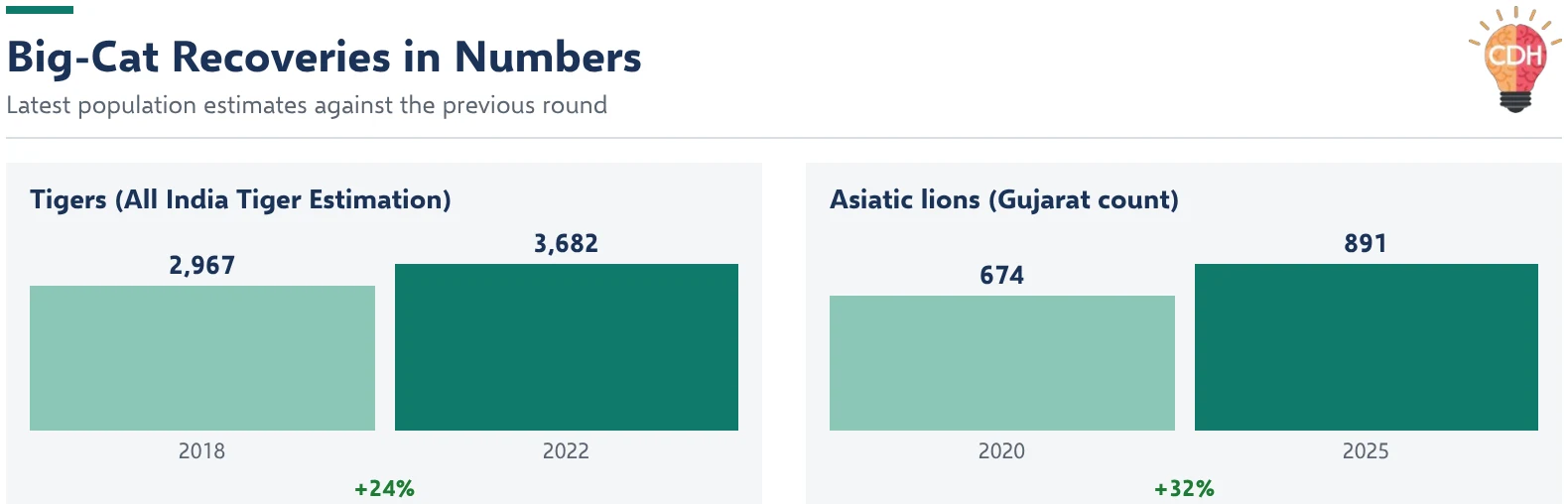
| Project Tiger (1973) | 3,682 tigers (2022), about three-quarters of the world’s wild tigers; 58 tiger reserves |
| Project Elephant (1992) | About 22,446 elephants in the 2025 DNA-based count; 33 Elephant Reserves |
| Asiatic lion | 891 in Gujarat (2025), up from 674 in 2020 |
| Greater one-horned rhino | About 4,014 (2022), mostly in Assam |
| Leopards | 13,874 common leopards (2022); 718 snow leopards (2023) |
| Project Cheetah (2022) | Cheetahs reintroduced at Kuno and Gandhi Sagar, with cubs born in India |
| Ganges river dolphin | About 6,324 in the first range-wide estimate |
| Dugong | About 270 in Tamil Nadu; India’s first Dugong Conservation Reserve in Palk Bay |
Why India Has Done Well
- Culture: sacred groves, totemic species and tolerance of wildlife near farms.
- Law: the Wild Life (Protection) Act, 1972 and a network of protected areas.
- Science: regular population estimates, camera traps and genetic studies.
Challenges
- Fragmentation: roads, railways and canals cut corridors; trains kill elephants every year.
- Conflict: crop raiding and attacks fuel local hostility.
- Trade and climate: poaching, illegal pet trade and shifting habitats.
- Data gaps: only a small share of India’s documented animals have been assessed for the IUCN Red List.
Way Forward
- Meet the Kunming–Montreal “30×30” target of protecting 30% of land and sea by 2030 with community support.
- Scale up tools such as the Gajraj AI-based system that warns train drivers of elephants on the tracks.
- Expand cryo-banking of endangered species’ genetic material at LaCONES, CCMB (Hyderabad).
📖 Read More: Conservation of Major Indian Wildlife Species • National Initiatives for Biodiversity Conservation • Species of Conservation Concern: Mammals
3. Naturopathy Day: Nature Cure in India’s Health Mix
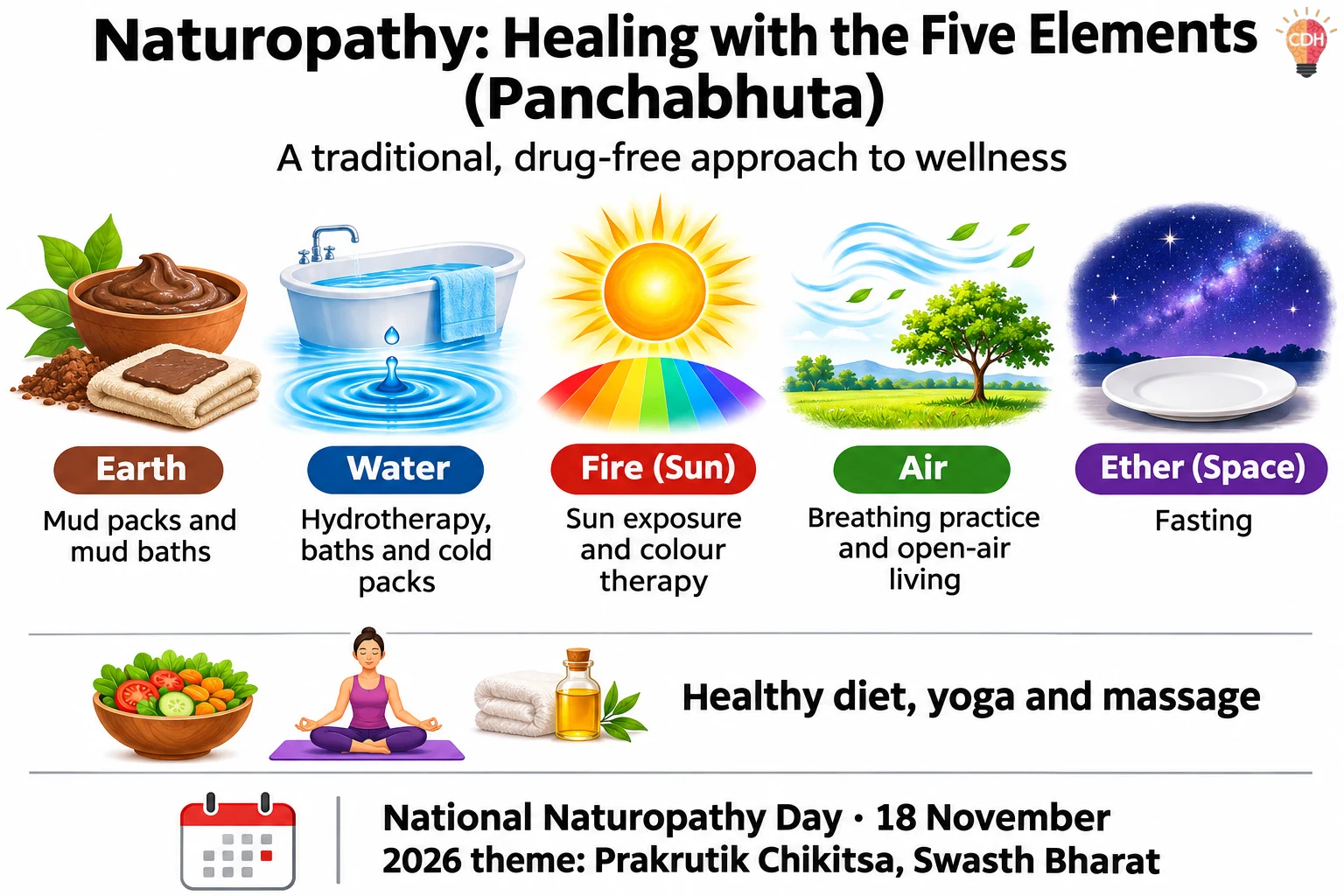
(SOCIAL JUSTICE) (PIB) The 9th National Naturopathy Day was observed on 18 November 2026 at the Central Research Institute of Yoga and Naturopathy (CRIYN), Nagamangala, Karnataka, with the theme “Prakrutik Chikitsa, Swasth Bharat”, focusing on preventing obesity and lifestyle disorders.
What Naturopathy Is
- Principle: the body can heal itself; therapy boosts its vitality using the Panchabhuta — earth, water, air, fire and ether.
- Therapies: fasting and diet, hydrotherapy, mud packs, baths and massage; in India it is practised with yoga.
- Status: Yoga and Naturopathy is one of the AYUSH systems, alongside Ayurveda, Unani, Siddha, Sowa Rigpa and Homoeopathy. It is used mainly as a complementary approach.
Why 18 November
On 18 November 1945, Mahatma Gandhi became Lifetime Chairman of the All India Nature Cure Foundation Trust, Pune. The Ministry of AYUSH declared the date Naturopathy Day in 2018.
Institutions
| Institution | Key facts |
|---|---|
| National Institute of Naturopathy (NIN), Pune | Set up 1986; new campus Nisarg Gram (2024) with a 250-bed hospital and a BNYS college (100 seats in 2026-27) |
| CCRYN | Research council for yoga and naturopathy since 1978, with 22 units |
| CRIYNs | 200-bed hospitals at Jhajjar (Haryana) and Nagamangala (Karnataka); new ones planned at Khorda (Odisha) and Raipur (Chhattisgarh) |
| Naturopathy Registration Board | Central registration of practitioners and accreditation of institutions |
| Tribal outreach | Nisarg Arogya Sadhana Kendra at Gohe (Pune district); a target to recognise one lakh tribal healers |
Wellness and Medical Tourism
- International patients rose from 1,82,945 (2020) to 6,44,387 (2024).
- An Ayush Visa was introduced on 27 July 2023; the Union Budget 2026-27 proposed five Regional Medical Value Tourism Hubs with Ayush centres.
The challenge is evidence: rigorous trials and integration with mainstream care will decide how far naturopathy can support India’s fight against lifestyle diseases.
📖 Read More: Health and Nutrition • Health: A Social Perspective
4. Contempt of Court: SC Clarifies Limits of BNSS Section 384
(POLITY AND GOVERNANCE) (IE) The Supreme Court questioned a Bihar Additional Sessions Judge who convicted a Superintendent of Police under Section 384 of the Bharatiya Nagarik Suraksha Sanhita (BNSS) for not registering an FIR. It held that ignoring such an order is not contempt “in the view or presence” of the court; such defiance must go to the High Court.
Two Kinds of Contempt
| Type | Meaning (Contempt of Courts Act, 1971) |
|---|---|
| Civil contempt | Wilful disobedience of a court’s judgment, order or direction, or wilful breach of an undertaking |
| Criminal contempt | Publication or act that scandalises or lowers the authority of a court, prejudices judicial proceedings, or obstructs the administration of justice |
Legal Framework
- Constitution: Articles 129 and 215 make the Supreme Court and High Courts courts of record with power to punish contempt; Article 142(2) covers the Supreme Court; Article 19(2) allows reasonable restrictions on speech for contempt.
- Act of 1971: based on the H.N. Sanyal Committee (1963).
- Section 10: High Courts punish contempt of subordinate courts.
- Section 12: punishment up to six months in jail, a fine up to ₹2,000, or both; an apology may be accepted.
- Section 15: private petitions for criminal contempt need the consent of the Attorney General or Advocate General.
- Section 20: one-year limitation period.
What Section 384 BNSS Covers
Section 384 (formerly Section 345 CrPC) lets a court deal summarily with certain offences committed in its view or presence, such as insulting or interrupting a public servant in a judicial proceeding. It does not reach disobedience of orders outside the courtroom, which the High Court handles under the 1971 Act.
Safeguards and Debate
- Truth as a defence (2006 amendment) and the substantial interference test.
- Fair reporting and fair criticism of judgments are not contempt.
- The Law Commission (274th Report, 2018) advised against dropping criminal contempt from the law.
📖 Read More: Jurisdiction and Powers of High Court • Articles Related to Supreme Court • Right to Freedom
5. Guru Nanak Dev Ji: Message of Oneness and Service
Life
1469: born at Rai Bhoi Ki Talwandi (Nankana Sahib) ➜ Awakening at Sultanpur Lodhi ➜ Four Udasis (journeys) ➜ Settles at Kartarpur ➜ 1539: Jyoti Jot at Kartarpur
- First Guru: founder of Sikhism, the first of ten Sikh Gurus.
- Successor: named Bhai Lehna as Guru Angad Dev, the second Guru.
Core Teachings
| Idea | Meaning |
|---|---|
| Ik Onkar | One formless, eternal God |
| Naam Japna | Remembering God’s name |
| Kirat Karni | Earning an honest living |
| Vand Chhakna | Sharing with those in need |
| Sarbat da Bhala | Welfare of all, regardless of caste, creed or gender |
- Equality: rejected caste discrimination, idol worship and empty ritual.
- Institutions: Sangat (congregation), Pangat and Langar (eating together as equals), and the Dharamsala.
- Writings: Japji Sahib, Asa di Var and Sidh Gosht, part of the Guru Granth Sahib.
His message placed him within the wider Bhakti movement, while laying the base for a distinct faith and community.
📖 Read More: Sikhism • The Bhakti Movement
6. Bengal Famine Lens: Conflicts Hurt the Global South Most
(INTERNATIONAL RELATIONS) (TH) At a UN Security Council briefing, India invoked the Bengal Famine of 1943 to argue that the costs of war are not shared equally: countries of the Global South bear the brunt of food, fuel and fertiliser shocks from conflicts far away.
The 1943 Lesson
During the Second World War, the loss of rice imports from Burma, wartime inflation, hoarding, crop disease and a slow colonial response turned a supply shock into a famine that killed millions in Bengal. The lesson: war-time decisions elsewhere can starve people who are not party to the war.
Why the Global South Is More Exposed
- Import dependence: for food, fuel and fertilisers.
- Thin fiscal space: high debt limits subsidies and relief.
- Poverty: poor households spend most of their income on food and energy.
- Weak safety nets: little social protection to absorb price spikes.
Conflict ➜ Supply and shipping disruption ➜ Food, fuel and fertiliser prices rise ➜ Imported inflation ➜ Hunger and debt stress
What India Is Asking For
- Protect humanitarian and food trade routes during conflicts.
- Give developing countries a voice in decisions that shape their food security.
- Reform the Security Council so it reflects today’s world.
The intervention fits India’s role as a voice of the Global South, seen in its G20 presidency and the Voice of Global South Summits.
📖 Read More: Soft Power, Cultural Diplomacy and the Global South • Famine • State of Food Security and Nutrition in the World
7. Bisleri Case Puts Packaged Water Rules in Focus
(SOCIAL JUSTICE) (IE) Food safety authorities granted sanction for prosecution against Bisleri International after regulatory tests found chemical contaminants in a packaged drinking water sample. Under Section 42 of the Food Safety and Standards (FSS) Act, 2006, only the Commissioner of Food Safety can sanction prosecution for offences punishable with imprisonment.
The Contaminants
| Contaminant | Source | Limit and risk |
|---|---|---|
| Bromate | By-product when ozone used for disinfection reacts with natural bromide | Limit 0.01 mg/L; potassium bromate is classed as possibly carcinogenic; high doses harm blood cells and kidneys |
| Polynuclear aromatic hydrocarbons (PAHs) | Incomplete burning of fuels, wood and tobacco; present in coal and crude oil | Must be not detectable; benzo[a]pyrene is a known human carcinogen |
How Packaged Water Is Regulated
- FSSAI sets standards; State Commissioners of Food Safety enforce them.
- BIS mark: mandatory BIS certification was dropped in 2024; packaged drinking and mineral water were then listed as high-risk foods, needing annual inspection and third-party audits.
- Testing scheme: since 1 January 2026, makers must test source water and finished products at FSSAI-notified, NABL-accredited labs.
- Appeals: disputed samples are re-tested at a Referral Food Laboratory, whose report is final.
Penalties under Section 59
Unsafe food, no injury: up to 6 months + ₹1 lakh ➜ Non-grievous injury: up to 1 year + ₹3 lakh ➜ Grievous injury: up to 6 years + ₹5 lakh ➜ Death: 7 years to life + at least ₹10 lakh
The case shows how a shift from product certification to risk-based inspection must be backed by strong testing labs and quick enforcement to protect consumers.
📖 Read More: Effects of Water Pollution • Water Pollution Control Measures
8. After COP31 Deadlock: Restoring Climate Justice
(ENVIRONMENT) (IE) (IE) The deadlock at COP31 in Antalya, Türkiye, over fossil fuels and finance has renewed calls to put climate justice back at the centre of talks. Climate justice means those most responsible for warming should support those who contributed least but suffer most.
Where the Gaps Lie
| Gap | What it means |
|---|---|
| Ambition | Current pledges (NDCs) fall far short of the cuts needed to keep warming near 1.5°C |
| Adaptation | Public adaptation finance reaching developing countries is a fraction of what they need |
| Finance goal | The NCQG of US$300 billion a year by 2035 is far below the US$1.3 trillion developing countries sought |
| Loss and damage | The new fund depends on voluntary pledges; payouts are small against actual losses |
| Historical responsibility | Developed countries emitted most of the carbon dioxide since 1850; India’s share is small |
Why Talks Stall
- Consensus rule: with no agreed voting rule, a few oil producers can block fossil-fuel language.
- Debt trap: shifting costs to loans and private capital makes the least responsible countries borrow to adapt.
- No liability: the Paris decision rules out using loss and damage as a basis for liability or compensation.
- Eroded differentiation: self-set NDCs for all have diluted Common but Differentiated Responsibilities and Respective Capabilities (CBDR-RC).
India’s Stance
- Fair access to the remaining carbon budget and climate finance from developed countries under Article 9.1 of the Paris Agreement.
- Opposition to unilateral trade measures such as the EU’s Carbon Border Adjustment Mechanism.
- Delivery at home: India reached 50% non-fossil installed power capacity in 2025, five years ahead of its 2030 target.
Pathways to Justice
Tripled, grant-based adaptation finance ➜ Solidarity levies for loss and damage ➜ Fair-share benchmarks in the Global Stocktake ➜ Majority voting as last resort ➜ Locally led adaptation
📖 Read More: UNFCCC • COP30, Belém • The Institutional Ecosystem Beyond COPs
9. Guru Tegh Bahadur: Martyr for Freedom of Faith
Life and Legacy
- Birth: 1 April 1621, Amritsar, as Tyag Mal, son of the sixth Guru, Guru Hargobind.
- Name: earned the title “Tegh Bahadur” (brave of the sword) for his valour in the Battle of Kartarpur against Mughal forces.
- Guruship: 1664–1675; father of the tenth Guru, Guru Gobind Singh.
- Founder: established Chakk Nanaki, which grew into Anandpur Sahib.
- Hymns: his compositions (over 100) are part of the Guru Granth Sahib.
Martyrdom
He stood up for Kashmiri Pandits facing forced conversion under Aurangzeb, earning the title “Hind di Chadar” (shield of India). He was executed in Delhi in 1675. Gurudwara Sis Ganj Sahib marks the site of his execution and Gurudwara Rakab Ganj Sahib the site of his cremation.
His sacrifice is remembered as a defence of freedom of conscience — the right of every person to follow their own faith, a value now enshrined in Article 25 of the Constitution.
📖 Read More: Sikhism • Aurangzeb
10. India Hosts 7th World Landslide Forum
(GEOGRAPHY) (PIB) India is hosting the 7th World Landslide Forum (WLF7) for the first time, from 22 to 27 November 2026, at Amrita Vishwa Vidyapeetham, Faridabad, with the International Consortium on Landslides. The Union Minister of State for Earth Sciences said India is shifting from post-disaster relief to prevention.
About the Forum
- WLF: a global meeting held every three years since 2008 on landslide science and risk reduction.
- Organiser: the International Consortium on Landslides (ICL), a non-profit scientific body headquartered in Kyoto, Japan, under its International Programme on Landslides.
India’s Landslide Risk Architecture
| Element | Status |
|---|---|
| Susceptibility mapping | About 4.3 lakh sq km mapped by the Geological Survey of India (GSI); an inventory of about 91,000 past landslides |
| Forecasting | Regional Landslide Forecasting System (2020); National Landslide Forecasting Centre, Kolkata (2024), now covering 20 districts |
| Mitigation money | ₹1,000 crore National Landslide Mitigation Project for 15 States (10 Himalayan + 5 others) |
| Weather science | Mission Mausam (initial ₹2,000 crore); the Bharat Forecast System at about 6 km resolution |
| Local early warning | Wireless sensor network at Munnar (Kerala); an advanced warning system in Sikkim |
Why Rain Forecasts Are Not Enough
Rainfall ➜ Soil moisture and pore-water pressure ➜ Slope deformation ➜ Slope failure
Landslides depend on geology, soil moisture, pore-water pressure and slope stability, not rain alone. Linking weather forecasts with ground sensors and satellite monitoring is the key to location-specific landslide warnings.
📖 Read More: Landslides: A Natural Hazard • Mass Movements • NDMA
11. 92nd NBWL Standing Committee Puts Marine Life First
(ENVIRONMENT) (PIB) The Union Environment Minister chaired the 92nd meeting of the Standing Committee of the National Board for Wildlife (SC-NBWL) in New Delhi on 23 November 2026, themed on marine conservation. It considered 133 project proposals needing wildlife clearance.
Key Publications Released
| Document | Highlights |
|---|---|
| Management Effectiveness Evaluation | 2024–26 assessment of 108 coastal and marine Protected Areas |
| Marine turtle assessment | Three nesting seasons (2022–25), about 1,300 km of coast and 360 beach stretches; four species |
| Dugong recovery (2016–2026) | First drone-based estimate in Tamil Nadu (270 ± 16); India’s first Dugong Conservation Reserve in Palk Bay |
| Arabian Sea humpback whale | 2022–25 study; seven sighting hotspots; entanglement in fishing gear is the main threat |
| Field Manual on Small Cats | Covers nine species of small cats found in India |
- Other highlights: Nameri Tiger Reserve (Assam) accredited under CA|TS; Wildlife Week 2026 initiatives included tiger reintroduction in Buxa and the expansion of Project Cheetah to a third site.
About the NBWL
- Nature: statutory body under the Wild Life (Protection) Act, 1972; it replaced the Indian Board for Wildlife (1952).
- Chair: the Prime Minister; the Environment Minister is Vice-Chairperson and chairs the Standing Committee.
- Role: advises on wildlife policy; its approval is needed for projects in and around national parks and sanctuaries and for changing their boundaries.
📖 Read More: India’s Wildlife Laws, Policies and Institutions • Measures to Curb Marine Pollution • Wildlife Sanctuaries in India
12. EU and IORA Hold First Maritime Security Roundtable
(INTERNATIONAL RELATIONS) (AIR) The European Union and the Indian Ocean Rim Association (IORA) held their first high-level roundtable on maritime security in New Delhi. It was organised by the EU under its ESIWA+ project on security cooperation in Asia and the Indo-Pacific.
About IORA
| Feature | Details |
|---|---|
| Founded | March 1997 as the Indian Ocean Rim Association for Regional Cooperation |
| Secretariat | Ebène, Mauritius |
| Members | 23 countries of the Indian Ocean rim, including India, Australia, South Africa, Indonesia, Iran, France and the UAE; plus dialogue partners |
| Chair | India, for 2025–27, succeeding Sri Lanka |
| Priority areas | Maritime safety and security; trade and investment; fisheries; disaster risk management; academic and science cooperation; tourism and culture |
Why the Roundtable Matters
- Shared threats: piracy, illegal fishing, trafficking and attacks on shipping in the Indian Ocean.
- EU role: ESIWA+ links the EU with partners on counter-terrorism, cyber security, crisis management and maritime security.
- India’s chairmanship: a chance to build a rules-based order in line with SAGAR and its newer MAHASAGAR vision.
📖 Read More: Indian Ocean • Coastal and Maritime Security
13. Asia Power Index 2026: India Holds Third Place
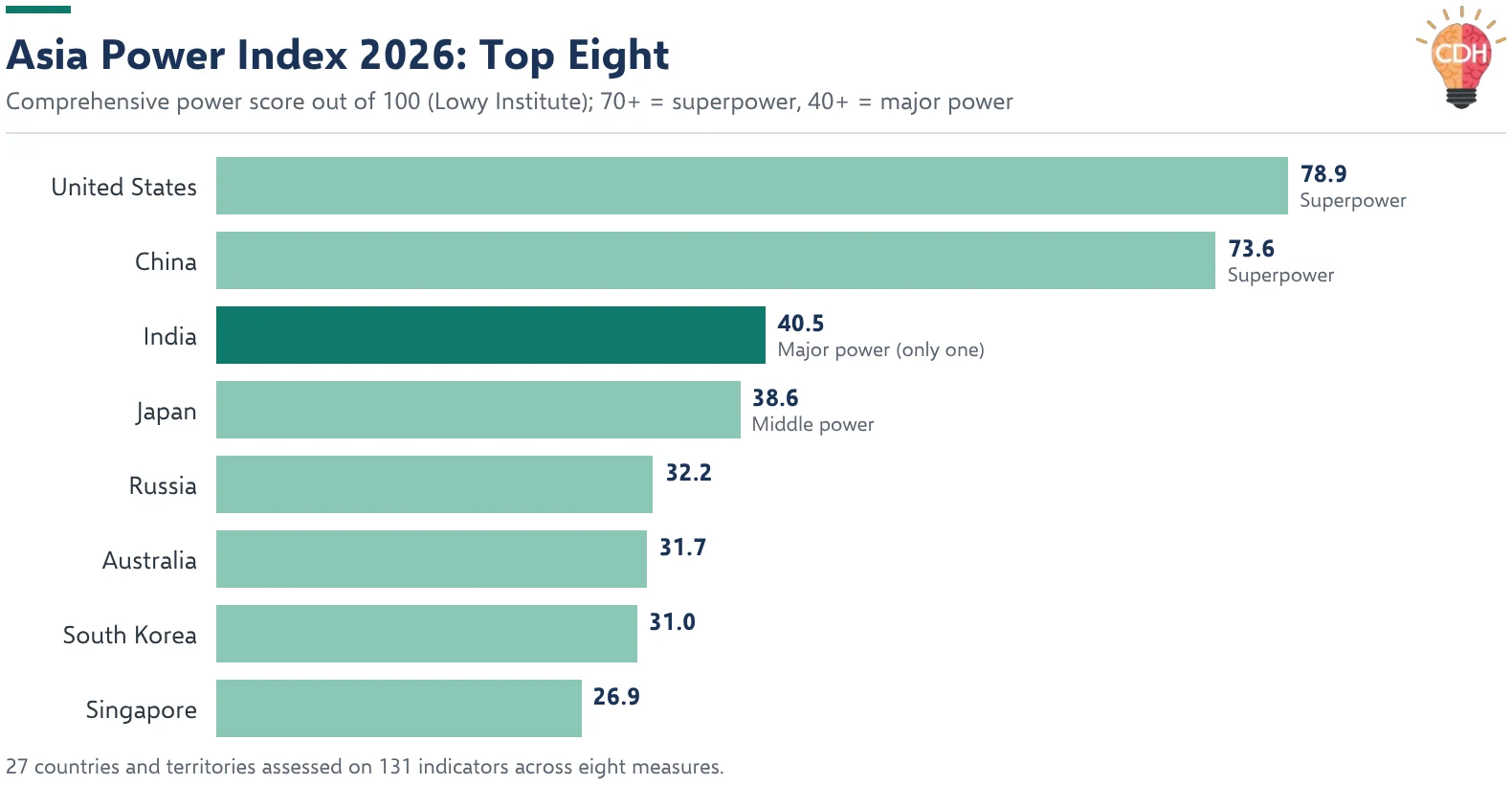
(INTERNATIONAL RELATIONS) (LOWY) The Lowy Institute’s Asia Power Index 2026 ranks India the third most powerful country in Asia, with a score of 40.5. India is the only major power in the index, behind the two superpowers, the US and China.
About the Index
- Publisher: Lowy Institute, an independent think tank in Sydney, Australia; published annually since 2018.
- Coverage: 27 countries and territories, 131 indicators, eight measures under two heads — resources (economic, military, resilience, future resources) and influence (economic relationships, defence networks, diplomatic and cultural influence).
- Tiers: 70+ superpower; 40+ major power; 15+ middle power.
India’s Profile
- Up: score rose by 0.5 points; strongest in future resources (ranked 3rd).
- Down: weakest in defence networks (ranked 9th), reflecting India’s preference for partnerships over alliances.
- Gap: India still punches below its resources, so turning capacity into regional influence is the task ahead.
📖 Read More: India and Neighbourhood Policy • ASEAN
14. Lachit Diwas: Remembering the Hero of Saraighat
The Commander
- Role: commander-in-chief (Borphukan) of the Ahom army under King Chakradhwaj Singha.
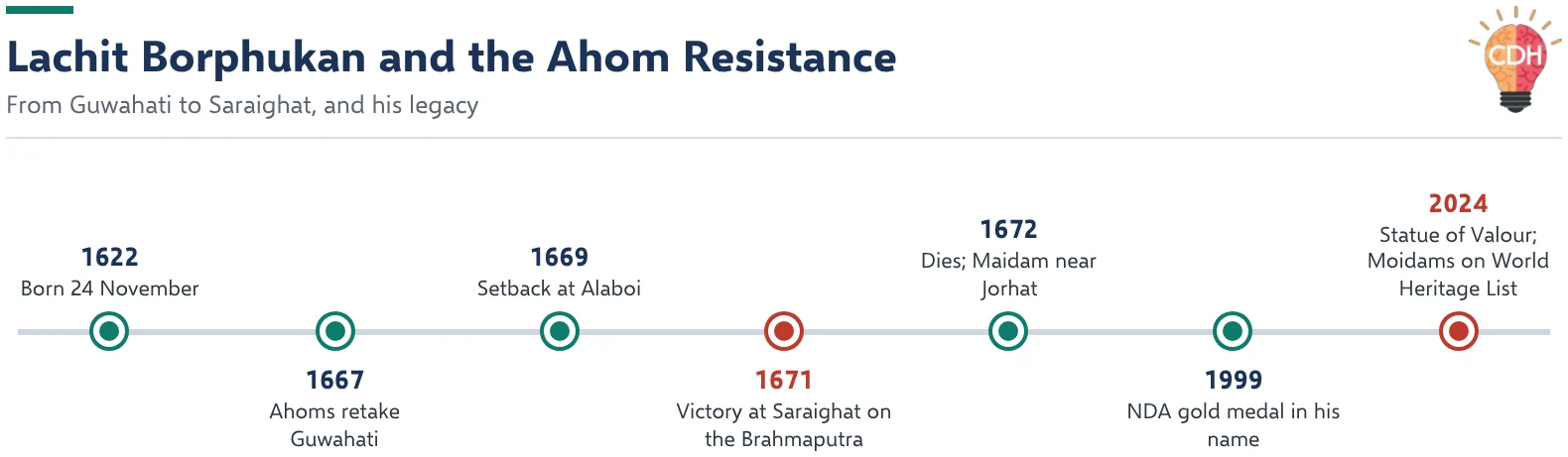
- Context: Guwahati had been ceded to the Mughals under the Treaty of Ghilajharighat (1663); the Ahoms retook it in 1667, and Aurangzeb sent Raja Ram Singh I of Amber to win it back.
- Battle of Alaboi (1669): a land setback for the Ahoms near Guwahati.
- Battle of Saraighat (1671): a naval battle on the Brahmaputra, where smaller, faster Ahom boats and clever use of the river defeated the larger Mughal fleet.
Legacy
- Maidam: his burial mound is at Hoollongapar near Jorhat, where a 125-ft bronze “Statue of Valour” stands since 2024.
- NDA: the Lachit Borphukan Gold Medal goes to the best passing-out cadet since 1999.
- Moidams: the Ahom royal mound burials at Charaideo became India’s 43rd World Heritage Site in 2024, the first cultural site from the North-East.
📖 Read More: Aurangzeb • Later Mughal Emperors
15. GRSE Delivers Ashank, Another Shallow-Water ASW Craft
(INTERNAL SECURITY) (PIB) Ashank (Yard 3036), an Anti-Submarine Warfare Shallow Water Craft (ASW-SWC) designed and built by Garden Reach Shipbuilders and Engineers (GRSE), Kolkata, was delivered to the Indian Navy at Visakhapatnam on 23 November 2026, with over 80% indigenous content.
The Programme
- Order: 16 ASW-SWCs — 8 by GRSE (Arnala class) and 8 by Cochin Shipyard (Mahe class) — to replace the ageing Abhay-class corvettes.
- Place in series: Ashank follows Amini, delivered on 5 November 2026 as the fifth GRSE craft.
- Classification: built to Indian Register of Shipping rules.
Capabilities
| Feature | Details |
|---|---|
| Roles | Sub-surface surveillance, search-and-attack, coordinated ASW with aircraft, low-intensity maritime operations, mine laying |
| Weapons and sensors | Lightweight torpedoes, indigenous anti-submarine rocket launchers and advanced shallow-water sonar |
| Propulsion | Diesel engine–waterjet combination — among the largest Indian Navy warships propelled by waterjets |
Shallow coastal waters are hard for large warships to work in but are a natural hiding ground for submarines. These craft strengthen coastal security and reflect Aatmanirbhar Bharat in naval shipbuilding.
📖 Read More: Naval Defence • Coastal and Maritime Security
16. Tangail Saree GI Dispute Reaches Madras High Court
The Saree
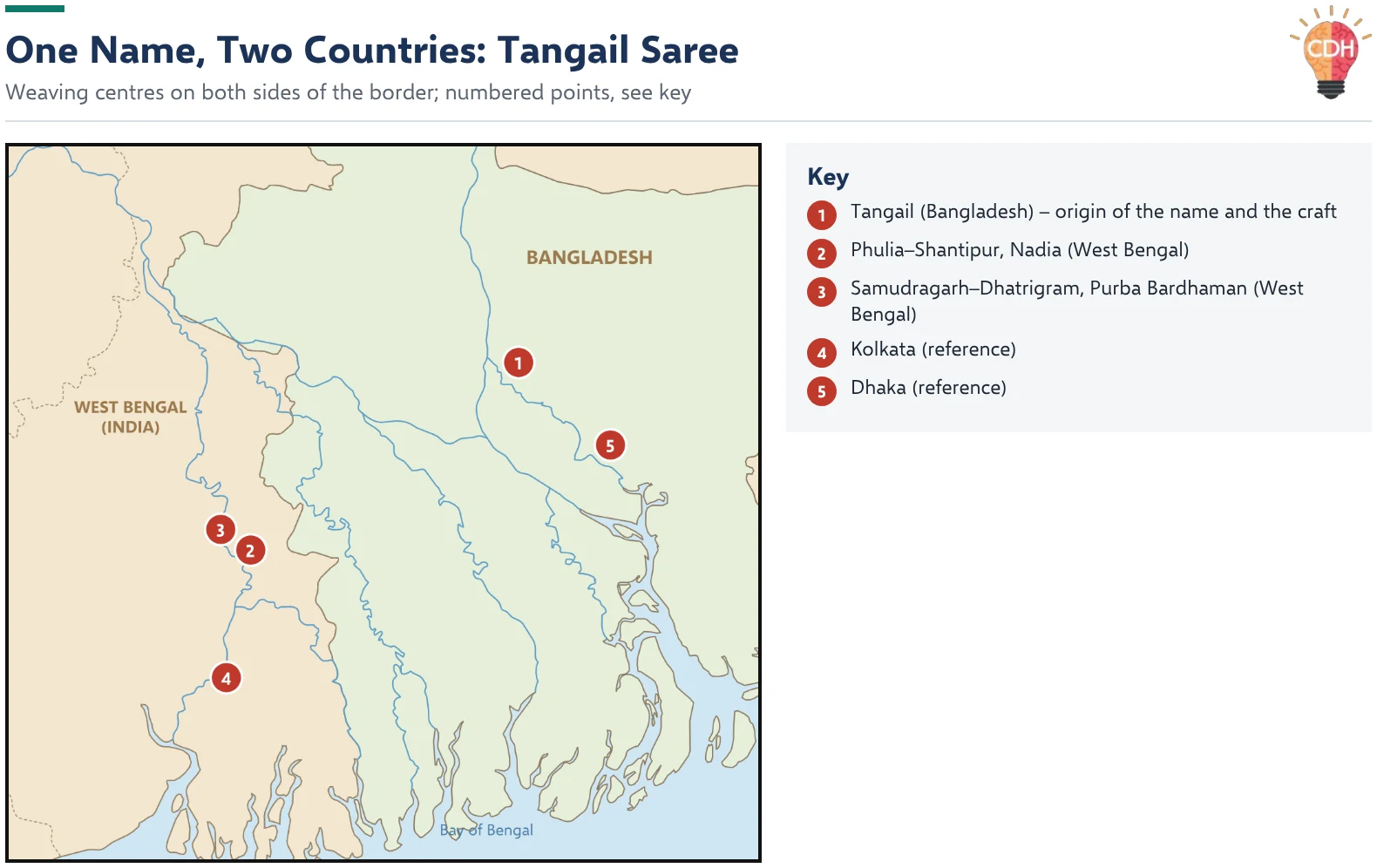
- Origin: named after Tangail district in Bangladesh; weavers who migrated after Partition carried the craft to Nadia and Purba Bardhaman in West Bengal.
- Look: fine cotton with extra-weft butis (floral, paisley and geometric motifs) and decorative borders and pallus.
- Recognition: India registered the GI in 2024; Bangladesh recognised Tangail saree as its own GI the same year, and UNESCO later inscribed Bangladesh’s Tangail saree weaving as Intangible Cultural Heritage.
The Legal Question
Under Section 27 of the Geographical Indications of Goods (Registration and Protection) Act, 1999, any aggrieved person may seek removal or correction of a GI entry. The case tests how shared heritage across borders is handled when two countries claim the same name.
- Don’t confuse: Tangaliya is a separate GI-tagged raised-dot weave from Surendranagar, Gujarat, made by the Dangasia community.
📖 Read More: Traditional Crafts of India • India and Bangladesh