
UPSC CURRENT AFFAIRS — 21 NOVEMBER 2026
1. Fundamental Duties: As Vital as Rights
(POLITY AND GOVERNANCE) (PIB) Vice President C. P. Radhakrishnan, inaugurating the 5th edition of Constitution Week Celebrations 2026 at Bennett University, said citizens’ Fundamental Duties matter as much as their Fundamental Rights. Rights, he argued, survive only when citizens act responsibly.
Constitutional Basis
- Where: Part IVA, Article 51A; the duties bind citizens only, not foreigners.
- Inspiration: the Constitution of the erstwhile USSR.
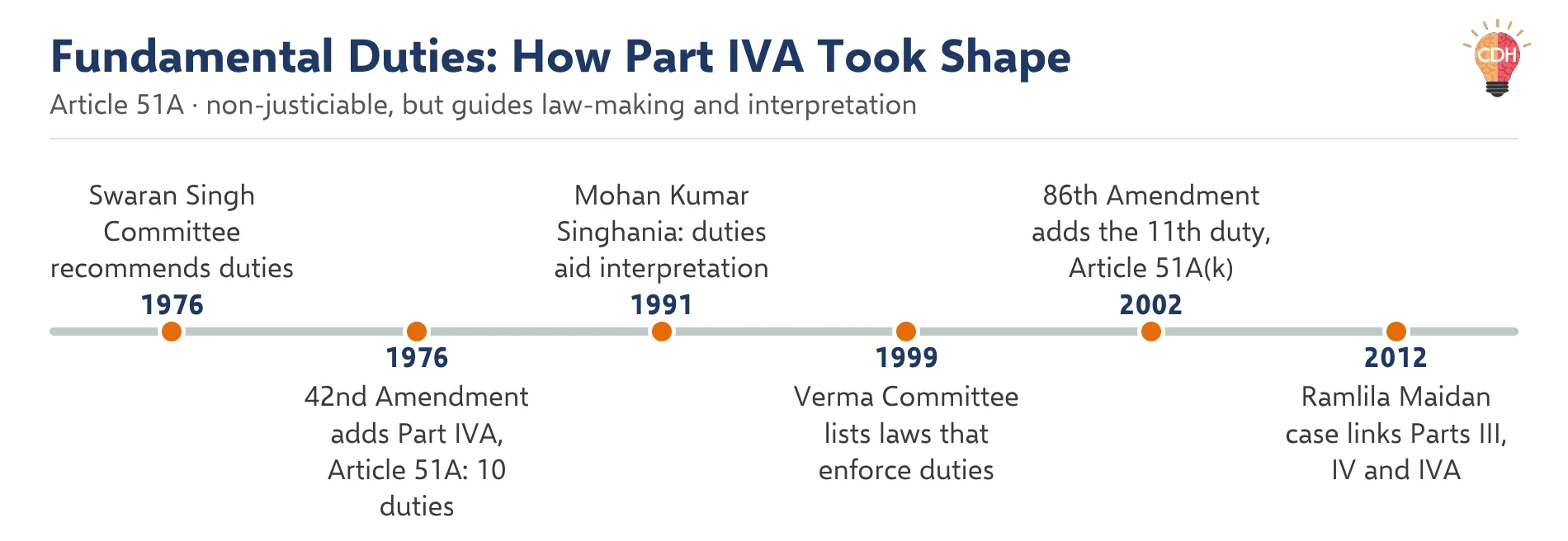
- Origin: the Swaran Singh Committee (1976) recommended them; the 42nd Amendment Act, 1976 added 10 duties.
- 11th duty: the 86th Amendment Act, 2002 added Article 51A(k): parents or guardians must provide education opportunities to children aged 6 to 14.
- Nature: non-justiciable; courts cannot enforce them directly, but Parliament can make laws to give effect to specific duties.
How Courts Have Used Them
| Case / Committee | Significance |
|---|---|
| Mohan Kumar Singhania (1991) | Duties are relevant when courts interpret laws |
| Verma Committee (1999) | Identified existing laws that enforce duties, e.g., Prevention of Insults to National Honour Act, 1971 and Wildlife (Protection) Act, 1972 |
| Ramlila Maidan Incident (2012) | Read Part III (Rights), Part IV (DPSPs) and Part IVA (Duties) as interconnected |
Why Duties Matter
Duties balance individual rights with collective responsibility. They promote constitutional morality, national integration, environmental care and civic discipline. A right to free speech, for instance, sits alongside the duty to uphold the unity and integrity of India.
📖 Read More: Fundamental Duties • Introduction to Fundamental Rights • Major Constitutional Amendments at a Glance
2. ICJ Holds Myanmar Responsible for Rohingya Genocide
(INTERNATIONAL RELATIONS) (TH) In The Gambia v. Myanmar, the International Court of Justice ruled on 19 November 2026 that Myanmar committed genocide against the Rohingya in northern Rakhine State during its 2017 military operations. It is the first time the Court has found a State itself responsible for committing genocide.
How the Case Reached the Court
The Gambia, a West African State, filed the case in November 2019 under the 1948 Genocide Convention. The Convention lets any State party bring another before the ICJ, because the duty to prevent genocide is owed to all parties (erga omnes partes).
Key Findings
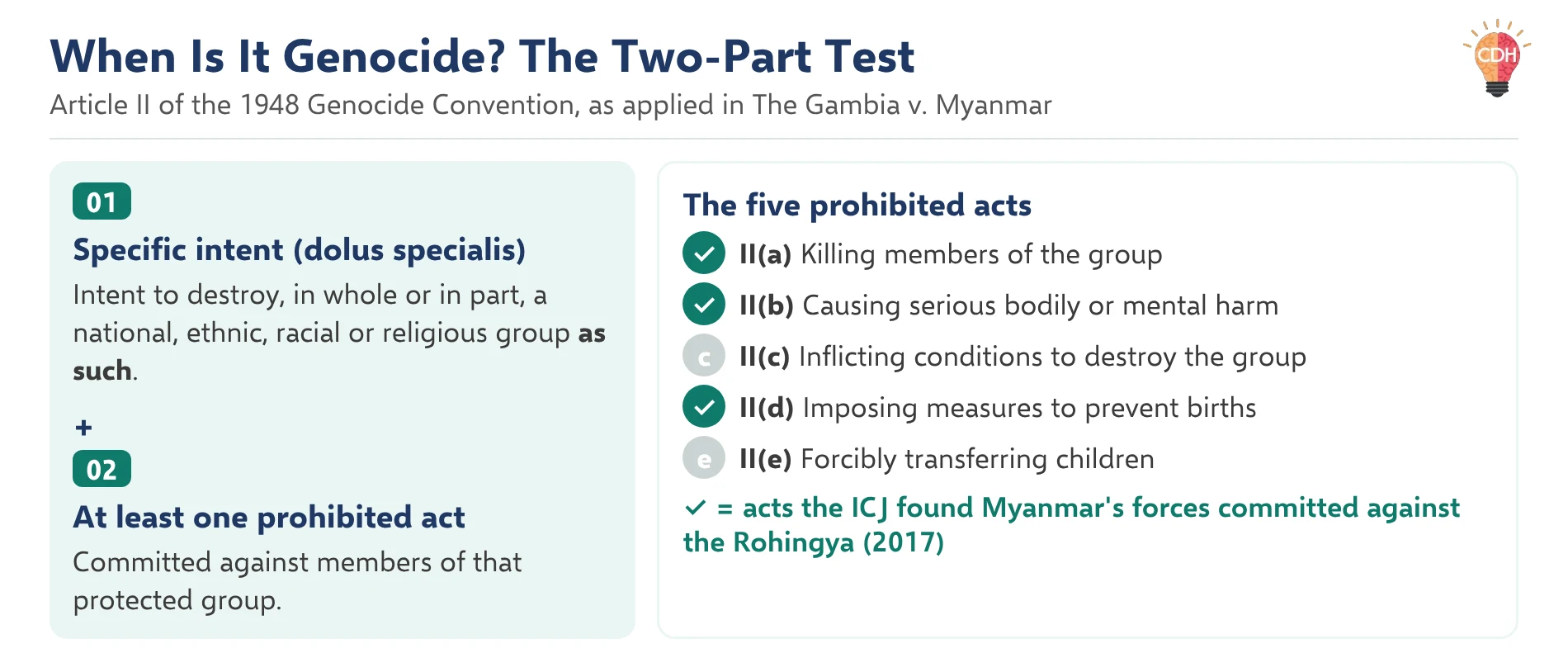
- Genocide committed: Myanmar’s security forces (Tatmadaw) carried out acts under Article II(a), (b) and (d): killings, serious bodily or mental harm, and measures to prevent births, with intent to destroy a substantial part of the group.
- Protected group: the Court treated the Rohingya as a distinct ethnic group, rejecting Myanmar’s portrayal of them as illegal migrants.
- Failure to prevent and punish: Myanmar breached its duties to prevent genocide and to punish perpetrators.
- Article V breach: Myanmar failed to enact domestic legislation giving effect to the Convention.
- Not established: Myanmar was not held responsible for direct and public incitement by private individuals.
What Myanmar Must Do
Safe, voluntary return of Rohingya ➜ Anti-genocide law and prosecutions ➜ Compensation ➜ Compliance report within two years
Why the Verdict Matters
- Precedent: in Bosnia v. Serbia (2007) and Croatia v. Serbia (2015), the Court found only a failure to prevent, or no proven intent.
- Wider meaning of destruction: undermining a group’s capacity to renew itself counts towards destruction.
- Enforcement gap: ICJ judgments bind the parties, but enforcement rests with the UN Security Council, where vetoes can stall action.
Rohingya and India
The Rohingya are a largely Muslim minority of Rakhine (formerly Arakan), left stateless by Myanmar’s 1982 Citizenship Law. The 2017 crackdown drove about 7.5 lakh people into Bangladesh, where Cox’s Bazar now hosts the world’s largest refugee camp.
- About 40,000 Rohingya live in India, at least 20,000 registered with UNHCR.
- India is not party to the 1951 Refugee Convention, but customary law’s non-refoulement principle bars return to danger.
- India signed the Genocide Convention in 1949 and ratified it in 1959, but has no specific domestic genocide law.
| Feature | ICJ | ICC |
|---|---|---|
| Tries | Disputes between States; gives advisory opinions | Individuals for genocide, war crimes, crimes against humanity, aggression |
| Basis | UN Charter (principal UN organ) | Rome Statute, 1998 (independent of UN) |
| Seat | The Hague | The Hague |
📖 Read More: India and Myanmar • International Criminal Court (ICC) • Genocide in Burundi and Rwanda • The United Nations
3. TRUST: A Five-Point Plan for India–US Trade
(INTERNATIONAL RELATIONS) (DD) Union Commerce and Industry Minister outlined a five-point TRUST agenda at the 23rd Indo-US Economic Summit, organised by the Indo-American Chamber of Commerce (IACC) in New Delhi. It is a call to action for governments, businesses and universities to deepen India–US economic ties.
The Five Calls to Action
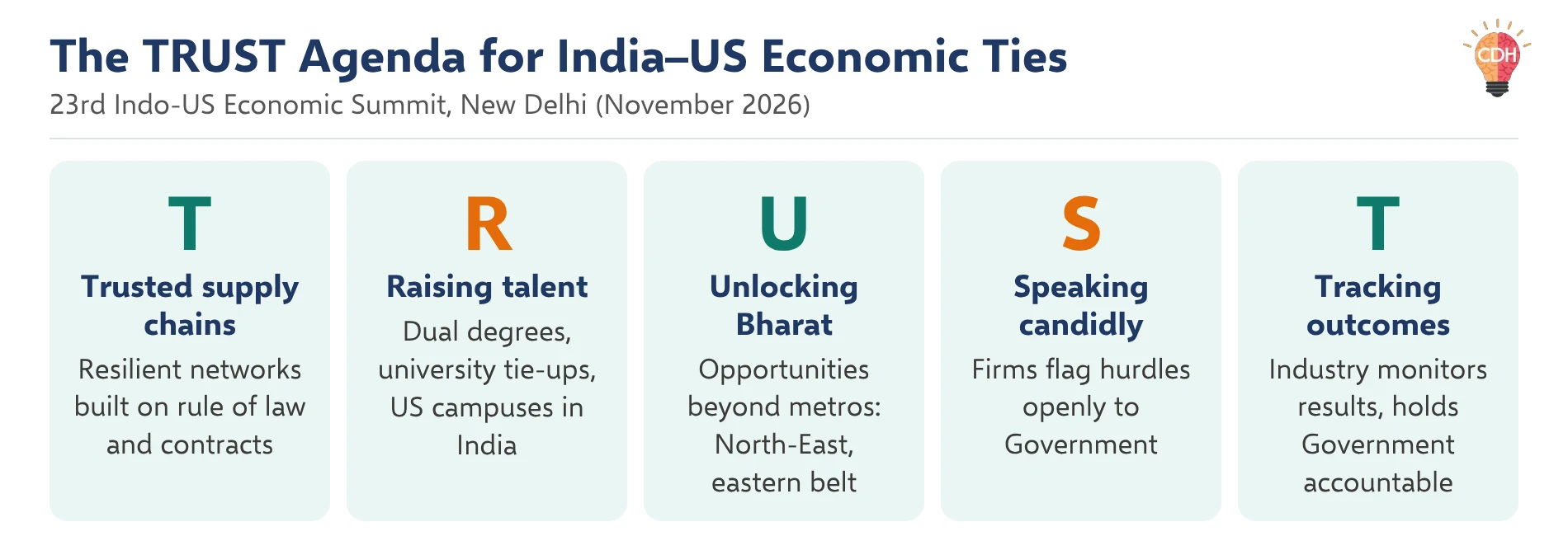
- T – Trusted supply chains: turn existing supply chains into resilient networks built on shared values, the rule of law and honoured contracts.
- R – Raising talent: dual-degree programmes, university collaboration and campuses of US universities in India, extended to partner countries.
- U – Unlocking Bharat beyond metros: take investment to the north-eastern States and the eastern belt.
- S – Speaking candidly: firms should flag difficulties openly so government arms can resolve them and widen market access.
- T – Tracking outcomes: industry should monitor results and hold the Government accountable.
Don’t Confuse It With
The U.S.–India TRUST Initiative (Transforming the Relationship Utilising Strategic Technology), launched in 2025, is a separate bilateral framework. It builds on iCET and covers defence co-production, secure 5G/6G networks, AI, semiconductors and critical minerals.
📖 Read More: India – United States Relations • Critical Minerals
4. Graça Machel Wins Indira Gandhi Peace Prize
(INTERNATIONAL RELATIONS) (TH) Graça Machel, Mozambican politician, educationist and advocate for women’s and children’s rights, received the Indira Gandhi Prize for Peace, Disarmament and Development 2025 at a ceremony in New Delhi.
About the Laureate
- Joined FRELIMO, Mozambique‘s liberation movement, and became the country’s first Minister of Education and Culture after independence in 1975.
- The only person to have been First Lady of two countries: Mozambique (wife of President Samora Machel) and South Africa (wife of President Nelson Mandela); see apartheid and majority rule.
About the Award
| Feature | Details |
|---|---|
| Instituted | 1985, by the Government of India, in memory of Indira Gandhi |
| First awarded | 1986, to Parliamentarians for Global Action |
| Administered by | Indira Gandhi Memorial Trust (endowment from the Government of India) |
| Eligibility | Living individuals and active organisations worldwide, regardless of nationality, race, gender or religion |
| Prize | ₹1 crore (or foreign-currency equivalent), a citation and a trophy |
| Previous laureate (2024) | Michelle Bachelet, former President of Chile |
Do not confuse: this prize is distinct from the Indira Gandhi Award for National Integration.
📖 Read More: India and Africa Policy • India and Mozambique Relations
5. Record Profits, Flat Pay: The Wage Puzzle
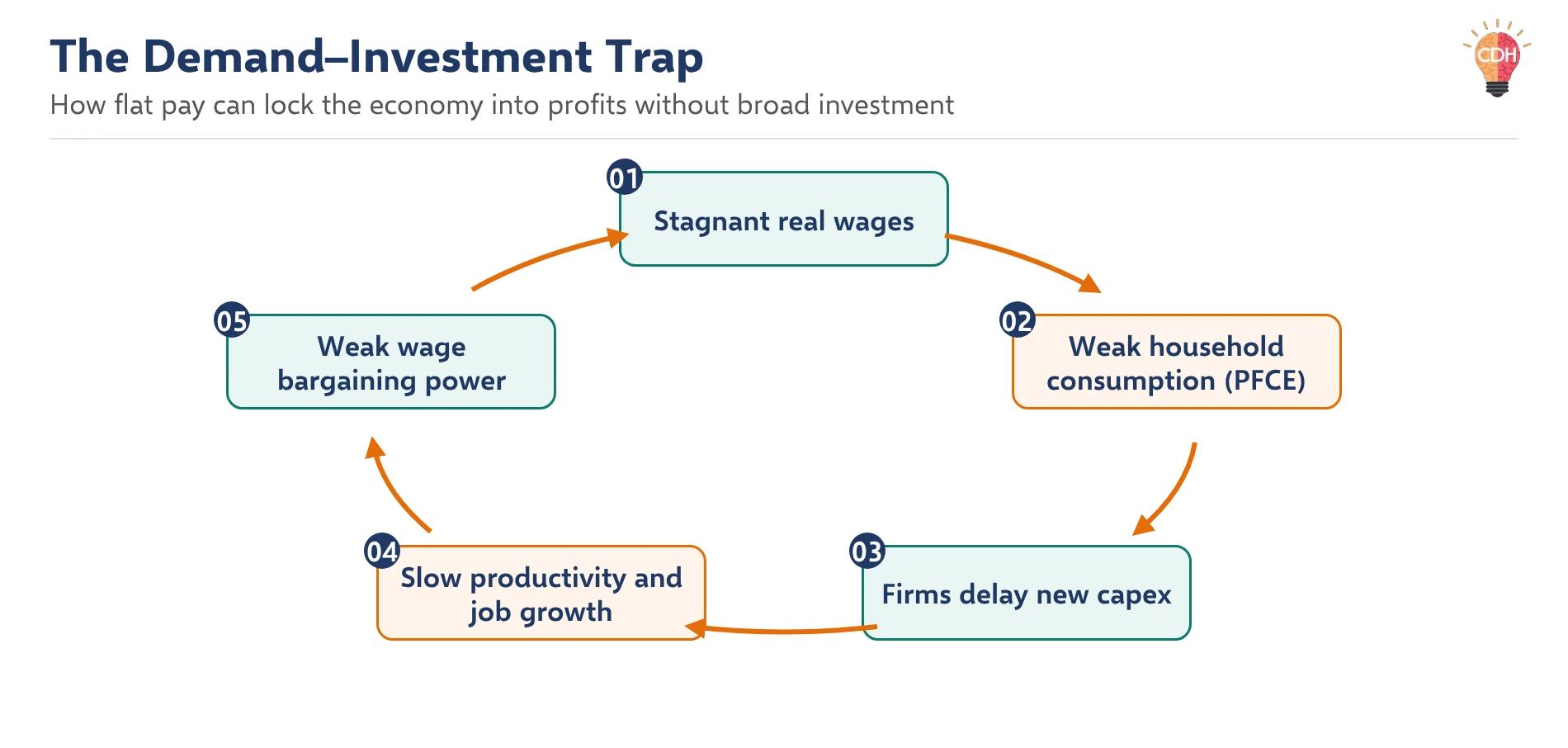
(ECONOMICS) (IE) At FICCI’s centenary celebrations, the Prime Minister criticised industry for not turning corporate tax cuts and ease-of-doing-business reforms into higher pay and more jobs. Annual Survey of Industries (ASI) 2024-25 data back the concern: real factory wages grew just 0.7% while profits hit records.
What the Data Show
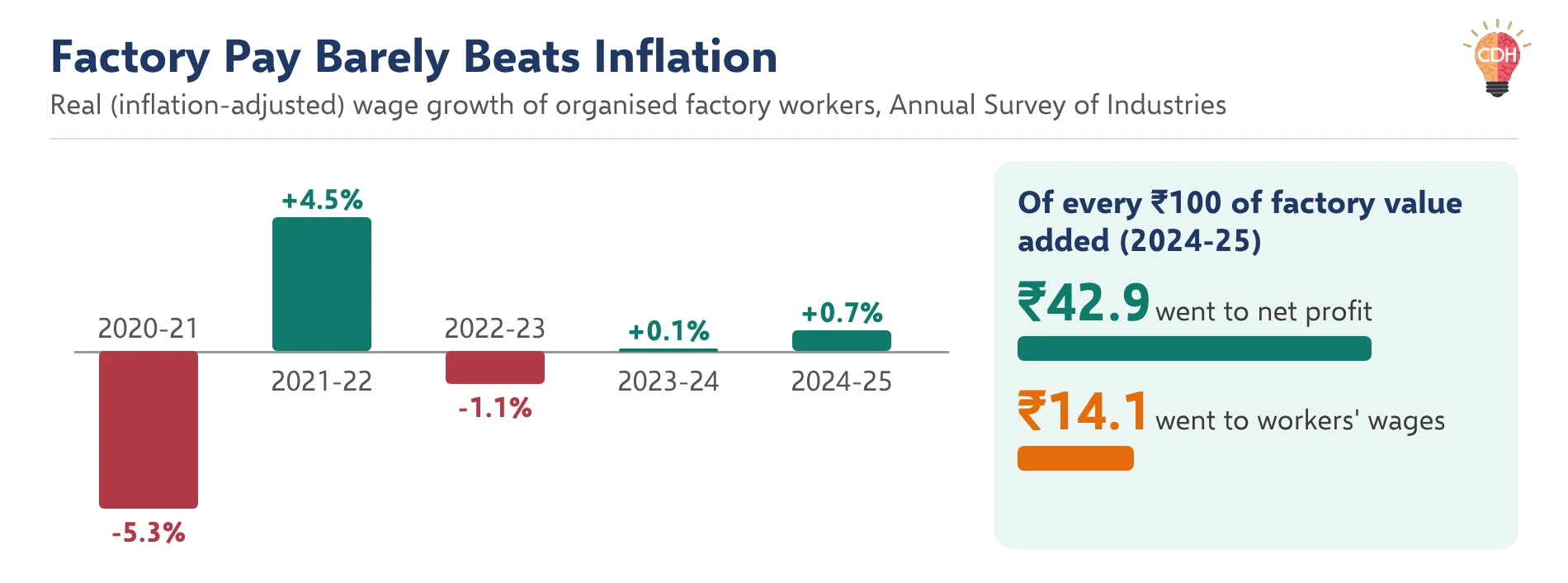
- Nominal vs real: factory wages rose 5.3% to ₹2.28 lakh a year, but with household inflation at 4.6%, real growth was only 0.7%, still the best in three years.
- Pay gap: supervisors and managers averaged ₹14.5 lakh, 6.36 times a worker’s pay (5.87 times in 2008-09).
- Profits: Nifty 500 profits reached 5.2% of GDP in 2025-26; Q2 FY26 profit growth of about 26–30% outpaced salary hikes of about 9%.
- Wider workforce: between 2017-18 and 2023-24, real monthly earnings fell 6.4% for regular salaried men and 12.5% for women (Economic Survey 2024-25).
Why Wages Lag
- Capital-heavy split: of every ₹100 of value added, ₹42.9 went to net profit and ₹14.1 to workers’ wages.
- Weak productivity per worker: manufacturing GVA grew 9.59% in 2024-25, but GVA per person engaged only 2.25%.
- Missing middle: large units (15.84% of factories) hold 87.42% of fixed capital and 78.07% of net value added; micro units are too small to pay more.
- Regional skew: five States account for over 54% of manufacturing GVA; surplus labour elsewhere weakens bargaining power.
- Corporate caution: after the September 2019 corporate tax cut, many firms built cash and margins rather than capacity or pay.
Why It Matters
- K-shaped growth and widening inequality; the problem is the quality of income, not only the number of jobs.
- Tax burden shift: personal income tax rose from 38.1% of direct taxes (FY14) to 53.4% (FY24), overtaking corporate tax.
- Human capital: low pay pushes households into debt and cuts spending on education and health.
Way Forward
- ELI Scheme: make the Employment Linked Incentive Scheme (outlay ₹99,446 crore; over 3.5 crore jobs; up to ₹15,000 for first-time employees; up to ₹3,000 a month to employers per extra worker) deliver net wage gains.
- Floor wage: enforce the statutory national floor wage under the Code on Wages to prevent a race to the bottom among States.
- Living wage: adopt evidence-based benchmarks (e.g., the Anker Methodology) and the Anoop Satpathy Committee (2019) approach, in line with Crown Aluminium Works (1957): an industry that cannot pay a bare minimum wage has no right to exist.
- Reorient PLI towards net formal jobs; deregulate at State level so MSMEs can scale up.
- Global models: Singapore’s Progressive Wage Model, Japan’s Shunto wage talks, Germany’s dual vocational training.
📖 Read More: Inequality • Unemployment • New Labour Codes • Inclusive Growth
6. Electronics Exports Surge Beyond Smartphones
Key Trends
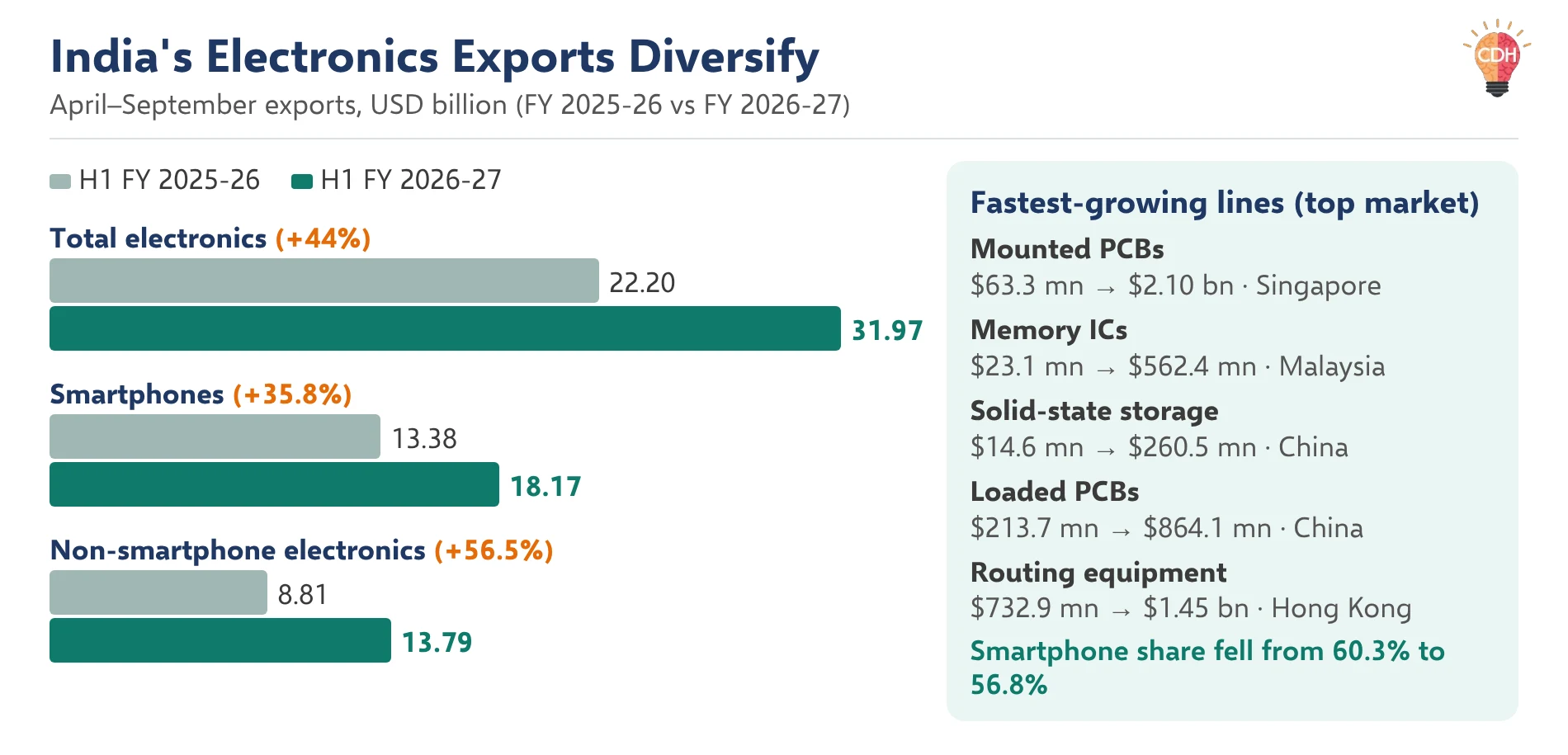
- Smartphones remain the largest item (USD 13.38 billion to 18.17 billion), but their share fell from 60.3% to 56.8%.
- Non-smartphone share rose from 39.7% to 43.2%, a 3.5 percentage-point gain.
- Components lead growth: mounted PCBs (+3,219%), memory ICs (+2,333%) and solid-state storage (+1,680%).
- Markets: Singapore, China, Hong Kong and Malaysia, plus the US and the Netherlands.
Significance and Caution
The shift shows deeper links with global electronics value chains, helped by PLI for large-scale electronics and component incentives. But export growth alone does not prove higher domestic value addition; much of the content may still be imported.
📖 Read More: PLI Scheme for Large Scale Electronics Manufacturing • Semiconductor Industry • Industrial Sector of Indian Economy
7. SSGB Campaign Marks World Toilet Day
(SOCIAL JUSTICE) (DD) The Department of Drinking Water and Sanitation (DDWS), Ministry of Jal Shakti, launched the Swachh Shauchalay – Garimamay Bhavishya (SSGB) campaign on World Toilet Day. It runs under the Swachh Bharat Mission (Grameen) and targets rural community and institutional toilets.
World Toilet Day
| Feature | Details |
|---|---|
| Date | 19 November every year |
| Started by | World Toilet Organization, 2001 |
| UN recognition | UN General Assembly, 2013 |
| 2026 theme | Sanitation and gender equality: “Safe toilets. Equal futures.” |
| Aim | Awareness of the sanitation crisis; universal safe sanitation |
SDG Link
The campaign serves SDG 6 (Clean Water and Sanitation), especially Target 6.2: adequate and equitable sanitation and hygiene for all, and an end to open defecation by 2030, with special attention to women and girls.
Clean, safe toilets matter for girls’ school attendance, menstrual hygiene and women’s safety, which ties sanitation to gender equality.
📖 Read More: Swachh Bharat Mission (Grameen) Phase II • Health and Nutrition
8. MAC Widens Watch to Radicalisation and Cyber Threats
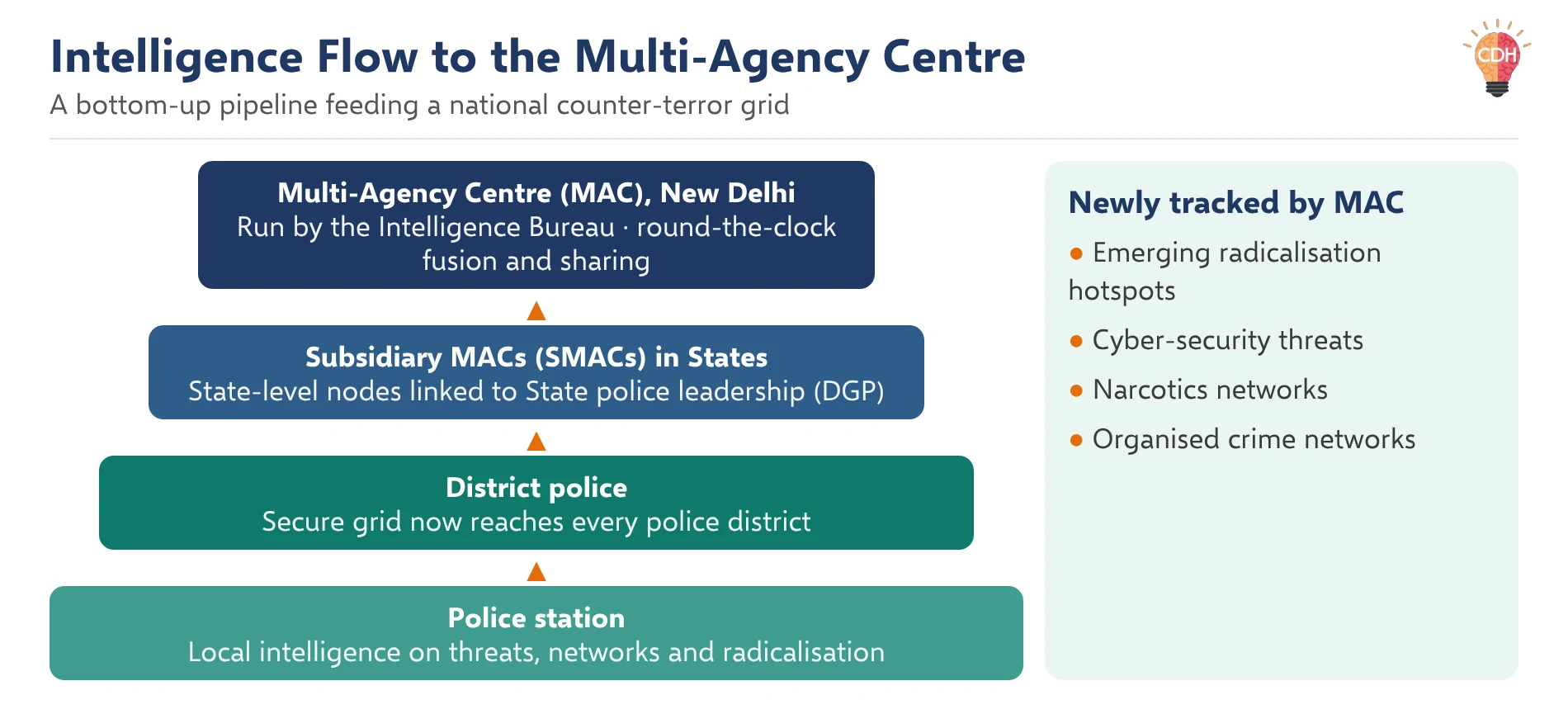
(INTERNAL SECURITY) (TH) At the 6th Anti-Terror Conference 2026, organised by the National Investigation Agency on the theme ‘Cross-Border Terrorism’, the Union Home Minister said the Multi-Agency Centre (MAC) now tracks emerging radicalisation hotspots, cyber threats, narcotics and organised crime networks.
About the Multi-Agency Centre
- What: a central intelligence-sharing platform and counter-terror grid under the Intelligence Bureau.
- Origin: created in December 2001 after the Kargil review of India’s security set-up; State nodes are called Subsidiary MACs (SMACs).
- Upgrades: restructured with new technology in 2023; in 2025 its network was revamped to connect all police districts through a secure grid.
Other Announcements
- State ATS: every State’s Anti-Terrorism Squad should strengthen its cyber-expert units.
- NIA: release of ‘Fail-Safe Investigation’, e-launch of the ‘Pushti’ portal, foundation stone for a Chandigarh office, and 70 new NIA Special Courts.
- Milestones: Kashmir reported no locally recruited terrorists for the first time in 35 years; over 40 modules of the Shahzad Bhatti network, designated under the UAPA, 1967, have been neutralised.
- Strategy: a uniform counter-terror strategy down to every police station, choking terror financing, and a Quadrangular Regional Security Grid in border States.
📖 Read More: Countering Terrorism in India • Intelligence and Investigative Agencies • Social Divisions and Radicalisation Leading to Extremism • Cybersecurity
9. India’s Solar Sector Enters a New Era
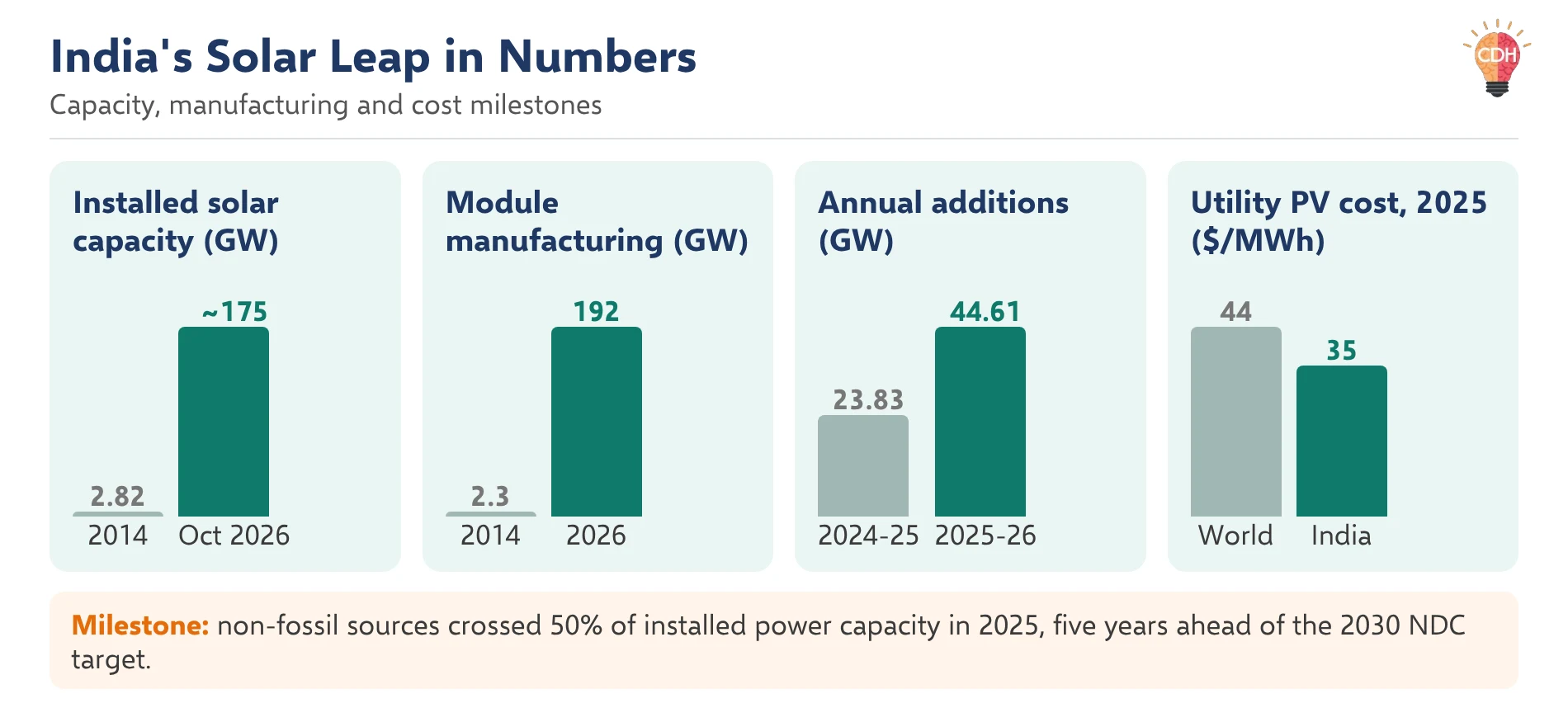
(ENVIRONMENT) (PIB) At the Bharat Renewable Energy Summit and Expo (BRESE) 2026 in New Delhi, the Union Government highlighted India’s entry into a new solar era. Installed solar capacity has grown about 62-fold, from 2.82 GW in 2014 to about 175 GW by October 2026.
Milestones
- Annual additions: a record 44.61 GW in 2025-26 (23.83 GW in 2024-25); distributed solar contributed 16.3 GW (36%).
- Global rank: India overtook the US in annual additions with 37 GW in 2025, becoming the second-largest solar growth market after China.
- Manufacturing: module capacity rose from 2.3 GW (2014) to 192 GW.
- Clean capacity: non-fossil sources crossed 50% of installed capacity in 2025 and reached 308.03 GW by September 2026.
- Cost: utility-scale solar PV cost $35/MWh in 2025, against $44 globally.
Policy Architecture
- Targets: Panchamrit (COP26, 2021) seeks 500 GW non-fossil capacity by 2030 and net zero by 2070. The National Solar Mission (2010) under the NAPCC raised its 2022 target from 20 GW to 100 GW in 2015.
- Demand mandates: Renewable Purchase Obligations require 35.95% renewable procurement for 2026-27; a Ministry of Power notification under the Energy Conservation Act, 2001 sets these shares up to 2029-30 as a nationwide Renewable Consumption Obligation.
- Price discovery: reverse auctions cut solar tariffs from about ₹18/unit (2010) to a record ₹1.99 (2020).
- Quality control: the ALMM limits government-backed projects to listed modules and domestic cells.
Key Schemes
| Scheme | What it does |
|---|---|
| Solar Parks Scheme | Ready land and common evacuation infrastructure; 39,461 MW sanctioned against 40 GW |
| Green Energy Corridor | Intra- and inter-State lines to evacuate variable renewable power |
| PM Surya Ghar | Up to ₹78,000 central aid and collateral-free loans for rooftop solar; up to 300 free units a month; about 65 lakh homes covered |
| PM-KUSUM | Solar plants on farmers’ land, standalone solar pumps, solarised grid pumps |
| PM Surya Sarovar Yojana | 5,000 MW floating solar with 10,000 MWh of two-hour storage |
| PLI for solar modules | Rewards domestic sales, efficiency and local value addition, from polysilicon to modules |
Global Leadership
- International Solar Alliance: India won a third straight term as President (France Co-President) at the 9th ISA Assembly; the Bahamas joined as its 116th member.
- Africa Solar Facility: India pledged $25 million to de-risk private mini-grid and distributed solar investment.
- Small islands: an ISA–World Bank SIDS platform with a $500 million project pipeline.
- One Sun One World One Grid: power trade with Nepal, Bhutan and Bangladesh; undersea links to the UAE and Saudi Arabia under study.
- G20 (2023): the New Delhi Leaders’ Declaration backed tripling global renewable capacity by 2030.
📖 Read More: Solar Energy • PM Surya Ghar Muft Bijli Yojana • PM-KUSUM • Measures to Boost Renewable Energy
10. Allan–Herndon–Dudley Syndrome: Cheaper Treatment
(SCIENCE AND TECHNOLOGY) (TH) A Hyderabad paediatrician has helped cut the yearly cost of tiratricol, a drug used to manage the rare genetic disorder Allan–Herndon–Dudley syndrome (AHDS), allowing seven children to get free treatment.
About the Disease
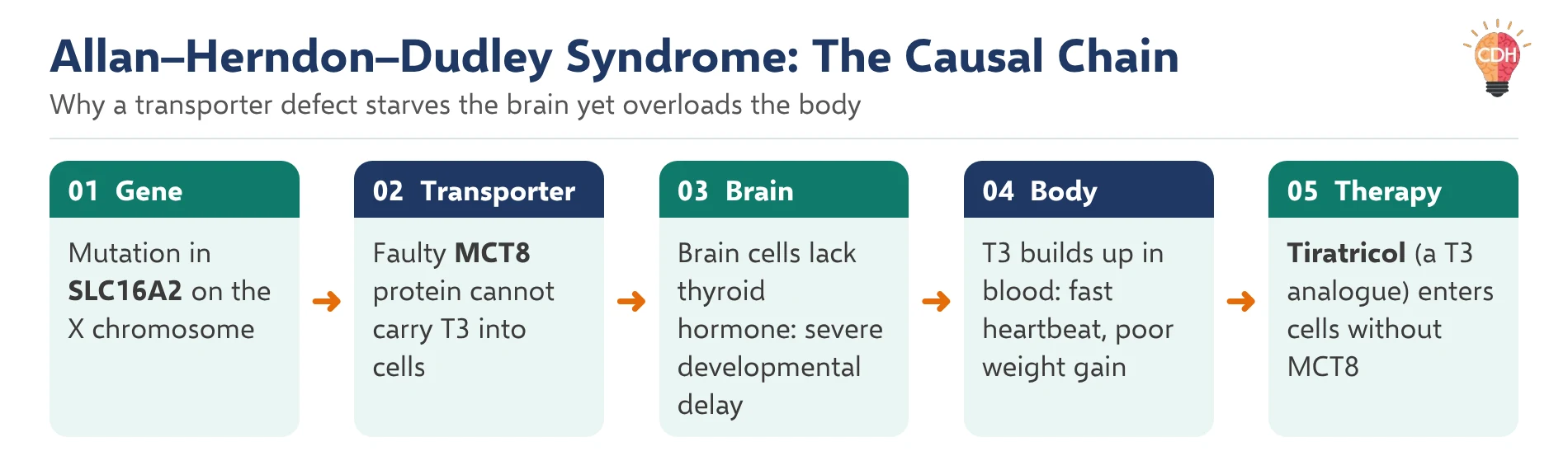
- Also called: MCT8 deficiency; a rare X-linked disorder, so it mostly affects males (heredity basics).
- Cause: mutations in the SLC16A2 gene, which codes for the monocarboxylate transporter 8 (MCT8).
- Role of MCT8: carries thyroid hormones into cells, including brain cells.
- Effects: severe neurodevelopmental delay, poor muscle tone and movement control; outside the brain, excess hormone causes fast heartbeat, poor weight gain and metabolic strain.
Treatment
Tiratricol (TRIAC) mimics the hormone T3 but does not need MCT8 to enter cells. The European Union authorised it as Emcitate on 12 February 2025 for peripheral thyrotoxicosis in MCT8 deficiency. High prices make such orphan drugs hard to access in India.
📖 Read More: Heredity • Chemical Coordination and Integration in Humans • Important Diseases Explained
11. Rani Lakshmibai: Remembering the Queen of Jhansi
(HISTORY) (PIB) (AIR) The Prime Minister paid tribute to Rani Lakshmibai on her birth anniversary (19 November), recalling her courage against British rule during the Revolt of 1857.
Life and Struggle
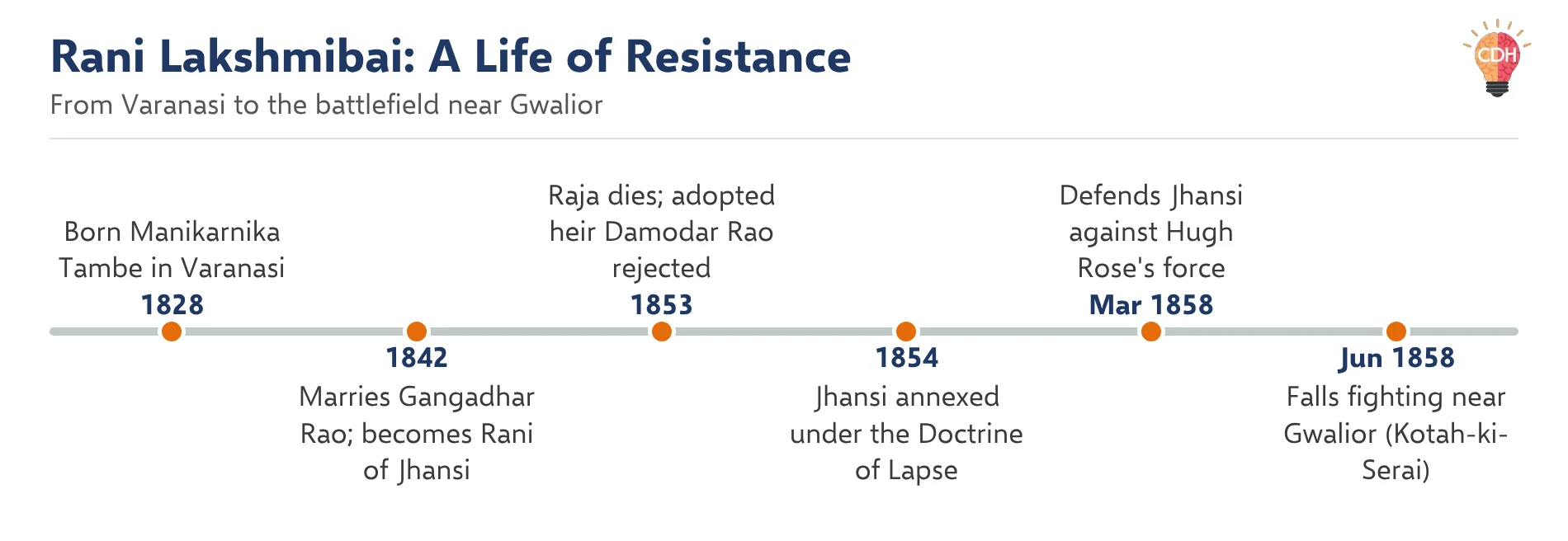
- Early life: born Manikarnika Tambe (‘Manu’) in Varanasi, traditionally dated 19 November 1828 (historians debate the exact year); trained in riding, swordsmanship and shooting alongside Nana Saheb and Tatya Tope at Peshwa Baji Rao II’s court.
- Marriage: in 1842 she married Maharaja Gangadhar Rao Newalkar of Jhansi and took the name Lakshmibai.
- Doctrine of Lapse: after the Maharaja died in 1853, Lord Dalhousie rejected the adopted heir Damodar Rao (born Anand Rao), annexed Jhansi in 1854, and offered her a ₹60,000 annual pension.
- 1857–58: in March 1858 she and women warriors such as Jhalkari Bai defended Jhansi for about two weeks against Sir Hugh Rose’s Central India Field Force. After Tatya Tope’s relief force lost at the Betwa, she escaped with Damodar Rao to Kalpi.
- Death: she joined Tatya Tope and Rao Sahib to capture Gwalior fort, and fell fighting British cavalry at Kotah-ki-Serai near Gwalior in June 1858 (most sources give 18 June; some give 17 June).
Legacy
- Hugh Rose called her the best and bravest military leader of the rebels.
- In 1943, Subhas Chandra Bose raised the Rani of Jhansi Regiment, the INA’s all-women unit led by Captain Lakshmi Sahgal.
- Subhadra Kumari Chauhan’s Hindi poem ‘Jhansi Ki Rani’ celebrates her valour in Veer Ras (the heroic sentiment).
Doctrine of Lapse: under it, Dalhousie annexed a dependent princely State whose ruler died without a natural male heir, e.g., Satara (1848), Jhansi and Nagpur (1854); see final wave of annexation.
📖 Read More: The Story of the Revolt of 1857 • Major Causes of the Revolt of 1857 • Lord Dalhousie • Indian National Army (INA) Trials